8 best AI workout generators in 2026: apps and chatbots compared
Fitbod, Freeletics, ChatGPT, Gemini and more: the best AI workout generators for building strength in 2026, with prices, free tiers and example prompts.
 Written byDr. Alap ZahidReviews And Guides Editor
Why you can trust The AI Future
Our writers research every product, link each claim to its source and correct mistakes openly. Companies can't pay for coverage or see reviews before they're published.
Read our editorial policy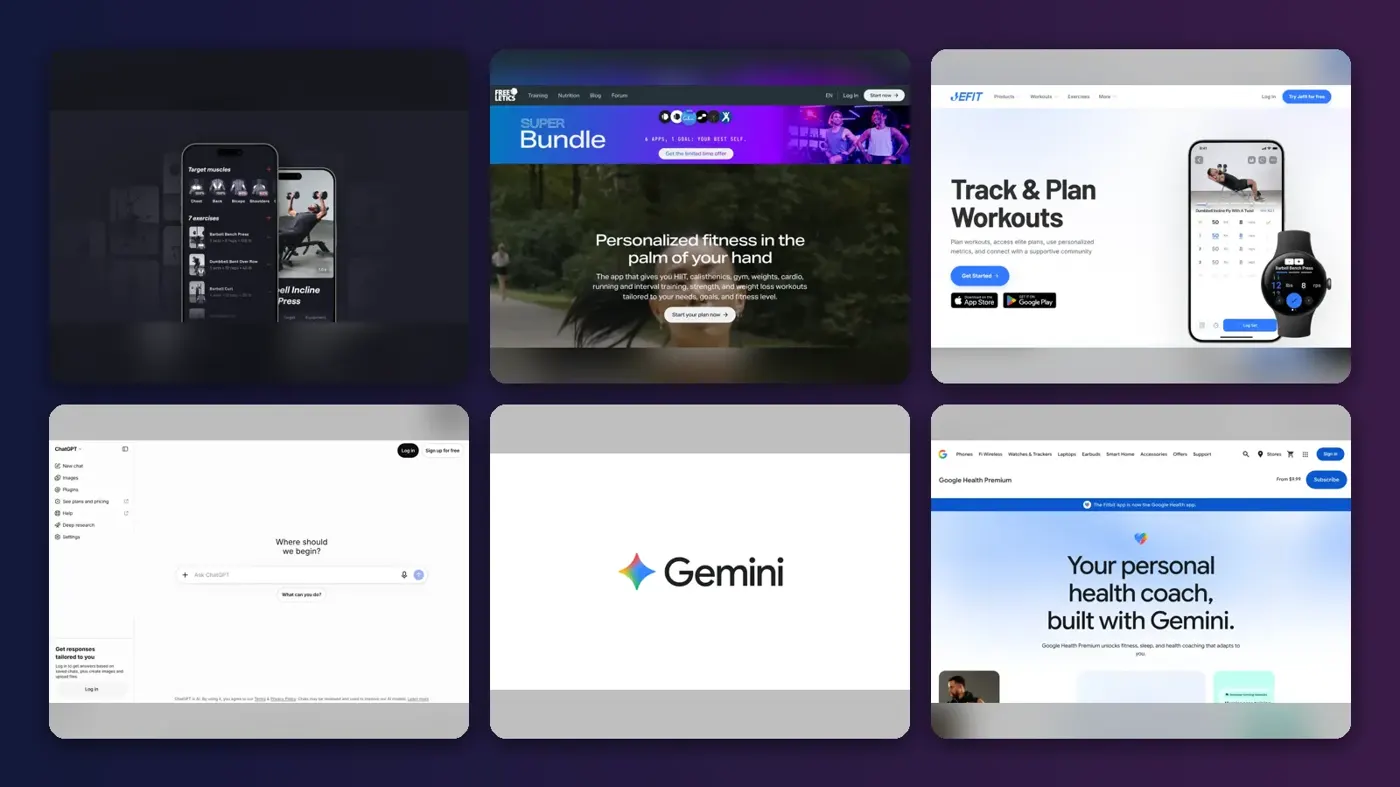
Short answer: if you lift, I'd pick Fitbod. It builds each session around your equipment, recovery and logged history, then adjusts the next one. If you train with bodyweight at home, pick Freeletics. If you want to spend nothing, ask ChatGPT or Gemini to write a plan with a well-built prompt and log it yourself.
That's the quick version. Below, we compare eight options, from dedicated apps to general chatbots to a human coach, using official pages and App Store listings checked in late October 2026. You'll find prices, what the free tiers include, and copy-ready example prompts.
Key takeaways
- Fitbod looks like the strongest pick for gym strength training: it plans weights, sets and reps from your own data and has 1,000+ exercise demos.
- A chatbot is the cheapest AI workout generator, since ChatGPT and Gemini both have free plans and will write a structured weekly plan if you give them the right details.
- Google AI Pro now bundles a fitness coach, and subscribers get Google Health Premium, with its Gemini-built Health Coach, at no extra cost.
- Apps probably beat chatbots on follow-through, because logging, progression and exercise videos are where paid apps earn their fee.
- Check with a doctor first if you have a health condition or injury, since no app can see how your body is moving.
Ranking method
Nobody at The AI Future hands-on tested these tools for this roundup. We compared them using official product pages, App Store listings and pricing, published reporting and user reviews, as of late October 2026. Six criteria decided the order.
- Personalization: how much the plan reflects your goals, level, schedule and equipment.
- Adaptation: whether the plan changes as you log workouts or give feedback.
- Exercise guidance: video demos, form cues and the size of the exercise library.
- Progress tracking: logging, strength history and progressive overload.
- Value: what the free tier includes and what a year costs.
- Safety signals: whether the tool asks about injuries and lets you swap exercises easily.
Prices are in US dollars, mostly taken from US App Store in-app purchase lists, and can differ by country, platform and promotion.
The 8 best AI workout generators at a glance
| # | Tool | Category | Best for | Free tier | Starts at |
|---|---|---|---|---|---|
| 1 | Fitbod | AI strength app | Gym strength training | No | $12.99/mo |
| 2 | Freeletics | AI coaching app | Bodyweight training anywhere | Yes (limited) | $34.99 |
| 3 | JEFIT | Workout tracker | Budget lifters who log | Yes | $12.99/mo |
| 4 | ChatGPT | General chatbot | Free custom plans | Yes | $8/mo |
| 5 | Gemini | General chatbot | Google users | Yes | $4.99/mo |
| 6 | Google Health Coach | Wearable coach | Fitbit and Pixel Watch owners | Yes (limited) | $9.99/mo |
| 7 | Ladder | Coach-built programs | Following a set program | No | $29.99/mo |
| 8 | Future | Human coaching app | One-to-one accountability | No | $199/mo |
Notes: Fitbod and Ladder offer free trials but no free plan. Freeletics sells 3, 6 and 12-month plans; $34.99 is the lowest price on its App Store list. The Google Health app is free, but the coach needs Premium. Future's first month costs $50.
The AI workout generators in 2026, ranked
Fitbod – best for gym strength training
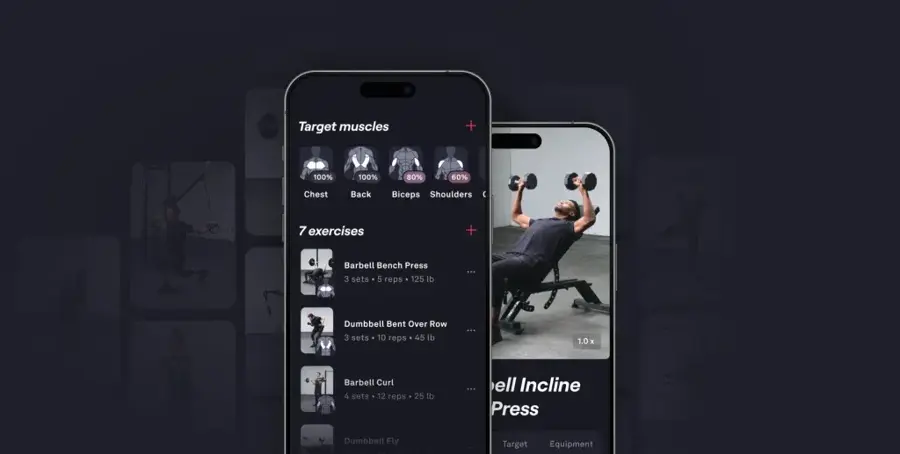
Fitbod is a strength training app that generates each workout from your goals, fitness level, equipment and logged history.
Standout points
Fitbod describes itself as built exclusively for resistance and strength training. Its algorithm tracks your logged sessions to balance muscle recovery and apply progressive overload, so the next workout reflects the last one. The App Store listing adds that the AI learns from your edits to its recommendations and uses non-linear periodization, which means it varies the training stimulus rather than pushing the same load every week.
The app was an Apple Editors' Choice pick, and user reviews focus on control. One App Store reviewer wrote that "Over all this app has helped me big time to get closer and closer to my fitness goals", while asking for more ways to personalize the interface. Verdict: if you lift and want the app to decide what comes next, I think this is the place to start.
Key features
- Adaptive AI workouts: built around your equipment, level and recovery.
- 1,000+ exercises: with multi-angle video walkthroughs.
- Workout modifiers: change length, focus or exercises for a single session.
- Integrations: Apple Health, Apple Watch, Strava and Fitbit.
- Trainer email support: send strength training questions to staff trainers.
Pros
- Plans weights, sets and reps for you
- Works with full gyms, limited gear or bodyweight
- Large, well-demonstrated exercise library
- Yearly plan works out to under $8 a month
Cons
- No free plan after the trial
- Mostly resistance training, light on cardio programming
- App Store reviewers report navigation limits during a workout
Fitbod pricing: No free plan (free trial), then the App Store lists monthly plans at $12.99 to $15.99 and yearly plans at $79.99 to $95.99 (checked October 2026). See pricing
Related: Best AI coaching tools Best AI apps for iPhone
Freeletics – best for bodyweight training anywhere
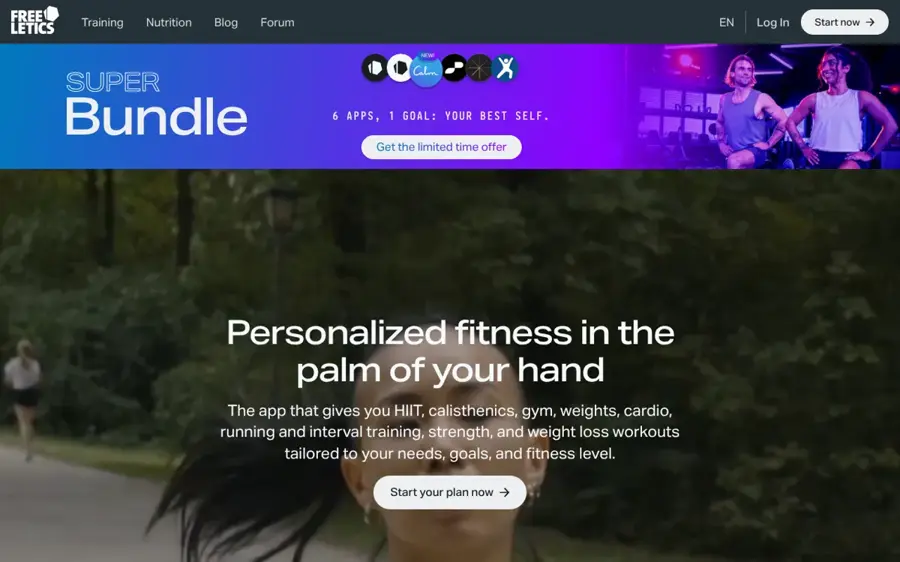
Freeletics is a fitness app whose AI Coach builds and adjusts workouts for home, gym or outdoor training, with a strong bodyweight and HIIT focus.
Standout points
Freeletics says its coaching is trusted by 60 million users. Its App Store listing explains that the AI Coach adjusts each workout based on your feedback and lets you switch focus on the spot, for example to an upper-body session when you're short on time. You pick from 30 training plans, and workouts can use bodyweight, weights, gym machines or cardio like running and rowing.
The free version is more useful than most (I didn't expect that): 34 bodyweight HIIT workouts and 100+ exercises. One App Store reviewer said it "keeps me motivated and makes it easy to work out without having to think about it", but noted you can't swap a single exercise that bothers an old injury. Verdict: probably the best choice if you train without a gym.
Key features
- AI Coach: plans and adjusts sessions from your feedback.
- 30 training plans: each with a different focus.
- 700+ exercises: plus a tool to build your own workouts.
- Apple Watch control: and Apple Health syncing.
- Progress tracking: badges, streaks and skill progressions.
Pros
- Genuinely usable free tier
- Strong for home and travel workouts
- Mixes strength, conditioning and cardio
- 14-day money-back guarantee on the Coach
Cons
- Plans are sold in 3 to 12-month blocks, not monthly
- Reviewers want finer per-exercise swaps and feedback
- Bodyweight HIIT can be intense for complete beginners
Freeletics pricing: Free, then Training Coach plans from $34.99 on the App Store, with 3, 6 and 12-month options up to $79.99 (checked October 2026). See pricing
Related: Best AI coaching tools
JEFIT – best for budget lifters who log
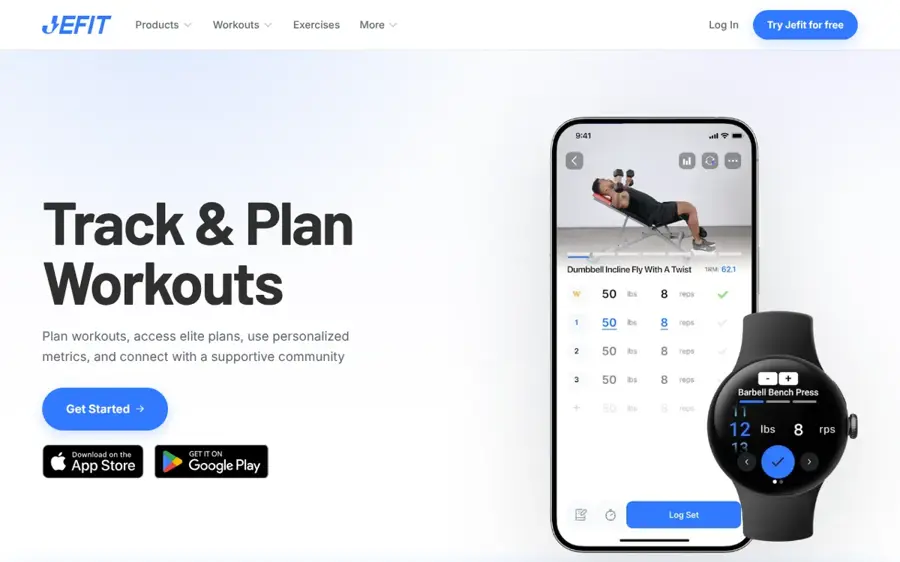
JEFIT is a free workout tracker and planner that adds an AI-powered adaptive plan and progressive overload suggestions on its Elite tier.
Standout points
JEFIT started as a gym log and still works well as one. Its App Store listing says more than 12 million people use it, and that the Adaptive Plan is "powered by AI and backed by mesocycle and progressive overload science", adapting weekly as you progress. The AI also reads your past logs to suggest what weight and reps to lift next.
Long-time users praise the flexibility. One App Store reviewer wrote: "The App does an excellent job in tracking my progress and is very customizable." Another long-term subscriber complained that frequent updates add prompts and change familiar screens. Verdict: likely the best value if you're happy to log every set.
Key features
- Adaptive Plan: AI-built training that updates weekly.
- AI progressive overload: next-session weight and rep suggestions.
- 1,400+ exercises: with HD video and animations.
- Analytics: volume charts, estimated one-rep max and a muscle recovery chart.
- Apple Watch live sync: plus lock screen set counts and rest timer.
Pros
- Free tier covers logging and built-in programs
- Cheapest yearly AI tier on this list at $69.99
- Detailed strength analytics
Cons
- The adaptive AI coach sits behind Elite
- Some users find recent updates cluttered
- More manual than Fitbod
JEFIT pricing: Free, then Elite at $12.99/month or $69.99/year (checked October 2026). See pricing
Related: Best AI coaching tools
ChatGPT – best for free custom plans
ChatGPT is OpenAI's general AI assistant. It isn't a fitness app, but it can write a detailed, personalized training plan from a single prompt.
Standout points
A chatbot is probably the most flexible AI workout generator you can get. You can describe your schedule, equipment, sport and any movements to avoid, and get a weekly plan back as a table. You can then ask it to make Thursday shorter or swap squats for a machine. The free plan covers this kind of use, though CometAPI's pricing guide notes it has limited messages and uploads, with the chat switching to a smaller model once you hit the cap.
The trade-off is follow-through. ChatGPT doesn't show exercise videos, log your sets or adjust loads automatically unless you paste your results back in. Verdict: good for a free first plan or a second opinion on an app's plan.
Key features
- Natural-language planning: describe your situation in plain words.
- Easy edits: change days, length or exercises in follow-up messages.
- Tables and checklists: printable weekly plans.
- File and image uploads: share a past log or a gym equipment photo.
Pros
- Free plan is enough for most plans
- Fully custom, including sports and odd schedules
- Cheap Go plan at $8/month
Cons
- No exercise demos or built-in logging
- Output quality depends on your prompt
- Can sound confident when it's wrong
ChatGPT pricing: Free, then Go at $8/month, Plus at $19.99/month in the App Store, Pro from $100/month (checked October 2026). See pricing
Related: ChatGPT with GPT-6 review Best ChatGPT alternatives
Gemini – best for Google users
Gemini is Google's AI assistant. Like ChatGPT, it can generate custom workout plans from a prompt, and its paid Pro plan now includes Google's fitness coaching subscription.
Standout points
Gemini's free plan includes Gems, Canvas, Deep Research and Gemini Live. Gems are worth a look for fitness: you can save a custom assistant with your goals, equipment and limits, then come back to it each week without retyping everything. Gemini Live lets you talk through a plan by voice.
The bigger reason to pick Gemini is the bundle. TechCrunch reported that Google AI Pro and Ultra subscribers get Google Health Premium, including the Health Coach, at no extra cost. Verdict: if you already pay for Google AI Pro, you've got a chatbot and a fitness coach covered, which seems like a fair deal.
Key features
- Gems: save a reusable "coach" with your details.
- Gemini Live: talk through your plan by voice.
- Canvas: build and edit a plan document side by side.
- Google Health Premium: included with AI Pro and Ultra.
Pros
- Strong free plan
- AI Plus is the cheapest paid tier here at $4.99/month
- AI Pro adds Google Health Premium
Cons
- No logging or exercise demos in the chat itself
- Same prompt-dependence as any chatbot
Gemini pricing: Free, then Google AI Plus at $4.99/month, Google AI Pro at $19.99/month, Ultra at $199.99/month in the App Store (checked October 2026). See pricing
Related: Gemini vs ChatGPT
Google Health Coach – best for Fitbit and Pixel Watch owners
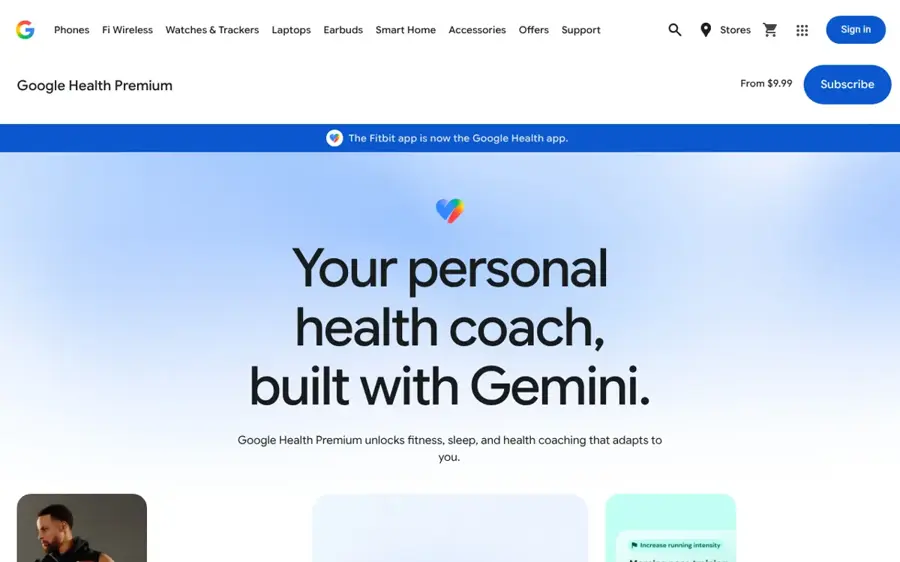
Google Health Coach is a Gemini-built coach inside Google Health Premium (formerly Fitbit Premium) that creates fitness plans using your wearable data.
Standout points
Google describes the coach as "Built with Gemini to deliver proactive, personal, and adaptive coaching", with fitness plans "for your big goals and quick pivots." According to TechCrunch, onboarding asks about your goals, routine, available equipment and any injuries. You can then update details in plain language and log workouts by voice, photo or file.
What sets it apart is context. The coach can combine workout suggestions with sleep and recovery data from your watch, which a chatbot can't see. At launch in May, it was available first for select Fitbit and Pixel Watch users, with other devices promised later. Verdict: the natural pick, I'd say, if you already wear a Google device.
Key features
- Personal onboarding: goals, equipment, routine and injuries.
- Adaptive fitness plans: that change as your week changes.
- Natural-language chat: update goals or log workouts by talking.
- Wearable data: uses sleep and activity metrics in its guidance.
- Privacy controls: delete or export health data from the app.
Pros
- Uses real sleep and recovery data
- Asks about injuries up front
- Free with Google AI Pro
Cons
- Best experience needs a Fitbit or Pixel Watch
- Rolled out device by device
- Less detailed lifting programming than Fitbod
Google Health Coach pricing: Google Health app free, then Premium at $9.99/month or $99/year, included with Google AI Pro and Ultra (checked October 2026). See pricing
Related: Best AI coaching tools
Ladder – best for following a set program
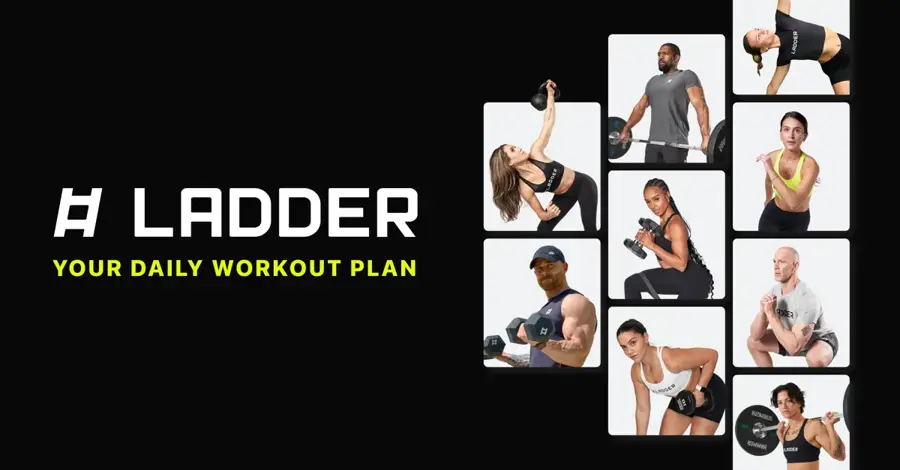
Ladder is a strength training app with coach-built progressive overload programs, a new plan each week and in-ear coaching.
Standout points
Ladder isn't an AI workout generator in the strict sense. Its App Store listing says plans are "created by expert coaches", across 20 named programs from bodybuilding to Pilates strength. We include it because many people searching for an AI planner really want structure, and Ladder supplies that. It was an Apple 2025 App of the Year finalist.
Reviews back this up. One App Store reviewer wrote, "My lower back especially is much stronger than it was before I started using the app," and praised how easy it is to swap exercises when the gym is busy. Verdict: choose it if you want a coach's program, not an algorithm's (personally, I'd want the human).
Key features
- Coach-led programs: 20 styles, each with a named coach.
- Weekly progressive plans: a structured workout every day.
- In-ear coaching: with video demos and a built-in timer.
- Ladder Journal: tracks reps and weights over time.
- Workout editing: swap and save blocks before a session.
Pros
- Clear structure from real coaches
- Easy exercise swaps
- 7-day free trial with no payment collected
Cons
- Most expensive app subscription here
- Plans are coach-written, not generated for you
Ladder pricing: No free plan (7-day trial), then PRO at $29.99, or $179.99/year, on the App Store (checked October 2026). See pricing
Related: Best AI coaching tools
Future – best for one-to-one accountability
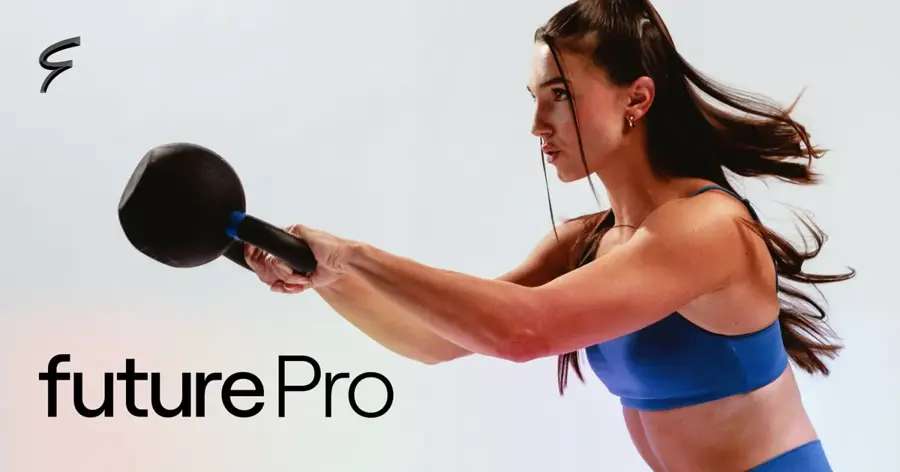
Future is a personal training app that pairs you with a human coach who writes and updates your program.
Standout points
Future is the benchmark the AI apps are trying to match, in my view. On its homepage, the company says your coach builds a plan around your schedule, equipment, experience, injury record and goals, checks in on your progress and refines the plan over time. The app adds video demos, voice cues and form guidance.
Future reports a 4.9/5 App Store rating and says 98% of members feel more consistent within four weeks, though those are the company's own figures. Verdict: worth the price if accountability is what you lack, or if you have an injury history that needs a human eye.
Key features
- Dedicated human coach: creates and adjusts your program.
- Check-ins: your coach monitors progress.
- Flexible scheduling: move or adapt workouts without penalty.
- Exercise library: video demos and voice cues.
Pros
- A real person reviews your plan
- Plans account for injury history
- 30-day full refund window
Cons
- $199/month after the first month
- Not AI-generated, so slower to change than an app
Future pricing: No free plan, then $50 for the first month, then $199/month (checked October 2026). See pricing
Related: Best AI coaching tools
Choosing an AI workout generator
Start with where you train
Fitbod or JEFIT fit gym training with weights. Freeletics suits home training or a lot of travel. Each app on this list lets you set equipment, so be honest about what you have. A cramped hotel gym and a full commercial one need very different plans, and the app can only work with what you tell it.
Decide how much you want to log
Adaptive plans only work if you record what you did. If you hate logging, a coach-built program like Ladder, or a simple chatbot plan, will probably suit you better than an algorithm that needs data.
Use what you already pay for
If you have Google AI Pro, try Google Health Premium before buying anything else. If you already pay for ChatGPT, start with a prompt. Our guide to writing better AI prompts will help you get a sharper plan.
Look for easy swaps
Pain, a busy gym or a missing machine shouldn't derail a session. Good apps let you replace a single exercise in a tap. Reviews of Freeletics show this is still a weak spot for some apps.
Example prompts to adapt
If you use ChatGPT or Gemini, the detail you give decides the quality of the plan. These are examples to adapt: change the brackets to fit you.
Example prompt (adapt to you): "Act as a strength coach. Write a 4-week beginner strength plan for 3 days a week, 45 minutes per session. I have [dumbbells up to 20 kg, a bench and resistance bands]. Show each day as a table with exercise, sets, reps and rest. Include a warm-up and explain how to progress each week."
Example prompt (adapt to you): "I want to get stronger for [hiking / football / carrying my kids]. I can train [Monday, Wednesday and Saturday] at [home with no equipment]. I need to avoid [deep knee bends] because [my physio said so]. Build a weekly plan and give an easier and a harder version of each exercise."
Example prompt (adapt to you): "Here is what I did last week: [paste your log]. Squats felt easy, push-ups felt hard. Adjust next week's plan to keep progressing safely, and tell me what you changed and why."
Not sure which chatbot to use? Our Gemini vs ChatGPT comparison covers the differences.
Free vs paid: what you actually get
Free options can carry you a long way; I'd honestly try them first. ChatGPT and Gemini will write a full plan for nothing. Freeletics gives you 34 bodyweight workouts, and JEFIT lets you log and follow built-in programs free.
Paying gets you three things: automatic progression, exercise demos inside the workout, and a plan that reacts to your logs without you asking. At $69.99 to $95.99 a year, JEFIT Elite and Fitbod cost less than a single month of Future. That's likely the budget sweet spot for people who train regularly.
| Need | Free option | Paid upgrade |
|---|---|---|
| A first plan | ChatGPT or Gemini | Not needed |
| Home workouts | Freeletics free | Freeletics Coach |
| Logging lifts | JEFIT free | JEFIT Elite or Fitbod |
| Wearable-aware coaching | Google Health app | Google Health Premium |
| Human accountability | None | Future |
A quick safety note
AI workout plans are general fitness guidance, not medical advice. If you have a health condition, an injury, are pregnant or are returning to exercise after a long break, check with your doctor or a physiotherapist before you start. Tell the app or chatbot about any limits, start lighter than you think you need, and stop any exercise that causes pain. Judge progress by how much stronger and fitter you feel, not by a number on a scale.
Final verdict
If you only pick one, I'd pick Fitbod.
It's probably the most complete AI workout generator for strength training, and the yearly plan costs less than many monthly gym classes. Freeletics makes more sense if you train with bodyweight, and JEFIT if budget comes first.
Go with ChatGPT or Gemini for a free plan today. Google Health Coach is the one for Fitbit or Pixel Watch wearers, especially if you already pay for Google AI Pro. Future is for anyone who wants a human holding them accountable. For more tools in this space, see our roundup of the best AI coaching tools.
FAQ
Is there a free AI workout generator?
Yes. ChatGPT and Gemini both have free plans that can write a full, personalized workout plan from a prompt. Freeletics offers 34 free bodyweight workouts, and JEFIT's free tier covers logging and built-in programs. You only need to pay if you want automatic progression, in-app exercise videos or a plan that adapts to your logs.
Can ChatGPT make a workout plan?
Yes. Give ChatGPT your goal, experience, days per week, session length, equipment and any movements to avoid, and ask for a table with sets, reps and rest. It can't watch your form or track your lifts automatically, so paste your results back each week and ask it to adjust the plan.
Are AI workout apps good for beginners?
They can be. Apps like Fitbod and JEFIT suggest starting weights and show video demos, which removes a lot of guesswork. Set your level to beginner, choose shorter sessions and start lighter than the app suggests. If you have a health condition or an injury, check with a doctor before you begin.
Is an AI workout app as good as a personal trainer?
Probably not quite. AI apps are good at planning, progression and variety, and they cost a fraction of a trainer. A human coach can watch your form, spot pain or fatigue and keep you accountable. Future sits in between, pairing an app with a human coach for $199 a month after the first month.
Sources
- Fitbod – Workout Planner & Fitness App (Fitbod)
- Fitbod: Gym & Fitness Planner (App Store)
- Fitbod: Gym & Fitness Planner – Ratings & Reviews (App Store)
- Intensive workouts & individual training plans (Freeletics)
- Freeletics: Workouts & Fitness (App Store)
- Freeletics: Workouts & Fitness – Ratings & Reviews (App Store)
- JEFIT Workout Plan Gym Tracker (App Store)
- JEFIT Workout Plan Gym Tracker – Ratings & Reviews (App Store)
- ChatGPT (App Store)
- ChatGPT Pricing 2026: Free vs Go vs Plus vs Pro (CometAPI)
- Google AI Pro & Ultra plans (Google)
- Google Gemini (App Store)
- Google's $9.99-per-month AI health coach launches May 19 (TechCrunch)
- Google Health Premium with Google Health Coach (Google Store)
- LADDER Strength Training Plans (App Store)
- LADDER Strength Training Plans – Ratings & Reviews (App Store)
- Future | Custom, 1-on-1 Personal Training (Future)