Best AI detectors in 2026: 7 AI checkers compared, with their limits
The best AI detector in 2026 for accuracy, free use and publishing teams, with prices, independent study results and an honest look at false positives.
 Written byMuhammad Usman SiddiquiFounder and editor-in-chief
Why you can trust The AI Future
Our writers research every product, link each claim to its source and correct mistakes openly. Companies can't pay for coverage or see reviews before they're published.
Read our editorial policy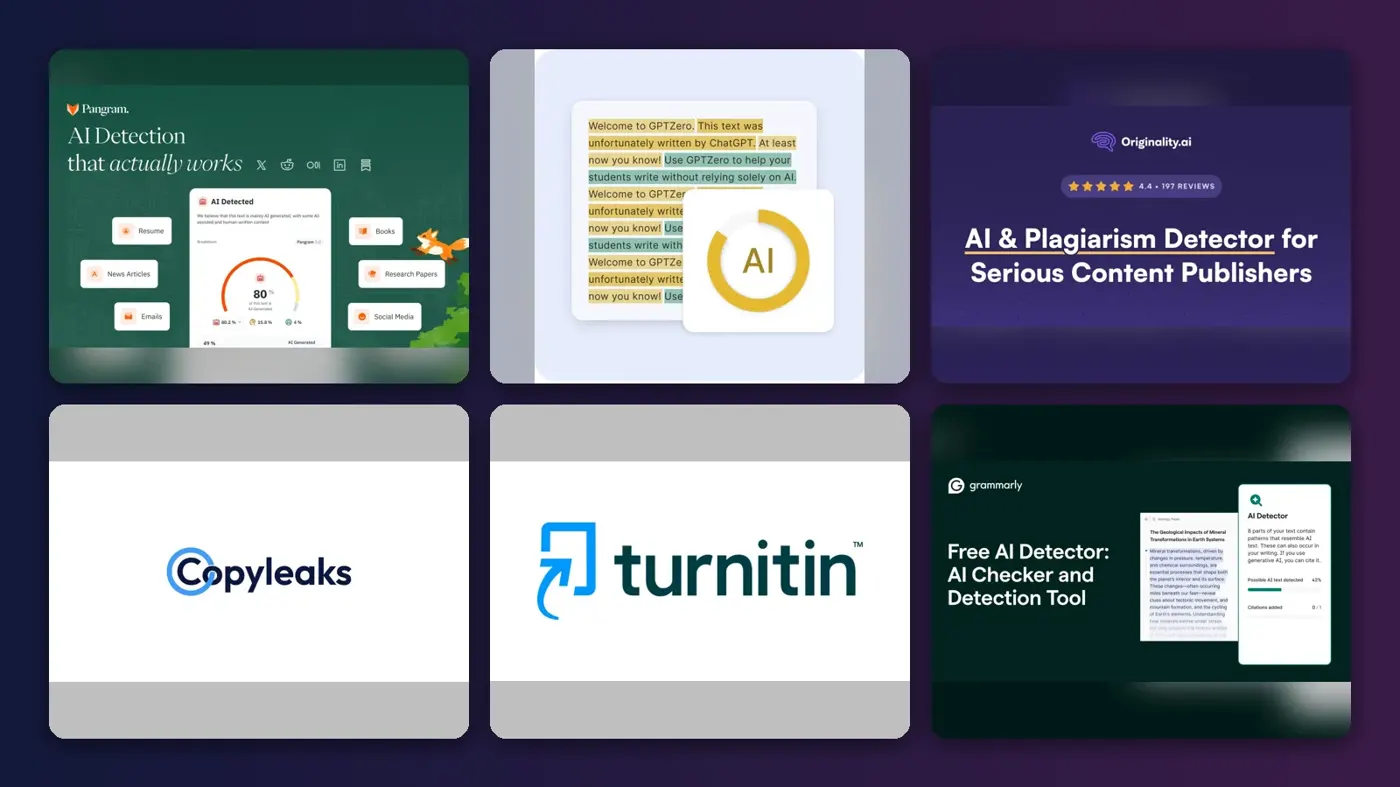
Short answer: if you need the most reliable AI detector in 2026, start with Pangram. It held up best on mixed and "humanized" text in the independent studies we reviewed. If you want a free AI checker that works well for most essays, use GPTZero. Publishers and SEO teams should look at Originality.ai.
One warning before you pick anything. No AI detector can prove that a person used AI. Every tool on this list makes mistakes in both directions. It can miss AI text, and it can flag honest human writing. Use a score as a reason to ask questions, never as a verdict.
Below are seven AI detectors worth your time, with current prices, free limits, what independent researchers found, and who each one suits. We built this guide from official product pages, published independent studies and user reviews, as of late October 2026. We did not run our own lab test, so every accuracy figure below is credited to whoever produced it.
Key takeaways
Pangram is the accuracy leader on hard cases. In a 2026 study of long academic papers, it caught far more hybrid and humanized papers than rivals, according to a summary by SaaS CRM Review.
GPTZero has the most useful free plan. You get 10,000 words a month at no cost, which is enough for a teacher spot-checking a class or a student checking their own drafts.
Turnitin is the one most students will meet, but you cannot buy it yourself. It is licensed to schools, and independent studies found it misses a lot of AI text.
Free detectors are fine for a quick check, not for decisions. Grammarly, QuillBot and Scribbr all offer free scans, but their results drop sharply on paraphrased text.
False positives are real. Non-native English writers and very formulaic writing get flagged more often. Always keep drafts and version history as evidence of your process.
How we ranked them
Let us be clear about method. Nobody at The AI Future ran a hands-on test for this article. Instead, we compared each AI detector using its official pricing and help pages, published independent studies, and user reviews on sites like Trustpilot, Capterra and G2, as of late October 2026.
We ranked the tools on five criteria:
Independent accuracy. How each tool did in peer-reviewed or academic studies, not in its own marketing.
Hard cases. Results on hybrid text (part human, part AI) and humanized text, because that is where detectors usually fail. We gave this the most weight.
False positive risk. How often a tool wrongly flagged human writing. A detector that accuses innocent people is worse than useless.
Free plan and price. How much you can check without paying, and what a paid plan costs per word.
Practical fit. Integrations, languages, minimum text length, and whether you can buy it as an individual.
Most of the study figures come from a roundup of 2026 research by SaaS CRM Review, updated October 13, 2026. It pulls together results from several studies, including Van Vlasselaer et al., Villa et al., Hadra et al. and a JAIT paper by Makhmutova et al. Those studies used different texts and lengths, so their numbers should not be averaged or compared one-to-one. Treat them as signals, not scores.
The 7 best AI detectors at a glance
# | Tool | Category | Best for | Free tier | Starts at |
|---|---|---|---|---|---|
1 | AI detector | Mixed and humanized text | Yes | $20/mo | |
2 | AI detector | Teachers and students on a budget | Yes | $8.33/mo | |
3 | AI and plagiarism checker | Publishers and SEO teams | Yes (limited) | $12.95/mo | |
4 | AI and plagiarism checker | Multilingual teams | No | $13.99/mo | |
5 | Institutional integrity suite | Schools and universities | No | Institutional quote | |
6 | Writing assistant add-on | Writers already using Grammarly | Yes | $12/mo | |
7 | Free AI checker | Quick free checks | Yes (limited) | $8.33/mo |
Starting prices are the cheapest paid plan, billed annually where that is cheaper. Prices are in US dollars and were checked against the sources linked below in October 2026. Vendors change plans often, so confirm on the official site before you pay.
The 7 best AI detectors in 2026, ranked
Pangram – best for accuracy on mixed and humanized text
Pangram is an AI detector built for accuracy on difficult text, and the one to pick if accuracy matters more than price. Try it at pangram.com.
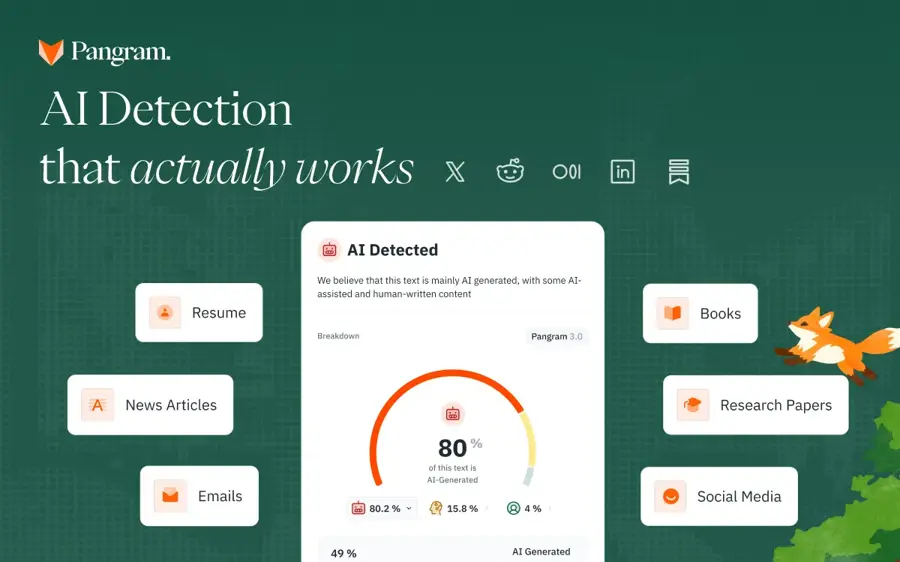
Image: Pangram, pangram.com (official website)
Why it stands out
Pangram's case rests on independent results. In the Van Vlasselaer et al. study of academic papers over 4,000 words, it scored 65% on fully AI-written papers where three rivals scored 0%, and 92.5% on hybrid and humanized papers, where the next best tools managed 60% and 50%, according to SaaS CRM Review. On Reddit's r/Professors, one associate computer science professor wrote that Pangram "does seem to have the best detector out there," as quoted by eesel. That is one opinion, and we found no major review-site score, but it matches what the studies show.
One thing to watch: with Pangram 4, the company moved billing to 100-word units, which halved the word allowance on paid plans. Pangram said the change "represents a price change of 1-2x for short documents and up to 10x for long-form documents," per eesel.
Key features
Section-level scoring: shows which parts of a document look AI-written
Tiered results: sorts text from fully human to fully AI-generated
Plagiarism check: included on paid plans
Image scans: 3 a day on the free plan
Team plans: per-seat billing plus Institutional and Enterprise options
Pros
Strongest independent results on hybrid and humanized text
Generous free daily allowance with no card needed
Plagiarism checking bundled into paid plans
Cons
Won't score texts under about 50 words
New billing units cost long-form users more
Team costs climb with every seat
Pangram pricing: Free (2,000 words a day) → paid plans from $20/month. Individual is $20/month or $180/year for 300,000 words. Professional is $65/month or $540/year for 1.5 million words. Team is $20 per seat per month with a two-seat minimum. Institutional and Enterprise are quote-only (checked October 2026, per eesel's Pangram pricing breakdown). Official site
GPTZero – best for teachers and students on a budget
GPTZero is one of the best-known AI checkers and the best free AI detector for most people, as long as you treat its score as a starting point. Try it at gptzero.me.
Image: GPTZero, gptzero.me (official website)
Why it stands out
GPTZero does very well on straightforward AI text. The JAIT study recorded 100% detection at baseline and 90% on non-native-style rewrites, and Villa et al. gave it an AUC of 0.99, according to SaaS CRM Review. But on long, hybrid academic papers in the Van Vlasselaer study, it caught none of 40 hybrid papers, and a separate working paper found it missed more than half of humanized texts. Users are split: GPTZero holds a TrustScore of 2.2 out of 5 on Trustpilot from 139 reviews, with false positives the top complaint. One reviewer wrote: "Super inaccurate results, my draft was 100% humanly written, yet it was detected as 100% AI."
Key features
Sentence highlighting: marks the sentences that look AI-written
Batch uploads: check a stack of essays at once
Integrations: Chrome, Google Docs, Canvas, Moodle and Google Classroom
Paid extras: plagiarism checks and team features
Free plan: 10,000 words a month
Pros
Best free allowance of any major detector
Strong results on unedited AI text
Annual billing saves about 45%
Cons
Struggles with hybrid and humanized writing
Poor Trustpilot score driven by false positive complaints
Plagiarism checks need a paid plan
GPTZero pricing: Free (10,000 words a month) → paid plans from $8.33/month billed annually. Essential is $14.99/month ($8.33 annually) for 150,000 words. Premium is $23.99/month ($12.99 annually) for 300,000 words. Professional is $45.99/month ($24.99 annually) for 500,000 words (checked October 2026, per ToolsForHumans' GPTZero listing). Official site
Originality.ai – best for publishers and SEO teams
Originality.ai combines AI detection, plagiarism checking and fact-checking for web content, and is the safest pick for content teams who need to audit writers without falsely accusing them. Try it at originality.ai.
Image: Originality.ai, originality.ai (official website)
Why it stands out
Originality.ai is careful with human writing. In Hadra et al., it classified all 48 human texts correctly and caught 83% of AI texts, but only 2% of hybrid texts, per SaaS CRM Review. So it rarely accuses people, but it can miss AI text that someone has edited. It also flags formulaic intros, conclusions and stats-heavy articles more often, which matters if you publish listicles. On review sites, it scores 5.0 out of 5 on Capterra, though from only 7 reviews, and G2 reviewers rate its support quality 9.4 out of 10 and ease of use 8.7.
Key features
AI detection: built for auditing published web content
Plagiarism checking: in the same scan workflow
Fact-checking: flags claims worth verifying
Team seats: extra seats at $9.95/month
API access: on the Enterprise plan
Pros
Very low false positive rate in independent testing
Three checks in one tool
Pay-as-you-go option for occasional users
Cons
Weak on blended human and AI text
Subscription credits expire monthly
Needs at least 100 words per scan
Originality.ai pricing: Free (3 AI scans a day of up to 2,000 words) → paid plans from $12.95/month billed yearly. Pro is $14.95/month, or $12.95/month yearly, for 2,000 credits (about 200,000 words). Enterprise is $179/month ($136.58 yearly) with 15,000 credits. A $20 pay-as-you-go pack is also listed (checked October 2026, per SaaS CRM Review and Capterra). Official site
Copyleaks – best for multilingual teams
Copyleaks is an AI detector and plagiarism checker that supports more than 30 languages and is common in enterprise and education settings. Try it at copyleaks.com.
Image: Copyleaks, copyleaks.com (official website)
Why it stands out
Copyleaks posted strong numbers in the JAIT study: 100% on paraphrased text and 87.5% on non-native-style rewrites. It also flagged none of 40 human papers in Van Vlasselaer et al. The catch is that the same study found 0% strict detection on fully AI-written long papers, per SaaS CRM Review, so its results seem to depend heavily on text type and length. Users are mostly positive: Copyleaks has a 4.4 out of 5 rating on Capterra from 91 reviews. One reviewer, Kalyan K., summed it up: "Altogether, I have a positive attitude towards Copyleaks."
Key features
30+ languages: AI and plagiarism checks beyond English
LMS integrations: fits into school learning platforms
API: for enterprise and developer workflows
Image checks: one credit covers 250 words or one image
Team seats: 25 seats on the Pro plan
Pros
Low false positives on human papers in testing
Strong on paraphrased text in the JAIT study
Good fit for enterprise teams
Cons
No free plan
Small credits (250 words each), so costs add up
Switching plans forfeits remaining credits
Copyleaks pricing: No free plan → paid plans from $13.99/month billed yearly. Personal is $16.99/month (100 credits), or $13.99/month yearly. Pro is $99.99/month (1,000 credits), or $74.99/month yearly (checked October 2026, per SaaS CRM Review). Official site
Turnitin – best for schools and universities
Turnitin is the plagiarism and AI detection system built into many schools' learning platforms. If you are a student, this is probably the Turnitin AI checker your work goes through, and individuals cannot buy it. See turnitin.com.
Image: Turnitin, turnitin.com (official website)
Why it stands out
Turnitin has long said its goal is "ensuring a high accuracy rate accompanied by a less than 1% false positive rate," in a 2023 company blog post. Independent studies paint a weaker picture on detection. Villa et al. found the Turnitin AI detector caught only 26.7% of AI manuscripts, with results ranging from 66.7% to 3.3% depending on which AI model wrote the text, per SaaS CRM Review. The real-world record is mixed too. A Popular AI roundup of false positive cases lists several, including AP reporting that Temple University staff called the detector "incredibly inaccurate," and Australian Catholic University dropping the tool after many AI misconduct cases were dismissed. Schools should treat its score as one signal among many.
Key features
LMS integration: built into the platforms schools already use
Combined report: plagiarism and AI checks side by side
Length range: needs 300 to 30,000 words of prose
Low-score masking: hides scores between 1% and 19% because they are less reliable
Pros
Already in place at many institutions
Rarely flagged human manuscripts in independent studies
One report for two kinds of checks
Cons
Missed most AI text in several 2026 studies
Not available to individuals
Unreliable on short text, poetry, code, lists and tables
Turnitin pricing: No free plan → pricing is not published. AI writing detection is a license add-on quoted to institutions (checked October 2026, per SaaS CRM Review). Official site
Grammarly AI Detector – best for writers already using Grammarly
Grammarly's AI detector estimates what share of a text looks AI-generated. It is fine for a free gut check on your own writing, but not strong enough to judge someone else's. Try the free web version.
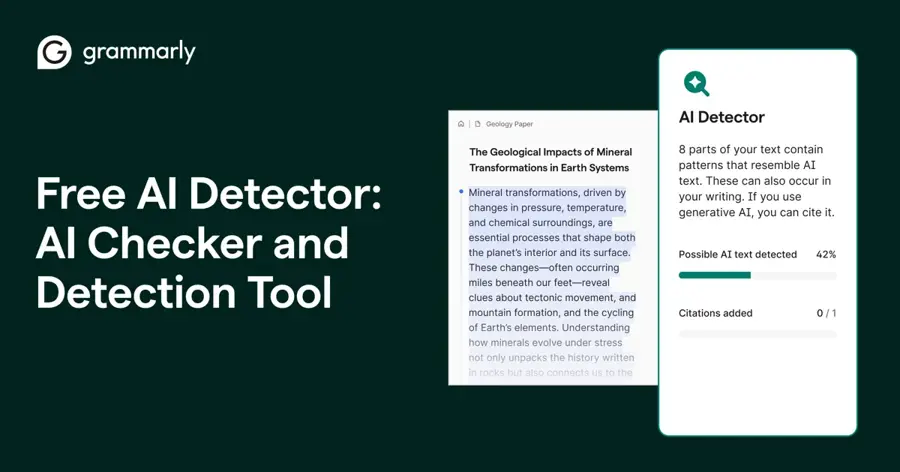
Image: Grammarly AI Detector, grammarly.com (official website)
Why it stands out
Grammarly is unusually frank about limits. Its own page states: "No AI detector is 100% accurate—every tool has limitations." That honesty is warranted. In the JAIT study, the Grammarly AI checker scored 90.9% at baseline but just 2.1% on non-native-style rewrites, per SaaS CRM Review. There is a twist, too: accepting rewrites from Grammarly's own AI features can push up a human draft's AI score. We could not find a review-site rating for the detector itself, separate from Grammarly as a whole.
Key features
Percentage score: shows how much of a text looks AI-generated
Free web checker: no sign-up needed
In-app detection: included with Grammarly Pro
Plain caveats: the page explains what a score can and cannot tell you
Pros
Free, fast, and no account needed
Fits into an editing tool many people already pay for
Honest about its own limits
Cons
Collapses on paraphrased or non-native-style text
Grammarly's own AI edits can raise your score
Short passages are harder to judge
Grammarly AI Detector pricing: Free web checker → Grammarly Pro from $12 per member per month billed annually, or $30 billed monthly (checked October 2026, per SaaS CRM Review). Official site
Related: Grammarly AI review
QuillBot AI Detector – best for quick free checks
QuillBot's detector gives a quick read on whether text looks AI-written, AI-refined or human. It is a solid free first pass, but pair it with a stronger tool before acting on any result. Try it at quillbot.com.
Image: Quillbot app screenshots, App Store (QuillBot, a Learneo Inc. business)
Why it stands out
QuillBot leans toward calling unclear text human. That cuts false accusations but raises misses. The JAIT study recorded 95.5% at baseline but only 22.3% on non-native-style rewrites, while Scribbr's own comparison gave it 78% with no false positives, per SaaS CRM Review. Keep in mind that QuillBot also sells the paraphrasing tools many people use to get around detectors. We did not find a detector-specific rating on G2, Trustpilot or Capterra, so we have not quoted one.
Key features
Three-way verdict: AI-written, AI-refined or human
Free scans: 6 a day of up to 1,200 words each
Minimum length: 80 words per scan
Writing suite: sits alongside QuillBot's paraphrasing and writing tools
Pros
Generous free daily scans
Low false positive tendency
Cheap Premium plan on annual billing
Cons
Misses a lot of rewritten AI text
Same company sells paraphrasing tools
No monthly or team price shown
QuillBot AI Detector pricing: Free (6 scans a day) → Premium from $8.33/month billed annually, which removes the limits (checked October 2026, per SaaS CRM Review). Official site
How to choose the right AI detector
Start with who you are and what happens if the tool is wrong. A false flag on a blog draft costs you a few minutes. A false flag on a student's essay can cost them a grade, or worse.
Choose Pangram if you need the most reliable result on long, edited or humanized text, and you can pay $20 a month.
Choose GPTZero if you are a teacher or student who wants a free AI detector with classroom integrations.
Choose Originality.ai if you run a content team and need AI, plagiarism and fact checks with very few false accusations.
Choose Copyleaks if you check work in several languages or need an enterprise API.
Use Turnitin if your institution already licenses it, and read its report alongside other evidence.
Use Grammarly or QuillBot if you just want a free AI check on your own writing before you submit it.
A few practical rules apply to every tool. Paste at least a few hundred words, since short texts are unreliable everywhere. Remove tables, code, bullet lists and references before scanning. Run anything important through two different detectors. And if you write with AI help, for example by drafting with ChatGPT or Claude, keep your prompts and drafts so you can show how the work came together.
Why AI detection goes wrong
AI detectors do not "know" who wrote a text. They estimate how predictable the wording is, based on patterns they learned in training. Plain, formulaic or very polished writing looks predictable, so it can score as AI. That is why non-native English speakers and people who write in a formal, simple style are flagged more often. Grammarly's own page notes that detectors "do not track authorship, which means even human-written text can be flagged as AI-generated."
The reverse also happens. A light round of human edits, or a pass through a paraphrasing tool, can drop an AI score sharply. Several of the studies above show detection rates falling from above 90% to below 25% once text was rewritten.
Free vs paid AI detectors: what you actually get
Free plans are good enough for most individuals. Paid plans make sense when you check a lot of text or need records for a team.
Feature | Typical free plan | Typical paid plan |
|---|---|---|
Volume | 1,200 to 2,000 words per scan, or 10,000 words/month (GPTZero) | 150,000 to 1.5 million words/month |
Detail | Overall percentage, sometimes highlights | Sentence or section-level breakdown |
Plagiarism check | Rarely included | Usually included |
Batch uploads and history | Limited or none | Yes, plus team seats |
Integrations and API | Browser extension at best | LMS, Google Docs, API access |
Here is the budget view. A student checking their own essays can stay free with GPTZero, QuillBot or Grammarly. A teacher grading a full class each week will run through free limits fast, so GPTZero's Essential plan at $8.33 a month (annual) or Pangram at $20 a month is the better buy. An agency auditing dozens of articles should budget for Originality.ai or Copyleaks.
Paying does not buy certainty, though. The paid tools did better in studies, but every one of them still missed AI text or flagged human text in at least one test. If you are a student looking for other helpful tools, our guide to the best free AI tools for students covers study and writing aids that do not cost a cent.
Final verdict
If you only pick one AI detector, pick Pangram. It had the strongest independent results on the hardest cases, and its free tier is generous enough to try properly. If price is the main factor, GPTZero's free plan is the best place to start. Originality.ai is the pick for content teams that cannot afford to falsely accuse a writer.
Whichever you choose, use the score to start a conversation, not end one. Look at drafts, version history and the person's past work. No AI checker in 2026 can do that judgment for you.
FAQ
Is this AI? How can I tell if text was written by AI?
You cannot know for sure from a detector alone. Run the text through one or two reliable tools, such as Pangram or GPTZero, and look at which sections are flagged. Then look for other evidence: drafts, edit history, sources that check out, and whether the writing matches the person's usual style.
What is the most accurate AI detector?
Based on the 2026 studies we reviewed, Pangram performed best on hybrid and humanized text, while GPTZero, Copyleaks and Originality.ai did well on unedited AI text. Results vary a lot by text type and length.
Is there a good AI detector free of charge?
Yes. GPTZero gives you 10,000 free words a month, Pangram gives you 2,000 words a day, and Grammarly, QuillBot and Scribbr offer free scans. Free tools are fine for checking your own writing.
Can Turnitin detect ChatGPT?
Sometimes. Turnitin's AI checker flagged some AI text in studies, but Villa et al. found it caught only about a quarter of AI manuscripts, and results depended on which model wrote the text. It is less reliable on edited or mixed writing.
Can AI detectors be wrong about human writing?
Yes. False positives happen with every tool, and they hit non-native English writers and formulaic writing hardest. If you are wrongly flagged, share your drafts, notes and version history, and ask for a human review.
Is the Grammarly AI checker accurate?
It works reasonably on plain AI text but dropped to about 2% in one study once text was rewritten in a non-native style. Grammarly itself says no detector is 100% accurate. Use it for a quick check, not as proof.
Sources
- 11 Best AI Detectors (2026): Studies, Costs, Free Limits (SaaS CRM Review)
- Pangram pricing in 2026: plans, credits, and API rates (eesel AI)
- GPTZero Review 2026 - Features, Pricing & Deals (ToolsForHumans)
- GPTZero Reviews (Trustpilot)
- Originality.AI Pricing 2026 (Capterra)
- Copyleaks vs Originality.AI (G2)
- Copyleaks Reviews 2026 (Capterra)
- Understanding false positives within our AI writing detection capabilities (Turnitin)
- These Turnitin false positives in 2025 and 2026 show why AI detectors can't be proof (Popular AI)
- Free AI Detector and AI Checker (Grammarly)