Uberduck AI review 2026: voice cloning, AI music, pricing and consent rules
Uberduck AI does text to speech, singing, rap, voice cloning and AI songs from $2 a month. We weigh its plans, consent rules and reliability complaints.
 Written byFahad HashmiContributing writer, AI in energy and industry
Why you can trust The AI Future
Our writers research every product, link each claim to its source and correct mistakes openly. Companies can't pay for coverage or see reviews before they're published.
Read our editorial policy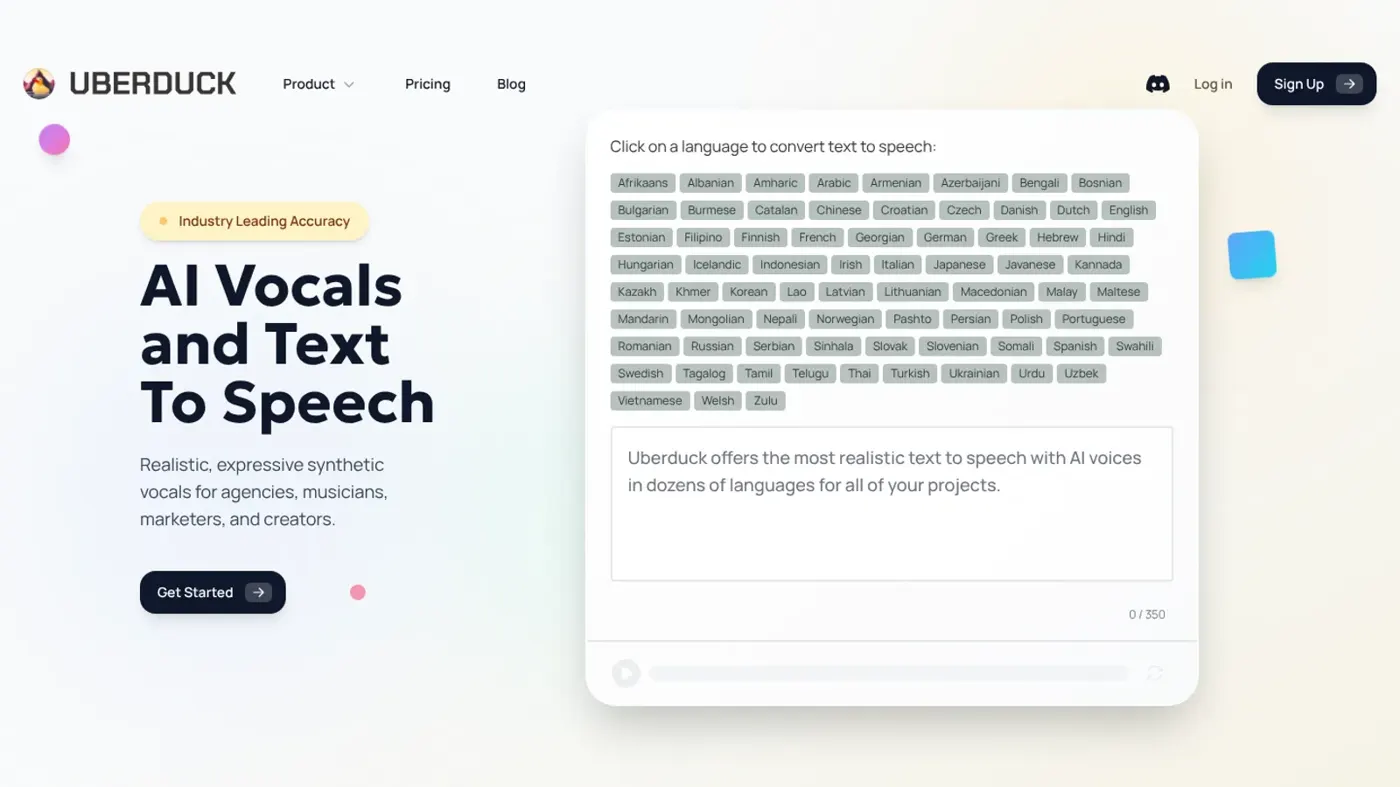
Our verdict on Uberduck AI
Uberduck AI is a cheap, broad toolkit for AI vocals, raps and songs, best for hobbyists and game prototyping with your own or licensed voices. Skip it if you need dependable support, polished client narration or clear licensing for released music.
Pricing Free (non-commercial); Starter $2/mo billed yearly (non-commercial, 1,000 credits); Creator $5/mo billed yearly (commercial, 3,600 credits); Pro $30/mo billed yearly (25,000 credits); Enterprise custom
Visit Uberduck AIUberduck AI is a Seattle-based web platform for synthetic vocals: text to speech, text to singing and rapping, voice cloning, speech-to-speech conversion and, more recently, full AI songs with lyrics. Paid plans start at $2 a month billed yearly, but only the $5 Creator plan and up give you a commercial licence. It's cheap and broad, and the weak spots are reliability, support and a no-refunds policy. I'd call it a fun playground rather than a dependable studio tool.
A note on method: nobody at The AI Future ran hands-on tests of Uberduck for this review, so you won't find stopwatch timings or screenshots of our own projects here. We looked at Uberduck AI as it stands in late October 2026 using its official site, pricing page, terms of service, help centre and API docs, plus independent write-ups and user reviews. Where someone else did the testing, we name them.
That matters more than usual here, because Uberduck has changed shape at least twice. Remember it as the site where you could type lyrics and hear a famous rapper "perform" them? That version's gone.
About Uberduck AI
Uberduck is a vocal toolbox with a music generator bolted on. The homepage describes it as "realistic, expressive synthetic vocals for agencies, musicians, marketers, and creators", and lists four core tools: text to speech (speech, singing and rapping), API access, voice cloning and speech to speech. A newer model creates full songs with lyrics, which Uberduck says works in 70+ languages and hundreds of musical styles.
The company is Uberduck, Inc., with a registered address in Seattle, going by its DMCA notice.
The pivots, briefly
- 2021 to mid-2023: the celebrity voice era. According to AudioCipher, Uberduck went viral in late 2021 with a library of celebrity voice models that anyone could use for free. Rappers, cartoon voice actors and podcast hosts were all in the mix, and users made most of the models.
- July 2023: the clean-out. Uberduck's own help centre says it removed user-created character voices "due to ethical and legal concerns around the hosting of voices belonging to characters and individuals from whom we hadn't received explicit consent". EaseUS links the change to legal pressure from Universal Music Group and SAG-AFTRA.
- 2024 to now: tools for creators. The current product is built around stock voices, your own cloned voice, an AI rap and singing generator, an API and an AI song generator. The Uberduck blog also points to a "Model v3" for songs and FLUX-based image generation with custom image clones.
If you searched for "duck ai voice" or "underduck ai", this is almost certainly the product you meant.
Key features
Text to speech in dozens of languages
The free text-to-speech page lets you type up to 350 characters and pick from a long voice list. Many of the voice IDs match the naming of big cloud TTS engines (for example "en-US-Neural2-A", "en-GB-Wavenet-B" and "JennyMultilingualNeural"), and the API docs say you can "browse and select from hundreds of voices across different providers". That suggests, though I can't be sure, that Uberduck works partly as a front end to several speech engines, alongside its own voices. The languages page claims text to speech "in 72 different languages", from Afrikaans to Zulu.
Text to singing and AI rap
This is the feature that still sets Uberduck apart from most plain TTS tools, and honestly it's the one I'd try first. The homepage promises speech, singing and rapping from text. AudioCipher walked through the rap tool: you choose a beat, generate or paste lyrics, then pick a voice. Its reviewer found the voices "rap on beat" and have "a fair amount of depth", while noting that free-plan lyrics come four lines at a time. On the pricing page, "AI-generated raps" are listed only from the Creator plan up.
AI music generation
The music generation page pitches complete songs, albums, jingles, podcast beds and game music from a text idea, with "no musical experience needed". Uberduck says outputs can be used commercially on any paid plan. Treat the "copyright-free music" claim on that page as marketing, not legal advice: the law on who owns AI-generated music is still unsettled, and our explainer on how AI music works covers why.
Voice cloning and speech to speech
The voice cloning page lets you record a sample in the browser and says clones typically reach "over 95% similarity to the original voice". That's a vendor claim with no published test method, so I'd read it as a ceiling. Speech to speech lets you record yourself and re-voice the take in another voice while keeping your timing and delivery. Uberduck lists podcasts, audiobooks, voiceovers, character voices and short-form video as uses.
API for developers
The Uberduck API covers text to speech, voice cloning and music generation with bearer-token authentication and a voices endpoint you can filter by language and gender. API access is included from the Creator plan, per the pricing page. Several deeper doc pages we tried returned 404 errors in late October 2026, so you'll probably lean on the quick-start material.
Uberduck AI pricing and plans
All prices below are from the official pricing page, checked October 2026. They're shown as monthly rates billed yearly, and a "6 months discount!" banner was running. The page offers a monthly billing toggle, but the month-to-month prices weren't shown in the version we could read.
| Plan | Price (billed yearly) | Monthly credits | Licence | Notable extras |
|---|---|---|---|---|
| Free | $0 | Not listed on pricing page | Non-commercial | For testing; details not published |
| Starter | $2/mo ($24/yr) | 1,000 | Non-commercial | Private voice access |
| Creator | $5/mo ($60/yr) | 3,600 | Commercial | API, AI raps, image generation, custom image clones |
| Pro | $30/mo ($360/yr) | 25,000 | Commercial | Everything in Creator, 24-hour support response time |
| Enterprise | Contact sales | Custom | Commercial | Extended usage rights for voices and beats, per the terms |
The free plan in practice
Uberduck doesn't spell out the free tier on its own pricing page. All it says is that paid plans go "beyond the free tier" and that you must "upgrade to use outputs commercially". Tools for Humans reports the free plan gives 300 monthly credits, which it equates to about 300 seconds of audio. The free plan seems to be for testing, and anything you publish for money needs Creator or above.
A worked example with numbers
Say you make a weekly 10-minute narrated video. That's about 40 minutes, or 2,400 seconds, of finished audio a month. Using Tools for Humans' rough one-credit-per-second figure:
- Free (about 300 credits): covers about 12% of your month. Not workable, and no commercial licence anyway.
- Starter (1,000 credits): about 16 minutes. Still short, and still non-commercial.
- Creator (3,600 credits): about 60 minutes, so you have roughly 20 minutes of headroom for retakes. At $60 a year, that works out to about 8 cents per minute of audio.
- Pro (25,000 credits): about 6.9 hours a month, for teams or daily publishing.
Two caveats. Uberduck doesn't publish an official credit-to-second rate on its pricing page, and songs, raps and clones may cost more credits than plain speech. Also, the terms say plainly: "We do not issue refunds." I'd start on a short plan or the free tier before paying for a year.
Performance and independent testing
Independent, recent, hands-on testing of Uberduck is thin. Most coverage either predates the 2023 changes or reads like a feature list. A few points hold up.
- Rap generation works and stays on beat. AudioCipher (updated April 2025) called finishing a rap track "a rewarding experience", but criticised the voice picker's placeholder names and avatars.
- Stock voices can sound synthetic. Staccato wrote that after the celebrity voices left, many voices "sound tinny, fake, and robotic", while still rating its rap tool as more impressive than some competitors.
- Mixed fit by user type. Tools for Humans gives it 2.5 out of 5 (last reviewed March 2026). It rates sentiment as positive for indie game developers prototyping dialogue, mixed for creators and musicians, and negative for marketing teams, citing quality glitches, rate limits and unclear music licensing.
- Reliability and support are the loudest complaints. On Trustpilot, Uberduck's unclaimed profile scores 1.7 from 17 reviews, 94% of them one-star, with only three in the last 12 months. Recent reviewers describe failed generations, unanswered support emails and unexpected annual renewals. One August 2025 reviewer reported the error "Error generating rap: Failed to fetch (api.uberduck.ai)" five times in a row. It's a small sample, but the themes repeat.
We could not find a G2, Capterra or app-store rating with enough reviews to report. GetApp lists Uberduck with no reviews as of September 2026.
Voice cloning and consent: the rules you agree to
Read this before you upload anyone's voice, including your own. The marketing says "clone any voice for free in seconds" and even suggests you "clone a loved one's voice" on the voice cloning page. The terms of service are stricter than that copy suggests.
- You need the right to the voice. When you post content, you warrant that it is yours or that you have the right to use it, and that it does not violate anyone's privacy, publicity or other rights.
- Uberduck can check. For custom clones, Uberduck "reserves the right to verify that you are legally permitted to create a custom voice clone and that the submitted data does not violate any copyright", and it can terminate the clone and delete your data.
- No impersonation. The prohibited uses include trying "to impersonate or attempt to impersonate Company, a Company employee, another user, or any other person or entity".
- Your clone stays private, but your posts may not. Uberduck says it won't expose clone data to other users or use it for other clones. Separately, content you post grants Uberduck a licence that includes making it "available to other users of Service". Know which is which before you upload.
- Age limit. The service is for people at least 13 years old.
The law seems to be moving the same way. Tennessee's ELVIS Act, in force since July 2024, gives people a property right in their voice and can also reach anyone who distributes a tool whose primary purpose is producing unauthorised voice clones. According to Recording Law, seven US states now have AI voice or digital-replica laws, and there's no federal voice-cloning law yet. The federal NO FAKES Act cleared the Senate Judiciary Committee on June 18, 2026, but AI Musicpreneur reports that Sen. Ted Cruz blocked a fast-track floor vote on September 30, 2026.
The safe rule is simple: clone your own voice, or one you've written permission to use, and label synthetic audio when it could mislead. Making someone appear to say or sing things they never did without consent can harm them and can be illegal. Our guide on how to make an AI voice of someone goes through consent in more detail.
One oddity: in late October 2026 the TTS voice list still included an entry labelled "SpongeBob SquarePants (Seasons 3–9A)". We couldn't confirm whether it's licensed, so don't assume you can use it commercially.
The limits
- Support response. Only Pro lists a support response time (24 hours). Several Trustpilot reviewers said they got no reply at all.
- Billing. Annual billing, auto-renewal and no refunds add up to real risk if the tool fails you in the first week.
- Docs gaps. Several API doc links returned 404s when we checked, which slows down integration work.
- Licensing grey zones. Commercial use is allowed on paid plans, but who owns AI music and whether a stock voice is properly licensed are questions Uberduck's pages don't fully answer.
- Quality ceiling. Reviewers repeatedly describe some voices as robotic in longer takes, so plan on auditioning several voices per project.
Who Uberduck AI is for
| You are... | Good fit? | Why |
|---|---|---|
| A hobbyist making raps or meme songs | Yes | Free tier and $2 Starter are cheap ways to play with text to singing |
| An indie game developer prototyping dialogue | Yes | Large voice list, API on Creator, low cost per minute |
| A YouTuber or podcaster needing weekly voiceovers | Maybe | Creator covers about an hour a month; compare quality before committing |
| A brand or agency shipping client work | Probably not | Support, reliability and licensing questions are hard to explain to a client |
| Anyone hoping to clone a celebrity | No | Against the terms, and potentially illegal |
If you mostly want narration for videos, see our guide to adding AI voice to a video first.
Uberduck AI alternatives worth considering
- Suno is the pick if what you really want is finished songs from a prompt rather than a vocal toolkit. Read our Suno AI review.
- Kits AI suits musicians who want AI voice conversion inside a production workflow. See our Kits AI review.
- A dedicated voice generator such as ElevenLabs is better for natural narration and voiceovers. Our roundup of the best AI voice generators compares the main options, and we also have a list of female AI voices.
Verdict on Uberduck AI
Uberduck AI earns a 3 out of 5 from us, and I think that's fair. Its strengths are real: a wide voice list, singing and rap from text, simple voice cloning, an API and a song generator, all from $5 a month billed yearly for commercial use. Its weaknesses are just as real: thin recent independent testing, a support record that users rate poorly and a no-refunds policy.
Use it if you want a cheap, flexible playground for AI vocals, rap demos or game prototypes, and you'll stick to your own or properly licensed voices. Skip it if you need dependable support, polished narration for clients or clear licensing for released music. In those cases, a specialist voice or music tool is probably a safer bet.
FAQ
How to use Uberduck AI?
Create a free account at uberduck.ai, then pick a tool. For speech, choose text to speech, select a voice and language, paste your script and generate. For songs, open the rap or music tool, choose a beat or style, write or generate lyrics, pick a voice and download the file. Upgrade to Creator before using anything commercially.
Is Uberduck AI free?
Yes, but it's non-commercial and small: Tools for Humans reports about 300 credits a month, roughly five minutes of audio. Paid plans start at $2 a month billed yearly, and commercial use starts with the $5 Creator plan, going by the pricing page.
Does Uberduck still have celebrity voices?
No. Uberduck removed user-made character and celebrity voices in July 2023, citing ethical and legal concerns about voices used without explicit consent, according to its help centre. Today you get stock voices, voices from other speech providers and clones of voices you have the right to use.
Can Uberduck do text to singing?
Yes. Uberduck's homepage lists speech, singing and rapping from text, and its music model creates full songs with lyrics. AI-generated raps are on the Creator plan and above. Reviewers say the rap stays on beat, though some voices sound synthetic.
Is it legal to clone a voice with Uberduck?
Cloning your own voice, or one you have permission to use, is allowed. Uberduck's terms ban impersonating any person and let the company verify that you are legally permitted to create a clone. Several US states, led by Tennessee's ELVIS Act, now give people rights over AI clones of their voice.
Can I get a refund from Uberduck?
Generally no. Uberduck's terms of service state that it does not issue refunds, although you can ask support for an exception in special circumstances. You can cancel a non-enterprise plan from the subscription page to stop renewal, so try the free tier first.
Ratings around the web
Ratings as of 7 Nov 2026. Scores change over time; follow the links for the latest.
What we like
- Text to speech, singing, rapping, voice cloning and speech to speech in one place
- AI song generator that creates full tracks with lyrics
- Commercial licence from just $5 a month billed yearly
- API access included from the Creator plan
- Removed non-consented celebrity and character voices in 2023
What could be better
- No refunds, with annual billing and auto-renewal
- Users report failed generations and unanswered support emails
- Some stock voices sound robotic in longer takes
- Free tier is small and its limits are not published on the pricing page
Sources
- AI Vocals and Text To Speech (Uberduck)
- Pricing Plans (Uberduck)
- Terms of Service (Uberduck)
- Free AI Voice Cloning (Uberduck)
- Free Online Text To Speech (Uberduck)
- Text to speech in 72 different languages (Uberduck)
- AI Music Generation (Uberduck)
- Blog (Uberduck)
- Frequently asked questions (Uberduck)
- What happened to the voice of X character? (Uberduck Help Center)
- Introduction, Uberduck API Documentation (Uberduck)
- Using Uberduck AI Voice Generator to Make Music (AudioCipher)
- Uberduck AI: What Is The State Of Play? (Staccato)
- Uberduck Text to Speech: Full Guide 2026 (EaseUS)
- Uberduck review 2026 (Tools for Humans)
- uberduck.ai Reviews (Trustpilot)
- Uberduck 2026 Pricing, Features, Reviews & Alternatives (GetApp)
- AI Voice Cloning Laws: The ELVIS Act and the States That Followed (Recording Law)
- NO FAKES Act Status: RIAA Chief Eyes Lame Duck After Cruz (AI Musicpreneur)