Fish AI review 2026: features, pricing, pros and cons of Fish Audio
Fish AI (Fish Audio) pairs expressive text-to-speech and voice cloning with low prices and a free API. We weigh Drama 3, the plans and the catches.
 Written byRahis SaifiCo-founder and news editor
Why you can trust The AI Future
Our writers research every product, link each claim to its source and correct mistakes openly. Companies can't pay for coverage or see reviews before they're published.
Read our editorial policy
Our verdict on Fish Audio (Fish AI)
Fish Audio offers some of the best value in AI voice in late 2026, with top pronunciation scores, directed delivery and a free API. Creators, audiobook producers and developers should try it; teams needing perfectly consistent output at scale should compare it with ElevenLabs first.
Pricing Free (personal use); Plus $15/mo ($11/mo annual); Pro $100/mo ($75/mo annual); Max $999/mo ($749/mo annual); Enterprise custom; API pay-as-you-go with free S2.1 Pro tier
Visit Fish Audio (Fish AI)Fish AI, sold as Fish Audio, is a text-to-speech and voice cloning platform that turns written scripts into expressive, human-sounding speech. It has a free plan, paid plans from $11 a month billed annually, and a developer API whose S2.1 Pro model is currently free to use. On October 13, 2026, the company added Drama 3, a model you direct with plain-language stage directions, according to its launch post.
The platform matters because it undercuts the market leader on price while scoring at or near the top of several quality tests. It also releases model weights publicly, which few rivals do.
This review is researched journalism. Nobody at The AI Future ran hands-on tests. It compares Fish Audio using the official plan page, developer docs and blog posts, independent benchmarks, other reviewers' published tests and user feedback, as of late October 2026.
What is Fish AI?
Fish Audio is a voice AI company founded in 2025, according to an eesel review. People searching for "fish ai", "fish audio ai" or "fish.audio ai" usually mean the same product: the web studio at fish.audio, its mobile apps and its API.
The company announced $52 million in seed funding on its first anniversary. Coreline Ventures and Capital Today led the round, according to the company blog published July 27, 2026. The same post says Fish Audio reached $21 million in annual recurring revenue, grew from 3 to 22 staff, and counts more than 8 million users.
The product started as Fish Speech, an open-source project. Chief scientist Shijia Liao began training models on a single RTX 4090, the blog says. Enterprise and developer customers now make up two-thirds of revenue, per the same post.
Fish Audio's core jobs are:
- Text to speech: type a script, pick a voice, download audio.
- Voice cloning: build a voice from a short recording.
- Speech to text: transcription with speaker turns and emotion cues.
- Voice agents: an end-to-end platform for conversational bots.
- Creative tools: image, video and avatar models from other vendors, listed on the homepage as GPT Image, Seedance, Kling and Veo among others.
If you are unsure how synthetic speech differs from older screen readers, see our explainer on whether text to speech counts as AI.
Key features
Drama 3 and directed delivery
Drama 3 is Fish Audio's newest text-to-speech model. You write a direction in square brackets before a line, such as "[barely holding it together, forcing a smile]". You can also drop in sounds like a shaky breath or a small laugh, according to the Drama 3 documentation.
Paired tags change only selected words. The docs list seven: whisper, emphasis, soft, fast, slow, stress and forceful. Directions can be written in a different language from the script.
The model speaks 83 languages and ships with open weights on Hugging Face, the launch post says. Commercial self-hosting is free only for companies with under US$500,000 in annual revenue. eesel notes the model is a 35-billion-parameter mixture-of-experts design with about 3 billion active parameters per token, citing Fish Audio's technical report.
One gotcha: if the API model header is missing or misspelled, the request silently falls back to S2.1 Pro, the docs warn.
S2.1 Pro, the everyday model
S2.1 Pro is the general-purpose model behind most plans. Fish Audio claims a 61% win rate over the older S2 Pro in listening tests and about 90 milliseconds to first audio on the standard API, according to its June 2026 announcement.
The earlier S2 model was open-sourced with weights, fine-tuning code and a streaming engine. It was trained on more than 10 million hours of audio, the S2 release post says.
Voice cloning
The homepage promises a clone "with perfect fidelity in 15 seconds", while its FAQ says as little as 10 seconds of audio is enough. In a hands-on review, Bitdoze reported cloning a voice from about 15 seconds of speech and having it working in under two minutes.
Paid plans add "professional voice slots" for verified, studio-quality clones. Plus includes one, Pro five and Max fifteen, per the plan page.
Cloning other people raises consent questions. The Drama 3 community licence bans cloning a real person's voice without consent, eesel reports. Fish Audio's own Uncle Roger demo used a clone "made and used with his permission", the launch post says. Our guide on making an AI voice of someone covers the rules in more depth.
Community voice library
Fish Audio hosts more than 2 million user-uploaded voices, according to its homepage. That library is why the site turns up for character searches such as AI Peter Griffin voices.
Quality varies. Bitdoze said it spent more time than it wanted browsing "mediocre voices" before finding good ones.
Developer API, speech to text and voice design
The API is pay-as-you-go with no monthly minimum. Transcription costs $0.36 per audio hour, and voice design, which generates a voice from a text prompt, costs $0.01 per successful request, according to the pricing docs.
Concurrency rises with spend: five simultaneous requests below $100 paid, 15 above $100 and 50 above $1,000.
Pricing and plans
Fish Audio sells four self-serve plans plus Enterprise. Prices below are from the official plan page, checked October 2026. Annual billing works out to three months free.
| Plan | Monthly | Annual (per month) | Credits per month | Audio per month | Characters per generation |
|---|---|---|---|---|---|
| Free | $0 | $0 | 8,000 | Up to 7 min | 500 |
| Plus | $15 | $11 ($132/yr) | 250,000 | Up to 200 min | 15,000 |
| Pro | $100 | $75 ($900/yr) | 2,000,000 | Up to 1,620 min | 30,000 |
| Max | $999 | $749 ($8,988/yr) | 25,000,000 | Up to 6,250 min | 30,000 |
| Enterprise | Custom | Custom | Custom | Custom | Custom |
Each minute of generated speech costs roughly 600 to 625 credits, and unused credits do not roll over, the plan page FAQ says. Pro adds three team seats and a seven-day money-back guarantee. Max adds ten seats. Enterprise offers zero data retention, on-premise deployment and SOC 2 compliance.
Until November 12, 2026, new Plus, Pro and Max subscriptions are 50% off the first month or first year, according to the Drama 3 launch post and eesel.
What the free plan really includes
The free tier gives 8,000 credits a month, about seven minutes of audio, 500 characters per generation, three public voice slots and standard speed. On the plan page, enhanced voice cloning and commercial use are struck through for free users.
That second point matters most. Free output is for personal, non-commercial projects only, the FAQ states. You need a paid plan to use voices on a monetised YouTube channel, podcast or client work. Some third-party price trackers list free commercial use or different prices, so check the official page before you buy.
API pricing
| API model | Price (USD) |
|---|---|
| s2.1-pro-free | $0 per million UTF-8 bytes (fair use) |
| s2.1-pro / s2-pro | $15 per million UTF-8 bytes |
| drama-3 | $50 per million UTF-8 bytes ($10 until November 12, 2026) |
| transcribe-1 / transcribe-1-pro | $0.36 per audio hour |
| voice-design-1 | $0.01 per successful request |
One million bytes is about 180,000 English words, or roughly 12 hours of speech, according to the API docs. The older S1 model retires on December 31, 2026.
Byte-based billing has a catch. Chinese, Japanese, Korean and Arabic characters take 3 to 4 bytes each, so the same word count costs more than in English, Smallest.ai notes.
Our take: the free S2.1 Pro API is the standout. ElevenLabs, by comparison, offers 10,000 free credits a month on its pricing page, and reserves commercial licensing and instant cloning for paid plans.
Performance and independent testing
Pronunciation: first place on Artificial Analysis
Drama 3 ranks first on Artificial Analysis' independent Pronunciation Robustness benchmark. It read 93.2% of hard words, numbers and codes correctly, against 88.1% for S2.1 Pro, according to the launch post. eesel reports Eleven v4 scored 91.7% on the same test.
Listener preference: strong, not first
Preference tests tell a different story. In Artificial Analysis' provider voice arena, Drama 3 holds an Elo of 1,243 across 1,857 matchups and ranks 10th, just behind Speechify's Simba 3.2, eesel reports. That is still a 101-point jump over S2.1 Pro.
eesel also flags take-to-take variation. Fish Audio itself advises users to "render a few and keep the one that plays".
Fish Audio's own blind test
In April 2026, Fish Audio published a 10-day blind A/B test run on its own production traffic. S2 Pro beat ElevenLabs V3 by 60% to 40% across 581 pairs, according to the company report. Treat this as vendor data: Fish Audio designed, ran and published it.
Hands-on reports from other reviewers
Bitdoze, a YouTube creator who switched from ElevenLabs, praised clean pronunciation on mixed English and Romanian scripts. It listed three weak spots: a slow web app for long audio, a learning curve for emotion tags, and uneven library quality.
A video review by Daniel Davidson cloned a voice and used it through the API. Independent creator coverage is broad, though many videos focus on the free API launch.
A warning about lookalike apps
Fish Audio says its official app is on iOS and Android. However, one App Store listing titled "Fish Audio: AI Voice Clone tts" is sold by an individual developer named Rizwan Rashid, according to the listing. It charges up to $19.99 a month. Download apps from links on fish.audio rather than by searching the store.
Who Fish AI is for
- YouTube and short-video creators: cheap narration, quick cloning and 83 languages. Plus covers about 200 minutes a month.
- Audiobook and audio drama producers: Drama 3's directions, multi-speaker scenes and pronunciation scores suit scripted work you render once and keep.
- Game and animation studios: per-line direction plus self-hostable weights, within the licence's revenue cap.
- Developers: the free S2.1 Pro API is an easy way to prototype voice apps and agents.
Who should skip it: teams that need consistent output at very high volume, where take variation hurts. Larger companies planning to self-host should budget for a commercial licence. Anyone wanting music rather than speech should look at our Suno AI review instead.
Fish AI alternatives worth considering
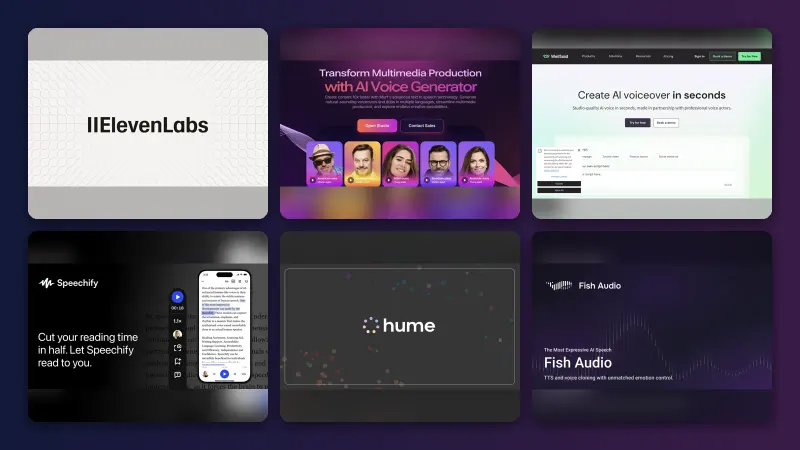
- ElevenLabs: the best-known rival, with voice cloning, dubbing and sound effects. Its free plan includes 10,000 credits a month, and Eleven v4 trails Drama 3 narrowly on pronunciation, per eesel.
- Speechify: its Simba 3.2 model sits just above Drama 3 in Artificial Analysis' listener-preference arena, eesel reports.
- Hume AI: another option focused on emotional delivery, which eesel suggests for emotion-led voice work.
For a wider comparison, see our roundups of the best AI voice generators and free AI text-to-speech tools. If you also need effects, try our list of free AI sound effect generators.
Verdict
Fish AI is one of the strongest-value voice platforms available in late October 2026. Drama 3 leads an independent pronunciation benchmark, the S2.1 Pro API is free under fair use, and Plus costs $11 a month on annual billing.
The caveats are real. Listeners still prefer nine other models in blind voice tests. The free plan bans commercial use. The web app can be slow on long scripts, and the company is barely a year old.
Our take: creators and developers who want expressive, multilingual narration on a budget should try it. Teams that need perfectly consistent output at scale should test it carefully against ElevenLabs first.
What happens next: the Drama 3 API price rises from $10 to $50 per million bytes after November 12, 2026, and the S1 model retires on December 31. Interactive editing and audio inpainting are in invite-only testing, according to eesel.
FAQ
Is Fish AI free?
Yes. The free plan includes 8,000 credits a month, about seven minutes of audio, for personal use only. Developers can also call the S2.1 Pro model free through the API under a fair-use policy. Commercial use needs a paid plan, starting at $15 a month or $11 a month billed annually.
Is Fish Audio better than ElevenLabs?
It depends on the test. Drama 3 beats Eleven v4 on Artificial Analysis' pronunciation benchmark, and Fish Audio's own blind test favoured S2 Pro over ElevenLabs V3. On price, Fish Audio is generally cheaper. ElevenLabs offers a broader feature set, including dubbing and sound effects.
Can I use Fish AI voices commercially?
Only on a paid plan. Premium subscribers can use verified voices they own for commercial purposes, according to the plan page FAQ. Free-plan audio is limited to personal, non-commercial projects.
How much audio do I need to clone a voice?
Fish Audio says 10 to 15 seconds of clear speech is enough for an instant clone. Professional, verified clones are available on paid plans. Only clone voices you own or have explicit permission to use.
What languages does Fish Audio support?
S2.1 Pro and Drama 3 support 83 languages, including English, Japanese, Chinese, Korean, Spanish, Arabic, French and German, according to Fish Audio's model announcements. Drama 3 also accepts directions written in a different language from the script.
Is Fish Audio open source?
Partly. Fish Audio publishes model weights for S2 and Drama 3. Drama 3 uses a community licence that is free for commercial use only below US$500,000 in annual revenue, so the company itself describes it as open-weight rather than open source.
What video reviewers say
Videos load from YouTube only when you press play.
What we like
- Drama 3 ranks first on Artificial Analysis' pronunciation benchmark
- S2.1 Pro API is free under a fair-use policy
- Paid plans cheaper than most rivals, from $11/mo billed annually
- Plain-language direction tags and 83 languages
- Open model weights for S2 and Drama 3
What could be better
- Free plan bans commercial use and enhanced cloning
- Ranks 10th, not first, in listener-preference voice tests
- Output varies from take to take, and the web app is slow on long scripts
- Lookalike third-party apps on the App Store
Sources
- Pricing & Plans (Fish Audio)
- Pricing & Rate Limits (Fish Audio Docs)
- Drama 3 (Fish Audio Docs)
- Fish Audio Drama 3: The Most Emotive Text-to-Speech Model We've Built (Fish Audio Blog)
- Fish Audio S2.1 Pro: Free Text-to-Speech API for Developers (Fish Audio Blog)
- We Blind-Tested Our TTS Against Every Major Competitor (Fish Audio Blog)
- 5 Models, 22 People, 1 Year (Fish Audio Blog)
- Fish Audio Open-Sources S2 (Fish Audio Blog)
- Best AI Text To Speech & Free Voice Cloning (Fish Audio)
- Fish Audio Drama 3 review: open-weight TTS you can direct (eesel AI)
- Fish Audio Review: I Cloned My Voice Free in 15 Seconds (Bitdoze)
- Fish Audio Pricing: Plans, API Billing & Commercial Use in 2026 (Smallest.ai)
- Fish Audio: AI Voice Clone tts (Apple App Store)
- ElevenLabs Pricing (ElevenLabs)
- Fish Audio S2.1 Pro Review (2026) - I Cloned My Voice and Used It Through an API (YouTube, Daniel Davidson)