Magisterium AI review 2026: what users and experts really think
Magisterium AI is a free Catholic AI chatbot that cites Church documents. We weigh its features, pricing, 4.8 app ratings and the accuracy concerns critics raise.
 Written byAlap ZahidReviews and guides editor
Why you can trust The AI Future
Our writers research every product, link each claim to its source and correct mistakes openly. Companies can't pay for coverage or see reviews before they're published.
Read our editorial policy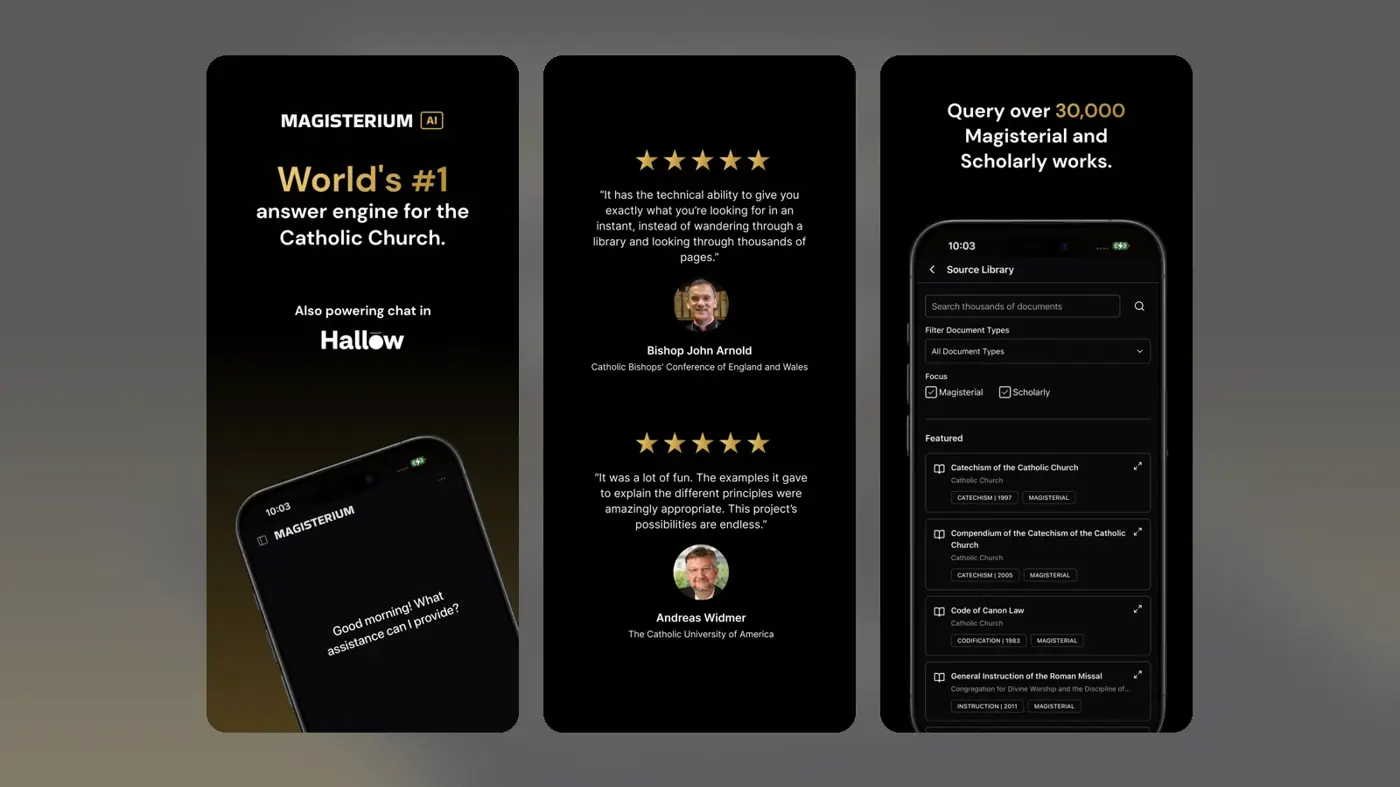
Our verdict on Magisterium AI (Longbeard)
Magisterium AI is the leading Catholic AI answer engine in late 2026, with cited answers, a deep document library and a generous free tier. Catechists, students and curious Catholics should use it as a research index and check its sources; skip it if you want neutral multi-faith answers or spiritual direction.
Pricing Free (90 queries/week); Pro listed at $3.99 or $29.99 on the App Store ($29.99/year per CatholicMom); Organization plan up to 100 seats; C-Intelligence for dioceses $1,083/mo
Visit Magisterium AI (Longbeard)Magisterium AI is a Catholic AI chatbot built by the Canadian company Longbeard. It answers questions about Church teaching using a curated library of Church documents, and it cites its sources. The app is free to use, with a limit of 90 queries per week, and a Pro upgrade is listed on the App Store at $3.99 or $29.99, according to its listing.
That matters because general chatbots often blur or invent religious sources. Magisterium AI's pitch is narrower: answers grounded in Catholic documents, with footnotes the user can check. Users rate it highly. Some theologians and commentators question both its accuracy on contested topics and the idea of a faith chatbot at all.
No one at The AI Future ran hands-on tests for this review. It is based on the official app listings, Longbeard's own pages, independent reviews and commentary, and about 50 recent app-store reviews, as of late October 2026. Where someone else tested the product, the article names them.
What is Magisterium AI?
Magisterium AI calls itself the "World's #1 answer engine for the Catholic Church", according to Longbeard's website. The name comes from the Latin term for the Church's teaching authority. People searching for "magesterium ai", a common misspelling, are looking for the same product.
Longbeard has worked on technology for the Catholic Church since 2015, the company says, with clients that include the Holy See. It turned to digitising the Church's written heritage in 2023. Its founder and CEO is Matthew Harvey Sanders. Faith.tools describes him as a former Canadian infantry officer and seminarian.
The product runs on the web and as iOS and Android apps. The seller on both stores is Longbeard Creative, based in Toronto. Longbeard's site says it is used in over 190 countries and more than 75 languages. The app-store listings give a smaller figure: 165+ countries and 50+ languages.
The source library is the core of the product. The figures vary by page:
- Longbeard's website cites over 26,453 magisterial documents, plus over 4,820 theological and philosophical works in Scholarly Mode.
- The App Store and Google Play listings describe a database of 28,000+ Church documents.
- Faith.tools and CatholicMom both put the library at over 32,000 Catholic texts.
The library covers papal encyclicals, council documents, the Catechism, Canon Law, the Church Fathers and Doctors such as Aquinas and Augustine, and Scripture. Longbeard also lists the Enchiridion (Denzinger) and biblical commentaries.
Magisterium AI sits inside a wider Longbeard family. It includes Vulgate, an AI library platform for research institutions, and Ephrem, a specialised Catholic language model the company says is "Coming 2026". A digitisation hub in Rome runs with the Pontifical Gregorian University, Longbeard says.
Key features
Cited answers from Church documents
Every answer comes with footnotes that link to the source passage. Learn of Christ's review, updated in May 2026, says clicking a footnote opens a panel with the exact paragraph, such as a Catechism section or a council document. The same review says the model declines to answer when its library does not cover a question.
Our take: this citation design is the main reason to choose it over a general chatbot. It lets users check the answer against the source, which is not the same as the answer always being right.
Modes for study and drafting
Faith.tools lists several modes. Learn Mode offers guided paths with quizzes and flashcards. Canvas Mode helps draft prayers, reflections and letters. Thinking Mode gives longer answers to complex questions. Voice Mode and read-aloud are on Pro plans.
The app listing says the AI can help draft homilies, lesson plans and study guides. Learn of Christ describes a homily-prep workflow tied to the lectionary readings.
Document library and reader
Users can read source texts in a built-in Document Viewer, bookmark them and listen to them. The native apps shipped version 1.3.4 on August 19, 2026, adding a Search Documents page and a 3D vector map of the library, according to faith.tools. Google Play shows the app was last updated on October 21, 2026.
Prayer and reference tools
The app includes "Holy Widgets": the Rosary, Stations of the Cross, confession guides, daily Mass readings and Saint of the Day. CatholicMom also lists Catholic news, a saints database, diocesan statistics, a quiz generator, novenas and chaplets, all in multiple languages.
Integrations and organisation tools
Magisterium AI is also available on WhatsApp and offers an API and MCP server for developers, faith.tools reports. Pro plans can connect to ChatGPT and Claude. It is built into the Hallow prayer app's mobile version through a partnership, Hallow's help centre says, though not for teacher and school accounts.
For dioceses, Longbeard sells C-Intelligence, a dashboard of anonymised trends in what people ask. Faith.tools lists it at $1,083 a month, with free partnerships for dioceses under $5 million in average annual revenue.
Magisterium AI pricing and plans
The official pricing page could not be accessed for this review, so the figures below come from the app stores and third-party reviews. Check the official site before you buy.
| Plan | Price | What you get |
|---|---|---|
| Free | $0 | Up to 90 queries per week, cited answers, document library, prayer tools |
| Pro | $3.99 or $29.99 (App Store in-app purchases) | More queries, voice mode and read-aloud, PDF uploads and connections to ChatGPT and Claude, per third-party reviews |
| Organization | Not published | Up to 100 seats, central billing, GDPR/CCPA compliance |
| C-Intelligence (dioceses) | $1,083/month | Anonymised question trends, manuscript digitisation; free for smaller dioceses |
Pricing checked October 2026. The 90-query weekly limit comes from the App Store and Google Play listings. CatholicMom reports that individual subscriptions cost $29.99/year, which matches the larger App Store option. Learn of Christ gives a different figure, "around $9.99/mo", so prices may vary by platform or region.
The free plan is more generous than it once was. A Substack post by writer Marco Fioretti described it as "free for 10 queries". Several App Store reviewers in 2026 mention the 90-per-week limit instead.
Privacy terms differ by source. Hallow says user data, including questions, is never used to train the model. Faith.tools reports that Magisterium AI's own chat content is used for training on all plans, with an opt-out. Users who care about this should read the privacy policy directly.
Performance and independent testing
What reviewers found
Learn of Christ calls it "The most rigorous source-grounded Catholic AI on the market." Its list of weaknesses includes long, citation-heavy answers, shifting Pro limits, a corpus that "leans heavily Roman", and no offline mode.
CatholicMom writer Andrea Vij says that "When it comes to AI for Catholics, Magisterium AI sets the standard." Her review notes that a question such as "What is faith?" returns an answer with clickable links to the Catechism.
Accuracy concerns
A guest opinion piece in the National Catholic Reporter tested one question three times: "What does the Catholic Church teach about women deacons?" The writer says the tool presented contested opinion as settled teaching. It cited articles from "a conservative academic journal" alongside magisterial documents, the piece says.
The NCR writer concluded that the tool "strikes the informed reader as a good start", but warned of a time lag and selective sourcing. The piece said its answer on eucharistic hospitality leaned right.
Hallow's own FAQ is cautious too. It says the tool "may occasionally misinterpret or misrepresent information" and is "not meant for spiritual or moral direction". Hallow tells users to verify answers with Church documents or a priest.
The wider debate
Some critics object to the idea itself. In January 2026, New Polity editor Marc Barnes argued that Longbeard should delete Magisterium AI, Fioretti reports. Sanders replied that Catholics should embrace the technology rather than abandon it to others, Fioretti writes.
A Blaze Media essay argued that the tool "leads the faithful into a dangerous gray area" by offering quick answers in place of slow spiritual formation. A Washington Post report, republished by Northeastern University's Ethics Institute, said Longbeard claimed up to 100,000 monthly users at the time.
What app-store users say
The app holds a 4.8 rating from 202 ratings on the US App Store and 4.8 from about 1,070 reviews on Google Play, with 50,000+ downloads, as checked in October 2026.
The AI Future read the 50 most recent US App Store reviews (March to October 2026) and the three featured Google Play reviews. About 83% were positive, 13% mixed and 4% negative.
Praise focused on sourced answers. One reviewer, a catechist, wrote: "I can rely on Magisterium AI to quickly find answers both in the classroom of life, the classroom of theology, and the classroom of the OCIA." Another said it is "very good at saying what it can and cannot answer."
Complaints were mostly about bugs. Reviewers reported screen flicker while typing, a jumpy document reader, broken text-to-speech and, in an October 2026 review, a login loop with no route to support. One three-star reviewer said its Chinese translation used Protestant terminology. Another said the app "just straw mans you" when you push back on a topic.
Who it's for
- Catechists and OCIA leaders who need quick, sourced answers to common questions.
- Theology students who want a fast way to find relevant Church documents before reading them in full.
- Priests and deacons drafting homilies and lesson plans.
- Catholics curious about their faith who want an answer with a reference, not an opinion.
It is a poor fit for anyone who wants a neutral, comparative view across Christian traditions. It is Catholic by design. It is also not a substitute for spiritual direction, a point Hallow makes explicitly. If you want a general assistant for everyday work, a tool from our list of AI like ChatGPT is a better match.
Magisterium AI alternatives worth considering
Credo Chat
Credo Chat is a simpler Catholic chatbot with a "Deeper Insights" tab for citations, daily Mass readings, a Rosary tool and a Mass finder. CatholicMom reports its founder is committed to keeping it completely free. It suits beginners who want fewer features.
Acutis AI
Acutis AI focuses on families, with parental controls for children's AI use, cited answers, a movie guide and an image generator. CatholicMom lists family plans from $22 a month, with some features still marked "coming soon".
ChatGPT or Claude
General assistants handle far more tasks, from writing to coding. They are not restricted to Church sources, so citations need closer checking. See our Claude AI review and ChatGPT review. Magisterium AI Pro can also connect to both, faith.tools reports.
Verdict
Magisterium AI is the most established Catholic AI tool available in late 2026. Its cited answers, large document library and generous free tier explain its 4.8 app-store ratings. Pro is cheap by chatbot standards.
The weaknesses are real. Critics have documented answers that present contested questions as settled, and users report app bugs. Treat it as a fast research index for Church teaching, then read the sources it cites. Catholics, catechists and students should try the free plan. Anyone wanting neutral, multi-faith answers or spiritual counsel should look elsewhere.
What happens next: Longbeard says its own Catholic language model, Ephrem, is due in 2026. Its launch could change how Magisterium AI answers.
FAQ
What is Magisterium AI?
Magisterium AI is a Catholic AI chatbot made by Longbeard. It answers questions about doctrine, Scripture, Church history and morals using a library of tens of thousands of Church documents, and it links each claim to its source. It is available on the web, iOS and Android, and inside the Hallow app.
Is Magisterium AI free?
Yes. The free version allows up to 90 queries per week, according to its App Store and Google Play listings. A Pro upgrade raises the limit and adds features such as voice mode. The App Store lists Pro at $3.99 or $29.99, and CatholicMom reports an individual plan at $29.99 a year.
Is Magisterium AI accurate?
It is usually well sourced, and users praise its citations. It is not infallible. A National Catholic Reporter guest writer found it presented contested views on women deacons as settled teaching, and Hallow warns it may misinterpret information. Check the cited documents and ask a priest on personal matters.
Is Magisterium AI approved by the Catholic Church?
None of the sources reviewed for this article describe official Church approval. Longbeard says it has served clients including the Holy See and partners with the Pontifical Gregorian University. Hallow says the tool is for learning, not for spiritual or moral direction.
Who owns Magisterium AI?
Magisterium AI is owned by Longbeard, a privately held company founded by CEO Matthew Harvey Sanders. The app-store seller is Longbeard Creative, based in Toronto, Canada. Longbeard also builds Vulgate, an AI library platform, and the Ephrem Catholic language model.
Ratings around the web
Ratings as of 31 Oct 2026. Scores change over time; follow the links for the latest.
What users are saying
We read 53 recent user reviews: the 50 most recent US App Store reviews (March to October 2026) and the three featured Google Play reviews. Most praised sourced, trustworthy answers on Church teaching; mixed and negative reviews centred on app bugs, one login failure and a few complaints about answer quality.
Common praise
- Answers cite Catholic sources users can check
- Useful for catechists, OCIA and theology study
- Generous free allowance and low Pro price
Common complaints
- Bugs in the document reader, scrolling and text-to-speech
- Login and support problems after an update
- Some answers feel rigid or poorly translated
Based on: App Store reviews of Magisterium AI, Google Play reviews of Magisterium AI
What we like
- Every answer cites Church documents with clickable footnotes
- Large library of Magisterial, patristic and scholarly texts
- Free plan allows 90 queries a week
- Low-cost Pro upgrade
- Extra tools: document reader, prayers, Mass readings, study modes
What could be better
- Critics say it presents contested questions as settled teaching
- Catholic-only by design, not suited to comparative or neutral answers
- Users report bugs in the reader, text-to-speech and login
- Conflicting public information on pricing and data use for training
Sources
- Longbeard | Building AI Products to Share Insight (Longbeard)
- Magisterium AI App (App Store)
- Magisterium AI - Apps on Google Play (Google Play)
- Magisterium AI: Christian Artificial Intelligence AI App (faith.tools)
- Magisterium AI Review 2026: The Catholic Answer Engine That Cites Its Sources (Learn of Christ)
- Magisterium AI FAQ (Hallow Help Center)
- AI for Catholics: Six Apps You Should Know About (CatholicMom)
- The dangers of letting AI represent Catholic teaching (National Catholic Reporter)
- Should religious AI chatbots be treated differently from all others? (Marco Fioretti, Substack)
- Questions about Catholicism? There's a bot for that (Blaze Media)
- A Catholic AI app promises answers for the faithful. Can it succeed? (Northeastern University Ethics Institute)
- Magisterium AI privacy policy (Magisterium AI)