Best AI visibility optimization tools in 2026: 8 GEO picks, ranked
The best AI visibility optimization tools for getting cited in ChatGPT, Gemini and AI Overviews, compared on GEO features, pricing and user ratings.
 Written byMuhammad Usman SiddiquiFounder and editor-in-chief
Why you can trust The AI Future
Our writers research every product, link each claim to its source and correct mistakes openly. Companies can't pay for coverage or see reviews before they're published.
Read our editorial policy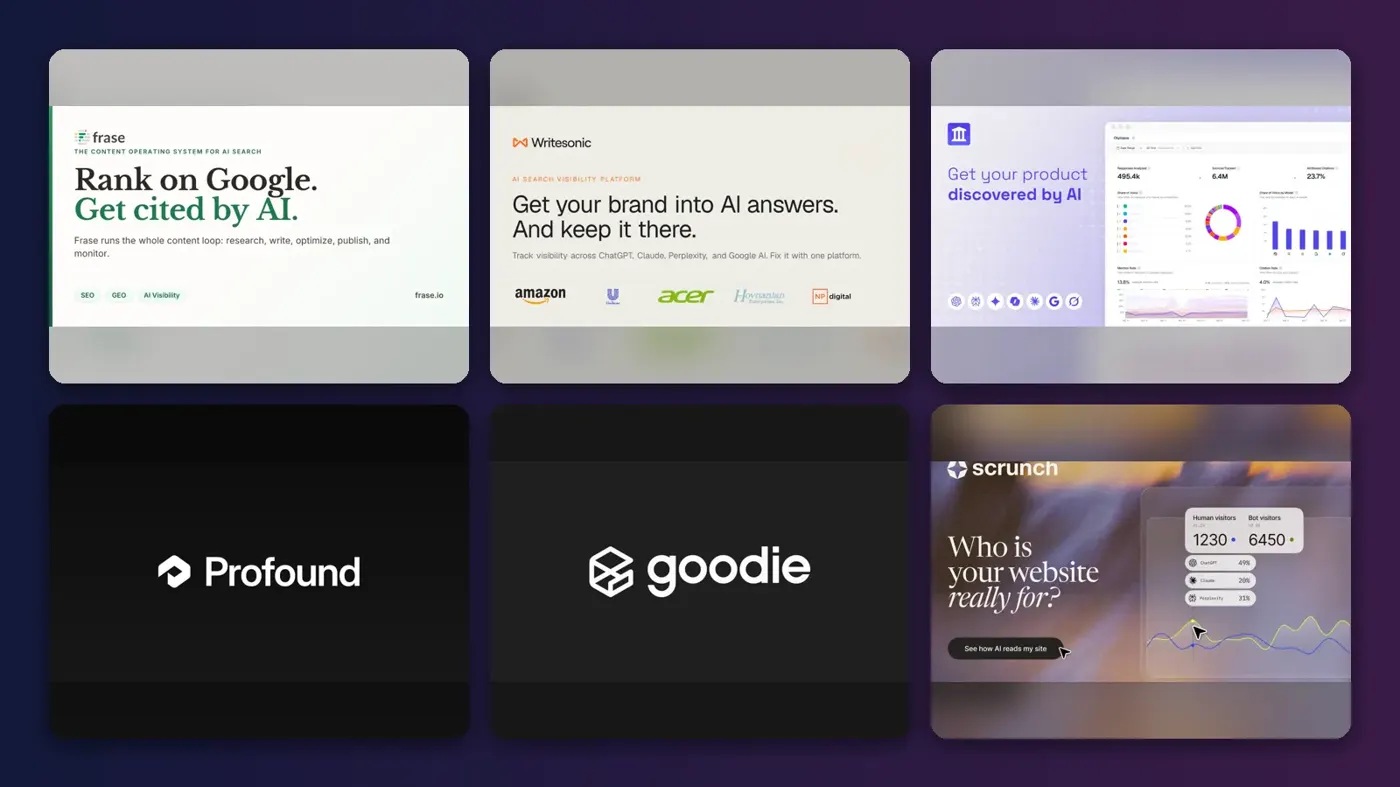
Short answer: the best AI visibility optimization tool for most teams is Frase, because it connects AI visibility data to the content work that actually changes it, and it starts at $39 a month. If you want SEO and GEO in one bigger suite, pick Writesonic. If you run an enterprise brand and want agents doing the work, shortlist Profound.
This guide is about the fixing side of the job. An AI visibility optimization tool helps you change your pages, content and site so ChatGPT, Gemini, Perplexity and Google's AI answers mention and cite you more often. That discipline is usually called generative engine optimization, or GEO. If you only need to watch your numbers, read our sister guides to the best AI visibility tracking tools and the best AI visibility checking tools instead.
Key takeaways
- Tracking is not optimization. Most AI visibility platforms stop at a dashboard. The eight picks below also tell you what to change, and most help you make the change.
- Budget sorts the market fast. Frase ($39/mo) and Surfer ($49/mo) are the cheapest serious options. AthenaHQ, Goodie and Scrunch start around $250 to $295 a month. Profound is sales-led.
- Content still does the heavy lifting. The original GEO research paper from 2023 found content changes could boost visibility in AI answers by up to 40%, and that results varied by domain.
- Use what you already pay for. If your team lives in Semrush, its AI visibility features may cover you before you add a new tool.
How we ranked them
Nobody at The AI Future ran hands-on tests for this roundup. We compared each tool using official pricing and product pages, published third-party roundups and user review sites such as GetApp, as of late October 2026. Several of the roundups we read are written by vendors that rank themselves first, so we treated them as context, not verdicts.
We scored each tool on six criteria:
- Optimization depth: does it go past reporting into recommendations, rewrites, audits or publishing?
- Content workflow: can you brief, draft and score content for AI answers in the same product?
- Technical fixes: help with AI crawler access, llms.txt, structured data and pages AI bots can read.
- Engine coverage: which AI answer engines it measures, so you can see if a fix worked.
- Price and entry point: the cheapest paid plan, plus any free plan or trial.
- User feedback: ratings and themes on review sites, where we could access them.
Prices are in US dollars and change often. Always confirm on the vendor's pricing page before you buy.
The 8 best AI visibility optimization tools at a glance
| # | Tool | Category | Best for | Free tier | Starts at |
|---|---|---|---|---|---|
| 1 | Frase | GEO content platform | Content teams on a budget | No | $39/mo |
| 2 | Writesonic | SEO + GEO suite | All-in-one SEO and GEO | No | $79/mo |
| 3 | AthenaHQ | GEO platform | Action plans and content agents | Yes (limited) | $295/mo |
| 4 | Profound | AI marketing platform | Enterprise teams | No | Custom |
| 5 | Goodie | AEO platform | Revenue attribution and commerce | No | $295/mo |
| 6 | Scrunch | AI site optimization | Making your site AI-readable | No | $250/mo |
| 7 | Surfer | Content optimization | On-page content scoring | No | $49/mo |
| 8 | Semrush | SEO suite | Teams already on Semrush | Yes (limited) | $165/mo |
Notes: Frase, Surfer and Semrush prices are billed yearly. Writesonic's $79 is its Starter plan billed annually. Profound offers a free 7-day trial but no public paid price. AthenaHQ's free plan is credit-limited.
The best AI visibility optimization tools in 2026, ranked
Frase – best for content teams on a budget
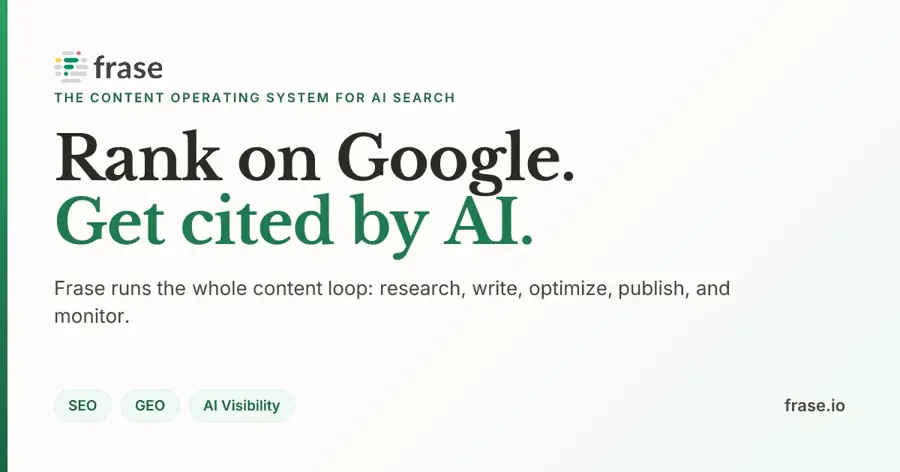
Frase is a content platform that scores pages for SEO and GEO, tracks AI visibility, then researches, drafts and publishes the fixes in one workspace.
Why it stands out
Frase closes the loop that most tools leave open. Its pricing page describes audits that score existing pages for "SEO, GEO, and AI visibility", drafts built from what already ranks, and one-click publishing to WordPress, Webflow, Sanity or Wix. A feature called Content Guard watches published pages for Google decay and drafts revisions. Frase also ships an MCP server and CLI on every plan, so you can run it from Claude, ChatGPT or Cursor.
A caveat: Frase's own GEO tools roundup ranks Frase first, so read it as a pitch. Independent user feedback is still strong. On GetApp, Frase has 335 verified reviews and a 4.9 value-for-money score, though some reviewers mention a learning curve and add-on costs.
Key features
- SEO and GEO page scores: audit existing pages and see what to fix first.
- AI visibility tracking: ChatGPT and Google AI on Starter, Perplexity on Professional, Claude and Gemini on Scale.
- Research-to-publish drafting: briefs, drafts and CMS publishing in one place.
- Content Guard: monitors 10 to 300 pages for decay depending on plan.
- FraseCMS: optional hosted blog with structured data and llms.txt on every page.
Pros
- Lowest entry price on this list for a full GEO workflow.
- Measurement and content creation live in the same tool.
- Agent access (MCP, CLI) on every plan.
Cons
- AI engine coverage widens only on pricier plans.
- No permanent free plan, only a 7-day trial.
- Tracking is only as good as the prompts you set up.
Frase pricing: No free plan (7-day free trial) → paid plans from $39/month billed yearly, or $49 month to month; Professional is $103/month and Scale $239/month billed yearly (checked October 2026). See pricing
Verdict: if you only pick one tool and you publish content regularly, pick Frase.
Writesonic – best for all-in-one SEO and GEO
Writesonic has grown from an AI writer into an AI search visibility platform that tracks your brand, writes articles, audits your site and recommends fixes.
Why it stands out
Writesonic's pitch is to find the prompts that "recommend your competitors instead of you" and fix them with AI agents, according to its pricing page. Every plan bundles visibility tracking with AI articles and site audits. The Action Center, which sorts on-page, off-page and technical fixes, sits on the higher tiers, and the pricing page lists sentiment analysis from the Growth plan up. NoGood's GEO tools ranking placed Writesonic fourth, citing its built-in writing and optimization tools and AI traffic analytics.
Users like how easy it is. Writesonic scores 4.8 for ease of use across 2,102 verified reviews on GetApp, but reviewers also complain about credit limits and pricing.
Key features
- AI visibility tracking: ChatGPT, Gemini and Google AI Overviews on every plan.
- AI article writer: 15 articles a month on Starter, 25 on Basic.
- Site audits: audit and fix your site for AI and SEO, with automatic fixes.
- Action Center: prioritized on-page, off-page and technical actions on higher tiers.
- Agentic workflows: AI agents that automate SEO, content and AI search tasks.
Pros
- Strong content tools from years as an AI writer.
- Clear published prices on its self-serve plans.
- Easy to use, according to reviewers.
Cons
- The best optimization features sit on $399+ plans.
- Starter tracks only 50 prompts.
- Credit and word limits frustrate some users.
Writesonic pricing: No free plan (free trial) → paid plans from $79/month billed annually; Basic is $199 and Growth $399 per month billed annually (checked October 2026). See pricing
Verdict: the best pick if you want one subscription to cover SEO content and AI visibility.
AthenaHQ – best for action plans and content agents
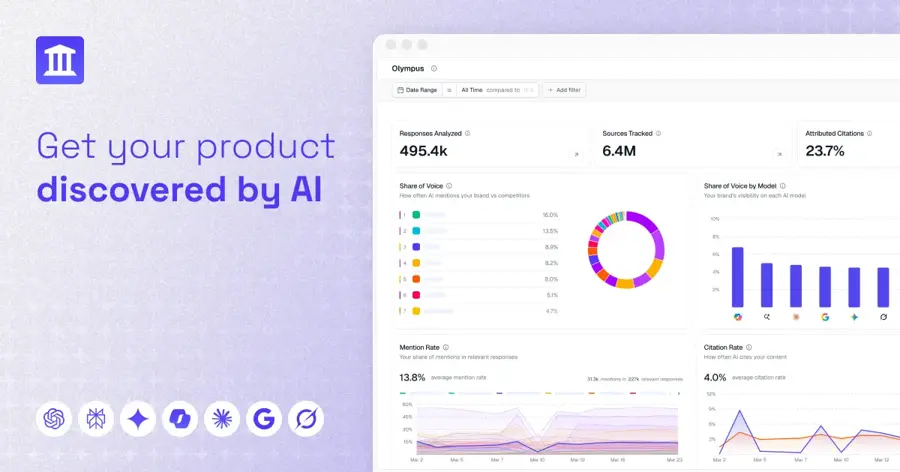
AthenaHQ is a GEO platform that tracks your brand across 11 AI models and turns gaps into on-page and off-page actions, with a content optimization agent to carry them out.
Why it stands out
AthenaHQ is the only pick here with a usable free plan that includes content recommendations and its Athena AI agent. Its pricing page lists the free Essential tier with 300 credits, where one credit equals one AI response. The $295 Starter plan adds visibility across 11 models, unlimited prompts and competitors, on-page and off-page actions, and "self-learning content improvement". It also offers a smart robots.txt and llms.txt to manage AI crawler access.
AthenaHQ's pricing page shows a G2 "Users Love Us" badge with a 4.9 out of 5 rating in the Answer Engine Optimization category, and a High Performer award for Spring 2026. We could not open G2 directly to confirm those figures.
Key features
- 11-model coverage: ChatGPT, Perplexity, Google AI Overviews, AI Mode, Gemini, Claude, Copilot, Grok and more.
- Content optimization agent: on Starter, with an advanced version on Enterprise.
- On-page and off-page actions: a to-do list for each visibility gap.
- Crawler controls: smart robots.txt and llms.txt management.
- Integrations: GA4, Google Search Console, Shopify and Webflow.
Pros
- Free plan with unlimited users to try the workflow.
- Unlimited prompts and competitors on Starter.
- Strong reported G2 ratings.
Cons
- Big jump from free to $295 a month.
- API access and extra credits cost extra.
- Credit-based billing takes some planning.
AthenaHQ pricing: Free (300 credits) → paid plans from $295/month; Enterprise is custom (checked October 2026). See pricing
Verdict: start here if you want to test a real GEO action workflow for free.
Profound – best for enterprise teams
Profound is an enterprise AI search platform built around an "AI Marketer" that finds opportunities, drafts content and stages changes for your approval.
Why it stands out
Profound has moved well past monitoring. Its homepage says its AI Marketer "Rewrites pages with citation decay and stages them in your CMS", builds pages for questions you have no answer for, and traces inaccurate claims back to the publishers repeating them. It also covers paid placement, writing "sponsored answer creative" for prompts you cannot win organically. Profound says it is trusted by a third of the Fortune 100.
The trade-off is access. The pricing page shows only a free trial (50 prompts daily for 7 days on ChatGPT, Gemini and Google AI Overviews) and a custom Enterprise plan. A customer quote there from Statsig reads: "We chose Profound because it seemed like the deepest and most complete tool in the market." That is a vendor-selected testimonial, so weigh it accordingly.
Key features
- AI Marketer: agents that research, write and report on your behalf.
- Answer Engine Insights: up to 9 answer engines on Enterprise.
- Agent Analytics: AI-sourced traffic via Cloudflare, Vercel, AWS, WordPress and more.
- Prompt Volumes: see what people actually ask AI engines.
- Governance: SSO/SAML, SOC 2 and role-based access.
Pros
- The deepest agent-driven workflow on this list.
- Handles misinformation fixes, not only content.
- Enterprise security and 200+ integrations.
Cons
- No public paid pricing.
- Overkill for small teams.
- Trial covers only three engines.
Profound pricing: No free plan (7-day free trial) → Enterprise pricing is custom (checked October 2026). See pricing
Verdict: the enterprise default if you have the budget and want agents doing the work.
Goodie – best for revenue attribution and commerce
Goodie is an answer engine optimization (AEO) platform that covers prompt research, monitoring, optimization actions, content and revenue attribution.
Why it stands out
Goodie frames AI visibility as a revenue channel. Its homepage lists an Optimization Actions playbook, a Content Studio for AI-optimized content, an Agentic Commerce Suite for products in AI shopping, and analytics that connect visibility to revenue. The pricing page includes 50 optimizations a month on Core and 100 on the next tier, with MCP access and an AEO strategist on every plan.
NoGood's GEO tools ranking placed Goodie first with a score of 95.5, praising its optimization hub and attribution. Note that NoGood also appears as a Goodie case study, which Goodie says saw a 335% increase in traffic from AI sources. We could not find an independent review-site rating to check.
Key features
- Optimization Actions: a prioritized list of what to fix and where.
- Content Studio: brand-voice content built for AI citation.
- Agentic commerce: product visibility in ChatGPT, Amazon Rufus and Perplexity shopping.
- Attribution: ties AI visibility to traffic and revenue.
- Wide model list: up to 14 models tracked on the top tier.
Pros
- Strategist support included on every plan.
- Strong ecommerce and shopping features.
- Unlimited seats.
Cons
- Core tracks only 110 prompts.
- Main tier jumps to $999 a month.
- Little independent user feedback yet.
Goodie pricing: No free plan → paid plans from $295/month; the next tier is $999/month, with annual billing giving two months free (checked October 2026). See pricing
Verdict: pick Goodie if you have to prove AI search revenue, especially in retail.
Scrunch – best for making your site AI-readable
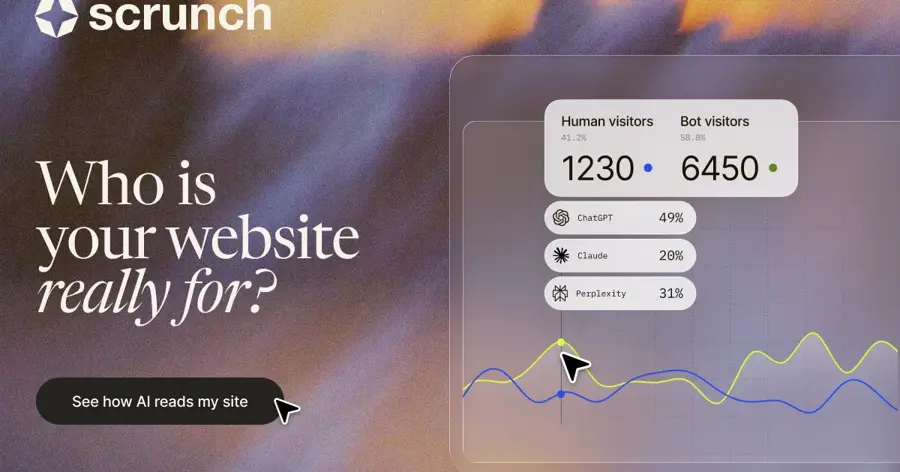
Scrunch monitors how AI engines see your brand and optimizes your website itself for AI agents, including a separate agent-facing version of your pages.
Why it stands out
Scrunch attacks the technical side. Its Agent Experience Platform (AXP) helps you "observe what agents say and do, optimize your web presence based on agent behavior, and deliver what agents need—all without disrupting the human experience." Agent Pages serve an optimized experience to AI agents. That is useful if your site is heavy on JavaScript or hard for crawlers to parse.
The catch is that AXP sits on the Enterprise plan. The $250 Core plan on the pricing page covers four engines, five site audits and one page optimization a month. A customer quote there says Scrunch "helps us make sure high-intent buyers find and choose us in those channels", which is a vendor-chosen testimonial.
Key features
- AXP and Agent Pages: AI-optimized content delivery to agents (Enterprise).
- Site audits: check how AI consumes your pages.
- Agent traffic analytics: see AI bot visits to your site.
- Insights and recommendations: actionable tips on Core.
- Monitoring: ChatGPT, Perplexity, Google AI Overviews and Copilot on Core; nine LLMs on Enterprise.
Pros
- Unique technical approach to AI readability.
- Free AI visibility audit to start.
- Five user licenses on Core.
Cons
- AXP requires Enterprise.
- Core is tightly metered on optimizations.
- No Claude or Gemini on Core.
Scrunch pricing: No free plan (free trial and free audit) → paid plans from $250/month; Enterprise is custom (checked October 2026). See pricing
Verdict: the specialist for technical AI-readiness, worth it mostly at enterprise level.
Surfer – best for on-page content scoring
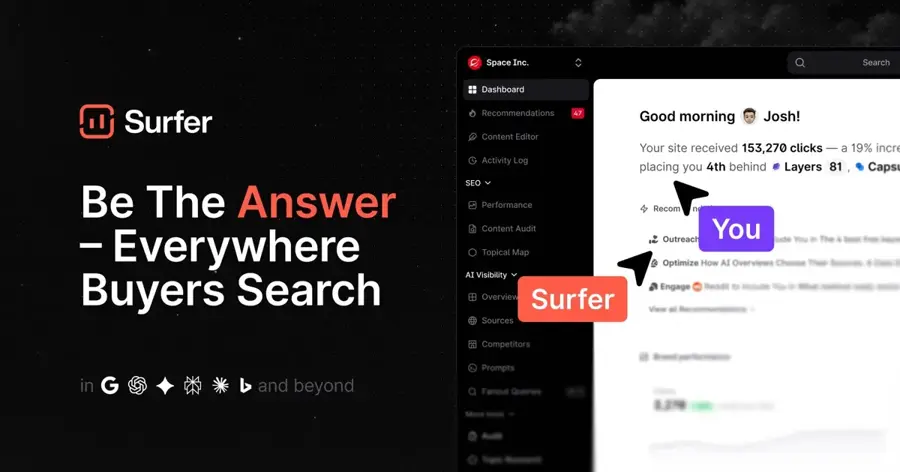
Surfer is a content optimization tool whose Content Editor gives live guidelines for writing pages that rank in search and get cited in AI chats, now with an AI Tracker.
Why it stands out
Surfer is the most familiar tool here for SEO writers, and it has rebuilt its pitch around AI search. Its pricing page says the Content Editor's guidelines help you write and refresh content "in a way that is rewarded both in SERPs and AI chats". Topical Map plans content clusters, Content Audit flags pages to refresh, and the AI Tracker measures mention gaps and competitor share of voice.
Feedback on GetApp is thin but positive, with a likelihood-to-recommend score of 8.52 out of 10 across 27 verified reviews.
Key features
- Content Editor: real-time, competition-based optimization guidelines.
- AI Tracker: 50 prompts refreshed daily, mention gaps and sentiment.
- Topical Map: plan clusters to build topical authority.
- Content Audit: spot rank drops and refresh candidates.
- MCP access: listed on several plans.
Pros
- $49 entry point for content optimization.
- Works in all languages, per Surfer.
- Mature, widely used editor.
Cons
- AI visibility tracking needs a higher plan.
- Little technical GEO (crawler, schema) help.
- Small sample of reviews on GetApp.
Surfer pricing: No free plan → paid plans from $49/month billed yearly (Discovery); Standard with AI visibility tracking is $99/month billed yearly (checked October 2026). See pricing
Verdict: the cheapest way to make every new article more citable.
Semrush – best for teams already on Semrush
Semrush is the big SEO suite, and its AI Visibility Toolkit adds AI search benchmarking, prompt research, prompt tracking and an AI-ready site audit.
Why it stands out
If you already pay for Semrush, start here. According to its knowledge base, the toolkit lets you discover prompts and topics to target, audit your site "for technical issues that could block AI crawlers", and get AI-generated strategic recommendations from its Brand Performance reports. Prompt Research works like keyword research for AI, with topic-level volume and difficulty.
On GetApp, Semrush has 2,330 verified reviews. Reviewers value its data, but many call the pricing high for small businesses and the interface overwhelming at first, and it scores 4.2 for value for money.
Key features
- Prompt Research: volume, difficulty and intent for AI topics.
- AI-ready Site Audit: finds issues that block AI crawlers.
- Brand Performance: share of voice, sentiment and recommendations.
- Prompt tracking: 50 prompts daily on the Starter SEO + AI Search plan.
- Content optimization: included from the Pro+ plan.
Pros
- Huge SEO dataset alongside AI data.
- Free plan to explore.
- One login for SEO and GEO.
Cons
- Expensive if you only need GEO.
- Content optimization needs Pro+ ($248/mo yearly).
- Steep learning curve, reviewers say.
Semrush pricing: Free (limited) → SEO + AI Search plans from $165.17/month billed annually ($199 month to month); Pro+ is $248.17/month billed annually (checked October 2026). See pricing
Verdict: the smart choice if Semrush is already in your stack, an expensive one if it isn't.
How to choose the right AI visibility optimization tools
Decide what you need to fix
Most gaps fall into three buckets: missing or weak content, a site AI crawlers struggle to read, and wrong or missing mentions on third-party sites. Choose Frase or Surfer if content is the problem. Choose Scrunch if it is technical. Choose Profound or AthenaHQ if you need off-page work too.
Check that it measures the engines your buyers use
You cannot tell if a fix worked without measurement. Entry plans often cover only ChatGPT and Google AI. If your audience uses Perplexity, Claude or Google's AI Mode, check the plan before you buy.
Match the price to your content output
A $295 platform makes sense if you publish weekly and have someone to act on its advice. A solo marketer gets more from Frase at $39 or Surfer at $49 plus a free checker.
Look for agents with an approval step
Frase, Writesonic, AthenaHQ and Profound all offer AI agents that draft or publish changes. Pick tools that stage changes for your review. Unchecked rewrites can introduce errors about your own brand.
Use this quick decision guide
- Choose Frase if you publish content and want the lowest-cost full loop.
- Choose Writesonic if you want one tool for SEO articles and AI visibility.
- Choose AthenaHQ if you want to try a GEO action workflow for free.
- Choose Profound if you are an enterprise brand with budget for agents.
- Choose Semrush if you already pay for it.
Free vs paid: what you actually get
Free options are real but narrow. AthenaHQ's free Essential plan gives you 300 credits, content recommendations and its AI agent. Semrush's free plan lets you explore one demo project. Scrunch and Surfer offer free AI visibility audits, and Profound runs a 7-day trial on three engines. These are enough to find your biggest gaps.
Paying buys three things: more prompts and engines to measure, more optimization actions or articles each month, and automation. Writesonic's Starter, for example, includes 50 prompts and 15 AI articles a month. Its Growth plan adds the Action Center and agentic workflows for $399. Frase's Professional plan quadruples articles and adds Perplexity tracking for $103.
You can also do a lot without any tool. Clear answers near the top of the page, cited statistics, updated dates and clean structure all help. Our guide on how to optimize content for AI search engines walks through the steps, and what is AI visibility covers the basics.
Final verdict
If you only pick one, pick Frase. It is the cheapest tool that takes you from "AI doesn't cite us" to a published fix, and you can keep watching the result. Writesonic is the better buy if you also want a full AI writing and SEO suite. Enterprise teams should trial Profound and AthenaHQ side by side, and use Scrunch for deep technical work. Everyone else should pair a content optimizer with one of the trackers in our AI visibility tracking tools guide.
FAQ
What is the top AI visibility optimization tool?
For most teams, Frase is the top AI visibility optimization tool in late 2026. It scores pages for GEO, tracks AI citations and publishes fixes from one workspace, starting at $39 a month billed yearly. Enterprises with bigger budgets should look at Profound, whose AI Marketer agents rewrite and stage pages for approval.
Which AI optimization service is best for visibility?
It depends on what is holding you back, so match the service to the gap. For content gaps, Frase or Writesonic. For technical problems with AI crawlers, Scrunch. For enterprise programs with off-page work and misinformation fixes, Profound. If you want hands-off help, Goodie includes an AEO strategist on every plan.
Is AI visibility optimization different from SEO?
It overlaps heavily. Good SEO content is often what AI engines cite. The difference is the target: GEO aims to get your brand mentioned or cited inside AI answers rather than ranked in links. Our guide to SEO using generative AI explains where the two meet.
Can a tool guarantee my brand appears in ChatGPT?
No. AI answers change from day to day, and no vendor controls them. Frase says it plainly on its pricing page: "No tool ranks you inside a trial". Treat these tools as ways to find and fix gaps, then measure over weeks.
Sources
- Frase pricing: SEO & GEO content platform plans (Frase)
- 10 Best GEO Tools 2026 (Frase)
- Pricing: Writesonic AI Search Visibility Platform (Writesonic)
- Plans & Pricing (AthenaHQ)
- AthenaHQ: Agents to win on AI search (AthenaHQ)
- Pricing (Profound)
- Profound: the AI platform to power your marketing (Profound)
- Pricing plans (Goodie)
- Answer Engine Optimization & AI Search Platform (Goodie)
- Scrunch pricing (Scrunch)
- Scrunch AXP: AI search visibility & optimization (Scrunch)
- Surfer pricing (Surfer)
- Semrush pricing (Semrush)
- AI Visibility Toolkit (Semrush Knowledge Base)
- Frase reviews (GetApp)
- Writesonic reviews (GetApp)
- Surfer reviews (GetApp)
- Semrush reviews (GetApp)
- Top Generative Engine Optimization (GEO) Tools 2026 (NoGood)
- GEO: Generative Engine Optimization (arXiv)