The 9 best AI data governance tools in 2026, compared
The best AI data governance tools for 2026, from Atlan and Microsoft Purview to Collibra and Credo AI, with pricing, user feedback and who each suits.
 Written byAlap ZahidReviews and guides editor
Why you can trust The AI Future
Our writers research every product, link each claim to its source and correct mistakes openly. Companies can't pay for coverage or see reviews before they're published.
Read our editorial policy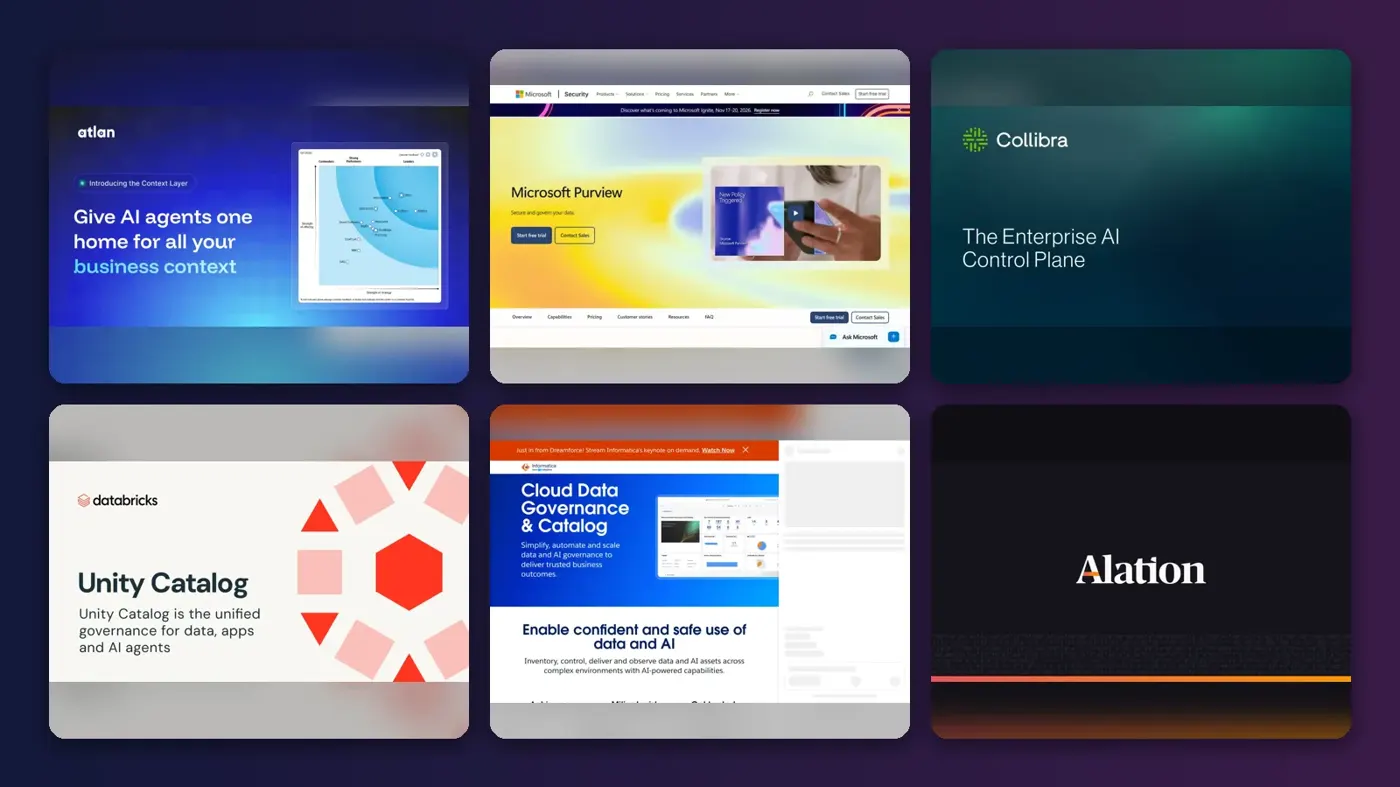
Short answer: the best AI data governance tool for most mid-size and large companies in 2026 is Atlan, if you run a modern cloud data stack and want something business users will actually open. If you are a Microsoft shop, start with Microsoft Purview, because it is the only big platform here with public pay-as-you-go pricing. Large, heavily regulated enterprises should shortlist Collibra and Informatica.
AI data governance means two things at once. It is using AI to run governance (auto-classifying data, tracing lineage, writing policies), and it is governing the data and models that feed your AI. Analysts now treat these as one job. Gartner's 2026 Magic Quadrant for data and analytics governance platforms, as summarised by Ataccama, added AI model governance and unstructured data as central requirements this year.
Key takeaways
- Pick by where your data lives. Databricks users get Unity Catalog almost for free, and Azure users get Purview with the cloud bill. Everyone else should compare Atlan, Collibra, Alation and Informatica.
- Expect to talk to sales. Most of these tools publish no list price. Microsoft Purview is the only one with public per-asset rates, and only Unity Catalog has a fully free open source version.
- Data governance and AI governance are merging. Catalog vendors now govern models and agents, and AI governance specialists like Credo AI and IBM watsonx.governance cover the risk and compliance side.
- Regulation still matters, but the clock moved. EU lawmakers agreed to push the AI Act's stand-alone high-risk rules to December 2027, so you have time to build properly rather than in a panic.
How we ranked them
Nobody at The AI Future ran hands-on tests or took screenshots of these platforms for this roundup. These are enterprise products sold through demos and contracts. Instead, we compared each tool using official product and pricing pages, analyst reports, and verified user reviews on PeerSpot, as of late October 2026. We scored each tool on six criteria:
- Governance depth: business glossary, policies, stewardship workflows and ownership models.
- AI readiness: whether it can govern models, agents and unstructured data, not just tables.
- Automation: how much classification, lineage and tagging it does without manual work.
- Ecosystem fit: connectors to the warehouses, lakehouses and BI tools teams already use.
- Pricing transparency: whether you can estimate cost before a sales call.
- User feedback: what verified reviewers praise and complain about.
Our top picks at a glance
| # | Tool | Category | Best for | Free tier | Starts at |
|---|---|---|---|---|---|
| 1 | Atlan | Metadata and governance platform | Modern cloud data stacks | No | Custom quote |
| 2 | Microsoft Purview | Data security and governance suite | Microsoft and Azure shops | No | Pay as you go |
| 3 | Collibra | Enterprise governance platform | Large regulated enterprises | No | Custom quote |
| 4 | Databricks Unity Catalog | Lakehouse catalog | Databricks users | Yes | Free (open source) |
| 5 | Informatica | Data management cloud | Complex multicloud estates | No | Custom quote |
| 6 | Alation | Data catalog | Data discovery and stewardship | No | Custom quote |
| 7 | BigID | Data security and privacy | Finding sensitive data | No | Custom quote |
| 8 | Credo AI | AI governance platform | Governing AI models and agents | No | Custom quote |
| 9 | IBM watsonx.governance | AI governance and GRC | AI risk and compliance teams | No | Pay as you go |
Notes: "Custom quote" means the vendor publishes no list price. Purview bills per governed asset. IBM offers a free trial and a pay-as-you-go cloud plan but does not list the rate publicly. Unity Catalog's open source version is free, while managed Unity Catalog comes with Databricks' usage-based pricing.
The 9 best AI data governance tools in 2026, ranked
Atlan – best for modern cloud data stacks
Atlan is a metadata and governance platform that catalogs your data, tracks lineage and enforces policies across warehouses, BI tools and AI pipelines.
Why it stands out
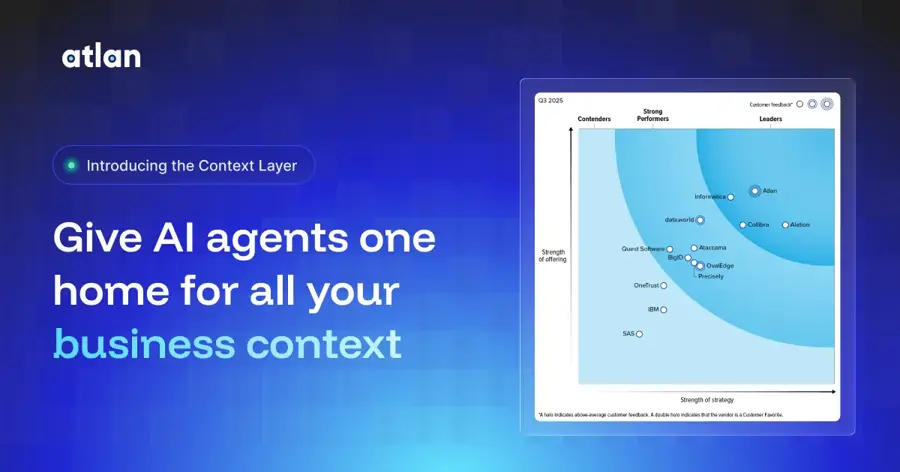
Atlan was named a Leader in the 2026 Gartner Magic Quadrant for data and analytics governance platforms, released on January 6, 2026, according to Atlan's announcement.
Users back up the ease-of-use claim. One PeerSpot reviewer whose team catalogued more than a million assets wrote that "the most valuable one is the abundance of out-of-the-box connectors" in a verified review. The same reviewer said its Playbooks automation feature can struggle to scale on some tasks.
Key features
- Metadata lakehouse built on Apache Iceberg for structured, semi-structured and unstructured data.
- Policies as code with automated, real-time enforcement.
- Automated lineage built into its connectors.
- Business-friendly interface aimed at analysts as well as engineers.
Pros
- Fast setup as a pure SaaS product
- Large library of ready-made connectors
- Strong analyst recognition in 2026
Cons
- No public pricing
- Workflow automation is less mature than older rivals, per user reviews
Atlan pricing: No free plan; pricing is by quote after a sales conversation (checked October 2026). See pricing
Related: Tools that help when AI transformation is a governance problem Best enterprise AI solutions
Verdict: if you only pick one modern platform to govern data for analytics and AI, pick Atlan.
Microsoft Purview – best for Microsoft and Azure shops
Microsoft Purview combines data security, governance and compliance in one suite, with a Unified Catalog for governing data assets and AI models.
Why it stands out
Purview is the only major tool here with public, per-asset pricing. Microsoft's Purview pricing page says the Unified Catalog bills only for "governed assets", meaning tables, views or AI models linked to data products, critical data elements or data quality rules. Its own example: 200 governed assets cost about $100 for a 30-day month before discounts.
On PeerSpot, users give Purview Data Governance an average of 7.6 out of 10. One healthcare tech lead wrote: "If it is for Azure, then I would recommend Microsoft Purview Data Governance."
Key features
- Unified Catalog for data products, critical data elements and data quality.
- Data Map scanning, with the first 1 MB of metadata storage free.
- Information protection and DLP for sensitive data at rest.
- Power BI integration with data quality for Power BI free for a limited time.
Pros
- Transparent, usage-based pricing
- Deep integration with Azure, Microsoft 365 and Power BI
- Security and governance in one console
Cons
- Best value only if you already run on Microsoft
- Consumption billing (assets plus processing units) can be hard to forecast
Microsoft Purview pricing: No free plan; pay as you go at roughly $0.50 per governed asset per month, based on Microsoft's own example, plus processing charges (checked October 2026). See pricing
Verdict: for Microsoft-first companies, Purview is the cheapest serious starting point.
Collibra – best for large regulated enterprises
Collibra is an enterprise governance platform that now markets itself as an "Enterprise AI Control Plane", governing data, context, models and agents.

Why it stands out
Collibra is the established choice for banks, insurers and other organisations that need strict ownership and approval workflows. Its site describes "eighteen years of ontology engineering" behind a model that defines what each business term means, whether data is certified, and who can access it.
A verified reviewer on PeerSpot praised its catalog, glossary and workflows, then added a fair warning: "Collibra Platform is very powerful, but for new or occasional users, it can feel complex." PeerSpot's October 2026 data puts Collibra's mindshare in the data governance category at 8.5%, the highest of the products it listed.
Key features
- Business glossary and ontology to align definitions across teams.
- Governance workflows for approvals, issues and new terms.
- AI governance for agents, use cases and models across their lifecycle.
- Unstructured data preparation via Deasy Labs.
Pros
- Mature operating model for owners and stewards
- Strong regulatory reporting use cases
Cons
- Steep learning curve for occasional users
- Management reporting is not always straightforward, per user reviews
- No public pricing
Collibra pricing: No free plan; pricing is by quote (checked October 2026). See pricing
Related: Tools that help when AI transformation is a governance problem
Verdict: choose Collibra when governance rigor matters more than speed of rollout.
Databricks Unity Catalog – best for Databricks users
Databricks Unity Catalog is a unified catalog that governs tables, files, models, agents and MCP servers in one place, with an open source version you can run yourself.
Why it stands out
If your data already sits in Databricks, Unity Catalog is the obvious first layer. Databricks says it offers end-to-end automated column-level lineage, attribute- and tag-based access policies, and AI-driven quality monitoring.
The open source Unity Catalog project is Apache 2.0 licensed and supports Delta Lake, Apache Iceberg, Parquet and other formats. We did not find enough verified user reviews of Unity Catalog on its own to quote, though a Collibra user on PeerSpot noted its integration with Unity Catalog "works very well".
Key features
- One catalog for data, models, agents and MCPs.
- Column-level lineage generated automatically.
- Attribute-based access control using tags and automated classification.
- Open formats and APIs, including the Iceberg REST Catalog API.
Pros
- Free open source version
- Native to the lakehouse, so no extra system to sync
- Governs AI assets, not only tables
Cons
- Business glossary and stewardship workflows are lighter than Collibra or Atlan
- Most value comes inside Databricks
Databricks Unity Catalog pricing: Free open source version; managed Unity Catalog comes with Databricks' usage-based platform pricing and a free trial (checked October 2026). See pricing
Related: Best enterprise AI solutions
Verdict: on Databricks, turn this on before you buy anything else.
Informatica – best for complex multicloud estates
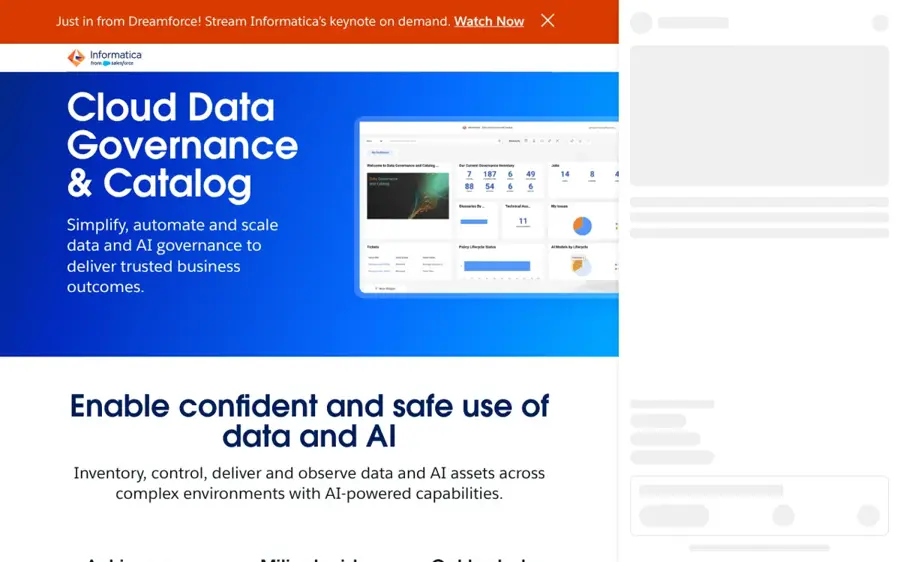
Informatica Cloud Data Governance and Catalog is part of the Intelligent Data Management Cloud (IDMC), now sold as Informatica from Salesforce.
Why it stands out
Informatica was named a Leader in the 2026 Gartner Magic Quadrant for data and analytics governance platforms, the company announced in January. It says IDMC is used by more than 5,000 organisations and governs structured, unstructured and AI assets across clouds.
Reviewers value its scale. One PeerSpot user with eight years on the platform called it "very scalable" but said of support, "Regarding tech support, I find it time-consuming," with tickets often taking one to two days, in a verified review.
Key features
- AI-powered classification that maps business and technical data.
- Automated lineage across source systems.
- Catalog of catalogs to unify other catalogs you already run.
- Policy automation for compliance and responsible AI use.
Pros
- Handles very large, mixed environments
- Broad data management suite in one vendor
Cons
- Support response can be slow, per user reviews
- Long-term roadmap now tied to Salesforce
Informatica pricing: No free plan; pricing is by quote (checked October 2026). See pricing
Related: Best enterprise AI solutions
Verdict: Informatica fits when you need one vendor for integration, quality and governance at scale.
Alation – best for data discovery and stewardship
Alation is a data catalog vendor now selling its platform as the Alation Intelligence Operating System, focused on keeping data, context and agents accurate.
Why it stands out
Alation is credited with starting the machine learning data catalog category in 2012, and its site lists it as a Leader in the 2025 Gartner Magic Quadrant for data and analytics governance.
A medtech user on PeerSpot uses it to govern cybersecurity and patient scan data and wrote that "we establish a single source of truth, centralizing metadata and standardizing definitions."
Key features
- Search-first data catalog for finding trusted data.
- Stewardship tools for ownership and curation.
- Business glossary with definitions and context.
- Lineage for impact analysis and audits.
Pros
- Long track record in data catalogs
- Strong for discovery and adoption by analysts
Cons
- No public pricing
- The repositioning toward agents is newer and less proven
Alation pricing: No free plan; pricing is by quote (checked October 2026). See pricing
Related: Tools that help when AI transformation is a governance problem
Verdict: choose Alation if getting people to find and trust data is your main problem.
BigID – best for finding sensitive data
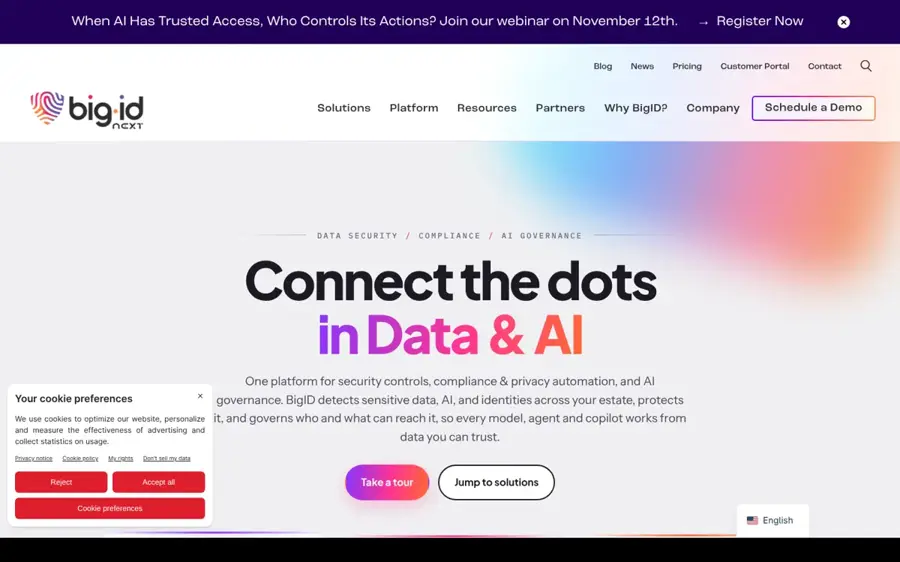
BigID is a data security, privacy and AI governance platform that discovers sensitive data, AI assets and identities across cloud, SaaS, on-premises and mainframe systems.
Why it stands out
Most governance tools start from a catalog. BigID starts from the risk: where personal or confidential data lives and who, or which AI agent, can reach it. BigID says it is a Leader in the Forrester Wave for sensitive data discovery and classification, Q2 2026, and claims first place in Intuit's classification challenge with 96.5% weighted precision and recall across 20 vendors. Those are vendor-reported figures.
A reseller on PeerSpot wrote that "BigID's scanning feature is its most valuable component," but noted it does not handle encryption or data masking on its own, so it needs to pair with your security tools.
Key features
- Sensitive data discovery across structured and unstructured sources.
- AI agent and model discovery, mapping what each can access.
- Privacy automation for data rights requests and assessments.
- Access governance to close overexposed files and tokens.
Pros
- Strong classification accuracy claims
- Covers privacy, security and AI governance
- Works across AWS, Google Cloud and on-premises
Cons
- Not a full business glossary or stewardship tool
- Relies on other tools for encryption and masking
BigID pricing: No free plan; pricing is by quote (checked October 2026). See pricing
Verdict: BigID is the pick when your biggest fear is AI touching data it should not.
Credo AI – best for governing AI models and agents
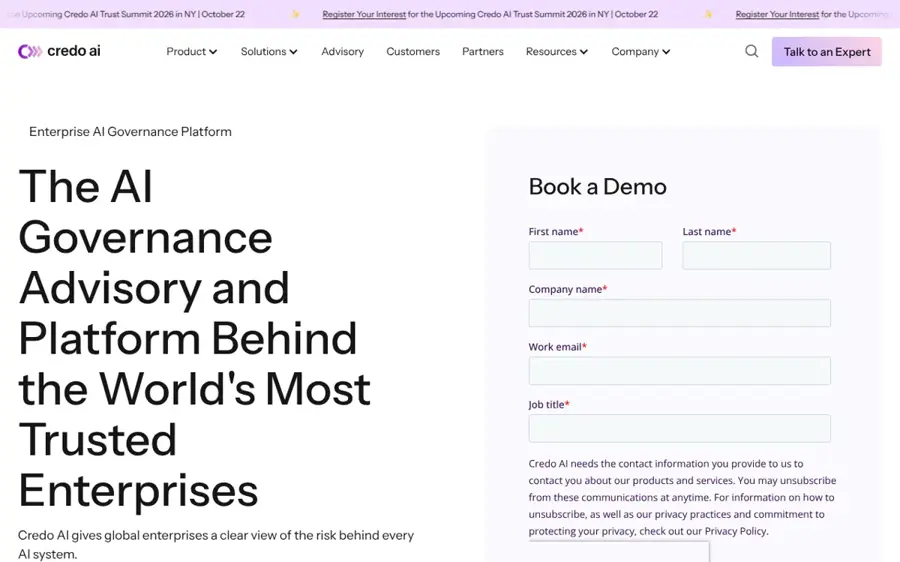
Credo AI is a dedicated AI governance platform that registers every AI system, agent, model and vendor, then maps them to policies and regulations.
Why it stands out
Credo AI governs the AI itself rather than the underlying data. Its platform includes an agent registry, shadow AI detection, risk classification and pre-built policy packs that turn regulations into controls. Credo AI lists itself as a Forrester Wave Leader.
PeerSpot lists Credo AI in its AI governance category but had no verified written reviews we could quote as of October 2026, so weigh analyst and vendor claims accordingly.
Key features
- Agent registry and agent cards for every deployed agent.
- Shadow AI detection across the organisation.
- Agentic risk and control library covering tool misuse and scope drift.
- Policy packs for major AI standards and regulations.
Pros
- Built specifically for AI, not bolted onto GRC
- Strong regulatory content
Cons
- Does not replace a data catalog
- Few public user reviews
Credo AI pricing: No free plan; pricing is by quote after a demo (checked October 2026). See pricing
Related: AI governance certification explained
Verdict: add Credo AI when your board asks which AI agents you run and who approved them.
IBM watsonx.governance – best for AI risk and compliance teams
IBM watsonx.governance is an AI governance product that combines model monitoring with IBM's enterprise governance, risk and compliance (GRC) tooling.

Why it stands out
IBM's strength is regulatory content and audit trails. The product page promises automated policy enforcement, obligation mapping and compliance evidence capture, backed by what IBM calls one of the industry's largest AI regulatory and risk content libraries.
It is also one of the easier enterprise tools to try. The pricing page lists a 14-day trial in a shared environment, a 30-day trial, and a pay-as-you-go plan, with software licences priced by virtual processor cores. We could not find verified user reviews to quote, so treat it as a shortlist candidate to trial.
Key features
- Policy and obligation mapping against AI regulations.
- Model evaluations and monitoring, sold in usage bundles.
- GRC integration with IBM OpenPages.
Pros
- Free trial and pay-as-you-go option
- Deep risk and compliance heritage
- Works for any AI, not only IBM models
Cons
- Pay-as-you-go rates not shown publicly
- Best fit for organisations already using IBM GRC
IBM watsonx.governance pricing: No free plan, but a free trial; pay-as-you-go and software licences priced by virtual processor cores (checked October 2026). See pricing
Verdict: IBM suits risk and compliance teams that need audit evidence more than a catalog.
How to choose the right AI data governance tools
Start with where your data already lives
This is the fastest way to narrow the list. Databricks customers should switch on Unity Catalog first. Azure and Microsoft 365 customers should price Purview. If your data spans Snowflake, BigQuery, several BI tools and legacy systems, you need a neutral platform like Atlan, Collibra, Alation or Informatica.
Decide whether you are governing data, AI, or both
Data governance for AI covers the inputs: what data is allowed into training sets and retrieval pipelines, who owns it and how good it is. AI governance covers the systems: models, agents, risk reviews and approvals. Catalog vendors are moving into AI, but Credo AI, IBM watsonx.governance and OneTrust go deeper on the AI side. OneTrust was named a Visionary in Gartner's first Magic Quadrant for AI governance platforms, which covered 13 vendors, according to OneTrust. If you are new to the distinction, our explainer on what an AI dataset is is a good primer.
Match the tool to your regulatory deadline
The EU AI Act includes data governance duties for high-risk systems. In 2026 EU lawmakers reached a provisional deal to move the rules for stand-alone high-risk systems, such as AI used in hiring, to December 2, 2027, and for AI embedded in regulated products to August 2, 2028, according to Sidley Austin. Use the extra time to build lineage and documentation properly. Our guide to AI regulation covers the wider picture.
Plan for adoption, not just features
The most common complaint in user reviews is complexity, not missing features. A platform your analysts never open will not govern anything.
Free vs paid: what you actually get
Real free plans are rare in this category. Here is what you can get without a contract:
| Tool | Free option | What it covers |
|---|---|---|
| Unity Catalog (open source) | Free, Apache 2.0 | Catalog, access control and open APIs you host yourself |
| Microsoft Purview | First 1 MB of Data Map metadata, some preview features | Enough to try scanning; real governance is billed per asset |
| IBM watsonx.governance | 14-day and 30-day trials | Limited instances, modules and users |
| Databricks | Free trial | Managed Unity Catalog inside the trial workspace |
| Everyone else | Demo or guided proof of concept | Scoped by the vendor's sales team |
Paid enterprise plans are usually priced on a mix of users, assets and usage. Ataccama's pricing page is a useful example of how this works: tiers are set by named users, data objects managed and active data quality checks, with unlimited read-only users. Ask every vendor the same three questions. Who counts as a paid user? What counts as an asset? What happens if you go over your limit?
Budget for people too. Governance tools need data owners and stewards to work, and the software is often the smaller cost.
Final verdict
Most companies should shortlist Atlan first. It is a 2026 Gartner Leader, it is quick to set up, and users praise its connectors. Choose Microsoft Purview if you live in Azure and want predictable per-asset pricing. Choose Collibra or Informatica if you are a large regulated enterprise that needs heavy workflows and multicloud coverage. On Databricks, start with Unity Catalog because it is already there.
Then layer on a specialist only if you need one. BigID handles sensitive data discovery, and Credo AI or IBM watsonx.governance handle AI risk and regulatory evidence.
FAQ
What is AI data governance?
AI data governance is the set of policies, roles and tools that control the data used to build and run AI, and increasingly the AI models and agents themselves. It covers data quality, ownership, lineage, privacy and access.
What is the difference between data governance and AI governance?
Data governance manages data assets: who owns them, what they mean, how good they are and who can access them. AI governance manages AI systems: risk reviews, approvals, monitoring and regulatory compliance. They overlap because AI is only as trustworthy as its data, which is why vendors increasingly sell both.
What are AI governance best practices?
Keep an inventory of every AI system and agent, assign a named owner to each, and classify them by risk. Track lineage from source data to model output. Document decisions so you can show auditors evidence.
Is there a free AI data governance tool?
Yes. The open source version of Unity Catalog is free under the Apache 2.0 licence, though you host and run it yourself. Microsoft Purview and IBM watsonx.governance offer limited free usage or trials. Most enterprise platforms, including Atlan, Collibra and Alation, offer demos and proofs of concept rather than free plans.
How much do data governance tools cost?
Most vendors only quote on request. Microsoft is the exception: its own example prices 200 governed assets at about $100 a month before discounts, plus processing charges. Enterprise platforms are typically priced by users, assets and usage, so costs scale with how much of your data estate you govern.
Does the EU AI Act require data governance?
Yes, for high-risk AI systems the AI Act sets data governance requirements for training, validation and testing data. Under a provisional 2026 deal, those high-risk rules would apply from December 2027 for stand-alone systems and August 2028 for AI in regulated products.
Sources
- Gartner Magic Quadrant for Data and Analytics Governance platforms 2026 explained (Ataccama)
- Atlan Named a Leader in 2026 Gartner D&A Governance Platform Magic Quadrant (Atlan)
- Atlan reviews 2026 (PeerSpot)
- Pricing - Microsoft Purview (Microsoft Azure)
- Microsoft Purview Data Governance reviews 2026 (PeerSpot)
- The Enterprise AI Control Plane (Collibra)
- Collibra Platform reviews 2026 (PeerSpot)
- Unity Catalog: Unified Governance for Data and AI (Databricks)
- Unity Catalog open source project (Unity Catalog)
- Databricks pricing (Databricks)
- Informatica Named a Leader in 2026 Gartner Magic Quadrant for Data & Analytics Governance Platforms (Informatica)
- Cloud Data Governance and Data Catalog (Informatica)
- Informatica Intelligent Data Management Cloud (IDMC) reviews 2026 (PeerSpot)
- Alation Intelligence Operating System (Alation)
- Alation Data Catalog reviews 2026 (PeerSpot)
- BigID: Enterprise Data Security Platform for DSPM & AI (BigID)
- BigID Next reviews 2026 (PeerSpot)
- Credo AI - The Trusted Leader in AI Governance (Credo AI)
- IBM watsonx.governance (IBM)
- IBM watsonx.governance pricing (IBM)
- OneTrust Named a Visionary in the 2026 Gartner Magic Quadrant for AI Governance Platforms (OneTrust)
- EU Lawmakers Reach Provisional Agreement to Delay Key EU AI Act Obligations (Sidley Austin Data Matters)
- Ataccama ONE Pricing (Ataccama)
- Microsoft Purview: Data Security and Governance (Microsoft)