AI transformation is a problem of governance: what it means in 2026 and the tools that help
Most firms use AI, few profit from it. Why AI transformation is a problem of governance, what the 2026 data shows, a checklist, and the tools worth a look.
 Written byMuhammad Usman SiddiquiFounder and editor-in-chief
Why you can trust The AI Future
Our writers research every product, link each claim to its source and correct mistakes openly. Companies can't pay for coverage or see reviews before they're published.
Read our editorial policy
Short answer: AI transformation is a problem of governance because the technology mostly works and the organisation around it mostly doesn't. Companies that redesign workflows, name an owner and measure results get value from AI. Companies that buy licences and hope for the best get pilots, risk and a bill.
The numbers back this up. McKinsey's 2026 State of AI survey found that nearly nine in ten organisations now use AI regularly, yet only 37% attribute any positive EBIT contribution to it, a figure that barely moved in a year. The gap between using AI and profiting from it is not a model problem. It's a decision-rights, data, accountability and oversight problem. That is what governance means here.
This is an argued explainer, not a product roundup. The phrase is a thesis, so a "best tools" list on its own would miss the point. You'll get what the claim means, the evidence for it as of late October 2026, a practical governance checklist, and then the software that can help, with honest notes on price and limits. Nobody at The AI Future has hands-on tested these platforms; we compared them using vendor pages, analyst reports and published user ratings.
Key takeaways
- Adoption is not the bottleneck. Use is near-universal, but only about 6% of McKinsey's respondents qualify as AI high performers, unchanged from 2025.
- Ownership predicts maturity. In McKinsey's AI trust survey, organisations with explicit responsible-AI ownership scored 2.6 on a four-level maturity scale, against 1.8 for those without.
- Agents widen the gap. Deloitte found 74% of leaders expect at least moderate use of AI agents by 2027, but only 21% report a mature governance model for agentic AI.
- Tools help, but only after the decisions. Gartner says organisations with AI governance platforms were 3.4 times more likely to achieve high effectiveness in AI governance. A platform still can't tell you who owns a decision.
- If you only pick one tool, pick the one that sits where your AI already lives. Microsoft shops should look at Agent 365 first; ServiceNow shops at Control Tower; regulated, multi-vendor estates at a specialist like Credo AI or IBM watsonx.governance.
What "AI transformation is a problem of governance" actually means
Governance sounds like compliance paperwork. In this argument it means something broader: who decides what AI is used for, who is accountable when it goes wrong, what data it can touch, how you know it's working, and when you switch it off.
The framing has been picked up widely this year. A March 2026 piece in CTO Magazine put it bluntly: "This is not a technology gap. It is a governance gap". Its author, Gizel Gomes, argues that AI programmes stall because of missing ownership, inconsistent data, undefined risk tolerance and weak oversight, not because the models fall short.
Break the claim down and it rests on four ideas:
- Value comes from redesigned work, not from tools. A chatbot bolted onto an old process saves minutes. A process rebuilt around AI changes the cost base. Rebuilding a process requires someone with the authority to change it.
- Risk scales faster than value. Every new use case adds data exposure, error modes and legal duties. Without a system to classify and monitor those, leaders slow everything down out of caution.
- Agents act, so they need permissions. A model that drafts text needs review. An agent that sends emails, moves money or edits code needs an identity, a scope and a kill switch.
- Regulation now expects proof. Laws like the EU AI Act require documentation, transparency and human oversight. You can't produce evidence for systems you haven't inventoried.
Notice that none of these is solved by a better model. That is the core of the thesis.
The evidence: what the 2026 data shows
Usage is high, profit is flat
McKinsey's 2026 survey, fielded from May to June 2026 with 1,719 participants in 97 countries, reports that 44% of organisations say AI is scaling across the enterprise, up from 38%. Yet the share reporting a positive EBIT contribution held at 37%. More organisations are spreading AI around without more of them making money from it.
High performers behave differently, and the differences are governance
The small group of high performers is where the argument gets concrete. According to McKinsey, nearly three-quarters of them have fundamentally redesigned workflows around AI, versus about one-quarter of other respondents. They are about twice as likely to say senior leaders show real commitment and to have defined processes for measuring AI's impact. They are also more likely to actively mitigate risks such as unintended actions by AI systems.
Workflow redesign, senior ownership, measurement and risk controls. Those are governance choices. None of them shows up in a model benchmark.
Clear ownership lifts maturity
McKinsey's separate AI Trust Maturity Survey, covering about 500 organisations from December 2025 to January 2026, found average responsible-AI maturity rose from 2.0 to 2.3. Only about 30% reach level 3 or higher on strategy, governance and agentic AI controls. Nearly two-thirds named security and risk concerns as the top barrier to scaling agentic AI. The strongest single signal was ownership: a clearly accountable function was linked to a 0.8-point higher maturity score.
Agents are arriving before the rules
Deloitte's 2026 State of AI in the Enterprise report surveyed 3,235 business and IT leaders in 24 countries. It found 74% expect at least moderate use of AI agents by 2027, while only 21% say they have a mature governance model for agentic AI. That is the governance gap in one sentence. If you're planning an agent rollout, our explainer on agentic AI covers what these systems can and can't do, and our analysis of AI agents at work looks at the effect on roles.
The regulatory clock is running, if a little slower
In Europe, lawmakers agreed in May 2026 to push back the AI Act's high-risk rules. Under the AI Omnibus, which the Council formally adopted on 29 June 2026, stand-alone high-risk systems (Annex III) now face obligations from 2 December 2027, and AI embedded in regulated products (Annex I) from 2 August 2028. Transparency duties under Article 50 and the general-purpose AI obligations kept their original timetable. Sidley also notes that the AI literacy duty shifts from companies to the Commission and Member States, who must now help organisations build it.
A delay is not a reprieve. It's more time to build the inventory and evidence you'll need. Gartner expects fragmented AI regulation to cover 75% of the world economy by 2030. Our AI regulation guide tracks the main rules.
Where AI transformation actually breaks down
Put the research together and the failure points are predictable. Here's how they map to governance fixes.
| Symptom | Governance cause | Fix |
|---|---|---|
| Dozens of pilots, nothing in production | No one owns the decision to scale or kill | A named executive owner and stage gates per use case |
| Teams use unapproved AI tools | No approved list, no easy path to approval | A fast intake process and an approved tools list |
| Legal blocks every project | No shared risk classification | A risk tiering scheme so low-risk uses move fast |
| No one can say if AI is paying off | No baseline or success metrics | Define the metric before the pilot starts |
| Agents with broad access | No identity, scope or audit trail for agents | Least-privilege access, logging and a kill switch |
| Audit or regulator asks for evidence | No inventory of AI systems | An AI registry with documentation per system |
Most organisations have three or four of these at once. The good news is that each fix is a decision, not a research project.
A practical AI governance checklist
You don't need a 60-page policy to start. You need these ten things, roughly in this order:
- Name one accountable owner. A senior person who can approve, fund and stop AI work. McKinsey's ownership data is the strongest argument you'll find for this.
- Build an AI inventory. List every model, tool, agent and vendor feature in use, including the ones people adopted on their own.
- Tier your risk. Three levels is enough for most firms: low (internal drafting), medium (customer-facing content), high (decisions about people, money, health or safety).
- Write a one-page acceptable use policy. What data can go into which tools, what needs human review, and who to ask.
- Set an intake path. A short form and a turnaround target, so teams don't route around you.
- Define success metrics before each pilot. Time saved, error rate, revenue, cost per task. No metric, no pilot.
- Give agents identities and limits. Each agent gets a scope, least-privilege access, an owner and a way to switch it off.
- Keep humans on high-risk decisions. Decide in advance which outputs a person must approve.
- Log and monitor. Keep audit trails and review performance on a schedule, not only at launch.
- Train people. Literacy is now partly a public duty in the EU, but your staff still need to know your rules.
Two free frameworks are worth borrowing from rather than reinventing: the NIST AI Risk Management Framework (Govern, Map, Measure, Manage) and the ISO/IEC 42001 standard for AI management systems. If you want formal credentials for the people running this, see our guide to AI governance certification.
Tools for AI governance: the shortlist
Once the decisions are made, software makes them stick. Gartner defines an AI governance platform by a set of core features, including an AI discovery and registry, audit trails, compliance risk management, evidence collection, workflow and approvals, and dynamic risk scoring. It also forecasts spending on these platforms will reach $492 million in 2026 and pass $1 billion by 2030.
How we picked them
We did not test these platforms hands-on. We compared them using official product and pricing pages, Gartner's market definition and the user ratings on Gartner Peer Insights, as of late October 2026. We looked at:
- Inventory and discovery: can it find and register every AI system, including shadow AI?
- Risk and compliance: risk scoring, evidence collection and mapping to frameworks such as the EU AI Act and NIST AI RMF.
- Agent oversight: identities, access limits, audit trails and a way to stop an agent.
- Fit with your stack: how well it sits where your AI already runs.
- Pricing transparency: whether a public price exists.
- User ratings: Gartner Peer Insights scores out of 5, with small samples flagged.
The 5 AI governance tools at a glance
| # | Tool | Category | Best for | Free tier | Starts at |
|---|---|---|---|---|---|
| 1 | Microsoft Agent 365 | Agent governance | Microsoft 365 organisations governing agents | No | $15/user/mo |
| 2 | IBM watsonx.governance | Model risk and compliance | Model risk in regulated firms | No | $0.64 pay as you go |
| 3 | ServiceNow Super Intelligence Control Tower | AI control tower | ServiceNow customers wanting one AI inventory | No | Quote only |
| 4 | Credo AI | Specialist governance platform | Policy-to-code governance at scale | No | Quote only |
| 5 | Trustible | Specialist governance platform | Fast, low-lift governance in regulated sectors | No | Quote only |
The best AI governance tools in 2026, ranked
Microsoft Agent 365 – best for Microsoft 365 organisations governing agents
Microsoft Agent 365 is a control plane to observe, govern and secure AI agents across Microsoft 365, including agents built elsewhere.

Why it stands out
Agent 365 became generally available on 1 May 2026, and its feature list reads like the agent half of our checklist. It is also the most-rated product in Gartner's category, with a 4.5 score from 87 ratings. Earlier licensing analysis by Rencore found it unclear whether every user needs a licence; Microsoft's licensing FAQ now says it is licensed per user, not per agent, and that users who delegate access to agents, plus the owners or sponsors of agents, need a licence. Verdict: the default choice if your agents live in Microsoft 365, but get the licence count in writing.
Key features
- Agent registry: with sync for third-party agents.
- Access controls: least-privilege access and risk signals per agent.
- Audit logging: a trail of what agents did.
- Data and threat protection: Purview data security and Defender threat protection.
- Shadow agent discovery: finds unmanaged agents on Windows devices.
Pros
- Agent identity, access, data security and audit in one place
- Published per-user price
- Largest user base in the category on Peer Insights
Cons
- Prerequisites apply: Microsoft 365 E5, or E3 plus Defender and Purview suites
- Strongest inside the Microsoft stack
- Copilot Studio credits are billed separately
Microsoft Agent 365 pricing: No free plan (Microsoft says foundational capabilities come with Microsoft Cloud subscriptions; premium features need a licence) → $15 per user per month, or included in Microsoft 365 E7 at $99 per user per month (checked October 2026). See pricing
Related: Microsoft AI (Copilot) review
IBM watsonx.governance – best for model risk in regulated firms
IBM watsonx.governance governs models and AI use cases with lifecycle tracking, evaluations and risk and compliance workflows, aimed at banks, insurers and healthcare firms.

Why it stands out
IBM is one of the few vendors in this space that publishes prices, which makes budgeting easier. The entry Risk & Compliance plan is small, though: one instance, one module and one concurrent user, with add-ons for more. Users rate it 4.5 from 23 ratings on Gartner Peer Insights. Verdict: the most transparent pricing of the enterprise platforms, and a strong fit for model risk teams. Budget for add-ons before you scale.
Key features
- Lifecycle tracking: for models and AI use cases.
- Evaluations: built-in model evaluation.
- Risk and compliance workflows: documented model risk management.
- Pay-as-you-go Model Management: start small before committing.
- AWS package: a separately priced bundle.
Pros
- Public, itemised pricing
- 14-day free trial
- Strong model lifecycle and evaluation focus
Cons
- Base plans are narrow
- Enterprise-oriented setup
- Costs rise with users and modules
IBM watsonx.governance pricing: No free plan (14-day free trial) → Model Management from $0.64 pay as you go; Risk & Compliance Basic from $3,500 a month; Advanced from $6,450 a month; an AWS package from $42,000. IBM calls these prices indicative (checked October 2026). See pricing
ServiceNow Super Intelligence Control Tower – best for ServiceNow customers wanting one AI inventory
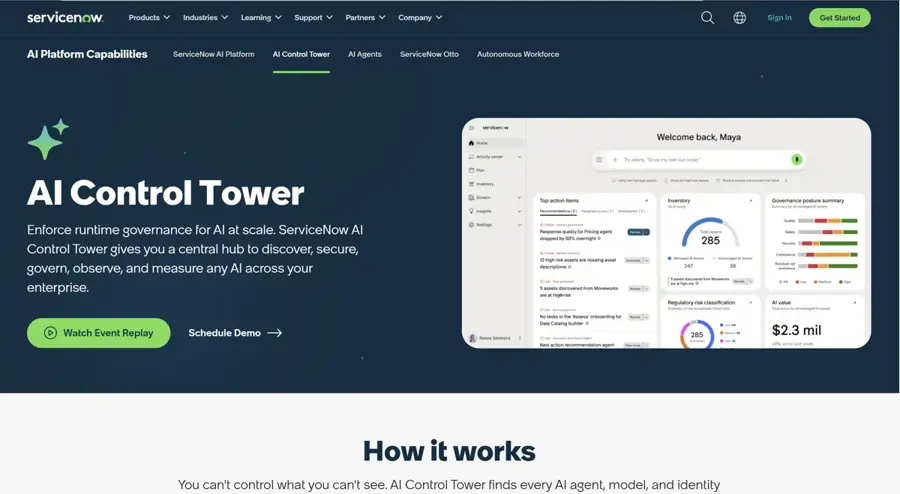
ServiceNow Super Intelligence Control Tower (formerly marketed as AI Control Tower) is a central hub that discovers, secures, governs, observes and measures AI, including agents, models and MCP servers.
Why it stands out
The pitch is a single inventory tied to your CMDB, so each AI asset maps to a business service. It also tracks adoption and ROI, which addresses the measurement gap McKinsey highlights. The Peer Insights sample is small, at 4.2 from 5 ratings, so treat it as a signal rather than proof. Verdict: compelling if ServiceNow is already your system of record; hard to justify as a standalone purchase.
Key features
- Automatic discovery: including shadow AI.
- CMDB-linked inventory: every AI asset tied to a business service.
- Prompt-injection blocking: listed among its security controls.
- Agent kill switch: stop an agent when needed.
- Framework content: for the NIST AI RMF and EU AI Act.
Pros
- Inventory linked to business services
- Value and ROI tracking built in
- Covers agents, models and MCP servers
Cons
- No public pricing
- Best value only for existing ServiceNow customers
- Very few published user ratings
ServiceNow Super Intelligence Control Tower pricing: No free plan → quote only; ServiceNow asks you to contact it for pricing (checked October 2026). See pricing
Credo AI – best for policy-to-code governance at scale
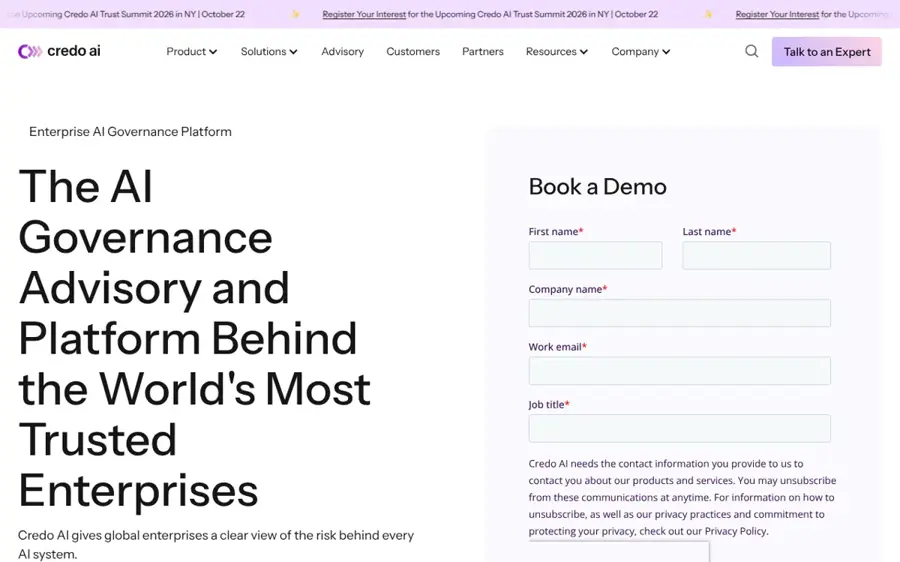
Credo AI is a dedicated AI governance platform that turns policies into checks and monitors compliance continuously, built for large enterprises governing many AI systems across vendors.
Why it stands out
It is vendor-neutral, which matters if you buy AI from several suppliers. Its rating on Gartner Peer Insights is 4.6 from 9 ratings. A comparison by The CTO Club warns that pricing may stretch mid-sized teams and that ready-made templates for niche industries are limited. Verdict: one of the most complete specialist platforms if you have multiple AI vendors and a real compliance burden.
Key features
- Governance knowledge graph: listed by The CTO Club as a core feature.
- "Policy-to-code" policy packs: turn rules into automated checks.
- Runtime evaluation for AI agents: checks agents as they run.
- API and SDK: connect it to your own pipelines.
- Automated evidence generation: audit-ready documentation.
Pros
- Vendor-neutral
- Automated evidence for audits
- Agent runtime evaluation
Cons
- Quote-only pricing
- May be costly for mid-sized firms
- Fewer industry-specific templates
Credo AI pricing: No free plan (free demo) → pricing on request (checked October 2026). See pricing
Trustible – best for fast, low-lift governance in regulated sectors
Trustible is a responsible-AI platform aimed at regulated sectors that want governance running quickly, as described in The CTO Club's comparison.
Why it stands out
It is built for compliance-led teams rather than engineers. It scores 5.0 on Gartner Peer Insights, but from only 5 ratings. Its key limit: it enforces policy at the governance layer, so it can't block a deployment or a non-compliant output at runtime. Verdict: a good first platform for compliance-led teams; pair it with runtime controls if you run agents.
Key features
- Rules-based risk engine: for scoring AI risk.
- Vendor and model evaluations: assess third-party AI.
- Audit-ready reports: evidence for reviewers.
- Framework mapping: EU AI Act, NIST AI RMF and ISO 42001.
Pros
- Quick to get governance running
- Maps to the main frameworks out of the box
- Highest Peer Insights score in this list
Cons
- No runtime enforcement
- Quote-only pricing
- Very small rating sample
Trustible pricing: No free plan (demo only) → pricing on request (checked October 2026). We could not reach an official Trustible pricing page. See pricing details
Related: AI regulation guide
Also worth a look: OneTrust and others
OneTrust AI Governance extends a vendor better known for privacy software. We could not verify its current feature set or pricing from an official page in our research window, so we list it for one reason: it has one of the larger user samples in the category, with a 4.2 rating from 25 reviews. Verdict: worth a demo if your privacy team already runs on OneTrust; otherwise compare it with the specialists above.
Other names you'll see in Gartner's category include Microsoft Purview (for data security), Dataiku, Collibra, Domino and Holistic AI, which says it was named a Challenger in Gartner's first Magic Quadrant for AI Governance Platforms.
How to choose an AI governance approach
Pick the tool after the operating model, not before. Then use this:
- Choose Microsoft Agent 365 if most of your AI runs through Microsoft 365 and Copilot, and your main worry is agents.
- Choose ServiceNow's Control Tower if ServiceNow already holds your IT and risk records and you want ROI tracking alongside governance.
- Choose IBM watsonx.governance if you build or tune your own models and need documented model risk management with a predictable starting price.
- Choose Credo AI or Trustible if you buy AI from many vendors and need vendor-neutral evidence for regulators.
- Choose a spreadsheet and the NIST framework if you have fewer than a dozen AI use cases. Seriously. An inventory, a risk tier and an owner per row will take you a long way.
On budget: Gartner expects large enterprises to run an average of 10 governance, risk and compliance tools by 2028, up from 8 in 2025. Before adding another, check whether your current GRC or IT platform already has an AI module.
Free vs paid: what you actually get
Free gets you the thinking. NIST's framework, ISO/IEC 42001 as a structure (the standard itself is sold, but widely summarised), vendor trials and your own spreadsheet cover policy, inventory and risk tiers. That's enough for a small or early-stage programme.
Paid gets you automation and evidence: automatic discovery of shadow AI, continuous monitoring, audit trails, regulatory mappings and agent controls such as kill switches. Gartner's research says this matters, with platform users 3.4 times more likely to report highly effective AI governance. As Gartner analyst Lauren Kornutick put it, "Point-in-time audits are simply not enough." Expect to pay from a few thousand dollars a month for enterprise platforms, or per user if you buy inside Microsoft's stack.
Final verdict
The claim holds up. In 2026, the organisations getting real returns from AI are the ones that decided who owns it, redesigned work around it, measured it and put limits on it. The ones stuck in pilot mode mostly skipped those steps.
So start with governance decisions, not software. Name an owner this month. Build the inventory next. Tier your risk, set metrics and give every agent a scope and an off switch. Then, if you're in Microsoft 365, look at Agent 365; if you're multi-vendor and regulated, shortlist Credo AI, Trustible and IBM watsonx.governance. And invest in people: our roundup of AI training courses is a sensible place to start.
FAQ
What does "AI transformation is a problem of governance" mean?
It means the main obstacles to getting value from AI are organisational: unclear ownership, missing metrics, weak data controls and no oversight of risk. The models are usually good enough; the decision-making around them isn't.
Is there evidence for the claim?
Yes, though it's correlational. McKinsey's 2026 data shows flat EBIT impact despite near-universal use, and high performers stand out for workflow redesign, leadership ownership and measurement. Its trust survey links explicit responsible-AI ownership to higher maturity scores.
What's the first step in AI governance?
Name one accountable owner with the authority to approve, fund and stop AI projects. Then build an inventory of every AI system in use.
Do small businesses need an AI governance platform?
Usually not at first. A spreadsheet inventory, a one-page usage policy and a simple risk tier are enough until you run many AI systems or face regulatory audits.
Did the EU delay the AI act?
Partly. The AI Omnibus moved high-risk obligations to 2 December 2027 for Annex III systems and 2 August 2028 for Annex I, but transparency and general-purpose AI duties kept their original dates.
Do I need a degree in AI to work in AI governance?
No. Governance roles draw on risk, legal, data and product experience as much as technical depth. Degrees in AI or an online master's in AI can help, but many practitioners start with a certification instead; see our AI governance certification guide.
Sources
- Microsoft Agent 365 overview (Microsoft Learn)
- Enterprise AI Governance Platform (Credo AI)
- The state of AI in 2026: On the road to ROI (McKinsey)
- State of AI trust in 2026: Shifting to the agentic era (McKinsey)
- Deloitte Survey Finds Enterprises Charging Ahead With AI Agents While Governance Struggles to Keep Up (GRC Report)
- Global AI Regulations Fuel Billion-Dollar Market for AI Governance Platforms (Gartner)
- Best AI Governance Platforms Reviews 2026 (Gartner Peer Insights)
- AI Transformation is a Problem of Governance (CTO Magazine)
- EU Lawmakers Reach Provisional Agreement to Delay Key EU AI Act Obligations (Sidley Data Matters)
- AI Omnibus adopted: what still applies from August 2 (iubenda)
- watsonx.governance purchasing options (IBM)
- Understanding Microsoft Agent 365 pricing (Rencore)
- Super Intelligence Control Tower (ServiceNow)
- Trustible vs. Credo AI: Comparison & Expert Reviews for 2026 (The CTO Club)
- Holistic AI acknowledged as a Challenger in Gartner's first-ever Magic Quadrant for AI Governance Platforms (Holistic AI)
- Microsoft Licensing FAQs: Agent 365 (Microsoft)