Best AI supply chain tools in 2026: 8 picks for every budget
From Kinaxis and Blue Yonder agents to $49 Shopify planning apps, these are the AI supply chain tools worth shortlisting in 2026.
 Written byMuhammad Usman SiddiquiFounder and editor-in-chief
Why you can trust The AI Future
Our writers research every product, link each claim to its source and correct mistakes openly. Companies can't pay for coverage or see reviews before they're published.
Read our editorial policy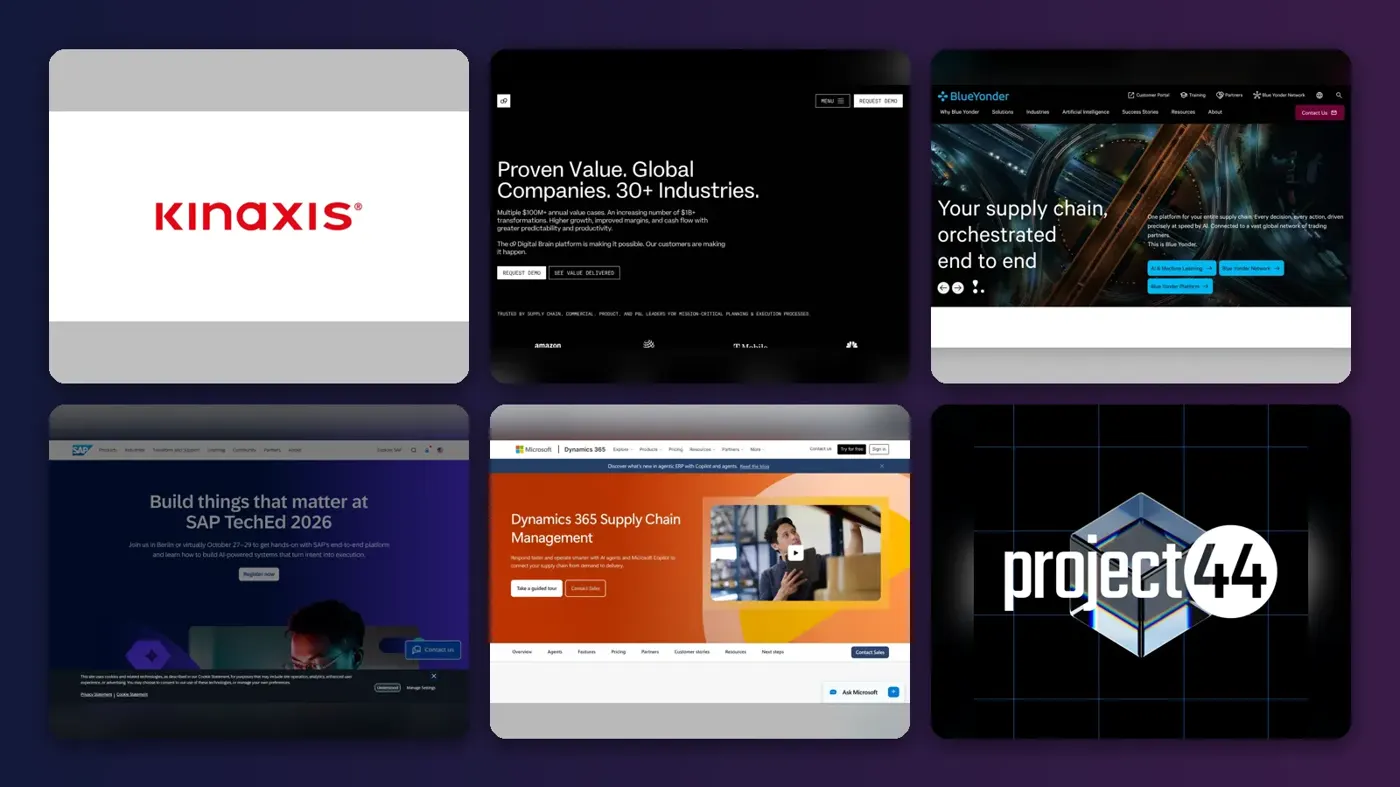
Short answer: if you run a complex manufacturing network, start with Kinaxis Maestro. If you sell on Shopify and just need to stop running out of stock, Prediko does the job from $49 a month. Everything else on this list sits between those two poles, and the right AI supply chain tool depends mostly on where your data already lives.
2026 is the year AI in supply chain management stopped being a demo. Kinaxis, o9, Blue Yonder, SAP, Microsoft and project44 all now ship AI agents that watch your data, flag risks and propose (or take) the next action. Analysts at ARC said Kinaxis’s 2026 customer event showed customers moving from pilots to production. Below are the eight supply chain AI software picks we think matter most, with prices where vendors publish them.
Key takeaways
- Agentic AI in supply chain is now the default pitch. Every enterprise vendor here sells agents that monitor, explain and recommend, usually with a human approval step.
- Enterprise planning suites don’t publish prices. Kinaxis, o9, Blue Yonder, SAP IBP and project44 all sell on custom quotes, so budget for a long sales cycle.
- Microsoft is the most transparent big vendor. Dynamics 365 Supply Chain Management lists at $210 per user per month, with a Procurement Agent in preview.
- Small businesses have real options. Prediko starts at $49 a month for Shopify stores, and Netstock targets mid-sized distributors.
- Vendor ROI numbers are vendor numbers. Treat “10x productivity” claims as a starting point for your own pilot, not a forecast.
How we ranked them
Nobody at The AI Future ran hands-on tests for this roundup. We compared each tool using official product pages and press releases, analyst coverage, published pricing and user review sites, as of late October 2026. We scored each tool on six criteria:
- AI depth: whether the AI goes beyond dashboards to forecasting, scenario planning and agents that act.
- Planning scope: how much of plan, source, make and deliver it covers.
- Human control: explainability, audit trails and approval steps before an agent acts.
- Proof: named customers, analyst recognition and independent user ratings.
- Price transparency: whether you can see what it costs before a sales call.
- Fit by company size: how realistic it is for a mid-market firm or small brand, not just a Fortune 500.
Enterprise suites rank higher because they cover more of the chain. The two budget picks rank lower overall but are the better buy if you have one warehouse and a Shopify store. Prices are in US dollars unless noted and change often, so confirm with the vendor.
The 8 best AI supply chain tools at a glance
| # | Tool | Category | Best for | Free tier | Starts at |
|---|---|---|---|---|---|
| 1 | Kinaxis Maestro | Supply chain planning | Complex manufacturing networks | No | Custom quote |
| 2 | o9 Solutions | Integrated planning | Cross-functional planning | No | Custom quote |
| 3 | Blue Yonder | Planning and execution | Retail, warehouse and logistics | No | Custom quote |
| 4 | SAP IBP | Supply chain planning | Companies already on SAP | No | Custom quote |
| 5 | Microsoft Dynamics 365 Supply Chain Management | ERP supply chain | Microsoft-based operations | No | $210/user/mo |
| 6 | project44 | Logistics visibility | Freight and shipment disruption | No | Custom quote |
| 7 | Netstock | Inventory optimization | Mid-sized distributors | No | About $900/mo |
| 8 | Prediko | Inventory planning | Shopify brands | No | $49/mo |
Notes: Prediko offers a 14-day free trial rather than a free plan. Netstock’s figure comes from a third-party pricing tracker, not Netstock itself. Microsoft’s price is the US base licence from a partner price list.
The best AI supply chain software in 2026, ranked
Kinaxis Maestro – best for complex manufacturing networks
Kinaxis Maestro is a concurrent supply chain planning platform with built-in AI agents that analyze live data, spot problems and recommend fixes. See kinaxis.com.
Why it stands out
Kinaxis launched Maestro Agents in October 2025: agents that account for real constraints like supplier capacity and inventory, explain their reasoning and keep a human in the loop. A no-code Maestro Agent Studio and an agent marketplace planned for 2026 came with it. At its 2026 customer event, ARC reported a prebuilt agent skills library and NVIDIA cuOpt integration that cut calculation time by up to 12 times in a semiconductor test with about 50 million decision variables. Unilever described seven AI agents and a move from 150 systems to 10.
The customer evidence is strong for big, messy networks. In the launch release, a top-10 pharma company reported up to 10x planner productivity and cut the steps to find inventory risk from 40 clicks to 4. Jabil’s John Finnigan put it this way: “With human-in-the-loop safeguards, we’re reaching decisions faster today.” Verdict: the strongest pick if your bottleneck is fast replanning across many plants and suppliers.
Key features
- Concurrent planning: demand, supply and capacity plans update together.
- Maestro Agents: explainable agents that flag risks and suggest next steps.
- Agent Studio: build your own agents, with a marketplace planned.
- GPU optimization: NVIDIA cuOpt for large solver runs.
- MCP server: a Genpact-built server with audit trails and approval gates.
Pros
- Built for scenario planning at very large scale
- Explainability and human approval built in
- Strong named customers such as Unilever, Jabil and Cardinal Health
Cons
- No public pricing
- Overkill for single-site businesses
- Most results quoted are vendor or customer claims
Kinaxis Maestro pricing: No free plan → custom quote only (checked October 2026). See pricing
o9 Solutions – best for cross-functional planning
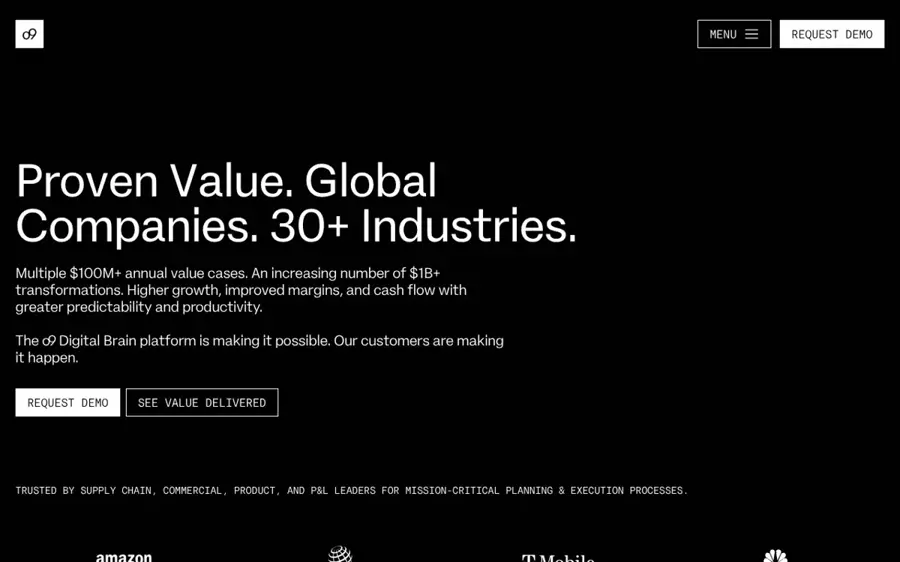
o9’s Digital Brain platform links demand, supply, commercial and financial planning on one knowledge graph, with AI agents on top. See o9solutions.com.
Why it stands out
o9 made its specialized AI agents generally available in June 2025. They sit on its Enterprise Knowledge Graph and answer three questions: what happened and why, what is likely to happen, and what to do next across functions. Its Post-Game-Analysis tools trace why execution drifted from plan, and a self-service platform lets you build no-code and low-code agents without waiting on o9. Back in 2024, it added LLM composite agents that coordinate several AI systems for forecasting and performance analysis.
For a third-party signal, o9 says it was named a Leader in Gartner’s 2026 Magic Quadrant for Supply Chain Planning Solutions for Process Industries, its second year in that report. Verdict: pick o9 if your real problem is that sales, finance and supply plan in separate silos.
Key features
- Enterprise Knowledge Graph: connects supply chain, finance and procurement data.
- AI agents: explain variances, predict outcomes and propose actions.
- Post-Game-Analysis: root-cause analysis of plan versus actual.
- Self-service platform: no-code and low-code agent building.
- Integrated business planning: S&OP and revenue planning in one model.
Pros
- Strong at cross-functional, finance-linked planning
- Gartner Leader recognition in 2026
- Lets customers extend agents themselves
Cons
- No public pricing
- Agents are described broadly, with few named examples
- Needs clean, connected data to pay off
o9 Solutions pricing: No free plan → custom quote only (checked October 2026). See pricing
Blue Yonder – best for retail, warehouse and logistics
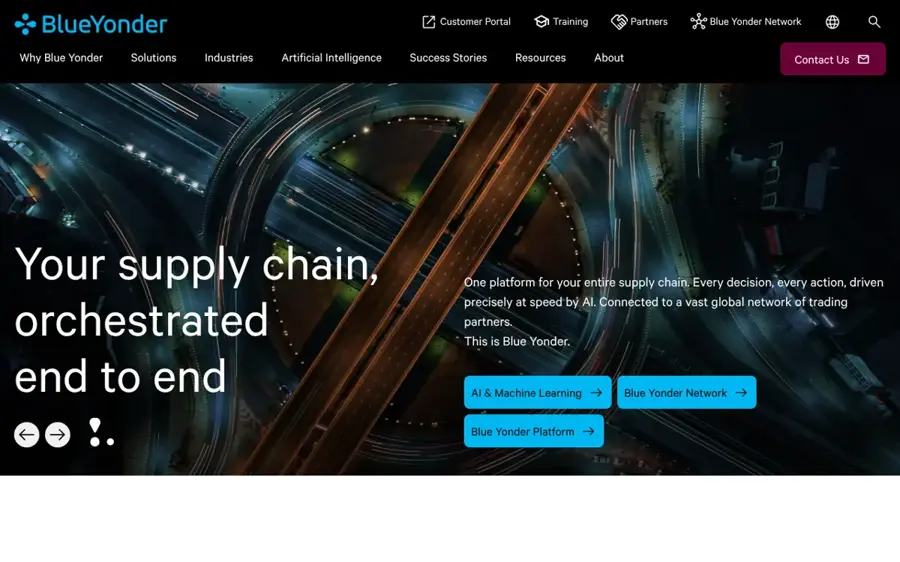
Blue Yonder sells a “cognitive” suite of planning, warehouse, transport, order and returns software, now built around domain AI agents. See blueyonder.com.
Why it stands out
Blue Yonder has gone all in. Diginomica reports that since the start of 2026 it has sold only its cognitive portfolio, with domain agents for warehouse, logistics and inventory moving from monitoring to autonomous action. At ICON 2026 in May, it added new Inventory Ops Agent skills, a Workforce Management Knowledge Agent and new cognitive solutions for production planning and space planning. Nucleus Research notes a Model Training Factory that uses NVIDIA Nemotron models to build supply chain tuned models rather than wrapping a generic chatbot.
The best proof comes from retail: Sainsbury’s CEO cited product availability “regularly at 98%” across about 30,000 SKUs, as diginomica reported. Incisiv flags that many implementation claims, such as a WMS migration start cut from 11 weeks to 7 days, lack baselines. Verdict: the best fit for retailers and 3PLs who want planning and execution from one vendor.
Key features
- Domain agents: inventory, warehouse, logistics, replenishment and returns.
- Inventory Ops Agent: agentic supplier ordering with explanations.
- Production planning and scheduling: new cognitive solution from ICON 2026.
- Space planning: real-time planogram co-creation with suppliers.
- Mobile apps: for store associates and warehouse managers.
Pros
- Covers planning and execution end to end
- Strong retail references such as Sainsbury’s
- Forward-deployed engineers help with rollout
Cons
- No public pricing
- Many headline numbers are vendor supplied
- Value depends on redesigning your workflows
Blue Yonder pricing: No free plan → custom quote only (checked October 2026). See pricing
SAP IBP – best for companies already on SAP
SAP Integrated Business Planning is SAP’s cloud planning suite for demand, supply, inventory and S&OP, with Joule AI features layered in. See sap.com.
Why it stands out
SAP’s strength is that the AI sits next to your ERP data. Its Q1 2026 release added AI-assisted MRO inventory analysis, which explains in plain language what drives recommended safety stock and reorder points, plus an Excel add-in that writes planning formulas from a description. SAP claims a 30% cut in time spent analyzing inventory runs, though those are its own estimates.
SAP’s training material describes four focus areas for AI agents in IBP: routine planning updates, automated system configuration, disruption response with scenario comparison, and root-cause analysis. Verdict: if you run S/4HANA, this is the low-friction choice, but check which agent features are generally available and not just on the roadmap.
Key features
- AI inventory explanations: plain-language reasons behind safety stock.
- Excel add-in: describe a need, get the formula.
- Exception agents: compare scenarios when a supplier fails.
- Root-cause analysis: traces outcomes to bottlenecks.
- Native SAP integration: works with S/4HANA data.
Pros
- Tight fit with SAP ERP
- Excel add-in suits how planners already work
- Clear explanations of inventory recommendations
Cons
- No public pricing
- Several agent capabilities are described as focus areas, not shipped products
- Less attractive if you don’t run SAP
SAP IBP pricing: No free plan → custom quote only (checked October 2026). See pricing
Microsoft Dynamics 365 Supply Chain Management – best for Microsoft-based operations
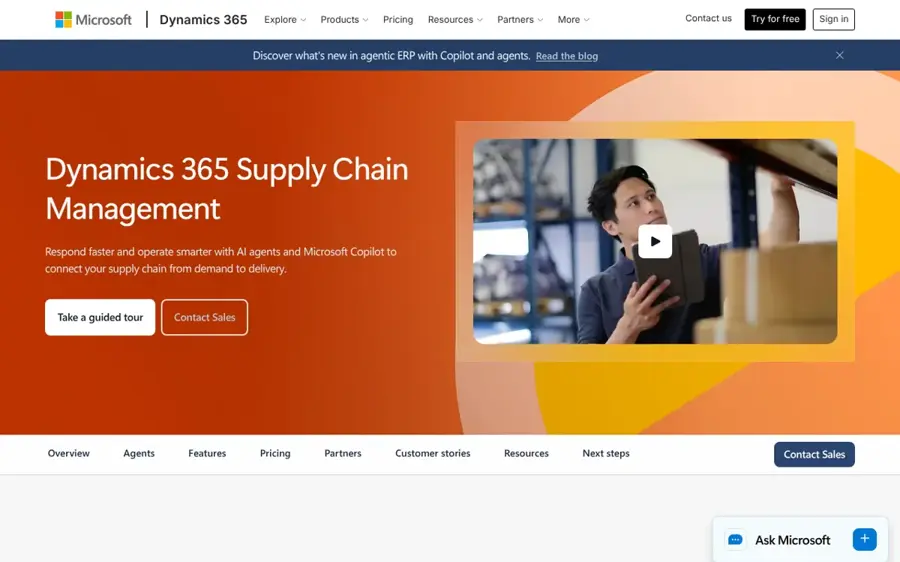
Dynamics 365 Supply Chain Management is Microsoft’s ERP module for manufacturing, warehousing and procurement, with Copilot and agents built in. See microsoft.com.
Why it stands out
This is the most transparent enterprise option on the list. Microsoft’s pricing page shows two plans, Supply Chain Management and Premium, with Premium adding full demand planning and 1,000 Copilot Credits per user per month. Both include a Procurement Agent in preview. You need an Azure subscription to run agents, and extra Copilot Studio credits cost more.
A partner price list puts the US base licence at $210 per user per month, or $30 as an attach licence. On Capterra it holds 4.5 out of 5 from 10 reviews, with one reviewer calling it “a great product and highly recommended.” Verdict: choose it if your finance and operations already run on Dynamics and Microsoft 365.
Key features
- Procurement Agent (preview): included in both plans.
- Copilot Credits: 1,000 per user per month on Premium.
- Demand planning: limited on base, full on Premium.
- Copilot Studio: build custom agents on pay-as-you-go or prepaid credits.
- Microsoft 365 fit: works with Teams, Excel and Power BI.
Pros
- Published per-user pricing
- Agents included in the plans
- Natural fit for Microsoft shops
Cons
- Agent use needs Azure and Copilot credits
- Full demand planning only on Premium
- Small number of user reviews
Microsoft Dynamics 365 Supply Chain Management pricing: No free plan → from $210/user/month, or $30/user/month as an attach licence (checked October 2026). See pricing
Related: Microsoft AI and Copilot review
project44 – best for freight and shipment disruption
project44 is a logistics visibility and decision intelligence platform that tracks shipments across carriers and now runs AI agents on freight work. See project44.com.
Why it stands out
In April 2026, project44 launched six AI agents for freight procurement, disruption management, network operations, exceptions, slot booking and carrier onboarding. Its network covers more than 259,000 carriers in 186 countries and over 700 million logistics events a day, which gives the agents a lot of context. Agent-driven outreach grew from 500 interactions a week to more than 30,000.
FreightWaves reported that the Freight Procurement Agent cut sourcing cycle time by 75% and mitigated freight costs by 4.1%, while cargo theft risk agents cut intervention time from 40 minutes to 12. Verdict: the pick for shippers whose pain is in transport, not planning.
Key features
- Freight Procurement Agent: continuous sourcing and carrier negotiation.
- Cargo theft risk agents: combine door-open and GPS spoofing signals.
- Dynamic Slot Booking Agent: manages yard appointments.
- Exception and disruption agents: automate last-mile responses.
- Carrier network: 259,000+ carriers connected.
Pros
- Huge carrier network for visibility
- Concrete, task-specific agents
- Clear metrics on freight savings
Cons
- No public pricing
- Covers logistics, not demand or supply planning
- Several agents were still rolling out mid-2026
project44 pricing: No free plan → custom quote only (checked October 2026). See pricing
Netstock – best for mid-sized distributors
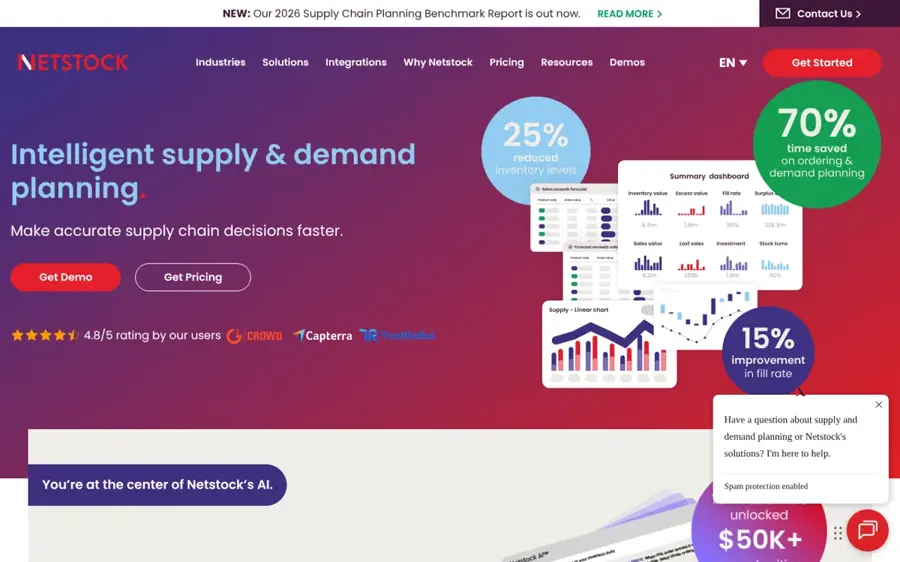
Netstock is cloud inventory planning software for small and mid-sized businesses that sits on top of your ERP and recommends what to order. See netstock.com.
Why it stands out
Netstock is built for companies that have outgrown spreadsheets but don’t need a Kinaxis-scale project. Software Advice lists AI-driven inventory planning, an AI Copilot and supplier and forecast risk checks refreshed every 24 hours. Users rate it highly: 4.8 out of 5 from 75 reviews on Capterra, where one reviewer called it “a powerful tool for inventory management.”
Netstock doesn’t publish prices. A third-party tracker puts the starting price at about $900 a month, which you should treat as a ballpark. Verdict: the sensible middle ground for distributors with a few thousand SKUs and an existing ERP.
Key features
- Demand forecasting: SKU-level forecasts from your ERP history.
- Replenishment suggestions: what to order and when.
- AI Copilot: explains dashboards and reports.
- Risk checks: supplier and forecast risk refreshed daily.
Pros
- Very strong user ratings
- Faster to deploy than enterprise suites
- Works on top of common ERPs
Cons
- No public pricing or free trial
- Narrower scope than full planning suites
Netstock pricing: No free plan → quote-based; reported to start around $900/month (checked October 2026). See pricing
Prediko – best for Shopify brands
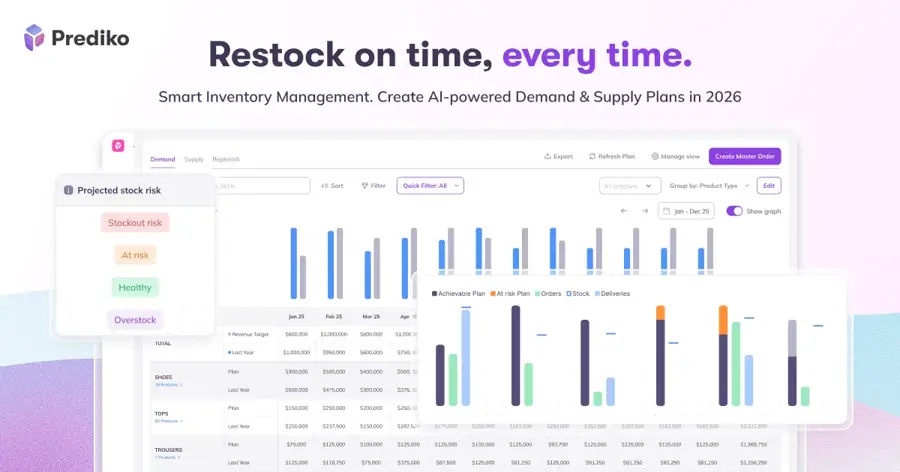
Prediko is an AI inventory planning app for Shopify brands that forecasts demand and builds purchase orders. See prediko.io.
Why it stands out
This is the cheapest serious AI supply chain planning tool here. Prediko says its forecasting algorithm is trained on 25 million+ SKUs across 15+ industries and that it builds a 12-month purchase order calendar, with 100+ integrations for 3PLs and warehouses. Those are the vendor’s own claims.
Shopify merchants like it. On the Shopify App Store it rates 4.9 out of 5 from 264 reviews, and one store wrote that it “integrates seamlessly with Shopify, making inventory management much easier.” Verdict: if you are a direct-to-consumer brand, start here before you talk to any enterprise vendor.
Key features
- AI demand planning: forecasts tied to revenue targets.
- AI supply planning: 12-month purchase order calendar.
- Purchase order management: real-time sync with Shopify.
- Integrations: 100+ WMS, 3PL and platform connections.
Pros
- Transparent pricing from $49/month
- 14-day free trial on all plans
- Excellent Shopify App Store rating
Cons
- Built mainly for Shopify
- Price scales with your annual sales
- Not a fit for multi-plant manufacturing
Prediko pricing: No free plan (14-day trial) → paid plans from $49/month for stores under $100K annual sales, then $119 and $199/month (checked October 2026). See pricing
Related: Generative AI in ecommerce Best AI dropshipping tools
How to choose the right AI supply chain tools
Start with your system of record
The best AI for supply chain management is usually the one that can read your data without a year of integration work. If you run SAP, look at SAP IBP first. If you run Dynamics, look at Dynamics 365. If you run Oracle, note that Oracle was named a Leader in both 2026 Gartner Magic Quadrants for supply chain planning, so its own planning cloud deserves a look too.
Match the tool to your bottleneck
Choose Kinaxis or o9 if the problem is slow replanning across plants and functions. Choose Blue Yonder if stores and warehouses are the pain. Choose project44 if late trucks and freight costs keep you up at night. Choose Netstock or Prediko if the problem is simply buying the right stock at the right time.
Insist on explainable, supervised agents
Agentic AI in supply chain only works if planners trust it. Look for agents that show their reasoning, log every action and wait for approval on anything costly. Kinaxis and Genpact, for example, built audit trails and human approval gates into their MCP server. For background on how agents work, read our guide to agentic AI.
Pilot one decision, then scale
Nucleus Research makes the key point about Blue Yonder, and it applies to every vendor: the payoff depends on whether you are “ready to redesign workflows around autonomous execution”. Pick one decision, such as supplier order approvals, measure it for a quarter, and only then expand.
Free vs paid: what you actually get
There is no genuinely free AI supply chain platform on this list. The closest you get is a trial, such as Prediko’s 14 days. What you pay for falls into three bands:
| Budget | What you get | Examples |
|---|---|---|
| Under $200/month | AI demand forecasting and purchase order suggestions for one online store | Prediko |
| Roughly $900+/month or per-user ERP pricing | SKU-level forecasting, replenishment and risk alerts on top of your ERP | Netstock, Dynamics 365 |
| Custom enterprise contract | Concurrent planning, scenario modelling, domain AI agents and deployment help | Kinaxis, o9, Blue Yonder, SAP IBP, project44 |
A general chatbot can still help on a budget. You can paste a stock report into a paid assistant and ask it to spot slow movers, but it won’t connect to live data or place orders. For a broader view of where companies are spending, see our guide to enterprise AI solutions.
Final verdict
If you only pick one enterprise platform, pick Kinaxis Maestro for manufacturing or Blue Yonder for retail and warehousing. Choose o9 if finance and supply need one plan, and stay with SAP IBP or Dynamics 365 if your ERP already lives there. Add project44 when transport is the weak link. For smaller businesses, Prediko and Netstock deliver most of the everyday value, forecasting and smarter purchase orders, at a fraction of the cost.
FAQ
How is AI changing supply chains?
AI is moving supply chains from reports to decisions. Instead of planners digging through dashboards, AI agents now watch inventory, demand and shipments, flag risks and propose fixes. Vendors such as Blue Yonder and Kinaxis are building agents that act on routine decisions, while humans approve the costly ones.
How can AI be applied to supply chain activities?
AI applies to almost every step: demand forecasting, inventory and safety stock planning, supplier ordering, production scheduling, freight sourcing, warehouse slotting and returns. A practical start is AI forecasting plus suggested purchase orders, which tools like Netstock and Prediko provide without a large implementation project.
How is AI being used in supply chain today?
Companies use AI to explain inventory recommendations, negotiate freight and spot disruptions. project44’s freight procurement agent reportedly cut sourcing cycle time by 75%, and SAP uses AI to explain safety stock settings in plain language. Most deployments keep a human reviewer in the loop.
How can AI solve supply chain problems?
AI helps most with speed and visibility. It can replan in minutes instead of hours, warn you about stockouts or late shipments earlier, and test several scenarios before you commit. It cannot fix bad master data or broken processes, so clean data and clear decision rights come first.
Will the supply chain be replaced by AI?
No. AI is automating routine planning and coordination tasks, but people still set strategy, manage suppliers and handle exceptions. Blue Yonder’s Duncan Angove frames it as using AI “to drive better business outcomes” rather than replacing planners. For the wider picture, see what AI agents at work mean for jobs.
Sources
- Kinaxis Accelerates Agentic Era for Supply Chain Orchestration with the Launch of Maestro Agents (Business Wire)
- Kinexions 2026: AI Skills, Speed to Supply Chain Decisions, and Modernization Strategies (ARC Advisory Group)
- o9 is raising the bar for enterprise planning and execution (o9 Solutions)
- o9 Enhances Its Digital Brain Platform With Generative AI Powered Composite Agents (Business Wire)
- 2026 Gartner Magic Quadrant for Supply Chain Planning Solutions: Process Manufacturing (o9 Solutions)
- Blue Yonder Launches New Cognitive Solutions and AI Driven Innovations at ICON 2026 (Business Wire)
- ICON 2026: Blue Yonder bets everything on the cognitive agent app (diginomica)
- Blue Yonder ICON 2026: From Building the Foundation to Delivering Real Value (Incisiv)
- Blue Yonder ICON 2026 updates and announcements (Nucleus Research)
- SAP Business AI release highlights Q1 2026 (SAP News)
- Summarizing the four primary focus areas for AI agents within IBP (SAP Learning)
- Dynamics 365 Supply Chain Management pricing (Microsoft)
- Dynamics 365 Finance & Operations Price List 2026 (ERP Research)
- Dynamics 365 Supply Chain Management reviews (Capterra)
- project44 launches AI agent portfolio at decision44 (project44)
- project44 unveils fleet of AI agents at customer event Decision44 (FreightWaves)
- Netstock profile (Software Advice)
- Netstock reviews (Capterra)
- Netstock Pricing Plans & History (PricingSaaS)
- Prediko Inventory Management (Shopify App Store)
- Inventory Planner vs Prediko (Prediko)
- Gartner Magic Quadrant for Supply Chain Planning (Oracle)