Mistral Large 4 review: open weights, a cyber pitch and what the numbers say
Mistral has released the weights for its 1-trillion-parameter Large 4, pitched at cyber defense. We haven't run it ourselves, so here's what the benchmarks, partners and fine print show.
 Written byAlap ZahidReviews and guides editor
Why you can trust The AI Future
Our writers research every product, link each claim to its source and correct mistakes openly. Companies can't pay for coverage or see reviews before they're published.
Read our editorial policy
Verdict box (first take, not a hands-on score): Mistral Large 4, nicknamed "Le Chonk", is now a downloadable 1-trillion-parameter model with a clear cyber-defense pitch. The coding and efficiency numbers look strong. The cyber claims are mostly Mistral's own and its partners', so treat them as a reason to test it, not proof. I haven't run it myself, so I'm not handing out feature, ease-of-use, value or performance scores today.
I'd love to tell you how many minutes it took Le Chonk to patch a buggy C library on my machine. I can't, because I haven't done that test. What I can do is read everything Mistral and the early press have published and tell you where it holds up and where it needs your own evaluation.
What it is
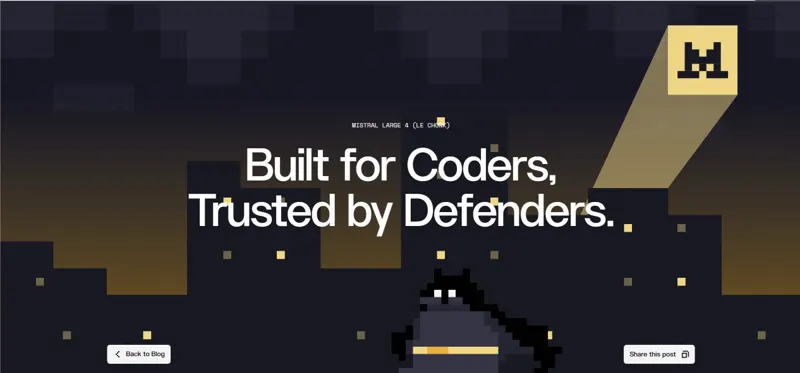
On October 29, TechCrunch reported that French AI company Mistral released the weights for Mistral Large 4 (ML4), a trillion-parameter open model that businesses and governments can download and deploy themselves. It was first introduced earlier in October as a public preview.
Weights are the trained numbers that make the model work. Once you have them, you can run the model on your own hardware instead of calling someone else's API.
According to Mistral's announcement, this is an improved version of the preview, after three more weeks of reinforcement learning aimed at coding and defensive security. The Next Web reports it reads text and images, produces text and code, and activates 52 billion of its parameters per task. There's also a quantised version that runs on four Nvidia B200 or B300 GPUs.
One small discrepancy: VKTR's preview coverage listed 49 billion active parameters, while the current figures from TNW and Mistral's own Hugging Face link name point to 52 billion. The released model is the updated one, so I'd go with 52 billion.
What's been tested, and by whom
This section is where I'd normally describe my own prompts. Instead, here's what others report.
Coding
Mistral says Large 4 scores 48% on the Artificial Analysis Coding Agent Index, effectively tied with the leading open-weight model, GLM-5.3. The difference is that it uses 47% fewer tokens per task on average. TechCrunch repeats that figure as Mistral's claim.
On Terminal-Bench 4.0, which tests agentic coding in a terminal, TNW reports ML4 climbed from 28% at preview to 41%, just ahead of GLM-5.3 at 40%. That's a narrow lead, not a blowout.
Mistral also cites a blind human-preference test from Surge Code. It says graders preferred Large 4 over GLM-5.3, Kimi K3 and DeepSeek V4.1 Flash, and ranked it behind only Claude Opus 5.5 among the models evaluated. That's a vendor-published result, so I'd weigh it accordingly.
Cyber defense
Mistral says the model scores 51% on the Artificial Analysis Cyber Index. That index measures finding vulnerabilities in a codebase, reproducing them and patching them without breaking anything.
TNW adds a more concrete data point. ML4 scored 79% on CyberGym-E2E, a test of whether a model can find, reproduce and patch real memory-safety bugs in open-source C and C++ projects. That matches MiMo-V2.6-Pro and beats DeepSeek V4.1 Flash at 76%.
So "matches the best open models" is a fair reading. "Clearly beats them" is Mistral's framing, not what the CyberGym-E2E number shows.
Mistral also says it worked with cybersecurity vendors during the preview. Its page carries supportive quotes from Booz Allen, Cloudflare, CrowdStrike, Elastic, Fortinet, Zscaler and the EU agency ENISA. These are published on Mistral's own page, so they read as endorsements, not independent reviews. Booz Allen's quote is the most specific: it says the model matched other frontier cyber models on vulnerability-detection recall on an internal benchmark, "with a compelling cost curve".
Guardrails
Mistral reports an average refusal rate of 96.6% on malicious cyber requests, which it calls the highest among open models it measures. It also says the model avoids unnecessary refusals on legitimate defensive tasks.
Then comes the part I found most interesting. Mistral says that after the preview it watched live traffic and saw "potential for uplift" for real attacks, so it's modifying its guardrails and will keep updating them. A vetted set of enterprise design partners, such as Orange Cyberdefense, gets preview access to a specialised cyber variant for penetration testing and red-teaming.
One caveat applies to every open-weight release. Guardrails built into the model are a weaker protection once anyone can download the weights. Mistral's VP of Science, Pierre Stock, told TechCrunch that defenders should get this capability quickly because some malicious actors may use their own technology to attack. TNW notes that rivals argue open models carry more risk.
Why the open-weights angle matters for security teams
Stock's argument is about control. He told TechCrunch that access to frontier intelligence for defense can't be cut off "by definition" when the model is open-weighted. He also said companies can run it on-premises in their own environment.
If your security team can't send client code or incident data to a third party, that matters. It's the whole pitch.
It comes with a cost. A trillion-parameter model isn't a laptop download. Mistral says smaller, distilled versions will follow in the coming months, including one that runs on a laptop, but TNW notes it wouldn't commit to dates.
Pricing and license
The weights are free to use, modify, fine-tune and commercialise under the Mistral Ecosystem Open-Weight license, which Mistral describes as a modified MIT license. There's one condition. Businesses that run a Model-as-a-Service offering need a separate commercial license from Mistral first. Read the license text before you build a product around it.
If you'd rather not host it, Mistral's page lists the API, Mistral Studio, OpenRouter, Nvidia-hosted endpoints and Microsoft Foundry. Mistral says API pricing starts today at $0.70 per million input tokens, $0.07 per million cached input tokens and $2.10 per million output tokens.
The sources disagree on pricing. TNW wrote that API pricing hadn't been published yet. VKTR's preview coverage listed $1.36 input and $4.18 output per million tokens. Mistral's own page, which is the one to trust, shows the lower figures. If you're budgeting, check the pricing page directly.
Stock also argued that per-token rates can mislead when a model needs far fewer tokens per job. That's reasonable, but it's a claim you can check on your own workloads.
What other reviewers and users are saying
Early coverage is mostly news reporting, not long-term reviews. TechCrunch's Lucas Ropek framed the release as open-weight developers against closed-model providers like OpenAI and Anthropic. He noted the control argument may carry more weight in cybersecurity. TNW's Ana-Maria Stanciuc called the released version noticeably sharper than the preview. TNW also pointed out that Mistral's claim of building ML4 on far fewer resources than rivals is hard to test, given how little Chinese labs disclose about training costs.
I didn't find independent user reports or video reviews in what I read for this piece. Mistral itself says it encourages the community to run its own evaluations, so expect more third-party numbers to arrive over the coming days.
Pros and cons
Pros
Downloadable weights, so you can self-host and keep data in your own environment.
Competitive open-weight coding scores with 47% fewer tokens per task, by Mistral's and TNW's account.
Three reasoning modes (low, medium, high) so you can trade cost against depth.
A modified MIT license that allows commercial use for most organisations.
Low listed API pricing, if Mistral's page holds.
Cons
Most cyber evidence comes from Mistral and its partners, not independent testers.
On CyberGym-E2E it matches a rival rather than beating it.
Self-hosting a trillion-parameter model needs serious GPUs, even in the quantised version.
Mistral itself says it's tightening guardrails after seeing potential for attack uplift.
Companies selling the model as a service need a separate license.
Who should look at it
If you run a security team, a bank or a public body with strict data-residency rules, Large 4 deserves a proper trial. That's especially true if cutting you off from a hosted API would be a real risk. Run it against your own code, with your own vulnerability cases, and compare the token bills.
If you just want a coding assistant and already pay for a closed model you like, there's no urgent reason to switch. The 41% versus 40% Terminal-Bench gap over GLM-5.3 isn't a reason to rebuild your tooling. The token savings and the license are the more interesting parts.
The verdict
Le Chonk is a serious open-weight release with a sensible argument behind it. The pitch is control you can't lose to a vendor decision, and the early benchmarks suggest you aren't giving up much capability to get it.
Still, most of what we know comes from the people selling it. Once independent testers publish their results, I'll update my view and give it proper scores after I've run it myself.
Sources
- Mistral releases weights for its trillion-parameter AI model, targeting cybersecurity (TechCrunch)
- Mistral Large 4 (Le Chonk) is now open weight (Mistral)
- Mistral releases open weights for its 1 trillion-parameter Large 4 model (The Next Web)
- Mistral Large 4 Debuts as 1T-Parameter Open-Weight Model Built for Cyber Defense (VKTR)