Best cybersecurity AI automation tools in 2026: 8 picks for SOAR and AI triage
Eight cybersecurity AI automation tools for SOAR, AI SOC analysts and automated triage, compared on features, autonomy and pricing as of October 2026.
 Written byDr. Alap ZahidReviews And Guides Editor
Why you can trust The AI Future
Our writers research every product, link each claim to its source and correct mistakes openly. Companies can't pay for coverage or see reviews before they're published.
Read our editorial policy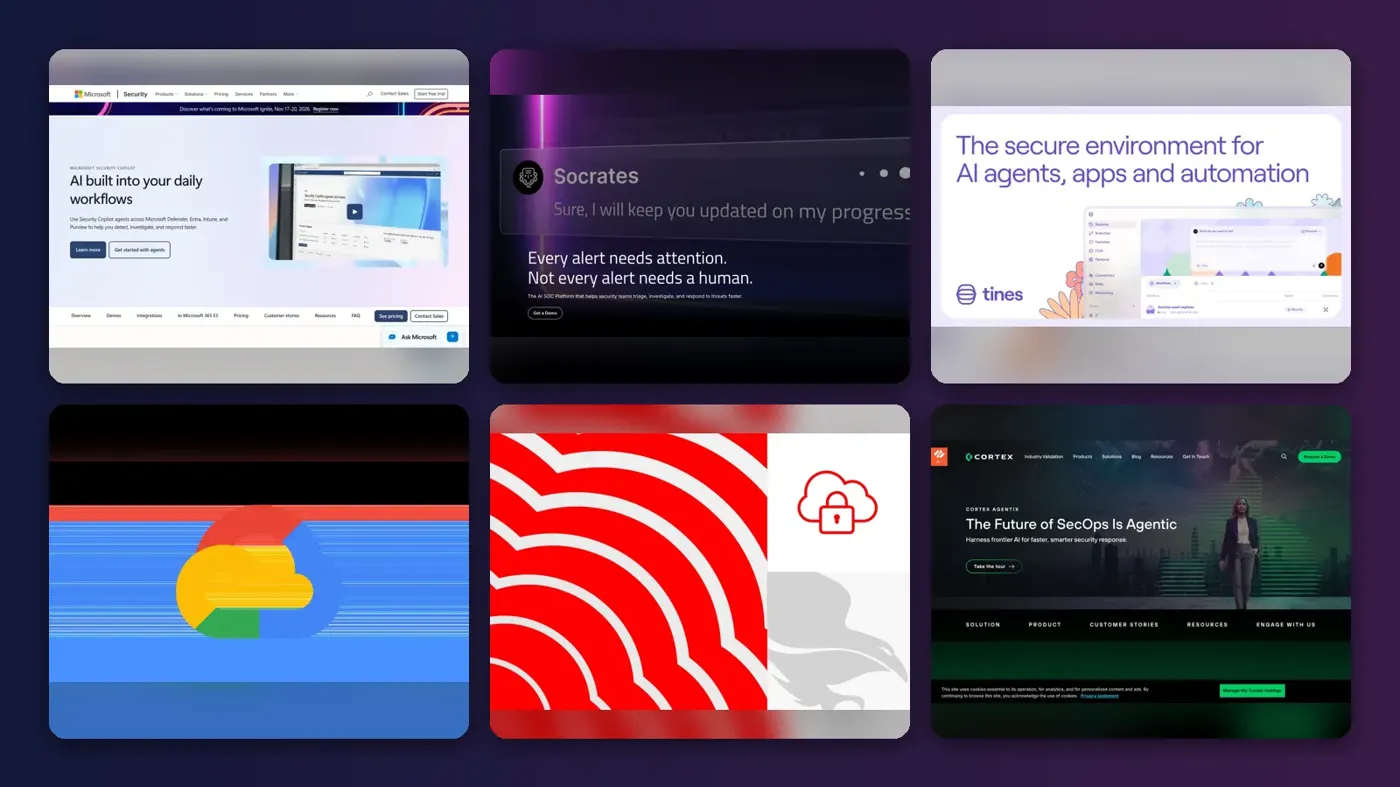
Short answer: if your company already runs Microsoft 365 E5, start with Microsoft Security Copilot, because you may already have capacity included. If you run a mixed security stack and want alerts triaged and closed with less human effort, shortlist Torq and Dropzone AI. If you want to build your own workflows and test before you buy, Tines is the only pick here with a real free edition.
Cybersecurity AI automation in 2026 is no longer just SOAR playbooks. Most major vendors now sell AI agents that read an alert, gather evidence, give a verdict and, if you allow it, take action. I think that shift is real, though it's still early. This guide compares eight tools for security automation: AI SOC analysts, automated triage, and orchestration and response. If you want the companies behind them, our sister guide to AI cybersecurity companies profiles the vendors themselves.
Key takeaways
- Your existing platform probably decides most of the shortlist, since Microsoft, Google, CrowdStrike, Palo Alto Networks and SentinelOne all build their AI agents into their own consoles first.
- Independent AI SOC platforms work across vendors: Torq, Tines and Dropzone AI sit on top of the tools you already own, which matters if you run a mixed stack.
- Pricing is mostly hidden. Only Microsoft publishes a per-unit price ($4 per provisioned SCU per hour), and everyone else asks you to contact sales.
- Accuracy numbers are almost all vendor-reported, so I'd read claims like "98% decision accuracy" as a starting point for your own proof of concept.
- Keep humans on high-impact actions. The tools here let you set approval gates, and they're worth using while you build trust.
Our ranking method
Nobody at The AI Future tested these tools hands-on. Enterprise security platforms need production data and sales-led trials, so we compared them using official product and pricing pages, published research, and user reviews on PeerSpot and Gartner Peer Insights, as of late October 2026. We scored each tool on six criteria:
- Automation depth: does it only summarize, or can it triage, investigate and respond by itself?
- Stack coverage: how many third-party tools it connects to, and whether it works outside its own vendor's ecosystem.
- Human control: approval gates, audit trails and adjustable autonomy.
- Evidence: independent studies or user reviews, not just vendor claims.
- Pricing clarity: whether you can estimate cost before a sales call.
- Ease of start: free editions, trials or bundled access.
Tools that work across many vendors rank higher than tools locked to one console, unless you're probably paying for the locked tool already.
The 8 best cybersecurity AI automation tools at a glance
| # | Tool | Category | Best for | Free tier | Starts at |
|---|---|---|---|---|---|
| 1 | Microsoft Security Copilot | AI security assistant and agents | Microsoft 365 E5 shops | No | $4/SCU per hour |
| 2 | Torq | AI SOC platform | Autonomous triage and response | No | Contact sales |
| 3 | Tines | Workflow automation (SOAR) | Building your own AI workflows | Yes (limited) | Contact sales |
| 4 | Google Security Operations | SIEM plus SOAR | SIEM and SOAR in one platform | No | Contact sales |
| 5 | CrowdStrike Charlotte AI | Agentic SOC and SOAR | CrowdStrike Falcon customers | No | Contact sales |
| 6 | Cortex AgentiX | Agentic SOAR | Palo Alto Networks shops | No | Contact sales |
| 7 | SentinelOne Purple AI | AI SOC analyst | Plain-English threat hunting | No | Contact sales |
| 8 | Dropzone AI | AI SOC analyst | Adding AI analysts to any stack | No | Contact sales |
Notes: Security Copilot is also included with eligible Microsoft 365 E5 and E7 licenses. SentinelOne offers complimentary trial credits for Purple AI Agentic Investigation, but that's a trial, not a free plan.
The best cybersecurity AI automation tools in 2026, ranked
Microsoft Security Copilot – best for Microsoft 365 E5 shops
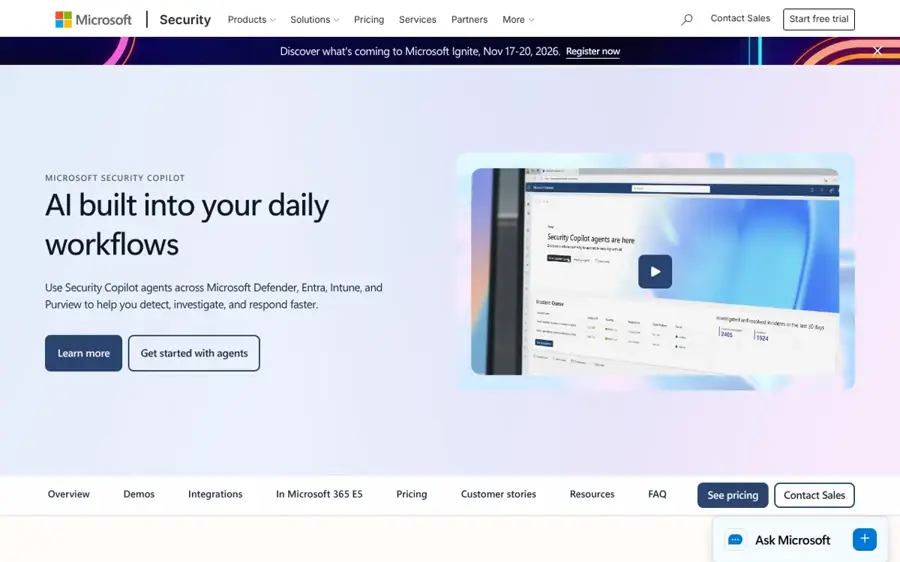
Security Copilot is Microsoft's AI assistant and agent platform for security and IT teams, built into Defender, Sentinel, Entra, Intune and Purview. See it at microsoft.com.
Strengths
The biggest reason to look at Security Copilot is cost, and that's a refreshing thing to say about an enterprise security tool. Microsoft says eligible Microsoft 365 E5 and E7 customers get 400 Security Compute Units (SCUs) per month for every 1,000 user licenses, up to 10,000 SCUs. A 4,000-seat company gets 1,600 SCUs a month without a separate purchase. Agents run inside the consoles your team already uses.
It also has the strongest published evidence on this list, as far as I can tell. A randomized controlled trial of the Phishing Triage Agent found agent-assisted analysts achieved "up to 6.5 times as many true positives per analyst minute and a 77% improvement in verdict accuracy" compared with a control group. The study evaluates Microsoft's own product, so it's vendor-linked. On PeerSpot, one reviewer wrote: "The ability to build Microsoft Security Copilot agents is outstanding."
Key features
- Embedded agents in Defender, Entra, Intune and Purview.
- Promptbooks for repeatable, multi-step investigations.
- Partner plugins and agents that extend beyond Microsoft tools.
- Incident summaries and guided response inside Microsoft Defender.
Pros
- Included capacity for eligible E5 and E7 customers.
- Only tool here with a published per-unit price.
- Randomized controlled trial evidence for phishing triage.
Cons
- Works best when most of your stack is Microsoft.
- SCU billing is hard to forecast until you measure real usage.
Microsoft Security Copilot pricing: No free plan. Provisioned capacity costs $4 per SCU per hour, with overage SCUs at $6 each (checked October 2026). One SCU provisioned around the clock works out to roughly $2,920 a month by our arithmetic. See pricing
Related: Microsoft AI and Copilot review AI cybersecurity companies guide
Verdict: if you already pay for E5, switch it on and measure before you buy anything else. I'd be cautious about SCU bills past the included amount.
Torq – best for autonomous triage and response
Torq is an AI SOC platform that triages, investigates and remediates alerts across your existing security tools using AI agents and automated workflows. See it at torq.io.
Strengths
Torq aims to close cases, not just summarize them. Going by the Auto Triage page, the engine normalizes incoming alerts to the Open Cybersecurity Schema Framework, enriches them with threat intel and business context, and assigns a verdict with MITRE ATT&CK mapping. Torq claims over 90% of cases are remediated autonomously, and it cites an August 2026 Gartner AI Vendor Race report naming it the company to beat in AI SOC agents for threat investigation. Both are vendor-quoted claims, so I'd want to see them on your own alerts.
User feedback is positive but realistic. Torq's own page reports 4.8 out of 5 from 21 reviews on Gartner Peer Insights as of October 16, 2026. On PeerSpot, an MSSP user said the AI orchestrator "is effective in handling alerts as long as you provide summarized data; otherwise, it could blow out of context and hallucinate." That review describes an early version, but the lesson probably holds.
Key features
- Auto Triage with explainable verdicts and severity scoring.
- Specialized AI agents that gather evidence and build timelines.
- 300 prebuilt integrations and 4,000+ prebuilt workflow steps.
- Deterministic guardrails so crown-jewel assets and VIP users are always treated as critical.
Pros
- Vendor-neutral, so it fits mixed stacks.
- Covers triage, investigation and response in one platform.
- Strong analyst recognition and peer ratings.
Cons
- No public pricing or free plan.
- AI results depend heavily on the quality of data you feed it.
- Cloud-only deployment, per a PeerSpot reviewer.
Torq pricing: No free plan; pricing is by quote only (checked October 2026). See pricing
Related: What is agentic AI? AI cybersecurity companies guide
Verdict: the strongest pick, in my view, if you want an independent AI SOC that acts, not just advises. The hidden pricing is a pain.
Tines – best for building your own AI workflows
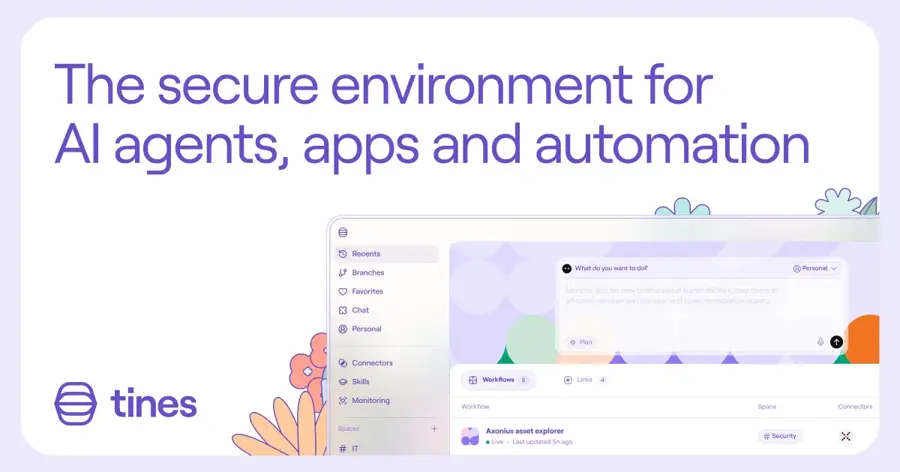
Tines is a workflow platform for building security automations, AI agents and internal apps, with a free edition you can start on today. See it at tines.com.
Strengths
Tines is the build-it-yourself option. You design workflows with natural language or a drag-and-drop canvas, then decide where AI suggests, assists or acts, with approvals and oversight built in. Its security use cases include multi-agent investigations, intelligent alert triage and automated phishing response. Paid editions let you bring your own AI model, which helps if your company has rules about which LLMs can touch security data.
One reviewer praises how easy it is to connect things. One PeerSpot reviewer said: "The API capabilities are what I find most valuable." The same reviewer described automating initial triage for alerts across about 12,000 customers.
Key features
- Free edition with unlimited users and three live workflows.
- AI agent and copilot orchestration for security and IT.
- Bring your own AI model on paid editions.
- Flexible case management with AI agents that create, triage and resolve cases.
Pros
- The only real free tier on this list.
- Very flexible API and webhook building blocks.
- You control model choice and autonomy levels.
Cons
- You build the logic, so you need automation skills on the team.
- No out-of-the-box AI analyst like Dropzone or Torq.
- Paid pricing isn't published.
Tines pricing: Free edition with three live workflows and a one-time $50 AI allowance; paid editions are by quote (checked October 2026). See pricing
Related: Automation vs AI compared
Verdict: probably the best place to start if you have engineers and want full control. Without them, it'd be a slog.
Google Security Operations – best for SIEM and SOAR in one platform
Google Security Operations (Google SecOps) combines SIEM, SOAR, threat intelligence and Gemini AI in one cloud-native platform. See it at cloud.google.com.

Strengths
Google SecOps is probably the best fit if you want detection and response automation in a single product. The built-in SOAR lets you build playbooks that orchestrate over 300 tools, and a context-aware AI chat can help you create those playbooks. Gemini adds natural-language search, AI case summaries and recommended response actions. Gemini is only included from the Enterprise package up, not in Standard, which is a letdown.
On PeerSpot, Google Security Operations has an average rating of 8.8 out of 10. One reviewer wrote: "Google SecOps is extremely useful for threat detection and hunting."
Key features
- Three packages: Standard, Enterprise and Enterprise Plus.
- 700+ parsers and 300+ SOAR integrations in every package.
- Gemini investigation assistant for summaries and response recommendations.
- Google Threat Intelligence, including Mandiant and VirusTotal, in Enterprise Plus.
Pros
- SIEM, SOAR and threat intel under one contract.
- Strong threat intelligence at the top tier.
- High peer rating on PeerSpot.
Cons
- Gemini features require Enterprise or higher.
- Ingestion-based pricing isn't published.
- Some reviewers want easier third-party log ingestion.
Google Security Operations pricing: No free plan; all three packages are priced by ingestion through sales (checked October 2026). See pricing
Related: AI cybersecurity companies guide
Verdict: pick it when you're replacing your SIEM and want SOAR built in; otherwise there's little reason to switch.
CrowdStrike Charlotte AI – best for CrowdStrike Falcon customers
Charlotte AI is CrowdStrike's agentic analyst for the Falcon platform, now paired with Charlotte Agentic SOAR for governed response workflows. See it at crowdstrike.com.

Strengths
Charlotte AI dispatches specialized agents to investigate endpoint, identity, cloud and network signals in parallel. CrowdStrike reports over 98% decision accuracy with agentic detection triage, measured against decisions from its own Falcon Complete MDR team. Charlotte Agentic SOAR, announced at Fal.Con 2026, combines no-code agents (AgentWorks), deterministic workflows and custom apps, with bidirectional MCP and a choice of LLMs from OpenAI, Anthropic and NVIDIA.
On PeerSpot, one user is enthusiastic and wrote that Charlotte AI "has changed the way my security team investigates and responds to threats by making us faster than a speeding bullet."
Key features
- Multi-agent investigations across endpoints, identity, cloud and network.
- AgentWorks for building no-code custom agents.
- Agentic SOAR with autonomy settings from human approval to fully autonomous.
- Bidirectional MCP to connect third-party tools and agents.
Pros
- Deep context from Falcon telemetry.
- Clear governance and permission controls.
- Model choice, including bring your own.
Cons
- Most valuable only if you already run Falcon.
- Charlotte AI pricing isn't published.
- Accuracy figures are vendor-measured.
CrowdStrike Charlotte AI pricing: No free plan; Charlotte AI is quoted through sales. CrowdStrike's public Falcon bundles start at $7.99 per device per month, but Charlotte AI isn't listed in them (checked October 2026). See pricing
Related: AI cybersecurity companies guide What is agentic AI?
Verdict: an easy add for Falcon customers and, I'd guess, a hard sell for anyone else.
Cortex AgentiX – best for Palo Alto Networks shops
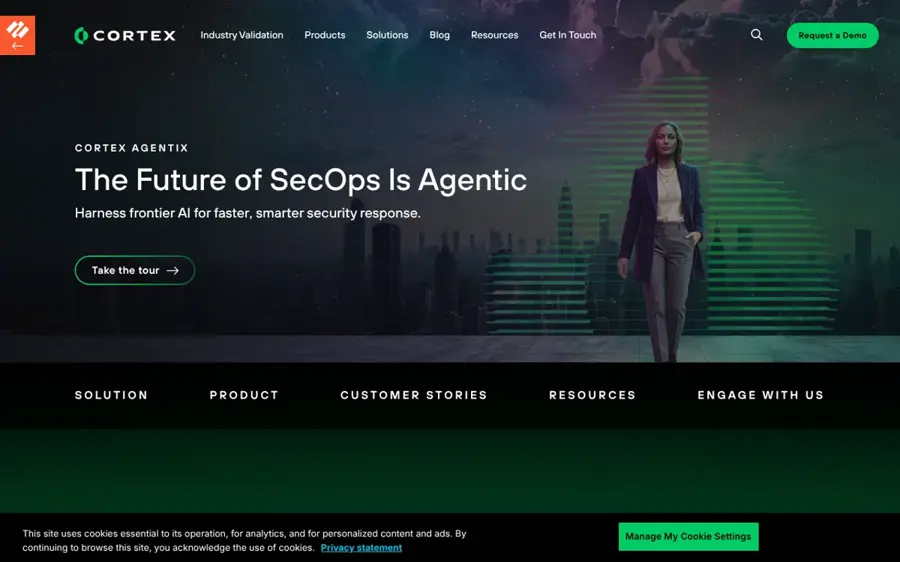
Cortex AgentiX is Palo Alto Networks' next generation of Cortex XSOAR, adding AI agents to playbook automation across Cortex XSIAM, XDR and Cortex Cloud. See it at paloaltonetworks.com.
Strengths
AgentiX has the largest integration library here, with over 1,100 prebuilt integrations and native MCP support. You can drop AI prompts straight into existing playbooks, so teams with years of XSOAR automation don't have to start over. Agents run under the same roles and permissions as analysts, with approvals for high-impact actions. Palo Alto says over 1,000 Cortex customers have enabled AgentiX.
On PeerSpot, an XSOAR user said: "The integration is very good, especially with the addition of AI features that require little to no programming." If you want a full SOC platform, Cortex XSIAM bundles SIEM, SOAR, EDR and AgentiX together.
Key features
- 1,100+ prebuilt integrations plus MCP server support.
- Library of specialized agents, or build your own.
- AI prompts inside playbooks for log summaries and data normalization.
- Role-based guardrails and human approval steps.
Pros
- Biggest integration catalog in this roundup.
- Upgrade path for existing XSOAR playbooks.
- Strong fit with Palo Alto firewalls and Cortex.
Cons
- Enterprise-only pricing and sales process.
- Complex to run without dedicated automation engineers.
Cortex AgentiX pricing: No free plan; pricing is by quote (checked October 2026). See pricing
Related: AI cybersecurity companies guide Best AI code security tools
Verdict: the natural upgrade if you already live in XSOAR or XSIAM, though I'd expect a hefty sales process.
SentinelOne Purple AI – best for plain-English threat hunting
Purple AI is SentinelOne's AI analyst for the Singularity Platform, now able to start investigations on its own when a threat crosses a set threshold. See it at sentinelone.com.
Strengths
In June 2026, SentinelOne opened Purple AI Agentic Investigation to all customers. It runs "zero-click" investigations, gives a verdict with a full evidence chain, and can trigger policy-driven responses. SentinelOne says it combines Anthropic's Claude, OpenAI's GPT and its own "Ultraviolet" models, and that activation takes a single click with no data leaving the platform. Usage draws on new Singularity Credits.
The everyday value looks simpler. A PeerSpot reviewer wrote: "There is no need to learn a querying language to do correlations."
Key features
- Agentic Investigation that starts automatically on high-severity threats.
- Natural-language queries across endpoint, identity, cloud and third-party data.
- Adjustable human-in-the-loop autonomy and reversible activation.
- Auditable evidence chain for every verdict.
Pros
- Zero configuration for existing Singularity users.
- Free trial credits to test agentic investigation.
- Lowers the skill barrier for threat hunting.
Cons
- Tied to the SentinelOne platform.
- Credit-based costs aren't published.
- Less of a general-purpose SOAR than Torq or Tines.
SentinelOne Purple AI pricing: No free plan; a complimentary credit trial is available, then Singularity Credits are bought through partners, direct billing or eCommerce (checked October 2026). See pricing
Related: AI cybersecurity companies guide
Verdict: a strong analyst sidekick if SentinelOne already protects your endpoints. Elsewhere it's hard to justify.
Dropzone AI – best for adding AI analysts to any stack
Dropzone AI sells pre-trained AI SOC agents that investigate every alert, hunt threats and track threat intel on top of the SIEM, EDR and cloud tools you already run. See it at dropzone.ai.
Strengths
Dropzone is the closest thing to hiring a tier 1 analyst who never sleeps (a fun idea, anyway). The AI SOC Analyst investigates alerts end to end and shows every tool it queried and every piece of evidence it weighed. You coach it in natural language instead of writing playbooks. Dropzone says it deploys in about an hour with 100+ integrations, and that 400+ security teams run it in production.
Independent evidence is thin so far. G2's agent evaluation page for Dropzone lists it as "Not evaluated" and shows only vendor-reported claims, and PeerSpot hadn't yet collected user reviews. Ask for a proof of concept on your own alerts.
Key features
- AI SOC Analyst with a full, auditable reasoning trail.
- AI Threat Hunter using prebuilt hunt packs or your own hypotheses.
- AI Threat Intel Analyst, in beta, that turns new CVEs into hunts.
- Unlimited containment actions, limited to blocking IPs and disabling accounts on confirmed threats.
Pros
- Works across existing tools with no data migration.
- No playbooks to build or maintain.
- All-inclusive enterprise package sized on employee count.
Cons
- Few independent reviews yet.
- Response actions are deliberately narrow.
- No public pricing.
Dropzone AI pricing: No free plan; Enterprise is sized on employee count, with separate MSSP and federal packages, all by quote (checked October 2026). See pricing
Related: What is agentic AI? AI cybersecurity companies guide
Verdict: probably the fastest way to add AI triage without changing your stack, but I'd insist on a pilot.
Choosing the right cybersecurity AI automation tools
Start with the platform you already pay for
If most of your telemetry sits in Microsoft, Google, CrowdStrike, Palo Alto Networks or SentinelOne, test that vendor's AI first. You avoid new integrations and may already have bundled capacity.
Decide between build and buy
Tines and Cortex AgentiX give you building blocks, so you shape the workflow. Dropzone AI and Torq ship pre-trained agents that work out of the box. Choose Tines if you have automation engineers. Choose Dropzone or Torq if you need results without a build project.
Check what the AI is allowed to do
Look at autonomy settings before features. The tools here support approval gates and audit trails. Start with AI triage and recommendations, then allow automatic containment for narrow, low-risk actions like blocking a known-bad IP. Our guide to agentic AI explains why that gradual approach makes sense.
Run a proof of concept on your own alerts
Vendor accuracy numbers are measured on their data, not yours. Feed two shortlisted tools the same week of real alerts and compare verdicts against your analysts. Messy data is the point; a demo set won't tell you much.
Free versus paid
Free options are rare in security automation. This is what's available as of October 2026:
| Tool | Free option | What paying adds |
|---|---|---|
| Tines | Free edition: unlimited users, 3 live workflows, one-time $50 AI allowance | Unlimited workflows, flexible deployment, bring your own AI model |
| Microsoft Security Copilot | Included SCUs with eligible Microsoft 365 E5 and E7 licenses | Extra provisioned SCUs at $4 per hour, overage at $6 |
| SentinelOne Purple AI | Complimentary trial credits, no payment method needed | Ongoing Singularity Credits |
| Everyone else | Demo or sales-led trial | Full platform, priced by quote |
The budget angle is simple, I think: learn on the Tines free edition, use E5 SCUs if you have them, and budget for a pilot and a sales cycle for anything else.
Final verdict
Most teams should probably start with the AI built into their main security platform, and Microsoft Security Copilot is the easiest win if you hold E5 licenses. If you run a mixed stack and want alerts closed instead of summarized, Torq is my top independent pick, with Dropzone AI as the simpler, playbook-free alternative. Choose Tines if you want to build and control every step. For the bigger picture on whether these tools change security careers, see our piece on whether AI will take over cyber security jobs.
FAQ
What is cybersecurity AI automation?
Cybersecurity AI automation uses AI models and workflows to handle security operations work that analysts used to do by hand: triaging alerts, enriching them with threat intel, investigating incidents, writing summaries and taking response actions such as isolating a device, usually with human approval for high-impact steps.
What is the difference between SOAR and an AI SOC analyst?
SOAR (security orchestration, automation and response) runs predefined playbooks: if this alert arrives, do these steps. An AI SOC analyst reasons about each alert, decides what evidence to gather and gives a verdict without a fixed script. In 2026 most products blend both, as Charlotte Agentic SOAR and Cortex AgentiX show.
Will AI SOC agents replace security analysts?
Not on current evidence, as far as I can tell. Vendors including SentinelOne and Dropzone AI pitch their agents as extending analysts, and the Microsoft phishing triage trial found agent-assisted analysts spent 53% more time on malicious emails, shifting effort rather than disappearing. AI takes the repetitive tier 1 queue, while people keep judgment calls, threat hunting and high-impact decisions.
How much does Microsoft Security Copilot cost?
Microsoft charges $4 per provisioned Security Compute Unit per hour, billed monthly, with a minimum of one SCU. Extra overage SCUs cost $6 each and you can cap them. Eligible Microsoft 365 E5 and E7 customers get 400 SCUs a month per 1,000 licenses, up to 10,000 SCUs, at no extra charge.
Is there a free security automation tool?
Tines has a free edition with unlimited users, three live workflows and a one-time $50 AI allowance, which is enough to build and test a phishing or alert enrichment workflow. SentinelOne offers free trial credits for Purple AI. The other tools on this list require a demo or sales-led trial.
Can these tools take response actions automatically?
Yes, if you allow it. Torq, Charlotte AI, Cortex AgentiX, Purple AI and Dropzone AI can all trigger containment actions, and each lets you set autonomy levels, from recommendations only to fully automatic. Start with narrow, reversible actions and keep human approval for anything disruptive.
Sources
- Microsoft Security Copilot (Microsoft Security)
- Microsoft Security Copilot – Pricing (Microsoft Security)
- Randomized Controlled Trials for Phishing Triage Agent (arXiv)
- Microsoft Security Copilot reviews 2026 (PeerSpot)
- Torq AI SOC Platform (Torq)
- The Torq AI SOC Platform (Torq)
- Torq Auto Triage (Torq)
- Torq reviews 2026 (PeerSpot)
- Tines: the secure environment for AI agents, apps and automation (Tines)
- Pricing (Tines)
- AI agents, copilots and MCP: AI interaction layer (Tines)
- Tines reviews 2026 (PeerSpot)
- Google Security Operations (Google Cloud)
- Google Security Operations reviews 2026 (PeerSpot)
- Charlotte AI: Agentic Analyst for Cybersecurity (CrowdStrike)
- Charlotte Agentic SOAR (CrowdStrike)
- CrowdStrike pricing and bundles (CrowdStrike)
- Charlotte AI reviews 2026 (PeerSpot)
- Cortex AgentiX (Palo Alto Networks)
- Cortex XSIAM (Palo Alto Networks)
- Palo Alto Networks Cortex XSOAR reviews 2026 (PeerSpot)
- Purple AI (SentinelOne)
- SentinelOne Opens Purple AI Agentic Investigation to All Customers (SentinelOne)
- Purple AI reviews 2026 (PeerSpot)
- Agentic SOC: AI agents for alert triage and threat hunting (Dropzone AI)
- Agentic SOC pricing (Dropzone AI)
- Dropzone AI agent profile (G2 Agent Evaluations)