Best AI evaluation tools for production in 2026: 7 picks for every budget
The best AI evaluation tools for production in 2026, from open-source Langfuse and Phoenix to Braintrust and LangSmith, with prices and trade-offs.
 Written byDr. Alap ZahidReviews And Guides Editor
Why you can trust The AI Future
Our writers research every product, link each claim to its source and correct mistakes openly. Companies can't pay for coverage or see reviews before they're published.
Read our editorial policy
Short answer: if you want one tool to trace, evaluate and monitor an AI app in production, start with Langfuse. It's open source under MIT, you can self-host it for free, and its cloud plans begin with a free Hobby tier. If your team lives in CI and wants evals that block bad releases, pay for Braintrust. If you build on LangChain or LangGraph, LangSmith is the natural fit. That's my read, anyway, and I think it holds for most teams.
Those three cover most teams looking for the best AI evaluation tools for production. The rest of this list are specialists: Arize Phoenix for self-hosted agent tracing, W&B Weave for teams already on Weights & Biases, DeepEval for pytest-style tests, and Galileo for large companies that want guardrails on live traffic. Below, you'll find prices, open-source status and the trade-offs for each, checked in late October 2026. Some picks are clear wins; a couple are narrow.
Key takeaways
- Open source is a real option here: Langfuse (MIT), DeepEval (Apache 2.0), Weave (Apache 2.0) and Phoenix (Elastic License 2.0) can all run on your own infrastructure.
- Every pick except Galileo has a free entry point, and paid cloud plans start at $29 a month (Langfuse Core) and climb to $249 a month (Braintrust Pro) before enterprise deals.
- The market's consolidating: ClickHouse bought Langfuse, Cisco bought Galileo, CoreWeave folded Weights & Biases into CoreWeave Forge, and Humanloop shut down after its team joined Anthropic.
- Most of these tools accept OpenTelemetry traces, so instrumenting with it first should keep you free to switch vendors later.
Our ranking method
Nobody at The AI Future ran hands-on tests for this roundup, and we didn't take screenshots of the products. We compared each tool using official product, pricing and documentation pages, GitHub repositories, published independent comparisons and developer write-ups, as of late October 2026. G2 review pages weren't accessible to us, so we lean on GitHub adoption and independent articles for outside opinion. We scored each tool on seven criteria:
- Tracing depth: how well it captures multi-step agent runs, tool calls and retrieval steps.
- Evaluation: offline experiments, datasets, LLM-as-a-judge, code scorers and human review.
- Production monitoring: online evals on live traffic, dashboards and alerts.
- Openness: license, self-hosting and OpenTelemetry support.
- Price to start: how much a small team pays before it gets real value.
- Price at scale: how usage-based charges grow with trace volume and seats.
- Enterprise readiness: SSO, RBAC, SOC 2, HIPAA options and data residency.
Prices are in US dollars and exclude usage overages unless stated. Confirm on the vendor’s pricing page before you buy.
The 7 best AI evaluation tools for production at a glance
| # | Tool | Category | Best for | Free tier | Starts at |
|---|---|---|---|---|---|
| 1 | Langfuse | Open-source platform | Self-hosted, all-round LLMOps | Yes | $29/mo |
| 2 | Braintrust | Eval and observability platform | Eval-driven teams and CI gates | Yes | $249/mo |
| 3 | LangSmith | Agent observability platform | LangChain and LangGraph teams | Yes (limited) | $39/seat/mo |
| 4 | Arize Phoenix | Open-source tracing and evals | Agent tracing on your own servers | Yes | $50/mo |
| 5 | W&B Weave | Agent observability toolkit | Teams already on Weights & Biases | Yes | $60/mo |
| 6 | DeepEval | Open-source eval framework | Pytest-style tests in CI | Yes (limited) | $200/mo |
| 7 | Galileo | Enterprise eval and guardrails | Real-time guardrails at scale | No | Custom |
Notes: Arize Phoenix itself is free; $50 a month is Arize AX Pro, the hosted commercial tier. DeepEval is free; $200 a month is the Confident AI Starter plan per organization. Galileo’s old pricing link now redirects to Splunk, and we couldn't find a public self-serve plan.
The best AI evaluation tools for production in 2026, ranked
Langfuse – best for self-hosted, all-round LLMOps
Langfuse is an open-source platform for tracing, prompt management, evaluations and datasets, available as a managed cloud or as software you run yourself.
Strengths
Langfuse is probably the safest default because you're not locked in. Its GitHub repository has about 36,800 stars, and the team explains that open source lets developers inspect every line that handles their data. A pricing teardown on DEV Community notes that in June 2025 Langfuse moved all core product features, including LLM-as-a-judge and annotation queues, to the MIT license.
Ownership changed this year: ClickHouse acquired Langfuse, and the team says there are "no planned changes to licensing." Independent reviewers agree on the appeal. Gabriel Anhaia’s 2026 comparison concludes that "the least-regret default is Langfuse self-hosted," and one developer who tried four tools wrote that "Langfuse is genuinely good," while flagging weak alerting.
Key features
- Agent tracing: traces, graphs, sessions and user tracking, with token and cost tracking.
- Prompt management: versioning, release labels, caching and a playground.
- Evaluation: online and offline evals, datasets, LLM-as-a-judge and human annotation queues.
- Open standards: Python and JavaScript SDKs plus OpenTelemetry for Java, Go and custom setups.
- Data regions: US, EU or Japan on the cloud, or anywhere if you self-host.
Pros
- MIT-licensed core you can self-host with no usage caps
- Unlimited users from the $29 Core plan
- Broad framework integrations and OpenTelemetry support
- Transparent, usage-based pricing
Cons
- Self-hosting at scale means running ClickHouse yourself
- Built-in alerting is basic (two alerts on the free plan)
- SSO needs Pro plus the Teams add-on
Langfuse pricing: Free, then paid plans from $29/month (Core, 100k units included, then $8 per 100k), with Pro at $199/month according to CostBench’s October 29 check (checked October 2026). See pricing
Related: Best AI development solutions What is LLM AI?
Verdict: if you only pick one tool, pick Langfuse.
Braintrust – best for eval-driven teams and CI gates
Braintrust is a commercial platform that combines production tracing, experiments on real datasets and scoring with LLMs, code or humans, built around catching regressions before release.
Strengths
Braintrust is the pick when evals are part of your release process, and I'd say it's the most polished of the paid options. Anhaia’s independent comparison says "The CI-first pitch is real," describing scorers that run in CI and merges that block when quality drops. The same review warns it's closed source and that lower-tier retention can be short for long drift investigations.
The free plan is unusually team-friendly: unlimited users, projects and experiments, 1 GB of processed data and 10,000 scores a month. Braintrust also highlights its Brainstore database and hybrid deployment. One customer quoted on its homepage, CTO Luis Héctor Chávez, says it "helped us identify several patterns that we wouldn't have found." That's a vendor-selected testimonial, so weigh it accordingly.
Key features
- Experiments: compare prompts and models side by side on real datasets.
- Scorers: LLM-as-a-judge, autoevals and custom code scorers, plus human review.
- Loop agent: a built-in agent that runs evals, generates test cases and iterates on prompts.
- Brainstore: search across long prompts, responses and tool calls.
- Compliance: SOC 2 Type II, SSO, RBAC, HIPAA and hybrid deployment options.
Pros
- Generous free tier with unlimited users
- Strongest workflow for blocking regressions in CI
- Same platform for engineers and product managers
- Startup program offers 6–12 months of Pro free
Cons
- Big jump from free to $249 a month
- Closed source; self-hosting is enterprise or hybrid only
- 14-day retention on the free plan
Braintrust pricing: Free, then paid plans from $249/month (Pro, with $100 model credits, 5 GB data and 50k scores) (checked October 2026). See pricing
Related: Best AI development solutions How to create an AI agent
Verdict: the best paid choice if every pull request should run your eval suite.
LangSmith – best for LangChain and LangGraph teams
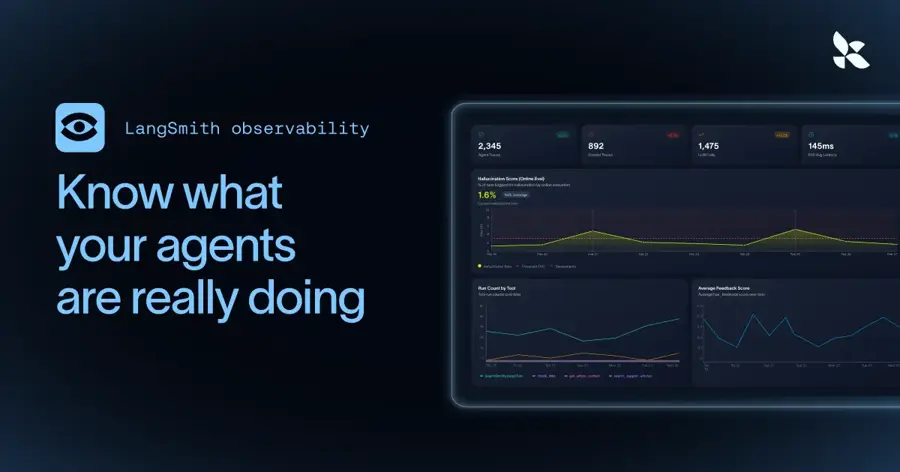
LangSmith is LangChain’s observability and evaluation platform for agents, with tracing, online evals, trace clustering and managed agent deployment.
Strengths
LangSmith goes deepest on the LangChain stack, but it isn't limited to it. The product page lists native tracing for popular frameworks and OpenTelemetry, SDKs for Python, TypeScript, Go and Java, online LLM-as-judge and code evals, and PagerDuty alerts. Its SmithDB store is built for nested agent traces, and Enterprise customers can self-host it.
Cost is the common complaint. One developer’s verdict was blunt: "Pricing is punitive." The complaint centers on the per-seat fee, which seems fair to me for larger teams. Anhaia’s comparison says pricing "escalates fast once you leave the free tier." Base traces keep only 14 days of history; extended 180-day retention costs extra.
Key features
- Agent tracing: step-by-step traces with message threading for multi-turn chats.
- Online evals: LLM-as-judge and code evaluators on production traffic.
- Insights: unsupervised topic clustering to surface usage patterns and failure modes.
- Deployment: managed LangSmith Deployment, with one small serverless deployment on Plus.
- Privacy: LangChain says it doesn't use your traces to train models.
Pros
- Tightest integration with LangChain and LangGraph
- Strong datasets, experiments and review queues
- Broad SDK coverage, including Go and Java
- Self-hosted and hybrid options on Enterprise
Cons
- $39 per seat adds up for larger teams
- Free plan is one seat and 5,000 base traces
- Short default retention on base traces
LangSmith pricing: Free, then paid plans from $39/seat/month (Plus, 10k base traces included), per CostBench’s check of the official page (checked October 2026). See pricing
Related: What is agentic AI? Best AI development solutions
Verdict: worth the seat fee if most of your app runs on LangChain; otherwise look at Langfuse first.
Arize Phoenix – best for agent tracing on your own servers
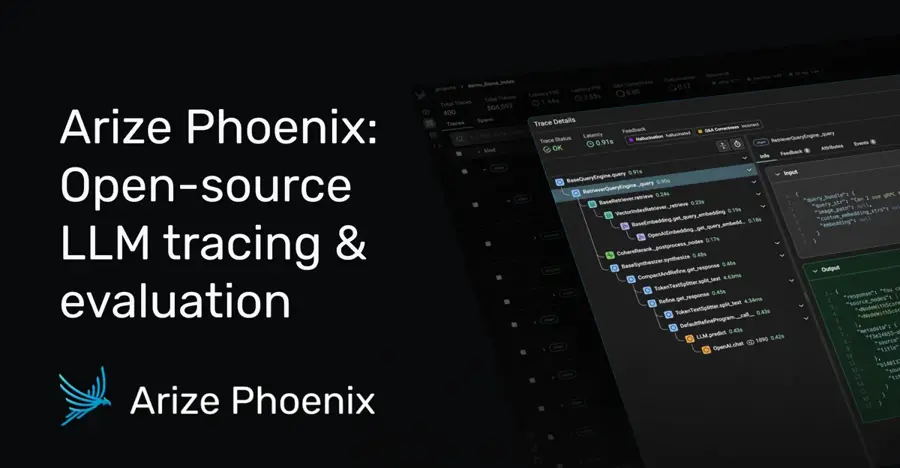
Arize Phoenix is an open-source, local-first tool for tracing, evaluating and experimenting on AI agents, with Arize AX as the hosted commercial upgrade.
Strengths
Phoenix suits teams that want traces to stay inside their own environment. The official site stresses native OpenTelemetry support, any model or framework, and Helm charts for Kubernetes. Its GitHub repository has about 12,100 stars. Anhaia’s review rates its agent evaluation "the deepest of the four" tools compared.
The license is Elastic License 2.0, not MIT, which matters only if you want to resell it as a hosted service. Also, one developer felt "The UI feels like it was designed for data scientists, not backend developers." If you outgrow self-hosting, Arize AX adds a managed service with unlimited users and evals on every plan.
Key features
- Tracing: every prompt, retrieval, tool call and output in an agent run.
- Annotation: human labels or LLM-as-judge on traces.
- Experiments: build datasets from traces and benchmark changes.
- Deploy anywhere: run locally, self-host or use Kubernetes with Helm.
- Agent skills: automations you can build with coding agents.
Pros
- Free to self-host with no usage caps
- OpenTelemetry-native, so little lock-in
- Strong views for multi-step agent runs
- Clear upgrade path to Arize AX
Cons
- Elastic License 2.0, not a permissive license
- Interface leans toward data scientists
- AX Pro’s 50k spans a month can be tight
Arize Phoenix pricing: Free and open source; then Arize AX paid plans from $50/month (AX Pro, 50k spans and 10 GB a month) (checked October 2026). See pricing
Related: Best cloud native AI platforms What is agentic AI?
Verdict: the open-source pick for agent-heavy teams that must keep data in-house.
W&B Weave – best for teams already on Weights & Biases
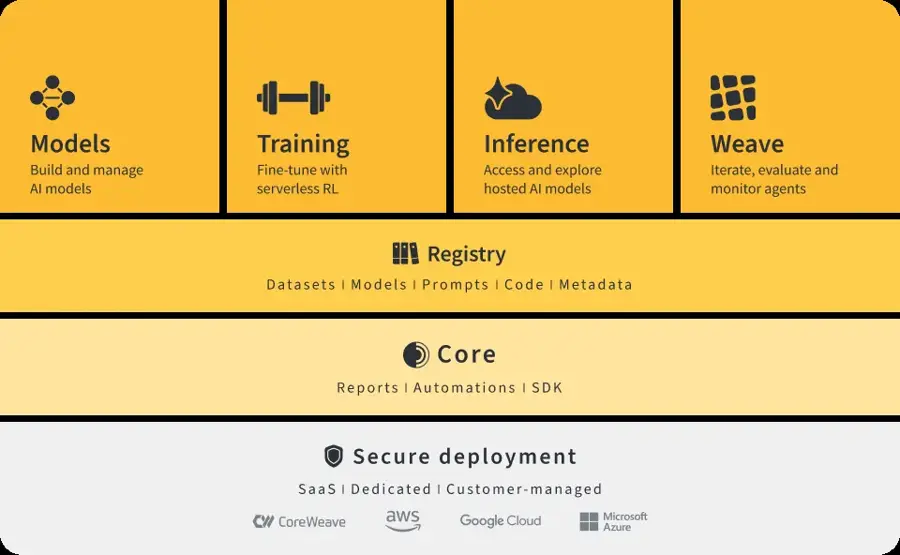
W&B Weave is Weights & Biases’ toolkit for tracing, evaluating and monitoring production agents, now sold inside CoreWeave Forge.
Strengths
Weave makes sense if your ML team already tracks experiments in Weights & Biases. The Weave page describes agent-native tracing with sessions, turns, tools and sub-agents, built-in signals with Slack and webhook alerts, and Guardrails scorers for toxicity, PII and hallucinations. The SDK is Apache 2.0 licensed on GitHub, though the repository is far smaller than Langfuse’s at about 1,100 stars.
The business around it has changed, and it's a lot to keep track of. Techstrong.ai reports that CoreWeave, which bought Weights & Biases in 2025, launched CoreWeave Forge to combine W&B Models with training, inference and sandboxes, and is moving existing W&B SaaS customers into the Forge environment. Weights & Biases stays cloud-agnostic, according to the same report. Whether that holds as Forge grows, I can't say.
Key features
- Agent-native tracing: sessions, turns, steps, tools and sub-agents as first-class objects.
- Signals and alerts: automatic classification of agent behavior with Slack and webhook alerts.
- Evaluation API: comparisons and visualizations to catch regressions.
- Guardrails: pre-built safety and quality scorers.
- Leaderboards and Playground: compare models and prompts against production traces.
Pros
- One platform for model training and agent monitoring
- Strong evaluation comparisons and leaderboards
- Coding agents can connect through MCP
- HIPAA option on Enterprise
Cons
- Small free ingestion allowance (1 GB a month)
- Pro is limited to teams under 50 employees
- Rebrand to CoreWeave Forge may confuse procurement
W&B Weave pricing: Free, then paid plans from $60/month (Pro, 1.5 GB Weave ingestion, then $0.10/MB) (checked October 2026). See pricing
Related: Best cloud native AI platforms
Verdict: a natural add-on for W&B shops, and an odd choice if you have never used W&B.
DeepEval – best for pytest-style tests in CI
DeepEval is an open-source LLM evaluation framework that works like pytest for AI apps, with Confident AI as its hosted platform for tracing, monitoring and team review.

Strengths
DeepEval is where a lot of engineers likely start, because it lives in your test suite. The official site lists 50+ research-backed metrics, including hallucination, faithfulness and answer relevancy, plus multi-turn and voice metrics and synthetic test generation. The GitHub repository has about 19,200 stars and an Apache 2.0 license.
For production monitoring you add Confident AI, which evaluates live traces, groups failures into issues and alerts your team. A customer quoted on its site says an improvement cycle went from 10 days to three hours: "Now the same cycle takes three hours." Treat that as a vendor testimonial. The free plan's narrow: two seats, one project and five test runs a week.
Key features
- 50+ metrics: hallucination, faithfulness, relevancy, toxicity, bias and more.
- Pytest-native: run evals in CI/CD or as Python scripts.
- Custom metrics: G-Eval, DAG metrics and plain-English criteria.
- Synthetic data: generate test cases from your knowledge base or simulate conversations.
- Confident AI: online evals, annotation queues, alerting and on-prem options.
Pros
- Free, permissive open-source framework
- Fits naturally into existing test pipelines
- Cheap tracing on Confident AI at $1 per GB-month
- Self-hosting available on Enterprise
Cons
- Hosted tiers jump from $200 to $2,000 a month
- Free cloud plan caps test runs at five a week
- Dashboards and monitoring require Confident AI
DeepEval pricing: Free and open source; then Confident AI paid plans from $200/month per organization (Starter), with Team at $2,000/month (checked October 2026). See pricing
Related: How to create an AI agent Best AI development solutions
Verdict: the best free way to put real tests around an LLM feature.
Galileo – best for real-time guardrails at scale
Galileo is an enterprise platform for AI evaluation, observability and guardrails, now part of Cisco and sold as Splunk Agent Observability.

Strengths
Galileo’s pitch is turning offline evals into production guardrails. Its site describes 20+ out-of-the-box evals for RAG, agents, safety and security, and Luna models that it says monitor all traffic at "96% lower cost" than using full LLM judges. You can deploy it as SaaS, in a virtual private cloud or on-premises.
Splunk confirms that Cisco has completed the acquisition and that Galileo is "now Splunk Agent Observability." Announcing the deal, Splunk’s Kamal Hathi wrote, as reported by Network World, that "Galileo was purpose-built to solve one of the hardest and most consequential problems in AI: Trust." Expect a Splunk sales process instead of a credit card checkout; that'd put me off if I were a small team.
Key features
- Out-of-the-box evals: 20+ metrics for RAG, agents, safety and security.
- Luna models: distilled evaluators for low-latency, low-cost monitoring.
- Guardrails: eval scores can control agent actions, tool access and escalation.
- Insights engine: finds failure modes and suggests fixes.
- Deployment choice: SaaS, VPC or on-premises.
Pros
- Built for real-time guardrails on 100% of traffic
- Fits companies already standardized on Splunk
- Flexible deployment for regulated industries
Cons
- No public pricing or self-serve plan
- Overkill for small teams
- Roadmap now tied to Splunk’s portfolio
Galileo pricing: No free plan listed; then custom pricing through Splunk (checked October 2026). See pricing
Verdict: for large enterprises that already buy from Splunk and need guardrails, not dashboards.
Humanloop's shutdown
Humanloop used to appear on most lists like this one. It's gone. Its homepage now says the team is joining Anthropic and that "we sunset the Humanloop platform." According to Latent Space’s profile, customers were told to export their data before September 8, 2025. If you've still got Humanloop workflows, Langfuse and Braintrust are the closest replacements for prompt management plus evals.
Choosing the right AI evaluation tools for production
Start with where your data can live
If you handle health, finance or EU-resident data, self-hosting may decide the question before features do. Langfuse, Phoenix and DeepEval run on your own servers for free. LangSmith, Braintrust, Confident AI and Galileo offer self-hosted or hybrid setups, but mostly on enterprise contracts.
Match the tool to your framework
Choose LangSmith if most of your agent code is LangChain or LangGraph. Choose W&B Weave if your ML team already uses Weights & Biases. Choose Langfuse or Phoenix if you use several frameworks and want to stay neutral. Simple.
Decide how strict your release gate is
Some teams want evals to block a merge. Others review scores weekly, and that's fine. Braintrust and DeepEval fit the first group best. Langfuse gives you the building blocks, but you wire up the CI gate yourself, as Anhaia notes.
Model your real costs
Seat fees and usage charges behave differently. LangSmith charges per seat, while Braintrust, Langfuse and Arize include unlimited users on paid plans and bill on data, units or scores. Estimate your monthly traces and team size, then use each vendor’s calculator. Do it before you commit.
Instrument with OpenTelemetry
Langfuse, LangSmith, Phoenix and Braintrust all support OpenTelemetry. Standard instrumentation means switching backends later is mostly a config change, which matters in a market where three of these vendors changed owners in a year.
Free vs paid: what you actually get
Free plans are good enough to prove value, though I doubt they'll carry a busy production app. Here's what the free tiers include, from official pricing pages in October 2026.
| Tool | Free plan limits | First paid plan adds |
|---|---|---|
| Langfuse | 50k units a month, 30 days of data, 2 users (or unlimited if self-hosted) | 100k units, 90 days, unlimited users for $29/mo |
| Braintrust | 1 GB data, 10k scores, 14-day retention, unlimited users | 5 GB, 50k scores, 30 days, RBAC for $249/mo |
| LangSmith | 1 seat, 5k base traces a month | Unlimited seats at $39 each, 10k base traces |
| Arize Phoenix / AX | Phoenix unlimited if self-hosted; AX Free 25k spans, 15 days | 50k spans, 10 GB, 30 days for $50/mo |
| W&B Weave | 1 GB Weave ingestion a month | 1.5 GB, team access controls, alerts from $60/mo |
| DeepEval / Confident AI | Framework free; cloud has 2 seats, 1 project, 5 test runs a week | Unlimited seats, online evals, alerting for $200/mo |
Paying mostly buys you longer retention, more users, higher volume and compliance features like SSO and SOC 2 reports. If budget is tight, self-hosting Langfuse or Phoenix and running DeepEval in CI costs nothing beyond your infrastructure. That's the route I'd take first.
Final verdict
Most teams should start with Langfuse. It covers tracing, prompts and evals, it's MIT licensed, and the $29 Core plan is the cheapest serious production tier on this list. I'd pick it over the others unless you have a specific reason not to.
- Choose Braintrust if you want evals enforced in CI and can justify $249 a month.
- Choose LangSmith if your agents run on LangChain or LangGraph.
- Choose Arize Phoenix if you need free, self-hosted agent tracing.
- Choose W&B Weave if your team already lives in Weights & Biases.
- Choose DeepEval if you want tests in your codebase before you buy a platform.
- Choose Galileo if you're a large Splunk customer that needs real-time guardrails.
For the wider build stack around these tools, see our guides to the best AI development solutions and cloud native AI platforms.
FAQ
What is an AI evaluation tool for production?
It's software that records what your LLM app or agent does on real traffic and scores the results. Most combine tracing, which logs every model call and tool step, with evaluations such as LLM-as-a-judge, code checks and human review. The goal is to catch hallucinations, regressions and cost spikes before users notice them.
What is the difference between LLM evaluation and LLM observability?
Observability shows you what happened: traces, latency, token costs and errors. Evaluation judges whether the output was good, using datasets, scorers and reviewers. Offline evals run before release; online evals score live traffic. The tools on this list do both.
Are open-source LLM evaluation tools good enough for production?
Yes, for many teams. Langfuse is MIT licensed and self-hostable with no usage caps, Phoenix runs on Kubernetes, and DeepEval is Apache 2.0. The trade-off is operations work: you run the databases, upgrades and backups yourself, and nobody's on call for you. Paid cloud plans mainly add retention, support and compliance features, which is what most teams are really paying for.
How much do AI evaluation tools cost?
As of October 2026, every pick except Galileo has a free entry point. Paid cloud plans start at $29 a month for Langfuse Core, $39 per seat for LangSmith Plus, $50 for Arize AX Pro, $60 for W&B Pro, $200 for Confident AI Starter and $249 for Braintrust Pro. Usage overages come on top.
Is Humanloop still available?
No. Humanloop’s team joined Anthropic, and the company sunset its platform. Customers were told to export their data before September 8, 2025. If you're after a replacement, try Langfuse or Braintrust.
Can I switch evaluation tools later?
Usually, if you instrument with OpenTelemetry. Langfuse, LangSmith, Phoenix and Braintrust all accept OpenTelemetry traces, so changing backends is mostly configuration. Datasets, prompts and custom scorers take more effort to move, so export them regularly whichever vendor you choose.
Sources
- Pricing - Langfuse (Langfuse)
- Langfuse Pricing 2026 (CostBench)
- langfuse/langfuse (GitHub)
- Langfuse joins ClickHouse (Langfuse)
- Why is Langfuse open source? (Langfuse)
- Langfuse Pricing Teardown 2026 (DEV Community)
- Braintrust - The active observability platform for agents (Braintrust)
- Pricing - Braintrust (Braintrust)
- LangSmith: Agent & LLM Observability Platform (LangChain)
- LangSmith Plans and Pricing (LangChain)
- LangSmith Pricing 2026 (CostBench)
- Arize Phoenix: Open-Source LLM Observability & Agent Evaluation (Arize AI)
- Arize-ai/phoenix (GitHub)
- Arize AX Pricing (Arize AI)
- W&B Weave: Observability for production agents (Weights & Biases)
- CoreWeave Forge Pricing (Weights & Biases)
- wandb/weave (GitHub)
- CoreWeave Forge Brings Acquired AI Tools Together in New Development Layer (Techstrong.ai)
- DeepEval - The LLM Evaluation Framework (Confident AI)
- confident-ai/deepeval (GitHub)
- Confident AI: Enterprise AI Evaluation & Observability Platform (Confident AI)
- Confident AI Pricing (Confident AI)
- Galileo AI: The AI Observability and Evaluation Platform (Galileo)
- Galileo (Splunk)
- Cisco to acquire Galileo for AI observability (Network World)
- Humanloop joins Anthropic (Humanloop)
- Humanloop (Latent Space)
- Langfuse vs LangSmith vs Phoenix vs Braintrust: The Honest 2026 Comparison (DEV Community)
- I tried LangSmith, Langfuse, Helicone, and Phoenix (DEV Community)