AI governance consulting in 2026: the 8 best firms for EU AI Act and ISO 42001 work
Eight real AI governance consulting firms compared on EU AI Act, ISO/IEC 42001 and NIST AI RMF support, from Deloitte and KPMG to specialist Nemko Digital.
 Written byMuhammad Usman SiddiquiFounder and editor-in-chief
Why you can trust The AI Future
Our writers research every product, link each claim to its source and correct mistakes openly. Companies can't pay for coverage or see reviews before they're published.
Read our editorial policy
Short answer: if you run a large, regulated business and need one partner for strategy, controls and assurance, start with Deloitte or KPMG. If your main goal is an ISO/IEC 42001 certificate, line up a specialist implementer such as Nemko Digital and an accredited auditor such as Schellman. Everything else on this list is a strong option for a specific situation. I think that two-firm split (builder plus auditor) is the part buyers most often get wrong.
AI governance consulting means paying outside experts to help you set up the policies, roles, risk assessments and controls that keep your AI use legal, safe and auditable. Demand is being driven by three frameworks: the EU AI Act, the ISO/IEC 42001 management system standard and the US NIST AI Risk Management Framework. The deadlines also moved this year. EU lawmakers agreed to push the AI Act's stand-alone high-risk rules to 2 December 2027, which gives you time, but probably not an excuse to wait.
Eight real firms with published AI governance consulting pages are ranked below for different buyers. Every claim comes from the firms' own sites or reputable coverage.
Key takeaways
- Deloitte, KPMG, PwC and EY lead on breadth, since all four combine AI governance advisory with assurance, legal and cyber teams.
- None of these firms publishes prices; they all work on custom quotes, so scope is the lever you control.
- Advice and certification are separate jobs, because an accredited ISO 42001 certification body audits you and can't also build your management system.
- The EU AI Act clock is still running: high-risk rules for Annex III systems now apply from 2 December 2027 and for Annex I products from 2 August 2028, according to Winston Taylor.
Our ranking method
Nobody at The AI Future hired these firms or ran hands-on tests for this roundup. Consulting engagements are private, so we compared each firm using its official AI governance service pages, press releases, published case studies and independent coverage, as of late October 2026. We didn't use or invent client results. We scored each firm on six criteria:
- Framework coverage: explicit support for the EU AI Act, ISO/IEC 42001 and the NIST AI RMF.
- Delivery depth: whether the firm goes beyond policy to controls, testing and monitoring.
- Assurance options: independent testing, attestation or certification routes.
- Technology fit: help selecting and running AI governance platforms.
- Proof: published, verifiable evidence such as the firm's own certifications or public case studies.
- Accessibility: how realistic the firm is for a mid-sized buyer, beyond the Fortune 500.
Review platforms such as G2 and Trustpilot don't carry meaningful ratings for consulting practices like these, so we leaned on primary sources instead.
The 8 best AI governance consulting firms at a glance
| # | Tool | Category | Best for | Free tier | Starts at |
|---|---|---|---|---|---|
| 1 | Deloitte | Big Four advisory | Enterprise-wide governance programs | No | Custom quote |
| 2 | KPMG | Big Four advisory | AI assurance and ISO 42001 readiness | No | Custom quote |
| 3 | PwC | Big Four advisory | EU AI Act compliance in Europe | No | Custom quote |
| 4 | EY | Big Four advisory | Framework-led AI risk reviews | No | Custom quote |
| 5 | IBM Consulting | Tech consultancy | Data-heavy firms using watsonx | No | Custom quote |
| 6 | Accenture | Tech consultancy | Governance inside large AI transformations | No | Custom quote |
| 7 | Nemko Digital | Specialist consultancy | Mid-sized ISO 42001 implementation | No | Custom quote |
| 8 | Schellman | Certification body | Independent ISO 42001 certification | No | Custom quote |
The best AI governance consulting services in 2026, ranked
Deloitte – best for enterprise-wide governance programs
Deloitte's Trustworthy AI practice helps large organisations build AI governance, regulatory compliance and assurance around its own Trustworthy AI framework.

Strengths
Deloitte frames compliance as the floor, and I like that. Its UK service page says EU AI Act compliance is required, but that "trustworthy AI goes well beyond complying with the Act", covering ethics, resilience, privacy, security and contractual duties. That suits you if your board wants one program instead of a dozen point fixes.
The service list is concrete: AI governance, regulatory compliance work that "typically" includes building AI inventories, AI assurance with independent model testing, guardrail design, control design and AI risk assessments. A buyer's comparison by Echelon Risk + Cyber, a rival consultancy, notes that Deloitte's model is built for large enterprise mandates, so smaller firms may find the scope heavy. I'd guess that's true for most mid-sized buyers.
Key features
- AI inventories: mapping every AI system as the base for compliance.
- AI assurance: independent model testing and framework reviews.
- Guardrail design: technical guardrails built into AI systems.
- Control design: from human-in-the-loop review to ITGC and security controls.
- Multidisciplinary teams: strategy, legal, cyber, risk and change management.
Pros
- Covers policy, controls and testing in one engagement
- Explicit EU AI Act and UK regulator focus
- Assurance and advisory under one roof
Cons
- Built for large budgets and long programs
- Auditor independence rules may limit work for existing Deloitte audit clients
Deloitte pricing: No free plan; then custom quotes only, with no public rate card (checked October 2026). See pricing
Verdict: the safest choice if you want one firm to own governance end to end.
KPMG – best for AI assurance and ISO 42001 readiness
KPMG's AI Trust services combine governance advisory with formal AI assurance, and the firm has put its own AI systems through ISO 42001 certification.

Strengths
KPMG practises what it sells, which counts for something. KPMG LLP in the US achieved ISO 42001 certification, audited by Schellman, and says the experience gives clients "a clear, actionable roadmap and a patent-pending methodology". In December 2025, KPMG International said it became the first Big Four international entity to earn the certificate, following member firms in Australia, Spain, India and the US.
Its assurance offer is unusually specific. In September 2025 KPMG US announced AI Assurance services covering model risk assessments and control testing, model validation, real-time system assessments and formal attestation against standards such as SOC, FedRAMP and HITRUST. If you need evidence an auditor will accept, that probably matters more than any brochure.
Key features
- AI model risk assessments: structured reviews plus hands-on statistical testing.
- Model validation: accuracy, assumptions and regulatory compliance.
- AI assurance and attestation: independent reports against defined frameworks.
- ISO 42001 support: helps clients pursue certification in several regions.
- Platform alliances: works with Microsoft, Google, ServiceNow and Cranium.
Pros
- Its own ISO 42001 certificates show hands-on knowledge of the standard
- Clear, named assurance services
- Strong fit for audit-heavy, regulated sectors
Cons
- Service pages are US-centric; check what your local member firm offers
- Enterprise pricing and scope
KPMG pricing: No free plan; then custom quotes only, with no public rate card (checked October 2026). See pricing
Related: AI governance certification explained
Verdict: pick KPMG when you need governance that will stand up to auditors.
PwC – best for EU AI Act compliance in Europe
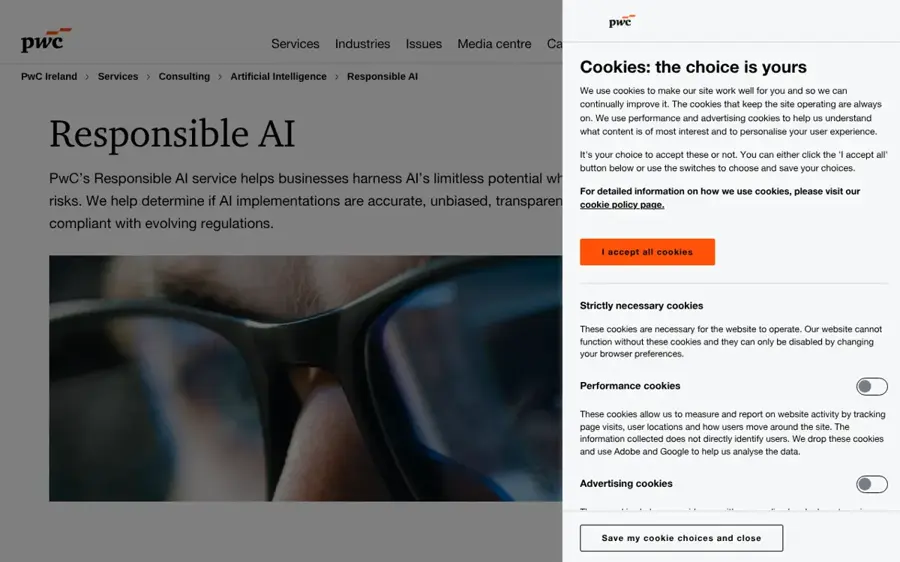
PwC's Responsible AI service uses a Responsible AI toolkit to assess AI models and processes, and its European teams run dedicated EU AI Act compliance programs.
Strengths
PwC's Central and Eastern Europe team publishes one of the most detailed EU AI Act service pages among the big firms. It covers compliance strategy, gap assessments against the AI Act alongside DORA, NIS2 and GDPR, policy design inside an AI governance framework, and training. Its interdisciplinary risk and legal teams work together, which helps when your lawyers and engineers disagree.
PwC also has a certification angle. Consulting.ca reports that PwC Canada launched an ISO 42001 certification solution and says it's the first Big Four firm to offer accreditation services for the standard. Remember that a firm can't certify a management system it helped you build, so you'd use PwC for one role or the other.
Key features
- Comprehensive AI assessments: performance, fairness, explainability and compliance.
- EU AI Act gap analysis: mapped against DORA, NIS2 and GDPR.
- AI evaluation and monitoring: ongoing checks after launch.
- ISO 42001 certification: offered by PwC Canada.
- Custom training: for AI literacy and governance roles.
Pros
- Deep EU regulatory coverage across several regulations at once
- Legal and risk teams work together
- Certification option in some countries
Cons
- Offerings vary a lot by country
- Same independence limits as other Big Four firms
PwC pricing: No free plan; then custom quotes only, with no public rate card (checked October 2026). See pricing
Related: AI governance certification explained Tools for AI transformation as a governance problem
Verdict: the strongest Big Four pick if Europe is your main regulatory exposure.
EY – best for framework-led AI risk reviews
EY's AI Risk and Governance services are grounded in named frameworks, including the NIST AI RMF, ISO/IEC 42001, MITRE ATLAS and OWASP.
Strengths
EY is the most explicit about frameworks. Its India practice page lists NIST AI RMF, ISO/IEC 42001, MITRE ATLAS and OWASP as the basis of its services, and its Responsible AI frameworks cover governance, resilience, data stewardship, identity and access control, threat monitoring and model reliability. That mix of governance and security frameworks suits teams worried about attacks on models as well as policy gaps.
EY has also published a case study in the UK government's AI assurance portfolio. It describes a review of a biopharmaceutical company's AI governance program using EY's global Responsible AI framework, through stakeholder interviews, documentation review and governance reviews of key AI projects, ending in an audit report and next steps.
Key features
- Named frameworks: NIST AI RMF, ISO/IEC 42001, MITRE ATLAS and OWASP.
- Responsible AI framework: principles linked to risk areas and practical actions.
- AI governance reviews: interviews, document review and project sampling.
- Security focus: threat monitoring and access control for AI.
- Multidisciplinary teams: digital ethicists, IT risk staff and data scientists.
Pros
- Clear framework mapping, good for audit trails
- Covers AI security as well as ethics
- Public case study shows the method
Cons
- Service pages differ by country
- Better for reviews and assurance than for building platforms
EY pricing: No free plan; then custom quotes only, with no public rate card (checked October 2026). See pricing
Verdict: choose EY if you want governance mapped line by line to recognised frameworks.
IBM Consulting – best for data-heavy firms using watsonx
IBM Consulting builds AI governance programs that plug into your data management setup, with guardrails underpinned by its watsonx.governance software.

Strengths
IBM pitches itself to chief data officers, and the pitch seems sensible. Its page says "We start where your data governance ends", which is a useful promise if you already have mature data controls. The service covers strategy, AI ethics boards and centres of excellence, multi-model implementation, an AI risk management framework for current and upcoming laws, and stakeholder reporting.
The catch is platform gravity. IBM states its guardrails are "underpinned by watsonx.governance". Echelon's comparison notes that IBM programs are often scoped around its own ecosystem, so if you don't want IBM software, ask early how vendor-neutral the work will be.
Key features
- AI ethics boards and COEs: structures for accountability.
- watsonx.governance: automated guardrails for explainability and fairness.
- Risk framework: aligned with existing and upcoming laws.
- Cyber guidance: advice on emerging AI threats.
- Open partner ecosystem: works across clouds and models.
Pros
- Strong link between data and AI governance
- Software and services from one vendor
- Good for large model portfolios
Cons
- Tends to lead with IBM technology
- Less useful if your data estate is immature
IBM Consulting pricing: No free plan; then custom quotes only, with no public rate card (checked October 2026). See pricing
Related: Best AI data governance tools Tools for AI transformation as a governance problem
Verdict: a natural fit if your data team already runs on IBM.
Accenture – best for governance inside large AI transformations
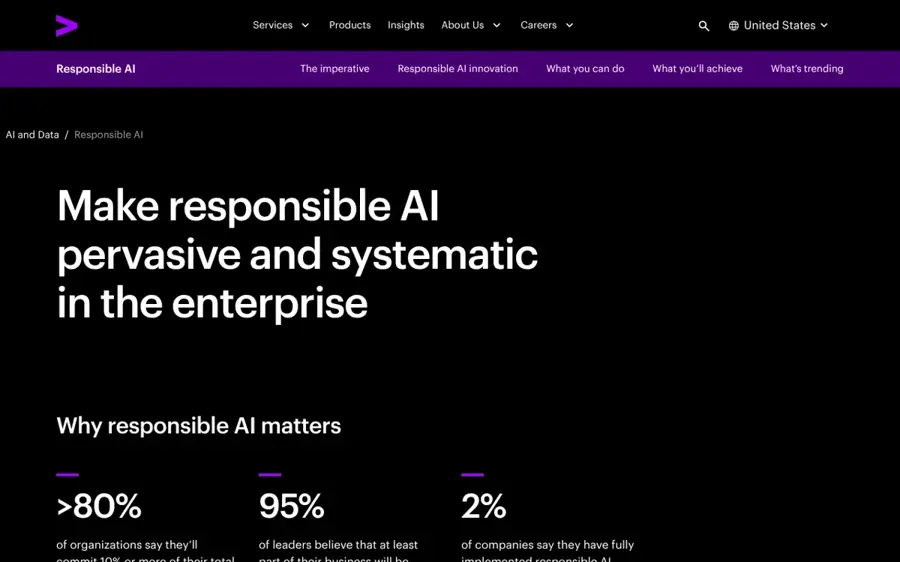
Accenture's responsible AI services help you adopt principles, assess AI risk, test systems and monitor compliance, led by a Chief Responsible AI Officer.
Strengths
Accenture treats governance as part of a wider AI rollout. Its page lists four steps: adopt principles with clear accountability, understand the risk of each AI use case with qualitative and quantitative assessments, test continuously for fairness, explainability, accuracy and safety, and monitor systems while running mitigation and compliance actions.
That makes Accenture a sensible choice if it's already building your AI systems, because governance can be designed in from the start. The page itself is light on framework detail, and some statistics on it are dated, so ask for EU AI Act and ISO 42001 specifics in your proposal.
Key features
- Principles and accountability: governance for design, deployment and use.
- Use-case risk assessment: qualitative and quantitative.
- Ongoing AI testing: fairness, transparency, accuracy and safety.
- Monitoring and oversight: continuous compliance actions.
- Senior ownership: a named Chief Responsible AI Officer, Arnab Chakraborty.
Pros
- Governance built into delivery work
- Global scale for multinational rollouts
- Cross-functional scope including workforce impact
Cons
- Public page gives little framework detail
- Best value only if Accenture also delivers your AI work
Accenture pricing: No free plan; then custom quotes only, with no public rate card (checked October 2026). See pricing
Related: Tools for AI transformation as a governance problem
Verdict: worth it when governance is one part of a bigger Accenture program.
Nemko Digital – best for mid-sized ISO 42001 implementation
Nemko Digital is a specialist AI governance consultancy that covers strategy, risk management, governance platform selection and ISO 42001 implementation through to audit preparation.

Strengths
Nemko Digital offers the most structured ISO 42001 path on this list. It runs from readiness assessment through AI management system implementation and certification support to audit preparation, then continual improvement. It also helps you pick and configure AI governance platforms and build an AI inventory with shadow AI detection, which many mid-sized firms probably struggle with.
Its FAQ is practical on the EU AI Act, explaining that high-risk systems may need risk management, data governance, technical documentation, human oversight, robustness, cybersecurity and conformity assessment. Nemko publishes one case study: a GenAI control framework for a Dutch government body, where it assessed more than 40 use-case risks against more than 150 possible controls and defined 39 control updates and new controls.
Key features
- ISO 42001 readiness: gap analysis and roadmap.
- AIMS implementation: management system design to the standard.
- Platform selection: choosing and configuring governance software.
- Shadow AI detection: inventories of systems, models and use cases.
- GenAI and agent governance: policies and safeguards for autonomous AI.
- Third-party AI governance: supplier assessments and vendor oversight.
Pros
- Focused specialist rather than a generalist
- Clear, step-by-step ISO 42001 offer
- Covers agents and vendor AI
Cons
- Smaller global footprint than the Big Four
- Less assurance and attestation depth
Nemko Digital pricing: No free plan; then custom quotes only, with no public rate card (checked October 2026). See pricing
Related: AI governance certification explained
Verdict: the best-value pick for a mid-sized firm chasing ISO 42001.
Schellman – best for independent ISO 42001 certification
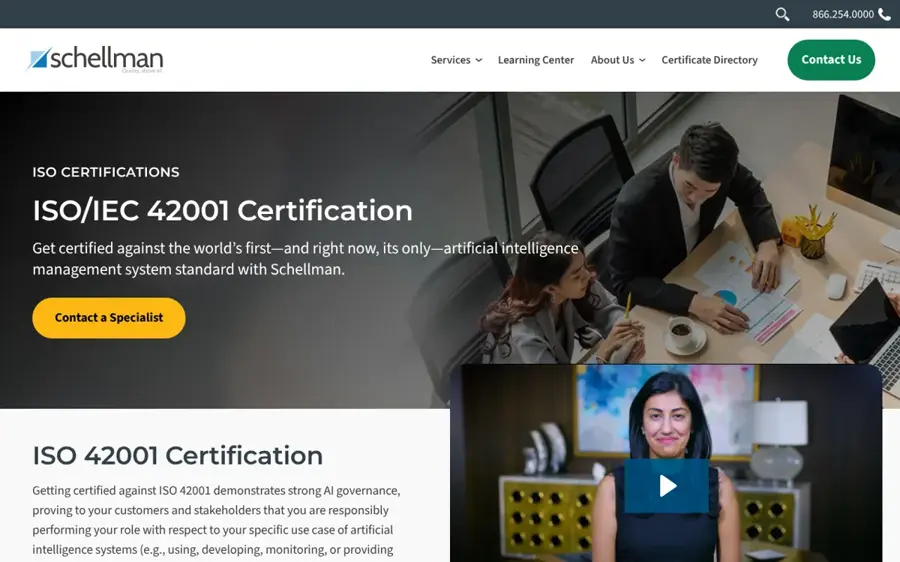
Schellman is an accredited certification body that audits and certifies AI management systems against ISO/IEC 42001.
Strengths
Schellman isn't a consultant, and that's the point. Its page describes it as "the first ANAB-accredited Certification Body for ISO 42001". Certification gives customers and regulators independent evidence that you manage AI responsibly within the scope of your certificate.
It shows up a lot: KPMG used Schellman for both its US and international ISO 42001 certifications. Pair Schellman with an implementer from earlier in this list. The consultant builds your system; Schellman audits it.
Key features
- ISO 42001 certification: ANAB-accredited audits.
- Integrated audits: can combine with existing management system certificates.
- SOC 2 links: guidance on expanding SOC 2 for AI.
- Framework guidance: FAQs on ISO 42001 versus NIST AI RMF.
Pros
- Accredited, independent certification
- Well-known name in compliance audits
- Combines with ISO 27001 and SOC 2 work
Cons
- Cannot design or implement your AI governance
- You still need internal or outside implementation help
Schellman pricing: No free plan; then custom quotes only, with no public rate card (checked October 2026). See pricing
Related: AI governance certification explained
Verdict: hire Schellman to prove your governance works, not to build it.
Choosing the right AI governance consulting firm
Start with your regulatory exposure
Ask for a system-by-system AI Act classification first if you sell or deploy AI in the EU. Under the Digital Omnibus deal, which the European Parliament voted to adopt in June 2026 according to Sidley Austin, Annex III high-risk rules land on 2 December 2027. US-only firms may prefer a NIST AI RMF baseline, which NIST describes as intended for voluntary use. See our guide to AI regulation for the wider picture.
Decide whether you need a certificate
ISO/IEC 42001 certification helps when customers ask for proof in procurement. It's a two-firm job. One consultant implements; one accredited body audits, and they can't be the same outfit. Our explainer on AI governance certification walks through the steps.
Check data governance first
AI governance fails when nobody knows where training data lives or who owns it. Fix a weak data catalogue alongside the AI work. Our list of AI data governance tools is a good place to start.
Ask about platforms and neutrality
Most firms now pair advice with governance software. Ask which platforms they partner with. Then ask whether those vendors pay them, and whether you can keep using the tools you already have. I think governance is an operating model problem first, as our piece on AI transformation as a problem of governance explains.
Check auditor independence
If a Big Four firm audits your financial statements, independence rules may restrict the consulting it can sell you. Check with your audit committee before you shortlist a firm; it's a boring step that saves an awkward conversation later.
Free vs paid: what you actually get
None of these firms offers a free plan, and none publishes a rate card. The free material is still useful:
- Free: public frameworks such as the NIST AI RMF and its companion playbook, plus the firms' own guides, FAQs and webinars. Nemko's FAQ and PwC's EU AI Act page are good primers.
- Paid, scoped: a readiness or gap assessment is the usual first engagement and the easiest to budget for.
- Paid, larger: full implementation, meaning operating model, inventory, controls, platform setup and training.
- Paid, separate: independent assurance or certification audits, from a firm that didn't build the system.
Buy a fixed-scope assessment first, then decide whether you need a large firm or a specialist for the build. That's what I'd do. If you're a small business, our roundup of AI consulting for small businesses covers lighter options.
Final verdict
If you only pick one firm and you're a large regulated enterprise, pick Deloitte for breadth or KPMG for assurance depth. Choose PwC if the EU AI Act is your biggest risk. Choose EY if you want everything mapped to NIST, ISO and security frameworks. Choose IBM Consulting or Accenture if they already run your data or AI delivery.
Mid-sized? Nemko Digital is the one I'd call first, because ISO 42001 without a Big Four bill is a rare offer. Then book Schellman for the certification audit. Honestly, I'd skip the Big Four entirely unless your board insists.
FAQ
What does an AI governance consultant do?
An AI governance consultant sets up policies, roles, risk assessments and controls. Typical work includes building an AI inventory, classifying systems under the EU AI Act, designing controls, aligning with ISO/IEC 42001 or the NIST AI RMF, and training staff.
How much do AI governance consulting services cost?
None of the firms in this roundup publishes prices; all work on custom quotes. Cost depends on how many AI systems you have, which regulations apply and whether you want assessment alone or full implementation. Starting with a fixed-scope gap assessment is the easiest way to control spend, and the only sensible way to compare quotes.
Which AI governance certification is worth getting?
For organisations, ISO/IEC 42001 is the main certifiable AI management system standard, and accredited bodies such as Schellman audit against it. For individuals, see our guides to AI governance certification and AI security certification, which compare the options.
When do EU AI Act high-risk rules apply?
Under the Digital Omnibus agreement reported by Winston Taylor, rules for stand-alone high-risk systems in Annex III apply from 2 December 2027, and rules for high-risk AI in regulated products under Annex I from 2 August 2028. Prohibited practices and AI literacy duties already apply.
Can the same firm implement and certify ISO 42001?
No. Accredited certification bodies have to stay independent, so they can't certify a management system they helped design. Use one firm, such as Nemko Digital or a Big Four practice, to implement, and a separate accredited body, such as Schellman, to audit.
Do I need the NIST AI RMF if I follow ISO 42001?
Not necessarily. The NIST AI RMF is voluntary and focuses on managing AI risk, while ISO/IEC 42001 is a certifiable management system. Some firms, including EY, map work to both. NIST says the AI RMF 1.0 is being revised, so check for updates.
Sources
- Trustworthy AI (Deloitte UK)
- AI Trust services (KPMG US)
- KPMG LLP among first of the Big Four in the U.S. to receive ISO 42001 AI certification (KPMG)
- KPMG International becomes first Big Four international entity to attain ISO 42001 certification (KPMG)
- KPMG expands AI Trust services with new AI Assurance capabilities (KPMG)
- Responsible AI (PwC Ireland)
- The EU AI Act: compliance and transformation (PwC Central and Eastern Europe)
- PwC launches new AI governance certification solution (Consulting.ca)
- Artificial Intelligence (AI) risk and governance (EY India)
- EY: Global Responsible AI Framework, AI governance review case study (GOV.UK)
- AI governance consulting (IBM)
- Responsible AI governance consulting and solutions (Accenture)
- AI governance consulting and ISO 42001 (Nemko Digital)
- ANAB-accredited ISO 42001 certification (Schellman)
- EU lawmakers reach provisional agreement to delay key EU AI Act obligations (Sidley Austin Data Matters)
- AI Act rules on high-risk AI delayed as AI Digital Omnibus agreed (Winston Taylor)
- AI Risk Management Framework (NIST)
- AI governance consulting for regulated industries: 2026 buyer's comparison guide (Echelon Risk + Cyber)