Moonshot AI review 2026: Kimi K3.1 Pro, pricing, privacy and is Kimi any good?
Moonshot AI's Kimi K3.1 Pro is a near-frontier open-weight model with a free app and a cheap API. We weigh plans, benchmarks, funding and privacy.
 Written byBurhan AqibSenior writer, policy and analysis
Why you can trust The AI Future
Our writers research every product, link each claim to its source and correct mistakes openly. Companies can't pay for coverage or see reviews before they're published.
Read our editorial policy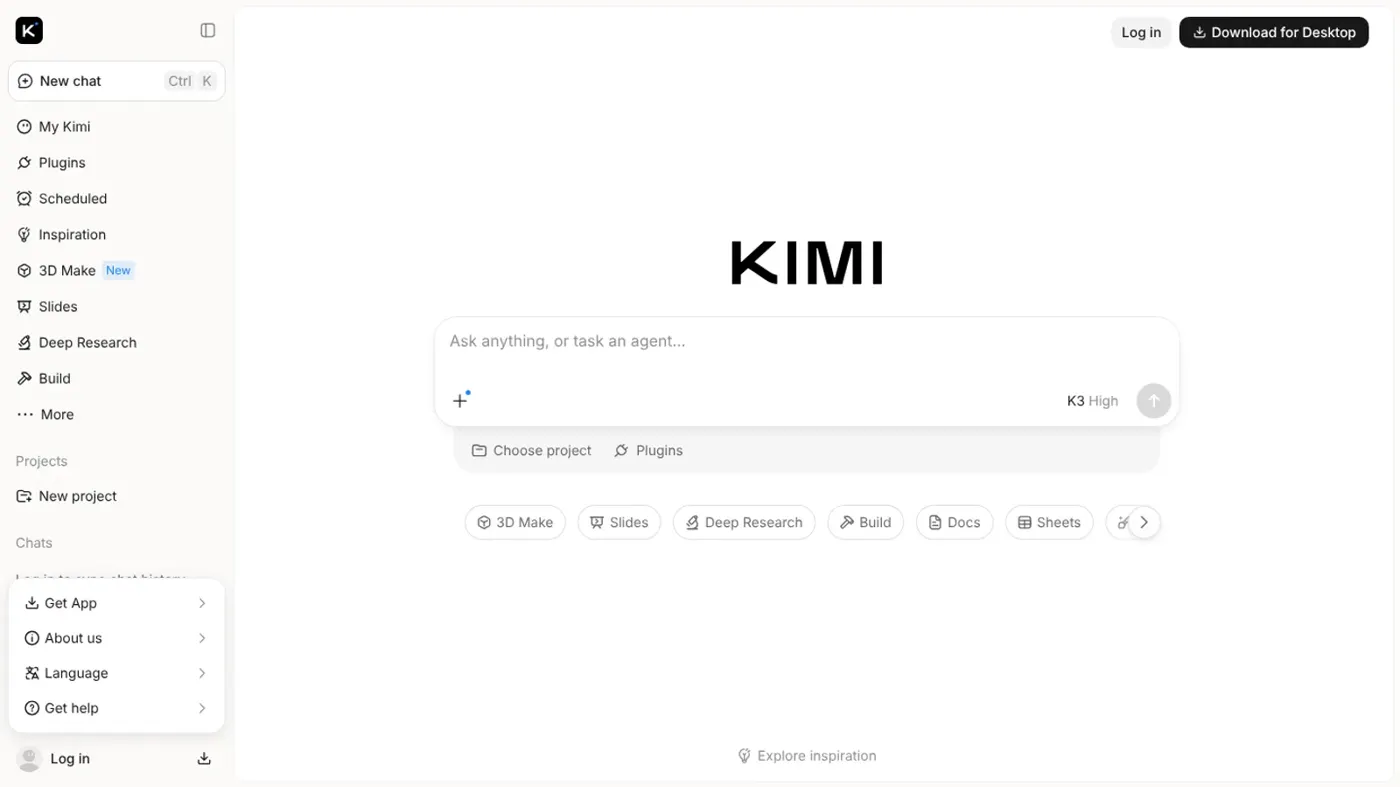
Our verdict on Kimi (Moonshot AI)
Kimi is probably the best open-weight AI you can use in late 2026, with a capable free app and a fairly priced API. Developers and power users should try it; skip the hosted app for confidential or regulated data, or use the open weights through a host you trust.
Pricing Free (Adagio); Plus $19/mo ($180/yr); Pro $39/mo ($372/yr); Max $99/mo ($948/yr); Ultra $199/mo ($1,908/yr); API from $0.95/$4 per 1M tokens, K3.1 Pro $2/$10
Visit Kimi (Moonshot AI)Moonshot AI is the Beijing lab behind Kimi, and as of early November 2026 it's making one of the strongest AI models you can get without paying a frontier-lab price. Its new flagship, Kimi K3.1 Pro, costs $2 per million input tokens on the API, sits second on the Artificial Analysis Intelligence Index, and is free to chat with in the Kimi app. I think it's a genuinely good AI for coding, research and agent work. The catches are a stingy, unpublished free quota and a privacy setup governed by Chinese law, and you should weigh both before you paste anything sensitive into it.
Quick note on method: nobody at The AI Future ran hands-on tests for this review. I built it from Moonshot's own docs and price tables, independent benchmark results, press coverage of the company's funding, and about 30 recent app-store reviews, all checked in late October and early November 2026. When someone else did the testing, I name them.
Moonshot AI, the company behind Kimi
Moonshot AI (Yuezhi Anmian in Chinese) was founded in March 2023 by Yang Zhilin, Zhou Xinyu and Wu Yuxin, who were classmates at Tsinghua University, The Next Web reports. Yang previously worked at Carnegie Mellon and Meta's FAIR lab. The company sells two things: Kimi, a consumer and work assistant on the web, iOS and Android, and the Kimi API for developers. It also releases model weights openly, which is a big part of why Western developers pay attention to it.
The money side has moved fast. An Alibaba-led round in February 2024 valued Moonshot at $2.5 billion. By the end of December 2025 the figure was $4.3 billion, according to TechNode, and a Meituan-led $2 billion round in May 2026 pushed it past $20 billion. In July, Yicai reported a raise of more than $3.5 billion, crediting strong Silicon Valley interest in Kimi K3.
Then came the big one. On October 6, Bloomberg reported (via The Edge Malaysia) that Moonshot had closed its final private round at about $50 billion and was heading for a Hong Kong IPO in the first quarter of 2027, possibly raising up to $5 billion. The same report put annual recurring revenue at $1 billion, with $2 billion expected by December. I suspect that's the steepest curve of any Chinese AI lab, and it's startling for a company that's barely three and a half years old (and I'd treat the December forecast as a target, not a fact, until the IPO filing is public).
Kimi models in November 2026
Moonshot names its models with a K and a version number. Looking at the current model list, here's what developers can call today:
- Kimi K3.1 Pro, the flagship, launched on the API on October 23. It's a "3T-class" open-weight model with a 1-million-token context window and native image understanding.
- K3.1 Pro Highspeed, which Moonshot says runs about 2-3 times faster at double the price.
- Kimi K3, the previous flagship: 2.8 trillion parameters, released on July 16, with weights posted to Hugging Face on July 27.
- K2.7 Code, a cheaper coding model with a 256K context, plus a Highspeed version rated at roughly 180 tokens a second.
- K2.6, an older multimodal model that also handles video input.
Older models are being cleared out quickly. K2.5 and the original moonshot-v1 family were switched off on August 31, and the API price list says new sign-ups lost access to K2-series models on October 31, with all of them retiring by the end of December 2026. If you've built anything on K2.6 or K2.7 Code, start planning the move now.
One small thing bothered me. The K3.1 Pro launch page still had template placeholders in place of some benchmark scores ("it scores [xx.x%]") when I read the K3.1 Pro guide on November 1. It's a cosmetic slip, but it doesn't inspire confidence in a launch this hyped. Moonshot promised the full weights "by Nov 4", so check Hugging Face for the release before you plan to self-host.
Key features
Chat with K3.1 Pro on the free plan
The free Kimi account (Moonshot calls it Adagio) uses K3.1 Pro as the default chat model. A DEV Community guide checked on October 24 found the picker set to K3.1 Pro with thinking effort on "High", alongside a faster "Instant" option. What you don't get is a published message count. Free users are limited to one concurrent agent task, two scheduled tasks, two projects and 500MB of project storage, and the full 1M-token chat context is reserved for the Max and Ultra plans.
Agent Swarm, slides and office work
Kimi has pushed hard toward doing work rather than just answering. The App Store listing describes Agent Swarm as coordinating "up to 300 AI agents across 4,000 parallel steps" for research and report writing. There's also an AI Slides maker, an Office Agent that converts PDFs to Word or Excel and writes formulas, a website builder, and data plugins for Wind and S&P. The newest addition is 3D: K3.1 Pro can generate 3D models and simple multiplayer games from a text prompt.
Honestly, the 3D feature reads like a launch demo more than a daily tool. The office and research features are where I'd expect most people to get value.
Kimi Code for developers
Kimi Code is Moonshot's coding agent, available as a desktop app, a command-line tool and IDE plugins, all on one subscription. It's not on the free plan; you need Plus or higher. Developers who'd rather stick with their own tools can point Claude Code, Codex or OpenCode at the Kimi API instead, and Moonshot's docs walk through each setup.
Kimi Claw and scheduled tasks
Kimi Claw is a cloud deployment of the open-source OpenClaw agent, included from the Pro plan up. Read the fine print, though. Going by the membership help page, a deployed Claw host eats about 0.6% of your monthly credits every day even when idle, and a published website costs about 0.08%. Over a month that idle Claw alone burns roughly 18% of your pool, which surprised me.
Kimi pricing and plans
Kimi has two separate billing systems. Memberships cover the app, Kimi Code and agents; the API is pay-as-you-go with no subscription. They don't share credit.
App and membership plans
The tempo-named plans (Moderato, Allegretto, Allegro, Vivace) were renamed Plus, Pro, Max and Ultra on September 28. UsagePricing noticed that list prices didn't change, but Moonshot said allowances were "adjusted accordingly" without publishing new totals. Here are the international prices (checked October 2026):
| Plan | Monthly | Annual | Main extras |
|---|---|---|---|
| Free (Adagio) | $0 | $0 | K3.1 Pro chat, 1 agent task, 2 projects, 500MB storage, no Kimi Code |
| Plus | $19 | $180 ($15/mo) | Kimi Code, Agent Swarm, Deep Research, 2 parallel agent tasks, 20 projects |
| Pro | $39 | $372 ($31/mo) | 2x agent credits, Goal Mode, dedicated Kimi Claw |
| Max | $99 | $948 ($79/mo) | 5x agent credits, 4 parallel tasks, 100 projects, 50GB storage |
| Ultra | $199 | $1,908 ($159/mo) | 10x agent credits, 25 scheduled and 25 widget tasks |
Every feature draws on one monthly credit pool that doesn't roll over, per the plans overview. Kimi Code also has a rolling five-hour limit. Plus at $19 matches ChatGPT Plus and Claude Pro on price, so the free tier is really the selling point; and Moonshot won't say how big it is.
API pricing
| Model | Input / 1M tokens | Output / 1M tokens | Cached input |
|---|---|---|---|
| kimi-k3.1-pro | $2.00 | $10.00 | $0.20 |
| kimi-k3.1-pro-highspeed | $4.00 | $20.00 | $0.20 |
| kimi-k3 | $3.00 | $15.00 | $0.30 |
| kimi-k2.7-code | $0.95 | $4.00 | $0.19 |
| kimi-k2.6 | $0.95 | $4.00 | $0.16 |
Yes, the newer K3.1 Pro is cheaper than K3. Simon Willison pointed out that $2 and $10 matches GPT-6.1 Sol and is half the price of Claude Opus 5.5. Batch jobs on K3.1 Pro and K3 run at 60% of the standard price, and caching is switched on automatically. To use K3.1 Pro at all, you'll need a minimum $1 top-up, and that first tier is capped at 3 requests a minute and 1.5 million tokens a day.
Performance and independent testing
The independent numbers are strong. Artificial Analysis gave K3.1 Pro a score of 55 on its Intelligence Index, behind only Claude Opus 5.5 (58) and ahead of Claude Fable 5.1, GPT-6 Astra and Gemini 4 Argon (all 53), as Willison noted. He called it "the first time a (soon-to-be) open weight model has scored this highly against the frontier."
Vals AI ran its own evaluation on October 24 and ranked K3.1 Pro 8th of 27 on the Vals Index (62.52%), the top open-weight model. Its coding result is the headline: 63.64% on Terminal-Bench 4.0, 3rd of 55 and within two points of Opus 5.5, up from just 17.17% for K3. But it went backwards on legal and tax tasks, scoring 37.50% on Legal Research Bench against K3's 46.15%. That's a real trade-off if your work is professional rather than technical.
On LMArena's crowd-voted text board, the older Kimi K3 (Max) placed 19th and was the top open-weight model, as we covered in our LMArena review. Developers clearly rate the base model too: Cursor built its Composer 2 coding model on Kimi K2.5, which we cover in our Cursor review.
Moonshot also claims K3.1 Pro's claim-level hallucination rate fell from 23.35% to 6.85% on a deliberately hard set of prompts. That's a vendor number, and Moonshot itself says it doesn't represent everyday error rates. I'd wait for an outside test before relying on it for anything factual.
Privacy and data location
This is the section I'd read twice. The English terms of service are a contract with Beijing Moonshot Technology Co., Ltd, governed by the laws of mainland China. They also say Moonshot "may use the Content for further development and training", and I couldn't find an opt-out in the terms. The App Store and Google Play listings name the same Beijing company, and the privacy policy linked from the App Store points to a Chinese-language page on kimi.moonshot.cn. I couldn't confirm where data from international users is stored.
There's regulatory history too. In May 2025, MLex reported that Kimi was among 35 apps flagged by a public-security-affiliated centre in China for illegally collecting and using personal data. Bloomberg's October report (via The Edge Malaysia) said Chinese regulators had opened a data-security probe into DeepSeek and Moonshot, citing The Information. And IntuitionLabs points out that many US states have banned Chinese-origin AI apps from government devices, which matters if you work in a regulated industry.
The open weights are the escape hatch. Run K3 (or K3.1 Pro, once its weights land) on your own hardware or through a host you trust, and your prompts never touch Moonshot's servers. The catch is scale: a 2.8-trillion-parameter model needs data-centre GPUs, so self-hosting is realistic only for large companies.
For everyone else, my advice is simple: I'd keep personal, client or confidential data out of the Kimi app. It seems like an obvious rule, but it's easy to forget once a chatbot starts being useful.
Best suited to
Kimi suits developers who want near-frontier coding at a lower API price, people who want a strong free chatbot for research and drafting, and teams that need open weights they can host themselves. It's a weaker fit for anyone handling regulated or confidential data in the hosted app, and for free users who need predictable access: several app-store reviewers complain about "credits used up" and "high demand" messages at busy times.
Moonshot AI alternatives
Three alternatives make sense, depending on what pulls you toward Kimi:
- Claude is the pick if you want the top-scoring model on Artificial Analysis and clearer data terms, at a higher API price. See our Claude AI review.
- ChatGPT matches Kimi's $19-20 entry price with a broader app, image generation and a US-based provider. Our ChatGPT review covers the plans.
- Poe lists Kimi K3.1 Pro next to GPT, Claude and Gemini models under one subscription, handy if you want Kimi without a Moonshot account. Read our Poe review.
If open weights are the main draw, our guide to the best open source AI tools compares Kimi with Qwen, Mistral and DeepSeek.
Verdict
I'd give Moonshot AI's Kimi 4 out of 5. K3.1 Pro is probably the best open-weight model available right now, the API is fairly priced, and the free app gives you that model at no cost. I'm docking a point for the vague free limits, the idle-credit drain on Claw, and terms that put your data under Chinese law with training rights attached. Developers and curious power users should try it; anyone with sensitive data should use the open weights through a trusted host or pick another assistant.
FAQ
What is Moonshot AI?
Moonshot AI is a Beijing-based AI company founded in March 2023 by Yang Zhilin, Zhou Xinyu and Wu Yuxin. It makes the Kimi assistant and the Kimi family of open-weight language models, including the K3.1 Pro flagship released in October 2026. Bloomberg reported in October 2026 that it's valued at about $50 billion and is preparing a Hong Kong IPO.
Is Kimi AI good?
Yes, for most tasks. K3.1 Pro scored 55 on the Artificial Analysis Intelligence Index, second only to Claude Opus 5.5. Its weak spots are unpredictable free limits and weaker legal and tax results than K3.
Is Kimi a good AI for coding?
It's likely one of the better choices right now, especially on price. K3.1 Pro came within two points of Claude Opus 5.5 on Terminal-Bench 4.0 in Vals AI's test, and its API costs half as much. Kimi Code needs a paid plan from $19 a month, but you can also connect the API to Claude Code, Codex or OpenCode.
Is Kimi free to use?
The Kimi web and mobile app has a free plan that uses K3.1 Pro by default. Moonshot doesn't publish the message limit, and free accounts get one agent task, two projects and no Kimi Code. The API isn't free: K3.1 Pro needs at least a $1 top-up, then costs $2 per million input tokens.
Is Kimi safe to use?
It's fine for everyday, non-sensitive work, but be careful with personal or business data. Kimi's terms are governed by Chinese law and let Moonshot use your content for training, and Chinese regulators have reportedly opened a data-security probe into the company. Self-hosting the open weights avoids sending data to Moonshot.
Ratings around the web
Ratings as of 8 Nov 2026. Scores change over time; follow the links for the latest.
What users are saying
We read 31 recent user reviews: 3 featured on Google Play and 28 on the US, UK and Australian App Stores. Most praised Kimi's research depth and answer quality, while the negative reviews centred on free-tier lockouts and paywalls, slow responses and worries about data and phone-number requirements.
Common praise
- Thorough, well-reasoned research answers
- Generous value compared with paid rivals
- Useful for academic and professional feedback
Common complaints
- 'Credits used up' and 'high demand' messages on the free tier
- Slow responses and a basic mobile app design
- Privacy worries, including a required phone number
Based on: Google Play reviews of Kimi, US App Store reviews of Kimi, UK App Store reviews of Kimi, Australian App Store reviews of Kimi
What we like
- K3.1 Pro scores 55 on the Artificial Analysis Intelligence Index, second only to Claude Opus 5.5
- Free app uses K3.1 Pro as the default chat model
- API at $2/$10 per million tokens, half the price of Claude Opus 5.5
- Open weights let large teams self-host and keep data in-house
- Strong agent tools: Agent Swarm, slides, office files and Kimi Code
What could be better
- Free-plan message limits aren't published, and users report 'high demand' lockouts
- Terms are governed by Chinese law and allow training on your content
- Kimi Claw drains about 0.6% of monthly credits per day even when idle
- K3.1 Pro scored lower than K3 on Vals AI's legal and tax benchmarks
Sources
- Introducing Kimi K3.1 Pro (Simon Willison's Weblog)
- Kimi K3.1 Pro quickstart (Kimi API Platform)
- Model List (Kimi API Platform)
- Model Inference Pricing (Kimi API Platform)
- Pricing details (Kimi Help Center)
- Membership plans overview (Kimi Help Center)
- Kimi renames its paid plans Plus, Pro, Max and Ultra (UsagePricing)
- How to Use Kimi K3.1 Pro for Free? (DEV Community)
- How to Use Kimi K3 for Free (Apidog)
- Kimi Code (Moonshot AI)
- Kimi - Your Personal AI Agent (App Store)
- Kimi (Google Play)
- Kimi Terms of Service (Moonshot AI)
- Moonshot AI's $20bn valuation seals one of China's fastest AI funding trajectories (The Next Web)
- Kimi reaches $30 billion valuation after sixfold increase in half a year (TechNode)
- Moonshot AI's Latest Fundraiser Lifts Valuation to USD35 Billion (Yicai Global)
- Moonshot said to eye early 2027 IPO after value hits US$50 bil (The Edge Malaysia / Bloomberg)
- Kimi K3.1 Pro Benchmarks, Cost and Capabilities (Vals AI)
- Kimi K3 for Life Sciences: Running It on Regulated Data (IntuitionLabs)
- Chinese AI startup Kimi, Zhipu among 35 apps cited for data-protection violations (MLex)