10 best AI skills assessment and reskilling platforms in 2026
The best AI skills assessment and reskilling platforms for 2026, from Workera and iMocha to Coursera and DataCamp, with honest notes on quote-based pricing.
 Written byFahad HashmiContributing writer, AI in energy and industry
Why you can trust The AI Future
Our writers research every product, link each claim to its source and correct mistakes openly. Companies can't pay for coverage or see reviews before they're published.
Read our editorial policy
Here's the short version. If you need to measure what your people can actually do with AI and then close the gap, Workera is my top pick for verified skills assessment, iMocha is the strongest skills-intelligence option for HR teams that also hire, and Degreed is the safest bet if the reskilling side matters more than the testing side. The cheaper course-library platforms (Coursera, LinkedIn Learning, DataCamp, Udemy Business) now ship skill assessments too, and they're the only ones with prices you can see without a sales call.
That last point shapes this whole list. Most AI skills assessment and reskilling platforms are quote-based: Workera, iMocha, Degreed, Eightfold and Gloat don't publish prices at all, so you'll be booking demos.
Key takeaways
- Pure assessment platforms (Workera, iMocha) are better at proving skill levels than at teaching, so most companies pair them with a content library.
- Five of the ten picks are quote-only, which means you can't compare them on price until you've sat through demos.
- The cheapest published team plans run from about $336 to $399 per seat per year, and DataCamp is the only pick with a free tier that includes skill assessments.
- Coursera finished merging with Udemy in May 2026, so two picks here now share an owner, though they're still sold separately.
Our ranking method
Nobody at The AI Future ran hands-on tests of these platforms. We compared them using vendor product and pricing pages, analyst recognition, third-party price trackers and verified user reviews on Capterra and Trustpilot, as of late October 2026. Each tool was scored on these criteria:
- Assessment depth looks at how a platform measures skill: adaptive tests, hands-on labs, proctoring or inferred skills from work data.
- Reskilling path asks whether results feed into learning, mobility or coaching, or just sit in a report.
- AI focus checks for specific AI-readiness tools, since that's what most buyers want this year.
- Integration covers connections to HR systems such as Workday and SAP SuccessFactors, plus SSO.
- Price transparency rewards platforms that publish what they charge.
- User feedback weighs public ratings and review comments, including the critical ones.
The 10 best AI skills assessment and reskilling platforms at a glance
| # | Tool | Category | Best for | Free tier | Starts at |
|---|---|---|---|---|---|
| 1 | Workera | Skills verification | AI readiness baselines | No | Quote |
| 2 | iMocha | Skills intelligence | Hiring plus internal mobility | No | Quote |
| 3 | Degreed | Learning experience platform | Enterprise upskilling programs | No | Quote |
| 4 | Eightfold AI | Talent intelligence | Large-scale internal mobility | No | Quote |
| 5 | Pluralsight | Tech skills platform | Engineering and IT teams | No | Quote (Teams list price unclear) |
| 6 | Coursera for Business | Course library | Credentials and university content | No | $399/user/yr |
| 7 | LinkedIn Learning | Course library | Broad business skills | No | $379.88/user/yr |
| 8 | DataCamp | Data and AI training | Data and AI literacy | Yes (limited) | $28/user/mo |
| 9 | Udemy Business | Course library | Small teams on a budget | No | $360/user/yr |
| 10 | Gloat | Agentic HR platform | Talent marketplaces | No | Quote |
The best AI skills assessment and reskilling platforms in 2026, ranked
Workera – best for AI readiness baselines
Workera is an assessment-first platform that verifies skills for any role and turns results into personalized learning; see it at workera.ai.
Strengths
Workera's pitch is narrow, and I like that. Going by its homepage, it runs 100+ signature assessments with benchmarks, and its AI Studio lets you build custom assessments "in a day, not weeks." The AI-readiness framing is specific: it sorts staff into five levels (Literate, Practitioner, Engineer, Scientist and Steward), and it suggests only 1–5% of a workforce will sit at the Scientist level.
Public reviews are thin. RFP.wiki's review roundup says users report "useful business outcomes from AI readiness," but it also flags that "pricing transparency is limited" and that implementation "can be significant for complex enterprise ecosystems."
Key features
- Over 100 signature assessments come with industry benchmarks.
- AI Studio builds custom assessments for your own roles.
- Ambient Coaching measures skills in the flow of work and suggests learning.
- Credentials renew as the work changes instead of lasting forever.
Pros
- Clear five-level model for reporting AI capability to a board
- Custom assessments without a long build cycle
- Hiring and workforce assessment in one product
Cons
- No public pricing at all
- Small pool of public user reviews
Workera pricing: No free plan; quote-based enterprise pricing only (checked October 2026). See pricing
Related: Best AI tools for HR teams AI training courses worth your time
iMocha – best for hiring plus internal mobility
iMocha is an AI skills-intelligence platform that infers, tests and validates skills across hiring, learning and workforce planning; see it at imocha.io.
Strengths
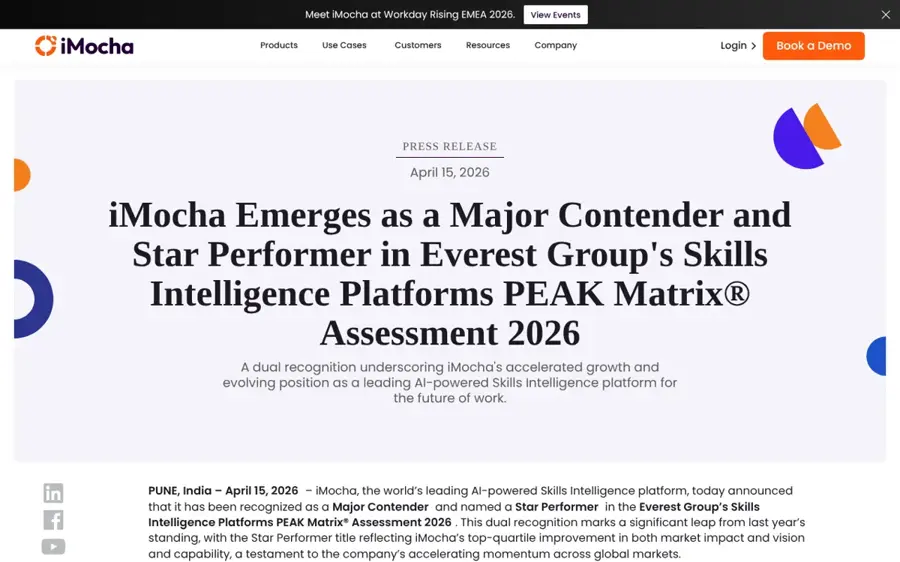
In April 2026, Everest Group named iMocha a Major Contender and Star Performer in its Skills Intelligence Platforms PEAK Matrix, per iMocha's announcement. The scale numbers are big: a 10,000+ skills assessment catalog, 3,000+ skills ontologies and an AI interviewer called Tara.
On Capterra, iMocha has 30 reviews with 97% positive sentiment. One senior director who'd used HackerRank and TestDome wrote that iMocha "provides the most quick way to create tests, but very little flexibility," in his review.
Key features
- The catalog holds more than 10,000 assessments, technical and non-technical.
- AI SkillsMatch scores candidates and staff against job requirements.
- Tara runs on-demand conversational AI interviews.
- Skills are validated through tests, managers and inferred work data.
Pros
- Huge assessment library
- Works on top of existing HR systems instead of replacing them
- Analyst recognition from Everest Group in 2026
Cons
- No free plan or free trial listed on Capterra
- One reviewer found test creation fast but inflexible
iMocha pricing: No free plan; quote-based, with pricing discussed after a personalized demo (checked October 2026). See pricing
Related: Best AI tools for HR teams What jobs AI will replace
Degreed – best for enterprise upskilling programs
Degreed is a learning experience platform that ties content, skills data and career paths together for large companies; see it at degreed.com.
Strengths
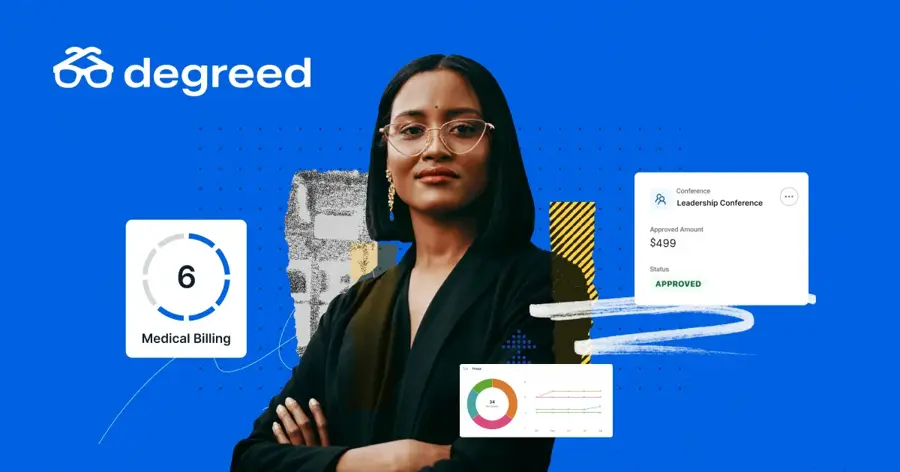
Degreed's product line has grown into several pieces: Degreed Maestro for AI-driven learning, the core LXP, Skills+ for skill data, Academies and an AI-curated Open Library. Its biggest proof point is Capgemini, which trained 150,000 employees in 10 weeks through a Gen AI Campus.
The weak spot is complexity. Capterra shows 24 reviews and 92% positive sentiment, but one reviewer wrote that it "can become cumbersome or confusing when trying to access what you want," finding it hard to tell a pathway from a role family (Capterra). Capterra also notes Degreed doesn't include classic learning-management or course-management features, so you'll likely keep an LMS for compliance training.
Key features
- Maestro adds AI-driven, personalized learning.
- Skills+ gathers skill data for workforce decisions.
- Pathways can be open to anyone or assigned to a group.
- A Daily Learning Digest emails content matched to each person's skills.
Pros
- Proven at very large scale
- Strong curation across many content sources
- Pairs well with assessment tools such as iMocha
Cons
- Navigation can confuse learners
- Not a full LMS for compliance tracking
Degreed pricing: No free plan; quote-based enterprise pricing (checked October 2026). See pricing
Related: AI training courses worth your time Best AI tools for HR teams
Eightfold AI – best for large-scale internal mobility
Eightfold AI is a talent intelligence platform that maps employee skills to roles, projects and learning across hiring and talent management; see it at eightfold.ai.

Strengths
Eightfold's edge is data volume. Its homepage cites 1.6 billion career trajectories and 1.6 million skills behind its models. The newer Workforce Readiness module, on the talent management page, gives CHROs three AI measures: AI Potential, AI Adoption and a Transformation Gap broken down by role and location.
Reviews outside analyst reports are scarce. Eightfold's Trustpilot page has just four reviews and a 2.8 score, and one HR reviewer called it "a solid platform" with "some gaps in terms of implementation and integration capabilities."
Key features
- Digital Twin builds skill profiles from live work signals.
- Career Hub suggests roles, projects, mentors and courses.
- Workforce Readiness tracks AI potential and adoption each quarter.
- TalentForge lets HR teams build custom apps and agents.
Pros
- Very large skills dataset
- FedRAMP Moderate and ISO/IEC 42001 certified
- Covers hiring and internal mobility in one system
Cons
- Heavy implementation for most companies
- Few public user reviews
Eightfold AI pricing: No free plan; quote-based enterprise pricing (checked October 2026). See pricing
Related: Best AI tools for HR teams AI taking over jobs
Pluralsight – best for engineering and IT teams
Pluralsight is a tech skills platform with courses, hands-on labs and Skill IQ assessments for software, cloud, data and AI teams; see it at pluralsight.com.
Strengths
For technical staff, I think Pluralsight's assessments are the most practical on this list. The business plans include Skill IQ Discovery, Prep and Verified, plus Role IQ, 2,500+ labs and AI sandboxes for Azure AI Foundry, AWS Bedrock, SageMaker and Vertex AI.
Capterra users give it 4.6 out of 5 from 109 reviews. One HR business partner liked "the UI of Pluralsight compared to other platforms such as Udemy and LinkedIn Learning," while a software engineer complained "I can't search for a very specific issue in the course."
Key features
- Skill IQ and Role IQ assessments are included on business plans.
- There are 6,500+ courses and 900+ learning paths.
- Cloud and AI sandboxes cover AWS, Azure and GCP.
- Iris adds an AI learning assistant inside the platform.
Pros
- Over 2,500 hands-on labs
- Assessments built for technical roles
- Well-rated by business users on Capterra
Cons
- Teams list price is confusing to read
- Little for non-technical staff
Pluralsight pricing: No free plan. The Teams plan covers 2–20 people and Enterprise covers 20+. Edubracket read a $399 per-seat list price on the Teams page but couldn't tell whether it was monthly or yearly, so confirm with sales (checked October 2026). See pricing
Related: AI training courses worth your time Best AI courses for beginners
Coursera for Business – best for credentials and university content
Coursera for Business gives teams access to university and company courses, Professional Certificates and in-course skill assessments; see it at coursera.org/business.
Strengths
Coursera's plan comparison lists 165+ Professional Certificates, assessments built into courses and AI proctoring with a lockdown browser for high-stakes exams. The Enterprise plan adds Skill Tracks for IT, Software and Product, Data and GenAI, plus an Enterprise MCP server for AI tool integrations. It's also the biggest company here after the Udemy merger closed in May 2026.
The Team plan is self-serve for up to 499 users. On the downside, Coursera's consumer reputation is rough: its Trustpilot page shows 1.3 out of 5 across 1,434 reviews, mostly about subscription charges. That's individual billing, not team plans, but I'd still read the contract renewal terms closely.
Key features
- More than 165 Professional Certificates are included.
- AI proctoring and a lockdown browser protect high-stakes exams.
- Skill Tracks cover IT, software, data and GenAI on Enterprise.
- An AI Course Builder customizes learning paths.
Pros
- Published price with a 14-day refund window
- Self-serve up to 499 seats
- Recognized credentials from universities and companies
Cons
- Skill Tracks are Enterprise-only
- Poor consumer billing reviews on Trustpilot
Coursera for Business pricing: No free plan. Team costs $399 per user per year for up to 499 users, per Edubracket; Enterprise (500+) is quote-based (checked October 2026). See pricing
Related: Best AI courses for beginners Google AI courses
LinkedIn Learning – best for broad business skills
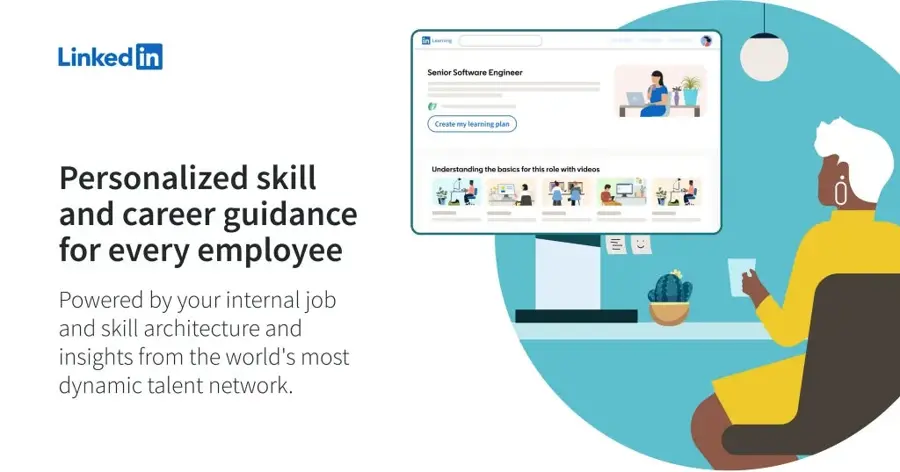
LinkedIn Learning is a course library with skill suggestions, career pathing and AI coaching, backed by LinkedIn's professional data; see it at learning.linkedin.com.
Strengths
The LinkedIn Learning site lists 24,000+ courses in 25 languages, AI-driven coaching and role-play, and AI Skill Pathways built with Microsoft. Assessment is lighter here, though: it's mostly credentials and prep courses, not adaptive testing.
Capterra users rate it 4.6 from 176 reviews. A design founder wrote that "the depth of the courses can vary," and a technical writer said "some courses are lower quality and self promote the people who created the courses."
Key features
- The library has more than 24,000 expert-led courses.
- AI coaching and role-play support soft-skills practice.
- Skill suggestions use LinkedIn's labour-market data.
- Certificates can be shared straight to a LinkedIn profile.
Pros
- One-month free trial
- Huge, multilingual library
- Skill data tied to real job market signals
Cons
- Course depth varies
- Online purchase capped at 20 licences at first
LinkedIn Learning pricing: No free plan, but a one-month free trial; Teams costs $379.88 per licence per year, with 2–20 licences bought online and up to 50 per account (checked October 2026). See pricing
Related: Best AI courses for beginners AI training courses worth your time
DataCamp – best for data and AI literacy
DataCamp is an interactive data and AI training platform with skill assessments, certifications and team reporting; see it at datacamp.com/business.
Strengths
DataCamp is the only pick where you can try the assessments for free. Looking at the plan table, skill assessments are included even on the free Basic tier, and paid plans add 790+ courses, career tracks and certifications. The Skill Matrix, which maps team skill levels, is Enterprise-only, though.
Learners like it a lot. DataCamp scores 4.6 on Trustpilot from 987 reviews, and one learner called it "an excellent platform for learning data science." The limit is scope: it covers data and AI only, so it won't reskill your sales or ops teams in anything else.
Key features
- Skill assessments are free on every plan.
- More than 790 courses cover Python, SQL, Power BI and AI.
- An AI tutor helps inside exercises.
- Skill Matrix maps team skill levels on Enterprise.
Pros
- Free tier with real assessments
- Lowest published team price here
- Hands-on coding exercises
Cons
- Data and AI topics only
- Skill Matrix and SAML SSO need Enterprise
DataCamp pricing: Free Basic plan, then Teams at $28 per user per month billed annually; Enterprise is quote-based. Edubracket recorded a $14 promotional rate on 19 October 2026, so prices shift (checked October 2026). See pricing
Related: Best AI courses for beginners
Udemy Business – best for small teams on a budget
Udemy Business is a curated course library for teams, with assessments, labs and skill insights on its Enterprise plan; see it at business.udemy.com.
Strengths
The Team plan is simple: $360 per user per year for 2 to 50 people, according to TrainingCost, which also notes the account admin needs a licence too. Enterprise adds assigned labs, assessments, Udemy paths and skill insights, going by Capterra's plan breakdown. Udemy is now a Coursera company after the May 2026 merger.
Reviews are mixed on content. A data engineer on Capterra wrote that "some of the courses are outdated and the quality of the content is not consistent," and a small-company CEO said they "found ourselves with unused licenses, yet were unable to adjust our subscription." That second point is the one I'd plan around.
Key features
- The Team plan includes certification prep and practice tests.
- AI-powered coding exercises sit alongside video courses.
- Enterprise adds labs, assessments and skill insights.
- An AI Fluency program is sold separately for larger groups.
Pros
- Clear published Team price
- Wide technical and business catalog
- Free trial on the Team plan
Cons
- Uneven course quality
- Can't shrink seat count mid-term, per one reviewer
Udemy Business pricing: No free plan. Team costs $360 per user per year for 2–50 people; Enterprise and AI Fluency are quote-based (checked October 2026). See pricing
Related: Best AI courses for beginners
Gloat – best for talent marketplaces
Gloat is an agentic HR platform built on a workforce skills graph, with talent marketplace and skills tools for large enterprises; see it at gloat.com.

Strengths
Gloat has repositioned around AI agents. Its homepage describes agents that flag skill gaps "a quarter early," enroll people in learning and update succession slates, all running on a workforce engine it calls Loomra. Capterra lists customers such as Schneider Electric, PepsiCo, Nestlé, Novartis and HSBC.
It's last because I couldn't find enough public feedback to judge it. Capterra shows a single user review, so you're relying on references from Gloat's sales team.
Key features
- A talent marketplace matches staff to internal projects and roles.
- Skills clustering and career-trajectory models power suggestions.
- Agents can enroll employees in learning automatically.
- Agents reach staff through Teams, Slack or email.
Pros
- Strong internal-mobility focus
- Big-name enterprise customers
- Works on top of an existing HCM
Cons
- Almost no public user reviews
- No built-in skills testing to speak of
Gloat pricing: No free plan; quote-based enterprise pricing (checked October 2026). See pricing
Related: Best AI tools for HR teams
Choosing the right AI skills assessment and reskilling platforms
Most buyers end up with two products, not one: something that measures and something that teaches. Here's a quick way to match the job to the tool.
| Your main goal | Start with | Pair with |
|---|---|---|
| Prove AI skill levels to leadership | Workera | Coursera or DataCamp |
| Skills-based hiring and internal moves | iMocha or Eightfold AI | Degreed |
| Reskill engineers on cloud and AI | Pluralsight | Its own Skill IQ |
| Broad upskilling under 50 people | Udemy Business or LinkedIn Learning | Nothing extra at first |
Decide whether you need proof or practice
A board asking "how AI-ready are we?" needs verified scores, which is Workera's or iMocha's job. A team that just needs to learn Copilot or Python doesn't; a library with built-in quizzes will do. Buying a skills-intelligence suite for a 30-person company would be overkill, in my view.
Check the seat limits before the price
Self-serve caps decide whether you get a public price at all. Pluralsight Teams stops at 20 seats, LinkedIn Learning's online purchase starts at a maximum of 20, Udemy's Team plan tops out at 50, and Coursera allows up to 499. Go one seat over and you're in a quote conversation.
Ask how results reach your HR system
Assessment data that sits in a vendor dashboard tends to get ignored. iMocha lists connectors for Workday and SAP SuccessFactors, and Pluralsight and Coursera offer APIs.
Free vs paid: what you actually get
Free options are slim. DataCamp's Basic plan is the only real free tier, and it includes skill assessments plus the first chapter of every course. LinkedIn Learning offers a one-month trial, Udemy Business has a trial on its Team plan, and Coursera gives a 14-day refund window instead of a trial.
Here's a worked example for a 25-person team buying a year of a self-serve library at list prices. DataCamp Teams at $28 a month comes to $336 per seat, or $8,400. Udemy Business at $360 per seat is $9,000, and since the admin needs a licence too, you'd be paying for 25 even if only 24 people learn. LinkedIn Learning at $379.88 works out to $9,497, though you'd buy 20 online first and add five later. Coursera at $399 is $9,975. Pluralsight Teams can't take 25 seats at all, so that's a sales call.
So the spread is about $1,575 a year between the cheapest and priciest option. Small, honestly. Catalog fit matters far more than that gap.
The quote-based platforms are a different budget line. Workera, iMocha, Degreed, Eightfold and Gloat sell annual enterprise contracts, and I'd guess implementation work will cost you as much attention as the licence itself.
Limits and failure modes
Skills assessments break in predictable ways. Inferred skills (from resumes, learning history or work apps) can be stale or flattering, which is why iMocha weights them against tests and manager input. And a test that's quick to build can be too rigid for niche roles, as one iMocha reviewer found.
Reskilling fails more quietly: people get licences and don't use them. Udemy's unused-licence complaint is a good example of the cost side of that. I'd pilot with one team for a quarter, measure completion and a before-and-after score, then scale.
Final verdict
If I had to pick one platform for a mid-size or large company that wants a defensible AI-skills baseline, I'd shortlist Workera, because its five-level model gives leadership a number they can track. For HR teams that also hire, iMocha is probably the better buy. Smaller teams shouldn't bother with either: DataCamp (for data and AI) or Udemy Business (for everything else) will get you most of the way for under $10,000 a year. For more context on why companies are spending on this, see our guides to AI jobs and which jobs AI will replace.
FAQ
What is an AI skills assessment and reskilling platform?
It's software that measures what employees can do, then points them to training that closes the gaps. Some, like Workera and iMocha, focus on testing and skills data. Others, like Coursera, LinkedIn Learning and DataCamp, are course libraries that add assessments. Most large companies use one of each.
How much do skills assessment platforms cost?
Most enterprise tools are quote-based, including Workera, iMocha, Degreed, Eightfold and Gloat. Published team prices start around $336 per seat per year for DataCamp and reach $399 for Coursera for Business. Expect annual contracts, and budget for renewal at full list price.
Can these platforms measure AI skills specifically?
Yes. Workera sorts staff into five AI levels, from Literate to Steward. Eightfold tracks AI potential and adoption by role. Pluralsight has AI sandboxes on AWS, Azure and Google Cloud, and Coursera Enterprise includes GenAI Skill Tracks. For general background, see our guide to AI training courses.
Sources
- Workera: Building AI agents to maximize human potential (Workera)
- Degreed vs Workera (2026): Scores, Reviews & Verdict (RFP.wiki)
- iMocha Recognized as a Major Contender and Star Performer in Everest PEAK Matrix 2026 (iMocha)
- Get a Personalized Demo of iMocha (iMocha)
- iMocha Software Pricing, Alternatives & More 2026 (Capterra)
- iMocha Reviews 2026 (Capterra)
- The Learning and Upskilling Platform (Degreed)
- Degreed Software Pricing, Alternatives & More 2026 (Capterra)
- Degreed Reviews 2026 (Capterra)
- Eightfold AI: AI Native Talent Intelligence Platform (Eightfold AI)
- Talent Management Platform (Eightfold AI)
- Eightfold Reviews (Trustpilot)
- Gloat: Agentic HR Platform & AI Workforce Agents (Gloat)
- Gloat Software Pricing, Alternatives & More 2026 (Capterra)
- Team and Business Pricing Plans (Pluralsight)
- Pluralsight Reviews 2026 (Capterra)
- DataCamp vs Coursera vs Udemy Business (2026): Team Pricing (Edubracket)
- Compare Plans and Pricing (Coursera for Business)
- Online Training for Teams (Coursera for Business)
- Coursera Reviews (Trustpilot)
- Online Learning Platforms Udemy and Coursera Complete Merger (Built In)
- Learning for Teams self-serve purchase FAQ (LinkedIn Help)
- Career Development & AI Skills (LinkedIn Learning)
- LinkedIn Learning Reviews 2026 (Capterra)
- Plans and Pricing (DataCamp)
- DataCamp for Business (DataCamp)
- DataCamp Reviews (Trustpilot)
- Udemy Business Pricing 2026 (TrainingCost.com)
- Udemy Business Reviews 2026 (Capterra)
- Udemy Business Pricing 2026 (Capterra)
- Udemy Business (Udemy)
- Udemy Business plans (Udemy)