Turn It In AI review 2026: how Turnitin's AI detector works, accuracy and your rights
Turnitin's AI detector claims under 1% false positives, but studies and universities disagree. How it works, who can access it, and what to do if you're flagged.
 Written byBurhan AqibSenior writer, policy and analysis
Why you can trust The AI Future
Our writers research every product, link each claim to its source and correct mistakes openly. Companies can't pay for coverage or see reviews before they're published.
Read our editorial policy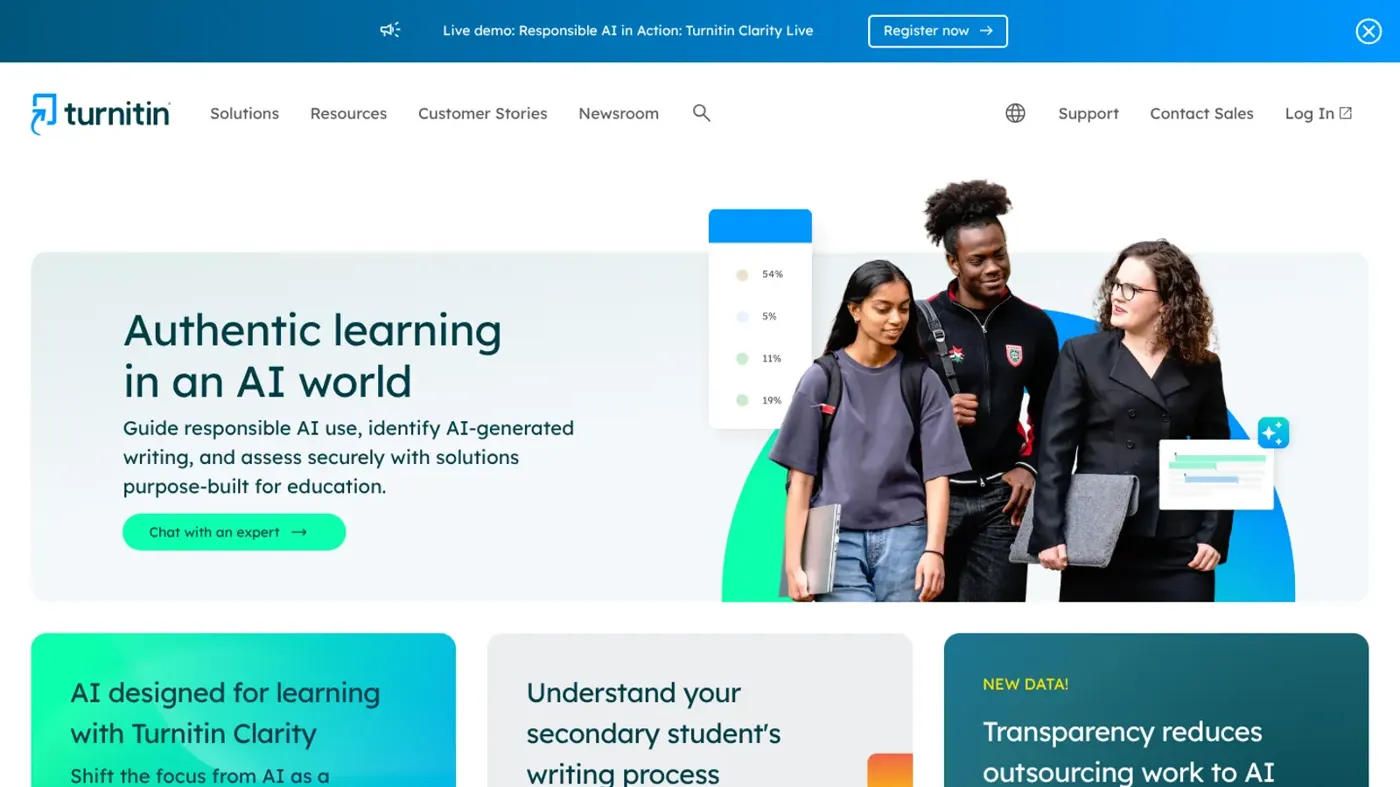
Our verdict on Turnitin AI writing detection (Turnitin)
Turnitin's AI indicator is a reasonable prompt for a conversation on long essays, but not proof of misconduct. Instructors already on Turnitin can use it as a first-pass signal; anyone deciding a student's grade or future on the score alone should skip it.
Pricing Institutional licence only, prices not published; AI detection requires Turnitin Originality (or the iThenticate 2.0 AI add-on). Reported contracts include $30,245/yr (Ocean County College) and a $10,000 AI add-on premium (Wright State). No individual or free plan.
Visit Turnitin AI writing detection (Turnitin)Turnitin's AI writing detector is good at one narrow thing and shaky at the thing people fear most. Turn It In AI (the AI writing indicator inside Turnitin) scores each sentence of a long essay, labels the ones above a threshold as likely AI, and shows teachers a percentage. Turnitin says it keeps false positives under 1% for documents with more than 20% AI writing, but independent researchers and several universities don't trust it enough to use it as evidence, and I think they're right to be cautious.
Nobody at The AI Future ran essays through Turnitin for this review. You can't buy it as an individual anyway. Instead, I compared Turnitin's own guides with published independent studies, university decisions, a 2026 court ruling and about 40 student reviews and Reddit comments, all as of late October 2026.
My short verdict: it's a reasonable prompt for a conversation and a poor basis for a punishment.
The basics of Turn It In AI
Turnitin is the plagiarism checker most schools already use. Its AI writing detection sits inside the Similarity Report, so instructors see an AI percentage next to the familiar matching score. Students don't see it by default: going by Turnitin's FAQ for English submissions, "only instructors and administrators are able to see the indicator", although a teacher can download the AI report as a PDF and share it.
If you've searched "what AI detector does Turnitin use", the answer is Turnitin's own. It isn't GPTZero or Copyleaks under the hood. Turnitin describes a transformer-based deep learning model trained on its in-house collection of academic writing, and it says the model isn't programmed to measure "burstiness" or "perplexity" directly; it learns statistical patterns instead. That's a shift from older explanations (and from how most people still talk about detectors, which our explainer on how AI detectors work covers in more depth).
One awkward consequence: Turnitin admits individual predictions "may not always be explainable in simple feature-by-feature terms." So when a student asks why a paragraph got flagged, there often isn't a satisfying answer.
Key features
Sentence-level scoring with a 20% floor
Each sentence gets a score from 0 to 1, judged in the context of the text around it. Sentences over a threshold are labelled AI, and the document score is the share of sentences above it. Scores from 1% to 19% now show only as an asterisk (*%) with no highlights, which Turnitin says is there to avoid false positives. In October 2026 Turnitin updated the English model to improve accuracy at "transition points" where writing switches between human and likely AI text.
Paraphraser and humanizer detection
Turnitin says it also flags AI text that's been run through paraphrasers or "bypassers" (humanizers), though only in English, and it won't name which tools it targets. I'd treat that claim with the same caution as the headline accuracy figure, since there's no independent audit of it. Either way, the honest route is the only safe one: many schools treat passing off AI text as your own as misconduct, whatever tool touched it.
Model coverage
The current list of supported LLMs runs to roughly 35 models, from GPT-4o and GPT-5.4 to Claude Opus 4.6, Gemini 3.1 Pro preview, DeepSeek V3.2 and Grok 4.1. The newest entries are from March 2026, so it doesn't list several models released since then.
File and language limits
English submissions need at least 300 words of prose and can't exceed 30,000 words or 100 MB; accepted formats are .docx, .pdf, .txt and .rtf. Bullet points, tables, code and references are stripped out before scoring. Long-form Spanish, Japanese, Arabic, Dutch, German and Turkish are also supported, but humanizer detection is English-only.
Turnitin Clarity
Clarity, generally available since July 2025, is a writing space where students draft inside Turnitin, optionally with an AI assistant, while teachers see revision timelines and "pasted vs. typed text". In May 2026 Turnitin added per-assignment controls for what the assistant may do. For students, I think this is the more interesting product: process evidence is far harder to misread than a single percentage.
Turnitin AI pricing and access
There's no public price list, because Turnitin only sells to institutions.
AI detection isn't even in every package. In the FAQ, access is limited to schools that license Turnitin Originality, or iThenticate 2.0 with an AI add-on; plain Similarity or Feedback Studio customers are told to speak to their account manager.
| Product | AI writing detection? | Who buys it | Known prices (checked October 2026) |
|---|---|---|---|
| Turnitin Similarity / Feedback Studio | Not on its own | Schools and colleges | Not published |
| Turnitin Originality | Yes | Schools, as an extra licence | Ocean County College: $30,245 a year; Wright State pays a $10,000 premium for the AI feature (GradPilot) |
| iThenticate 2.0 + AI add-on | Yes | Publishers and researchers | Not published |
| Turnitin Clarity | Yes, in the same view | Institutions, alongside Feedback Studio | Not published |
| Individual student | No direct option | n/a | No free plan |
Big systems pay real money: GradPilot's procurement round-up lists a $1.1 million Turnitin contract for the California State University system in 2025 and a five-year CUNY contract capped at $1,985,050. Cost is also why Cal State LA disabled the feature in June 2024, when it became a paid add-on.
So is there a free Turnitin AI checker for students? No. Sites selling "Turnitin checks" to individuals aren't Turnitin, and one Trustpilot reviewer described being billed €59.99 twice for a service they couldn't cancel (that wasn't necessarily Turnitin itself, which is rather the point).
Accuracy claims and independent testing
Start with Turnitin's own numbers. The company says it aims to keep the false positive rate, meaning fully human text flagged as AI, "under 1% for documents with over 20% of AI writing", and it validates each release on 700,000 academic papers written before ChatGPT. It also admits the trade-off: to keep false positives low it misses some AI text, so a document scored at 50% "could contain as much as 65% AI writing." GradPilot notes Turnitin has acknowledged a sentence-level false positive rate of roughly 4%, which is much higher than the headline figure.
One in 100 sounds small. It isn't, at scale.
Vanderbilt did the maths in 2023: it submitted 75,000 papers in 2022, so a 1% rate could have meant about 750 students wrongly flagged. It switched the detector off, citing false positives, bias concerns and "no insight into how it works."
The independent research hasn't been kind either. In the Weber-Wulff et al. study, which covered 12 public tools plus Turnitin and PlagiarismCheck, the authors concluded detectors were "neither accurate nor reliable" and leaned towards calling text human. As MIT Technology Review reported, the tools averaged 96% accuracy on human text but just 42% on ChatGPT text that had been lightly edited. Perkins and colleagues (2024) found six major detectors averaged 39.5% accuracy, falling to 17.4% on manipulated content, and said they "cannot currently be recommended" for deciding misconduct. Those studies are from 2023 and 2024, and Turnitin's model has changed since; I'd love a fresh, independent test of the October 2026 version, but I haven't found one.
Bias is the other worry. A Stanford-led study by Liang et al. found common GPT detectors "consistently misclassify non-native English writing samples as AI-generated" (Turnitin wasn't among the tools tested). Turnitin says it trained on second-language writers specifically to reduce this. The University of Waterloo wasn't persuaded: when it dropped the feature in September 2025, it cited research on bias and said its own testing found "in more than one instance the product flagged human written text as 100% generated by AI."
Turnitin is upfront that its weak spots include repetitive text, writing with little structural variety and short documents, where a mix of human and AI text "could be flagged as entirely AI-generated." Formulaic lab reports and tightly templated essays seem to me the most exposed. For a wider look at the whole category, see our piece on whether AI detectors are accurate.
Schools that switched it off
A growing list of universities now keep Turnitin's text matching but disable the AI score. Curtin University turned it off from 1 January 2026, and GradPilot counts more than 60 colleges that have switched AI detectors off. Separately, ProPakistani, citing Times Higher Education, reports that Southampton, Newcastle and Westminster plan to end their Turnitin contracts altogether, partly over proposed licence terms that could let Turnitin use student work to train AI services (Turnitin has postponed those changes until at least September 2027).
That second story matters for students too. Your essay's privacy is part of this, not just its score.
Student rights if you're flagged
Turnitin itself says it "does not make a determination of misconduct" and that the AI percentage "should not be used as the sole basis for action." That sentence is your friend. Quote it.
The clearest legal test so far is Newby v. Adelphi University. According to a summary by the law firm Liebert Cassidy Whitmore, a freshman in Adelphi's programme for autistic students got a zero after a Turnitin report showed a 100% AI score; he'd had help from university tutors and supplied results from two other detectors saying the essay was human.
A New York judge annulled the violation in 2026, finding the decision "without valid basis and devoid of reason" and that Adelphi hadn't followed its own code, including the right to an advisor and an appeal heard by someone new. CBS New York reported the student was back on campus.
It's one state ruling, so it won't bind your school. Still, it shows what fair process should look like.
If it happens to you, these steps come up again and again in Turnitin's guidance and in student threads:
- Ask for the full AI report (instructors can download it as a PDF) so you can see which sentences were highlighted.
- Gather your process evidence: Google Docs or Word version history, outlines, notes, sources and earlier drafts.
- Read your school's academic integrity policy and ask whether you can bring an advisor or a students' union representative.
- Offer to talk through your argument and sources in person; knowing your own work well is strong evidence.
- If the first decision goes against you, appeal to someone who wasn't involved in it.
On r/AskTeachers, a student whose personal essay about a relative with dementia was scored 70% AI got nowhere with the teacher until the department chair stepped in; the teacher then conceded "turnitin.com is not working as intended." On r/UniUK, a mature student flagged at 73% was told by commenters to bring notes, plans and version history and to call the students' union advice service first. Honestly, that's the advice I'd give too. Don't rewrite your essay to chase a lower number, and don't reach for a humanizer: it won't fix a false accusation and could create a real one.
Best suited to
Turnitin's AI indicator makes most sense for instructors who already use Turnitin and want a first-pass signal on long essays, as long as a flag leads to a conversation rather than a penalty. Admins get aggregated institution-wide scores, which helps with policy planning. It's a poor fit for short answers, bullet-heavy work, code or anything under 300 words, and I wouldn't let it anywhere near a decision about a student's future without other evidence.
Turnitin AI alternatives worth considering
Schools that leave Turnitin often move to Copyleaks or GPTZero, according to GradPilot, and none of them is immune to false positives. If you're comparing options, our roundup of the best AI detectors sets out their limits side by side.
- GPTZero: an education-focused detector some colleges buy directly or through K16 Solutions' Scaffold; a sensible choice if you want a tool students can also run themselves.
- Winston AI: worth a look for teachers and publishers who want a standalone checker outside an LMS contract.
- Scribbr: a free detector students often use to sanity-check a draft, with the same accuracy caveats as the rest.
Looking for something that behaves like Turnitin? Our guide to which AI detector is closest to Turnitin goes through the candidates.
Verdict
I'd rate Turnitin's AI writing detection 3 out of 5. Its documentation is more candid than most rivals' (the 20% floor, the admitted misses and the "not the sole basis" warning are all sensible), and for instructors already inside Turnitin it's convenient. But the method can't explain itself, the headline accuracy figure comes from Turnitin, and the strongest independent evidence, plus decisions at Vanderbilt, Waterloo and Curtin, points the other way. Teachers should use it as a reason to ask questions. Students who get flagged should know the score isn't proof, and that their drafts usually are.
FAQ
What AI detector does Turnitin use?
Turnitin uses its own AI writing detection model, not a third-party tool like GPTZero or Copyleaks. Going by its FAQ, it's a transformer-based deep learning model trained on Turnitin's in-house academic writing data. It scores each sentence from 0 to 1 and reports the share of sentences above its AI threshold, hiding anything below 20%. Turnitin won't say exactly where that threshold sits, and the model was last updated for English in October 2026.
What does Turnitin use to check for AI?
It checks long-form prose only. Lists, tables, code and references are removed, then each remaining sentence is scored in context. The model learned patterns from AI-generated and human academic writing rather than following fixed rules, and it also tries to spot text altered by paraphrasers or humanizers. Submissions need at least 300 words of prose.
Can students see their Turnitin AI score?
Not by default. Only instructors and administrators see the AI indicator, but an instructor can download the report as a PDF and share it. If you've been flagged, ask for it before any meeting.
Does Grammarly get flagged as AI by Turnitin?
Basic spelling and grammar fixes usually aren't, according to Turnitin's own tests on human-written documents. Text from Grammarly's generative features, such as drafting, paraphrasing or summarising, will likely be flagged. The Adelphi case started with a professor suspecting Grammarly, so keep records of exactly which tools you used.
What should I do if Turnitin falsely flags my essay?
Stay calm and collect evidence: version history, notes, outlines and drafts. Ask for the full AI report, read your school's integrity policy, and request an advisor if it allows one. Point out that Turnitin says its score shouldn't be the sole basis for action, and appeal to someone new if needed. Don't panic-rewrite the essay; that can look worse than the original flag.
Ratings around the web
Ratings as of 8 Nov 2026. Scores change over time; follow the links for the latest.
What users are saying
We read about 40 recent comments: 18 Trustpilot reviews (November 2025 to September 2026) and around 20 comments across four Reddit threads from students and teachers. Almost all came from students who say they were wrongly flagged, so this sample skews heavily negative and doesn't reflect instructors who use the tool quietly.
Common praise
- Flags are often resolved once students show drafts and version history
- Turnitin's own warning that the score isn't proof gives students something to point to
- Some teachers treat a flag as a prompt to talk rather than a verdict
Common complaints
- Human-written work flagged as AI, sometimes at 70% to 100%
- Students told to rewrite or 'use shorter sentences' to lower the score
- Inconsistent results on resubmission and worries about Turnitin using student work
Based on: Trustpilot reviews of Turnitin, Trustpilot reviews of Turnitin (page 2), r/AskTeachers: teacher ignored evidence after Turnitin AI flag, r/IBO: TOK essay flagged by Turnitin, r/UniUK: mature student flagged at 73% AI, r/academia: student asking for help after AI flag
What we like
- Built into the Similarity Report instructors already use, including via Canvas, Moodle and Blackboard
- Scores under 20% are hidden behind an asterisk to cut false positives
- Unusually candid documentation, including admitted misses and a 'not the sole basis' warning
- Covers about 35 named LLMs and seven languages, with humanizer detection in English
- Turnitin Clarity adds writing-process evidence such as revision timelines and pasted vs. typed text
What could be better
- Headline under-1% false positive rate is Turnitin's own figure; independent studies found detectors far less reliable
- Predictions can't be explained sentence by sentence, which makes flags hard to contest
- Students can't see their own score unless an instructor shares the report
- Several universities, including Vanderbilt, Waterloo and Curtin, have switched it off over reliability and bias concerns
Sources
- Turnitin's AI writing detection capabilities FAQs (Turnitin Guides)
- Turnitin Originality: AI writing detection (Turnitin)
- Understanding false positives within our AI writing detection capabilities (Turnitin)
- Turnitin Delivers Turnitin Clarity (Turnitin)
- Turnitin Clarity Adds Customizable AI Settings (AAP / PR Newswire)
- Guidance on AI Detection and Why We're Disabling Turnitin's AI Detector (Vanderbilt University)
- Discontinuing use of AI detection functionality in Turnitin: September 2025 (University of Waterloo)
- Update on Turnitin AI-Detection Tool (Curtin University)
- Testing of Detection Tools for AI-Generated Text (arXiv, Weber-Wulff et al.)
- AI-text detection tools are really easy to fool (MIT Technology Review)
- GenAI Detection Tools, Adversarial Techniques and Implications for Inclusivity in Higher Education (arXiv, Perkins et al.)
- GPT detectors are biased against non-native English writers (arXiv, Liang et al.)
- What AI Detectors Do Colleges Use? (2026 List) (GradPilot)
- Here's Why Universities Are Ending Turnitin Contracts (ProPakistani)
- Court Rules That University Must Expunge Record For Student Accused of AI Violation (Liebert Cassidy Whitmore)
- Adelphi student Orion Newby sues over AI plagiarism accusation and wins (CBS New York)
- Turnitin reviews (Trustpilot)
- My teacher accused me of using AI and ignored evidence (Reddit r/AskTeachers)
- Mature student freaking out over AI, please help! (Reddit r/UniUK)