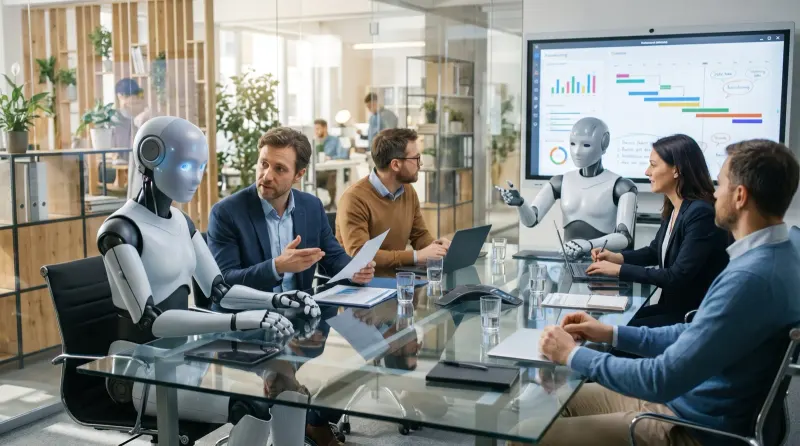
AI taking over jobs in 2026: what the data really shows
Is AI taking over jobs? AI now leads US layoff announcements, but unemployment hasn't spiked. The real squeeze is on entry-level work. Here's the evidence.
 Written byBurhan AqibSenior writer, policy and analysis
Why you can trust The AI Future
Our writers research every product, link each claim to its source and correct mistakes openly. Companies can't pay for coverage or see reviews before they're published.
Read our editorial policy
Is AI taking over jobs? Not in the sweeping way the headlines suggest, at least not yet. In 2026, AI is the most common reason US employers give for announced layoffs, but those cuts are a small slice of the job market, and the clearest damage so far is narrower: fewer openings for young people starting out in AI-exposed office work.
Here is a number worth sitting with. Between January and July 2026, US employers announced 112,713 job cuts that they attributed to artificial intelligence, according to the outplacement firm Challenger, Gray & Christmas. That sounds like a wave. Yet in September the Bureau of Labor Statistics counted 7.1 million unemployed Americans and an unemployment rate of 4.2%, a figure it described as having "changed little". Both facts are true at once, and the gap between them is where the real story of AI and jobs lives.
This guide walks through what the data actually shows, separates what we know from what we are guessing, and ends with practical steps you can take whatever your job is.
The short answer: is AI taking over jobs?
AI is replacing some tasks and a smaller number of whole jobs, but it is not causing mass unemployment. The strongest evidence of harm points to entry-level roles in exposed fields like customer service and software. Most researchers expect gradual reshaping of work rather than a sudden takeover.
That is the headline. The detail matters more, because "AI job replacement" means very different things depending on whether you are a 23-year-old graduate, a mid-career accountant or a chef.
How it works: tasks, not jobs
The most useful idea in this whole debate is simple. AI does not take jobs. It takes tasks. A job is a bundle of tasks, and what happens to the job depends on how much of the bundle a machine can do, and whether doing those tasks faster means the employer needs fewer people or simply gets more done.
Think of a dishwasher in a restaurant kitchen. Nobody thinks the machine "replaced" the kitchen porter. It took over one tiring task, and the person still clears tables, preps vegetables and keeps the place running. Now imagine a machine that could also chop, plate and plan the menu. At some point the bundle gets thin enough that the role changes, merges with another or disappears. Most office jobs in 2026 sit somewhere between those two kitchens.
Economists call this split automation versus augmentation. Automation means the AI does the task instead of you. Augmentation means it helps you do the task better. Anthropic, which makes the Claude models, tracks how people actually use its assistant. Its November 2025 Economic Index report found 52% of conversations were augmentation and 45% were automation, with software work dominating. That balance matters: augmentation tends to change jobs, while automation is what removes them.
There is also a big gap between what AI could do and what it is doing. In a March 2026 study, Anthropic economists combined theoretical capability with real usage data and found that Claude covers 75% of tasks for computer programmers and 67% for data entry keyers, while 30% of workers, including cooks, bartenders and lifeguards, have zero coverage. In their words, "actual coverage remains a fraction of what's feasible". The technology is ahead of the adoption.
A short history lesson
We have been here before. Spreadsheets were supposed to end bookkeeping. The ATM was supposed to end the bank teller. In both cases the work changed shape and some roles shrank, but the predicted collapse did not arrive on schedule. That is not proof that this time is the same. Generative AI reaches into writing, coding and analysis, the kind of thinking work earlier automation left alone. But history is a reason to be wary of anyone who claims to know the exact timetable.
What the numbers say about AI job displacement
Let us put the main figures side by side. These are the ones most often quoted in AI taking over jobs statistics, with what each actually measures.
| Source | What it found | What it measures |
|---|---|---|
| Challenger, Gray & Christmas (July 2026) | 112,713 announced cuts blamed on AI in Jan–Jul 2026, about 24% of all announced cuts; 184,538 since 2023 | Reasons employers give in layoff announcements, not confirmed job losses |
| BLS jobs report (Sept 2026) | Unemployment 4.2%, 7.1 million unemployed, +29,000 payroll jobs | The whole US labour market, from any cause |
| Anthropic labour market study (Mar 2026) | "No systematic increase in unemployment for highly exposed workers since late 2022" | Unemployment in AI-exposed occupations vs others |
| Stanford Digital Economy Lab (Aug 2025) | 13% relative fall in employment for 22 to 25-year-olds in the most AI-exposed jobs | Payroll data from ADP, by age and occupation |
| World Economic Forum (Jan 2025) | 170 million jobs created and 92 million displaced worldwide by 2030; 41% of employers plan cuts as AI automates tasks | An employer survey and forecast, not observed data |
Here is a quick back-of-the-envelope calculation of our own. If you set every AI-attributed layoff announced in the first seven months of 2026 against September's unemployed total, it comes to roughly 1.6% (112,713 out of about 7.1 million). It is a rough comparison, because announcements and unemployment are measured differently and not every announced cut becomes a lost job. But it shows the scale. AI layoffs are real and growing, yet they are still a small slice of why people are out of work.
There is another wrinkle. Challenger itself notes that "the ambiguous nature of what constitutes AI-attributed cuts was highlighted in July," and adds that "naming AI in a layoff announcement can win over investors." Martha Gimbel of the Yale Budget Lab told Fortune that some firms may cite AI to cover for other pressures such as tariffs, immigration changes and policy uncertainty. Her team's data showed little sign of economy-wide disruption and called the anxiety "largely speculative". Some of what gets labelled AI job loss is really ordinary cost-cutting with a fashionable explanation.
Real examples of AI replacing jobs, and backtracking
The company stories are more vivid than the statistics, and they point in more than one direction.
Salesforce: the clearest replacement case
In September 2025, Salesforce chief executive Marc Benioff said the company had cut its customer support staff from about 9,000 to 5,000 as AI agents took on more of the work, as TechRadar reported. His summary on a podcast was blunt: "I need less heads." This is what direct AI job replacement looks like: a high-volume, rules-heavy function where software can handle a large share of routine requests.
Klarna: the cautionary tale
Klarna went further, earlier. In 2024 the payments company said its AI assistant was doing the work of 700 customer service agents, and it froze hiring. By May 2025, chief executive Sebastian Siemiatkowski had changed course, admitting the cheaper AI produced "lower quality" service and starting to hire human agents again, Entrepreneur reported. His new promise to customers: "there will always be a human if you want." Replacing people is easier to announce than to sustain.
Big tech: the money moves first
In April 2026, Meta said it would cut about 10% of its workforce while raising AI spending, according to Yahoo Finance. Andy Challenger put the pattern neatly: "Regardless of whether individual jobs are being replaced by AI, the money for those roles is." In many firms, AI is not doing the laid-off person's work yet. It is absorbing the budget that used to pay for it.
Graduates: the quiet squeeze
The most worrying signal comes from people who never got hired in the first place. The Stanford "Canaries in the Coal Mine" paper by Erik Brynjolfsson and colleagues found the drop in employment for young workers was concentrated in jobs like customer service, accounting and software development, while older workers in the same roles held steady, as The Register summarised. Anthropic's 2026 study saw something similar: job-finding rates for 22 to 25-year-olds in the most exposed fields fell about 14% relative to 2022, though the authors note the result is only barely statistically significant. The New York Fed puts the unemployment rate for recent graduates at about 5.6% and underemployment at 42%. We wrote about this shift in more depth in our piece on AI agents and the entry-level career ladder.
Benefits and limitations
It would be lopsided to talk only about losses. The same research that finds pressure on some workers also finds gains for others.
PwC's 2026 Global AI Jobs Barometer, which analysed more than a billion job ads across 27 countries and territories, found that jobs requiring AI skills carry an average wage premium of 62%, and that roles needing specific AI skills grew 69% against 9% for the job market overall. Companies best placed to use AI grew headcount by 52% since 2018, compared with 36% at the least exposed firms. That is not what you would expect if AI were simply emptying offices. If you want to move toward that side of the market, our guides to AI jobs and what they pay and how to get into AI are a practical starting point.
The limits are just as real. PwC also found that the most AI-exposed entry-level roles are seven times more likely to ask for traditionally senior skills. Pete Brown, PwC's global workforce leader, warned that "AI is removing some of the routine work that once acted as an apprenticeship." That is the uncomfortable trade-off: AI can make experienced people more productive while making it harder for newcomers to become experienced.
There are also limits to the technology itself. Klarna's reversal is one example. AI still makes confident errors, struggles with unusual cases and needs people to check its work, which is why whole new jobs in testing and monitoring AI systems are appearing (our explainer on AI observability covers one of them). And the money question is open: Fortune cited PwC data showing that 56% of companies said they were getting "nothing out of" AI yet. If those returns do not show up, the pace of replacement may slow, a theme we explore in what is the AI bubble.
What it means for you
So, is AI going to replace jobs like yours? The honest answer depends less on your job title than on the mix of tasks inside it. A few practical takeaways follow from the evidence.
- Audit your own week. List the tasks you do most often. Highly repetitive, text-based or rules-driven tasks (drafting standard replies, entering data, writing routine code) are where AI coverage is highest. Tasks that need judgement, physical presence, trust or messy human negotiation are where it is lowest.
- Learn to use the tools you will be measured against. The wage premium for AI skills suggests employers reward people who use AI well. Our guide on how to use AI covers the basics.
- If you are early in your career, find the apprenticeship. Routine starter tasks are disappearing, so look for roles, internships or projects that give you real responsibility and feedback from experienced people.
- Read layoff headlines carefully. "Due to AI" in a press release is a claim, not a finding. Ask whether the work is actually being automated or the budget is being moved.
- Keep an eye on your field's data. Our breakdown of what jobs AI will replace looks at which occupations show the clearest exposure.
None of this is a guarantee. But people who understand where AI fits into their work are better placed than those who either ignore it or panic about it.
What happens next
Here we should be clear about the line between knowledge and guesswork.
What we know: AI-attributed layoff announcements are rising, and AI was the leading reason for the fifth month in a row in July 2026, according to Challenger. Hiring of young workers in exposed jobs looks weaker. Overall unemployment has not spiked.
What we are guessing: how fast this spreads. The forecasts vary widely. Goldman Sachs has projected that 6% to 7% of the US workforce could be displaced if AI is widely adopted, per Fortune. The World Economic Forum expects a net gain of 78 million jobs worldwide by 2030, while nearly 40% of the skills used on the job change. Back in 2024, IMF managing director Kristalina Georgieva said AI would affect "almost 40 percent of jobs" around the world and about 60% in advanced economies, some for better and some for worse.
Yale's Gimbel offered one test worth watching. She suggested AI's real labour impact may become clearer in a recession, when firms have stronger reasons to cut costs. If a downturn comes, companies may use it to make AI-driven changes they have been holding back. Policy will matter too, and governments are only starting to respond. Our guide to AI regulation tracks where the rules stand.
Where do we land? AI is not taking over jobs in the sense of a sudden, economy-wide replacement. It is slowly reshaping them, with the sharpest pain at the bottom of the career ladder and in a handful of task-heavy roles. That is less dramatic than the doom stories, but it is not nothing, and it is happening now.
FAQ
Will AI take over jobs?
AI will take over many tasks and some whole jobs, especially routine, screen-based roles like basic customer support and data entry. But current research, including Anthropic's 2026 study and the Yale Budget Lab's analysis, finds no broad rise in unemployment among AI-exposed workers so far. Most jobs are more likely to change than to disappear outright.
Is AI taking over?
Not in the sense of replacing human work across the economy. AI is spreading fast inside software and companies, and in 2026 it is the most cited reason for announced US layoffs. Yet US unemployment stood at 4.2% in September 2026, and many firms still report little return from AI. It is growing influence, not a takeover.
Is AI going to take over jobs?
Some, yes, gradually. Forecasts range from Goldman Sachs projecting 6% to 7% of US workers could be displaced under wide adoption, to the World Economic Forum expecting a net gain of 78 million jobs globally by 2030. The timing is uncertain, and adoption still lags far behind what the technology could theoretically do.
How will AI affect jobs?
Mostly by changing the tasks inside jobs. AI tends to automate routine writing, coding and data work, while boosting people who use it well: PwC found a 62% average wage premium for AI skills. The biggest early effect is fewer entry-level openings in exposed fields, which makes it harder for young workers to get started.
Will AI replace humans?
AI can replace people for specific tasks, but replacing humans altogether is a different matter. Klarna's experience shows the limits: it leaned heavily on an AI assistant, then rehired human agents after quality dropped. Work that depends on judgement, trust, physical skill and accountability still needs people, and new roles are emerging to build and supervise AI.
Sources
- Challenger Report July 2026 (Challenger, Gray & Christmas)
- Companies blame AI for deep job cuts for second month in a row (Yahoo Finance)
- The Employment Situation, September 2026 (U.S. Bureau of Labor Statistics)
- Yale Budget Lab finds AI anxiety largely speculative (Fortune)
- AI robs jobs from recent college grads, but isn't hurting wages, Stanford study says (The Register)
- Labor market impacts of AI: A new measure and early evidence (Anthropic)
- Anthropic finds AI augments rather than replaces (Let's Data Science)
- Future of Jobs Report 2025: 78 million new job opportunities by 2030 (World Economic Forum)
- The labor market for recent college graduates (Federal Reserve Bank of New York)
- PwC 2026 Global AI Jobs Barometer (PwC)
- Salesforce CEO says it cut 4,000 support jobs and replaced them with AI (TechRadar)
- Klarna is hiring customer service agents after AI couldn't cut it on calls (Entrepreneur)
- IMF chief says AI will affect almost 40 per cent of jobs worldwide (Ghana News Agency)