AI art vs real art in 2026: copyright, value and how to tell them apart
AI art vs real art compared: process, US copyright rules after Thaler, auction results, detection studies, audience bias and the training data debate.
 Written byRahis SaifiCo-founder and news editor
Why you can trust The AI Future
Our writers research every product, link each claim to its source and correct mistakes openly. Companies can't pay for coverage or see reviews before they're published.
Read our editorial policy
AI art and real art aren't competing on the same terms. AI image tools can produce a polished picture in seconds, and in blind tests many viewers can't tell the difference. Human-made art still wins on copyright protection, market trust and the meaning audiences attach to it. I think that split is the whole story.
It matters for anyone buying, making or judging images in 2026. This comparison of AI art vs real art draws on court records, the US Copyright Office's reports, auction results and peer-reviewed studies, as of late October 2026. Nobody at The AI Future ran original experiments for it, and no artworks are reproduced here.
Quick verdict: who wins for which use
There's no single winner. The answer depends on what the image is for.
- Speed and volume: AI wins. A text prompt returns several options in seconds, which suits drafts, mood boards and concept work.
- Legal ownership: human art wins. In the US, purely AI-generated images can't be copyrighted, according to the Copyright Office and the courts.
- Market value: human art dominates. AI-assisted work has sold at auction, but mostly when tied to a known artist.
- Perceived meaning: human art wins. In the 2023 Bellaiche study covered below, people rated the same image as deeper and more valuable when told a person made it.
- Pure looks: roughly a tie. In some blind tests, viewers liked AI images as much as, or more than, human ones.
AI art vs human art side by side
| Factor | AI-generated art | Human-made art |
|---|---|---|
| How it's made | Prompt to a model trained on large image datasets | Hand, tool or camera, guided by the artist's choices |
| Time per image | Seconds to minutes | Hours to months |
| US copyright | Not for purely AI output; human edits can be protected | Protected automatically once fixed |
| Auction track record | Small, uneven, artist-led | Centuries of established markets |
| Can viewers tell? | Often not, in controlled tests | Often misjudged as AI when digital |
| Audience rating of meaning | Lower when labelled AI | Higher when labelled human |
| Main ethical question | Consent and pay for training data | Rarely disputed |
Process: prompts versus practice
Human art starts with a person making choices. Each brushstroke, crop or edit reflects a decision. Skill builds over years, and the process itself is often part of what buyers value, which is probably why handmade work still sells.
AI image generators work differently. A user types a description. A model trained on huge collections of existing images produces a new picture that matches the statistical patterns it learned. Our guide to writing AI art prompts covers how users steer that output.
The user's control is limited, and that's the catch.
The US Copyright Office says that "the output of current generative AI systems may include content that was not specified and exclude content that was," as quoted by IPWatchdog. In the Office's own example, a prompt produced a bespectacled cat smoking a pipe but ignored the request for a detailed wood setting.
That gap is also where many visual errors come from. Garbled text, extra fingers and details that don't add up are covered in our explainer on bad AI art and why it happens.
Many working artists now sit between the two camps. They sketch by hand, then use AI for backgrounds or variations, or the reverse. To my mind that's the most interesting group. The law treats those hybrid works differently from pure AI output, as the next section explains.
Copyright: the 2025 report and the Thaler case
The US Copyright Office published Part 2 of its AI report, on copyrightability, on 29 January 2025, according to the Office's AI page. The report followed more than 10,000 public comments.
Its central finding was direct. "Given current generally available technology, prompts alone do not provide sufficient human control to make users of an AI system the authors of the output," the report said, as quoted by IPWatchdog. Whether a work has enough human control is decided case by case.
The report drew a line between using AI as a tool and using it as "a stand-in for human creativity." Human-made parts of a work stay protected. In one example, the Office registered a hand-drawn illustration that had been run through AI, but limited the registration to the human pictorial authorship that remained clearly visible.
The courts have backed the same principle. Computer scientist Stephen Thaler sought copyright for "A Recent Entrance to Paradise," an image made entirely by his AI system, with the AI listed as sole author. The DC Circuit upheld the human authorship requirement in 2025. On 2 March 2026, the Supreme Court declined to hear the case, leaving that ruling in place, according to law firm Mayer Brown.
The harder question's still open: how much human input is enough. Jason M. Allen's "Théâtre D'opéra Spatial," which won a 2022 Colorado State Fair prize, was refused full registration even though Allen said he used at least 624 prompts and revisions, according to Wikipedia's summary of the case. His challenge, Allen v. Perlmutter, was still pending in Colorado federal court as of Mayer Brown's March 2026 note.
A third part of the report, on training AI with copyrighted material, was released in pre-publication form on 9 May 2025. The Office says a final version will follow without substantive changes, per its AI page.
The market and auctions
AI-assisted art has a short but visible auction history. In 2018, a portrait generated by the French collective Obvious sold at Christie's for $432,500 including fees, according to Gulf News, citing AFP.
Christie's held its first sale dedicated to AI art, "Augmented Intelligence," in early 2025. It totalled $728,784, according to Christie's figures reported by Gulf News. That beat the $600,000 low estimate, CO/AI reported.
The results were uneven, and probably more telling than the headline total. Fourteen of 34 lots received no qualifying bids or sold below the low estimate. Refik Anadol's animation "Machine Hallucinations – ISS Dreams – A" was the top lot at $277,200. A work by Pindar Van Arman, billed as a highlight, drew no qualifying bids.
The sale did attract new buyers. Some 48% of bidders were Millennials or Gen Z, and 37% of registered bidders were new to Christie's, according to CO/AI.
Two caveats apply. Most of the successful lots came from established digital artists who build their own systems, not from one-line prompts. And the totals are tiny next to the wider art market for human work, which I'd guess is why collectors stay cautious.
Our take: the market isn't paying for AI images as such. It's paying for artists with a track record who happen to use AI. Generic AI output, which anyone can make in seconds, has little scarcity and so, I'd say, little resale value.
Telling AI art from real art
In controlled tests, most people struggle. Several studies point the same way.
- The AI art Turing test: writer Scott Alexander asked about 11,000 people to sort 50 images. The median score was 60%, "only a little above chance," he reported on Astral Codex Ten. He noted he had removed AI images with obvious flaws, which made the test harder than real life.
- A US survey of 406 adults: participants identified authorship correctly 53.51% of the time, according to a study listed by Oak Ridge National Laboratory. They often mislabelled human digital art as machine-made.
- Visual professionals versus non-professionals: a 2025 study in the Journal of Imaging, with 161 participants, found AI images were often misclassified as human-made. The authors concluded that people are "generally unable to accurately determine the source of an image," per the paper on PubMed Central.
- Expert judges: a September 2025 arXiv preprint found participants with cognitive and computer science backgrounds performed "no better than chance under certain conditions," according to its abstract. It has not yet been peer reviewed.
Style misleads people most. Alexander found respondents labelled almost all Impressionist-style images as human and many human digital pieces as AI. Judging by medium alone doesn't work.
Some practical checks still help:
- Look at details with logic: hands, text, jewellery, architecture and background objects. One skilled digital artist told Alexander that in real pictures, "the details have logic to them."
- Ask for process: sketches, layered files, timelapse video or work-in-progress posts are hard to fake at scale.
- Check provenance data: some tools attach metadata or content credentials, though these can be stripped.
- Treat detectors with care: automated checkers can help, but false positives happen. See our guides on how AI detectors work and whether AI detectors are accurate.
Artists' views and audience perception
Many artists object to how AI image models were built. The opposition is organised and public, and it's easy to see why.
Before the Christie's sale, about 6,490 people signed a petition calling for it to be cancelled, according to Gulf News. They argued some works used AI models "known to have made unauthorized use of works protected by intellectual property law." Christie's went ahead. Its director of digital art, Nicole Sales Giles, said the results confirmed collectors recognise the artists' importance.
Other artists embrace the tools. Anadol, Holly Herndon and Mat Dryhurst all sold work at the same auction, according to CO/AI. For them, AI is a medium they shape, and they don't treat it as a replacement for their judgement.
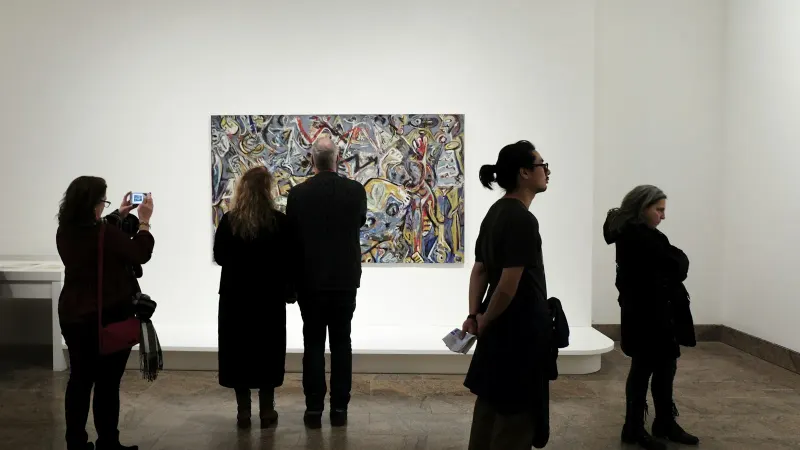
Audiences show a clear bias toward human work, at least when they know the source. In a study by Lucas Bellaiche and colleagues, published in 2023 in Cognitive Research: Principles and Implications, participants saw 30 paintings that were all made by AI. Each was labelled at random as human- or AI-created.
People rated the "human" works higher on liking, beauty, profundity and worth, PsyPost reported. The gap was largest for meaning and worth, and smaller for surface beauty. Perceived effort and the story behind the work drove much of the difference, according to the study abstract.
"AI can indeed make a pretty picture," Bellaiche told PsyPost. But he said the average person doesn't believe AI can communicate emotion, narrative or deep meaning as well as a human.
Blind tests complicate that picture. In Alexander's survey, the two most-liked images were both AI-made. Even people who said they loathed AI art picked AI pieces as favourites when they did not know which was which. Alexander suggested this might reflect frustration with the flood of low-quality AI images rather than with AI art at its best.
Ethics around training data
The biggest ethical dispute isn't about the images themselves. It's about how the models learned to make them.
The case against: image models such as Midjourney and Stable Diffusion were trained on large datasets of scraped online images, many copyrighted, according to the University of Chicago team behind Glaze. The team says many artists found their work in datasets such as LAION-5B "without their knowledge, consent, credit or compensation." It also warns of style mimicry, where models are fine-tuned to copy one living artist.
Some artists now use protective tools. Glaze adds small changes to an image that humans barely notice but that, according to its creators, make AI models misread the style. The team acknowledges the approach has limits as research moves on.
The case for: AI companies argue that training is fair use, a defence they raised in court, according to The Art Newspaper. Supporters also point out that human artists learn by studying others' work, and that output is new rather than copied.
The courts have not settled this. In Andersen v. Stability AI, illustrators including Sarah Andersen, Kelly McKernan and Karla Ortiz sued Stability AI, Midjourney, DeviantArt and Runway in January 2023. In August 2024, Judge William Orrick let key copyright claims go forward while dismissing others, per The Art Newspaper. A summary judgment hearing has been pushed to 17 February 2027, according to ChatGPT Is Eating the World, which tracks AI copyright cases.
For buyers and businesses, some legal risk probably remains. Tools that say they train only on licensed or public domain images reduce that risk. Our roundup of the best AI image generators notes how each one handles training data and commercial use.
Choosing between them
The right choice depends on the job, and I'd rarely pick one side for everything.
- Choose AI art for fast drafts, concept exploration, internal presentations and placeholder images, where ownership and originality matter less.
- Choose human art for logos, book covers, brand assets and anything you need to own, license or defend in court.
- Choose a hybrid if you want speed but also protection. Document the human contributions, since the Copyright Office protects human-authored elements.
- Choose human art for collecting and gifts, where buyers value the artist's story and effort.
Whatever you pick, disclose AI use where it matters. Competitions, publishers and clients increasingly ask. The Colorado State Fair began requiring entrants to disclose AI use from 2023, after Allen's win.
Next up
Three things are worth watching. The Andersen summary judgment hearing is set for February 2027. Allen v. Perlmutter could clarify how much human input counts. And the Copyright Office still plans a final version of its training report.
FAQ
Is AI art real art?
It depends on the definition. AI images can look like art and win prizes, as Allen's 2022 State Fair entry showed. But US law doesn't treat purely AI-generated images as authored works. Many people also see art as human communication, and Bellaiche's 2023 study found they credit less of it to AI.
Can you copyright AI-generated art?
Not in the US if it's purely AI-generated. The Copyright Office's January 2025 report says prompts alone do not give enough control. The Supreme Court declined to hear Thaler v. Perlmutter in March 2026. Human-made parts of a mixed work can still be registered, decided case by case.
Can people tell AI art from human art?
Mostly not, in controlled tests. Scott Alexander's survey of about 11,000 people found a median score of 60%, near chance. A US study of 406 adults found 53.51% accuracy. Obvious flaws such as garbled text make real-world AI images easier to spot, so don't read too much into the near-chance scores.
Why do people prefer human art?
Research points to effort and meaning. In a 2023 study, people rated identical AI paintings higher on beauty, profundity and worth when told a human made them. The gap was biggest for meaning and value, smaller for surface beauty.
Does AI art sell at auction?
Some does. Christie's first dedicated AI sale in 2025 totalled $728,784, led by a Refik Anadol work at $277,200. But 14 of 34 lots drew no qualifying bids or sold below estimate. Value mostly follows established artists, not the technology.
Is it ethical to use AI art?
Views differ. Critics say many models were trained on artists' work without consent or pay. AI companies argue training is fair use, and courts haven't ruled finally. Using tools trained on licensed data and disclosing AI use reduces both ethical and legal concerns.
Sources
- Supreme Court Denies Cert in AI Authorship Case (Mayer Brown)
- Part Two: Copyright Office AI Report Says Creative Prompting Doesn't Constitute Authorship (IPWatchdog)
- Copyright and Artificial Intelligence (U.S. Copyright Office)
- Théâtre D'opéra Spatial (Wikipedia)
- Christie's first AI art auction sees hits... and plenty of misses (Gulf News)
- Christie's first AI art auction hits $728K despite copyright controversy (CO/AI)
- How Did You Do On The AI Art Turing Test? (Astral Codex Ten)
- An eye for AI: quantitative insights into viewer ability to identify AI-generated artworks (Oak Ridge National Laboratory)
- Interpretation of AI-Generated vs. Human-Made Images (Journal of Imaging, PubMed Central)
- The Lovelace Test of Intelligence: Can Humans Recognise and Esteem AI-Generated Art? (arXiv)
- New psychology research reveals why people prefer human-created artwork to AI-created artwork (PsyPost)
- Humans versus AI: whether and why we prefer human-created compared to AI-created artwork (PubMed)
- What is Glaze (University of Chicago)
- US artists score victory in landmark AI copyright case (The Art Newspaper)
- Sarah Andersen's copyright lawsuit gets pushed back again at her request (ChatGPT Is Eating the World)