Best quantum AI tools in 2026: 8 real picks, and the scam to avoid
The best quantum AI tools for 2026, from PennyLane to IBM's free Qiskit hardware time, plus why the 'Quantum AI' trading app is a reported scam.
 Written byMuhammad Usman SiddiquiFounder and editor-in-chief
Why you can trust The AI Future
Our writers research every product from its official pages, independent tests and user reports, link each claim to its source and correct mistakes openly. Unless an article says otherwise, we haven't tested the product hands-on ourselves. Companies can't pay for coverage or see reviews before they're published.
Read our editorial policy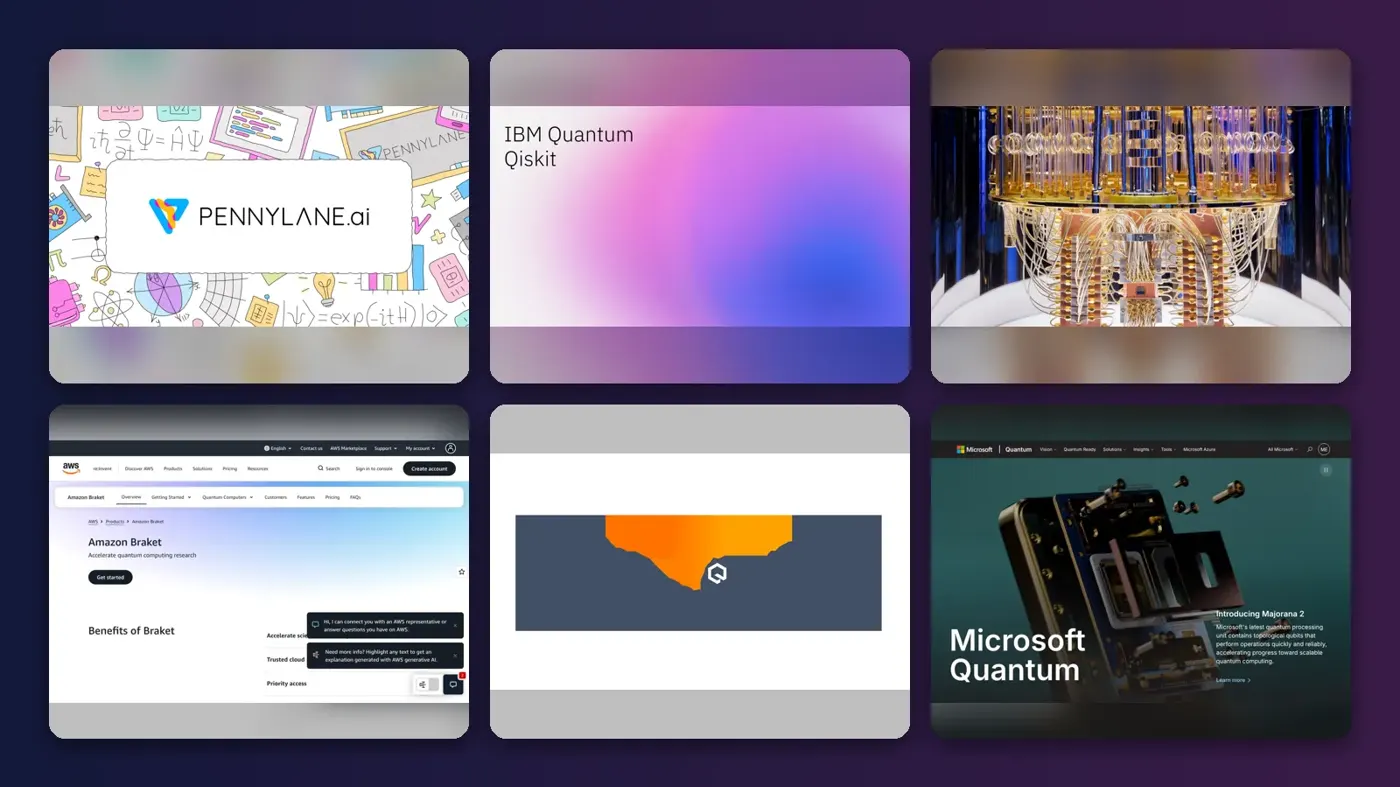
Short answer: if you want to try quantum AI for real, start with PennyLane for quantum machine learning or Qiskit if you want to run code on actual IBM hardware for free. Both are open source and cost nothing to install. "Quantum AI" in the honest sense means using quantum computers for machine learning (and, increasingly, using AI to help build quantum software), and today it's a research field, not a shortcut to better chatbots.
There's a second meaning you need to know about. "Quantum AI" is also the name of a crypto trading platform that regulators in Denmark, Belgium and Hong Kong have flagged as suspected fraud. It isn't on this list, I won't link it, and I'd stay well away from it. More on that below.
This roundup covers the eight real quantum AI tools I think are worth your time in 2026, with prices checked in early November 2026. If you're mostly curious about the hype, our explainer on why quantum AI is trending is a gentler place to start.
Key takeaways
- PennyLane is the most practical place to learn quantum machine learning, because it plugs into PyTorch and JAX and its tutorials are free.
- IBM's free Open Plan gives you up to 10 minutes of real quantum computer time a month, which is enough for small experiments.
- Most quantum AI work still runs on simulators and GPUs, so NVIDIA CUDA-Q matters more than its name suggests.
- Any app called "Quantum AI" that promises trading profits is a red flag, and several financial regulators have issued warnings about it.
Our ranking method
Nobody at The AI Future ran hands-on tests for this roundup. We compared the tools using official docs, pricing pages, GitHub activity and published research, as of early November 2026, and ranked them on six criteria:
- Machine learning support, meaning how well the tool connects quantum circuits to ML libraries such as PyTorch, TensorFlow or JAX.
- Access to real quantum hardware, and how many hardware vendors it reaches.
- Free access, including simulators and any free hardware minutes.
- Learning material, such as demos, courses and code examples.
- Signs of active upkeep, judged from recent releases and GitHub activity.
- Paid pricing, for when you outgrow the free options.
Anything with no docs, no code and no verifiable company behind it didn't make the cut.
The 8 best quantum AI tools at a glance
| # | Tool | Category | Best for | Free tier | Starts at |
|---|---|---|---|---|---|
| 1 | PennyLane | Open-source framework | Quantum machine learning | Yes | Free |
| 2 | Qiskit | SDK and cloud hardware | Free time on real hardware | Yes | $96/min |
| 3 | NVIDIA CUDA-Q | GPU-quantum platform | Fast simulation on GPUs | Yes | Free |
| 4 | Amazon Braket | Cloud hardware access | Trying several hardware makers | Yes (limited) | $0.30/task |
| 5 | TensorFlow Quantum | Open-source library | TensorFlow and Cirq users | Yes | Free |
| 6 | Microsoft Quantum Development Kit | SDK and VS Code tools | AI-assisted quantum coding | Yes | Free |
| 7 | D-Wave Leap | Quantum annealing cloud | Optimization problems | Yes (limited) | Custom |
| 8 | Classiq | Enterprise platform | Corporate quantum teams | No | Custom |
Notes: Amazon Braket's $0.30 is the per-task fee, with a per-shot charge on top that depends on the machine. D-Wave's free access is a three-month trial you apply for. Microsoft's kit is free, but running on hardware through Azure Quantum is billed by each hardware provider.
The best quantum AI tools in 2026, ranked
PennyLane – best for quantum machine learning
PennyLane is a free, open-source Python framework from Xanadu for quantum computing, quantum machine learning and quantum chemistry. Get it at pennylane.ai.
Strengths
PennyLane's big idea is that quantum circuits should be trainable like neural networks. Its site calls this quantum differentiable programming: you can compute gradients through a circuit, even on real hardware, and hand them to a classical optimizer. That's the core trick behind most quantum machine learning experiments today.
A 2025 arXiv guide to hybrid quantum-classical ML walks through PennyLane examples for quantum kernels, variational eigensolvers and portfolio optimization, with PyTorch, TensorFlow and JAX on the classical side. On GitHub the project has about 3,500 stars and more than 7,500 commits. Honestly, its free demo library is the main reason I rank it first: you can learn the field from it without buying a textbook.
Key features
- Gradients flow through quantum circuits, so you can train circuit parameters with standard optimizers.
- It works with PyTorch and JAX for the classical half of a hybrid model.
- The Lightning simulator runs on GPUs and uses NVIDIA cuQuantum.
Pros
- Completely free and Apache 2.0 licensed.
- The demo library is the best learning material in this list.
- Hardware-agnostic, so you're not locked to one vendor.
Cons
- It's research software, and the API still changes between releases.
- A recent commit deprecated maintenance of its TensorFlow interface, so TensorFlow users may need to switch libraries.
PennyLane pricing: Free and open source; there's no paid plan (checked November 2026). See pricing
Related: AI vs machine learning vs deep learning Best AI scientific research tools
Verdict: if you only pick one quantum AI tool to learn, pick this one.
Qiskit – best for free time on real hardware
Qiskit is IBM's open-source quantum software kit, paired with IBM Quantum's cloud access to real quantum computers. Start at ibm.com/quantum/qiskit.
Strengths
IBM says Qiskit has 27 million downloads, and it cites the Unitary Foundation's finding that 74% of developers use Qiskit as their primary SDK (IBM Qiskit page). Those are IBM's own numbers, mind. Still, the main GitHub repo has around 8,000 stars, more than any other tool here.
For the AI side, there's Qiskit Machine Learning, a library for quantum neural networks and kernels that now lives under the UK's STFC Hartree Centre on GitHub. IBM also runs the Qiskit Code Assistant, a set of LLMs tuned to write Qiskit code; the current one is mistral-small-3.2-24b-qiskit, and you can download the open models from Hugging Face and run them locally with Ollama. I like that IBM published its own Qiskit HumanEval benchmark (about 150 tests) instead of just claiming the assistant works.
Key features
- The free Open Plan includes up to 10 minutes of runtime a month on IBM quantum computers.
- Qiskit runs on hardware from IBM, IonQ, Quantinuum, IQM, Rigetti and others.
- Qiskit Machine Learning adds quantum neural networks and kernel methods.
Pros
- Free access to real quantum hardware, which is rare.
- The largest user base, so answers to common errors are easy to find.
- An AI coding assistant built for quantum code.
Cons
- Paid time is expensive once you pass the free 10 minutes.
- The machine learning add-on is a separate, smaller project than the main SDK.
Qiskit pricing: Free Open Plan, then Pay-As-You-Go from $96 per minute; Flex starts at $72 per minute and Premium at $48 per minute (checked November 2026). See pricing
Related: Best free AI coding assistants Best AI for science research
Verdict: the best way to touch a real quantum computer without paying.
NVIDIA CUDA-Q – best for fast simulation on GPUs
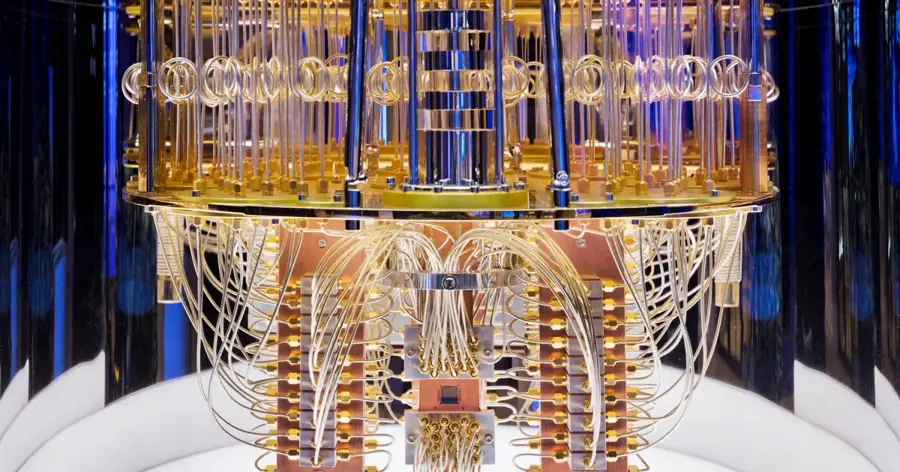
CUDA-Q is NVIDIA's open-source platform for programs that mix GPUs, CPUs and quantum processors in one codebase. Find it at developer.nvidia.com/cuda-q.
Strengths
Here's a fact the hype tends to skip: most quantum machine learning research runs on simulated qubits, and simulation eats GPU time. CUDA-Q is built for exactly that. NVIDIA says it works with 75% of publicly available QPUs, so you can test on GPUs and then point the same code at real hardware.
It's also where the "AI helps quantum" direction is most visible. NVIDIA's starter kits include QAOA-GPT, which uses a generative pretrained transformer to build circuits for the max-cut problem,. I'd guess this pick matters most to people who already have NVIDIA hardware.
Key features
- You write kernels in Python or C++ and the compiler targets GPU, CPU or QPU.
- Install is a single command: pip install cudaq.
- Libraries cover quantum error correction and algorithm development.
Pros
- Free and open source.
- GPU acceleration makes larger simulations practical.
Cons
- You get the biggest speedups only with NVIDIA GPUs.
- It's aimed at researchers and engineers, so beginners may find PennyLane friendlier.
NVIDIA CUDA-Q pricing: Free and open source; your costs are the GPUs or cloud instances you run it on (checked November 2026). See pricing
Related: AI laptops vs GPUs
Verdict: the pick for anyone whose bottleneck is simulation speed.
Amazon Braket – best for trying several hardware makers
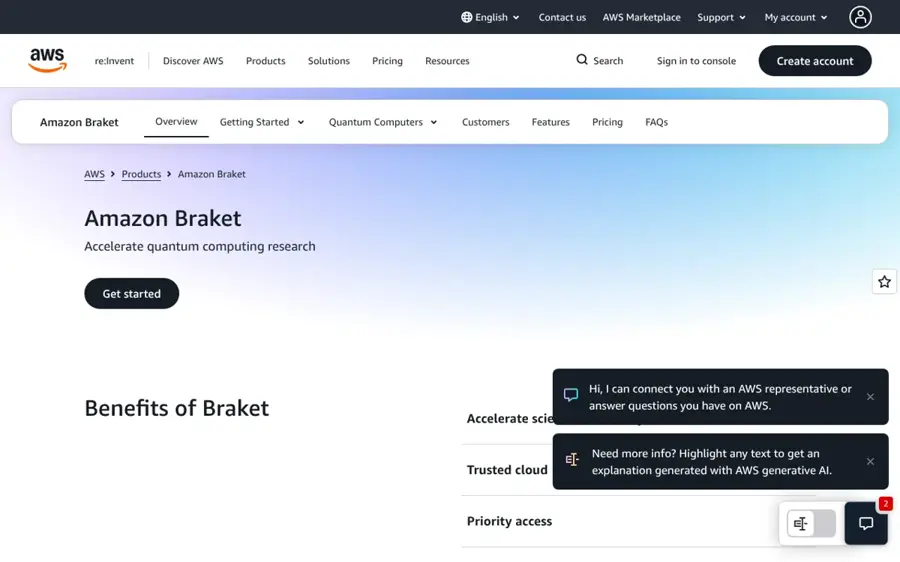
Amazon Braket is AWS's quantum computing service, with pay-per-use access to machines from several vendors plus managed simulators. Visit aws.amazon.com/braket.
Strengths
Braket's appeal is choice. One AWS account gets you to hardware from AQT, IonQ, IQM, QuEra and Rigetti, with simulators for noise-free, noisy and tensor-network runs. For quantum machine learning, the Hybrid Jobs feature runs your classical training loop next to the quantum tasks, and it supports PennyLane and CUDA-Q simulators inside the job container.
The pricing is transparent, which I appreciate, but it adds up. Every task costs $0.30, then per-shot fees range from $0.000425 on Rigetti Cepheus to $0.08 on IonQ Forte. So 1,000 shots on IonQ Forte would run about $80.30 by my maths. Reserved hours cost $2,500 to $7,000.
Key features
- On-demand access to quantum computers from five hardware makers.
- The SV1 simulator costs $0.075 per minute, billed by the millisecond.
- The AWS Free Tier includes one hour of on-demand simulation a month for your first 12 months.
- Hybrid Jobs bundle classical and quantum compute for training loops.
Pros
- The widest hardware choice through one account.
- Clear published per-shot prices.
- Works with PennyLane and CUDA-Q code.
Cons
- Costs climb fast on high-end machines.
- The free hour of simulation ends after 12 months.
Amazon Braket pricing: Free local simulator and a limited free tier, then pay per use from $0.30 per task plus per-shot fees (checked November 2026). See pricing
Related: Best cloud native AI platforms
Verdict: worth it once you know which hardware you want to compare.
TensorFlow Quantum – best for TensorFlow and Cirq users
TensorFlow Quantum is Google's open-source library for hybrid quantum-classical machine learning, built on the Cirq framework from Google Quantum AI. See tensorflow.org/quantum.

Strengths
It's the most literal "quantum plus AI" tool here. TensorFlow Quantum lets you drop a parametrized quantum circuit into a Keras model as a layer, so quantum circuit data flows in as tensors (TensorFlow Quantum). Circuits are written in Cirq, which Google uses to run experiments on its own quantum processors.
The repo has about 2,200 stars and roughly 1,000 commits on GitHub, and its README lists support for TensorFlow 2.19. That's a smaller community than PennyLane's. I suspect fewer new projects pick it because PyTorch and JAX have pulled ahead for research, but if your team lives in TensorFlow, it's the natural fit.
Key features
- Quantum circuits act as Keras layers inside normal TensorFlow models.
- Cirq's Quantum Virtual Machine mimics the noise of real Google hardware.
Pros
- Free and backed by Google Quantum AI.
- Fits existing TensorFlow and Keras code.
Cons
- Smaller, slower-moving project than PennyLane or Qiskit.
- Tied to TensorFlow at a time when many researchers use PyTorch.
TensorFlow Quantum pricing: Free and open source; no paid plan (checked November 2026). See pricing
Related: Google AI courses AI, machine learning and deep learning
Verdict: a good choice for TensorFlow shops; everyone else should probably start with PennyLane.
Microsoft Quantum Development Kit – best for AI-assisted quantum coding
The Microsoft Quantum Development Kit is a free, open-source toolkit for writing, simulating and running quantum programs, with a VS Code extension and Python packages. Start at quantum.microsoft.com.
Strengths
Microsoft pitches the kit as AI-assisted: its homepage mentions tools integrated with VS Code and GitHub Copilot that support several quantum languages and SDKs. You can write Q# or OpenQASM programs, import them in Python and run resource estimation, which tells you how big a quantum computer your algorithm would really need (QDK overview). That estimator is the feature I'd point most people to, because it's a sober check on quantum AI claims.
Running on hardware goes through Azure Quantum, where each provider sets its own price. As one example, IonQ jobs carry a minimum of $97.50 per program with error mitigation on (Azure Quantum pricing).
Key features
- A VS Code extension for writing and debugging Q# and OpenQASM.
- A qdk-chemistry library for chemistry and materials work.
- Resource estimation to size algorithms for future machines.
Pros
- The kit is free.
- Copilot support helps newcomers write quantum code.
- The resource estimator is useful for reality checks.
Cons
- Q# is another language to learn.
- Hardware pricing differs by provider and can be hard to compare.
Microsoft Quantum Development Kit pricing: Free; hardware runs on Azure Quantum are billed per provider (checked November 2026). See pricing
Related: Microsoft AI review Best free AI coding assistants
Verdict: best for Copilot users and anyone who wants to size an idea before spending money.
D-Wave Leap – best for optimization problems
D-Wave Leap is a cloud service for D-Wave's annealing quantum computers and hybrid solvers, aimed at scheduling, routing and other optimization jobs. Visit dwavequantum.com.
Strengths
D-Wave works differently from the gate-based machines above. Its annealers are built for optimization, and Leap's hybrid solvers accept problems with up to two million variables and constraints. That makes it the most business-ready option here, though it's less about machine learning and more about scheduling and logistics. IDC analyst Heather West, quoted by D-Wave, said "Access to the technology has been made easy via the development of a point-and-click interface".
D-Wave claims 99.9% uptime. Developers use the open-source Ocean SDK in Python.
Key features
- Access to Advantage2 and Advantage annealing systems.
- Hybrid solvers for problems with up to 2,000,000 variables and constraints.
- A three-month free trial through the Leap Quantum LaunchPad program for approved applicants.
Pros
- Strong fit for real optimization problems today.
- Fast responses, with solutions usually back in seconds.
Cons
- Annealing doesn't run general quantum circuits.
- Paid pricing isn't published.
- The free trial needs an application.
D-Wave Leap pricing: No open free plan; qualified users can apply for a three-month free trial, and paid access is quoted by sales (checked November 2026). See pricing
Related: Best AI for science research
Verdict: pick it if your problem is optimization, not model training.
Classiq – best for corporate quantum teams
Classiq is an enterprise quantum software platform that turns high-level models into optimized circuits for any hardware, with an AI-assisted natural language interface. See classiq.io.
Strengths
Classiq sits above the circuit level. You describe an algorithm in its Qmod language (or in plain language through its AI-assisted interface), and it synthesizes the circuit for whichever machine you target. Its platform login now promotes a new agentic Quantum Engineering interface, and the company says it's SOC 2 and GDPR compliant.
The catch is access. The platform asks you to contact the company to set things up, and Krowdbase lists no free trial. That surprised me a little, since many tools in this space give away a free tier.
Key features
- The Qmod language for high-level quantum algorithm design.
- Automatic circuit synthesis for any hardware or simulator.
- An AI-assisted natural language interface.
- A public algorithm library on GitHub with finance and telecom examples.
Pros
- No gate-level coding needed for many algorithms.
Cons
- No public pricing.
- Sales-led setup makes it a poor fit for individuals.
- A proprietary language means less portable skills.
Classiq pricing: No free plan listed; pricing is by quote (checked November 2026). See pricing
Related: Best enterprise AI solutions Best cloud native AI platforms
Verdict: worth a demo for large companies; skip it if you're learning alone.
Quantum AI, explained in plain terms
Quantum AI is the overlap of quantum computing and artificial intelligence. Mostly it means quantum machine learning, though it also covers AI that helps write quantum code.
The name also belongs to Google's research lab, Google Quantum AI, which built the Willow chip and recently published an algorithm called Quantum Echoes that it describes as the first verifiable quantum advantage.
Is any of it beating classical AI today? Not in any way that touches your daily tools. Back in 2022, physicists Maria Schuld and Nathan Killoran asked whether quantum advantage is even the right goal for quantum machine learning, arguing that it's very hard to show practical gains with the tools researchers currently use. I think that caution still holds. If you want the bigger picture, our comparison of quantum computing vs AI covers how the two fields differ.
The Quantum AI trading app is a reported scam
A lot of people searching "quantum AI" are really looking at a trading platform with that name. Here's what regulators have said, in their own warnings:
- Denmark's Finanstilsynet said the firm uses fake articles and videos featuring well-known Danes and has no authorization to operate as an investment firm in Denmark.
- Belgium's FSMA listed "Quantum AI" under fraud, with several sites attached, according to the IOSCO I-SCAN alert last updated on 27 October 2026.
- Hong Kong's Securities and Futures Commission warned that it used AI-generated deepfake videos of Elon Musk, and police blocked its website.
- Quebec's AMF keeps an investor warning sheet for Quantum AI Trading.
Don't sign up, and don't send money. If you've already deposited funds, contact your bank and your national financial regulator. Our piece on the dangers of AI covers deepfake scams like this one in more detail.
Choosing the right quantum AI tools
Start on a simulator
Every tool here except D-Wave and Classiq gives you a free simulator. Small quantum ML models run fine on a laptop, so there's no reason to pay for hardware before your code works.
Match the tool to your ML library
PyTorch or JAX users should pick PennyLane. TensorFlow users will feel at home with TensorFlow Quantum. If you don't use either yet, I'd say PennyLane has the gentler learning curve.
Pick hardware access last
IBM's free 10 minutes covers most first experiments; Braket is better once you want to compare IonQ, IQM and Rigetti side by side.
Free vs paid: what you actually get
Free goes a long way: five of the eight tools are completely free, and small hybrid models train fine on simulators. IBM adds up to 10 minutes of real hardware a month, while AWS gives new Braket users an hour of managed simulation a month for a year.
Paying buys you hardware time and scale. That's it, mostly. On IBM, that's $96 a minute on Pay-As-You-Go, or $72 and $48 a minute on the Flex and Premium plans with yearly commitments of 400 and 5,200 minutes. On Braket, you pay per task and per shot. D-Wave and Classiq quote prices to businesses directly. Most students and hobbyists probably won't need to pay anything this year.
Final verdict
If you want to learn quantum AI, install PennyLane and work through its demos; then use your free IBM minutes to run a model on a real machine. That combination costs nothing and covers both halves of the field. I'd add CUDA-Q only when your simulations get slow, and Braket only when you need specific hardware. And please, treat any "Quantum AI" app that talks about profits as the scam regulators say it is.
FAQ
What is quantum AI?
Quantum AI is the use of quantum computers for artificial intelligence, mostly quantum machine learning, where parts of a model run as quantum circuits trained by a classical computer. It's still a research field. Free tools such as PennyLane and Qiskit let you try it on simulators and, through IBM's Open Plan, on real hardware.
What is AI quantum?
"AI quantum" usually means the same thing as quantum AI, but it can also mean the reverse: using AI to help quantum computing. Examples include IBM's Qiskit Code Assistant, an LLM that writes quantum code, and NVIDIA's QAOA-GPT, which uses a transformer model to design circuits for optimization problems.
What is quantum in AI?
"Quantum" in AI refers to quantum computing, which uses qubits that can hold superposition and entanglement. In AI, quantum circuits can act as model layers or kernels. For now they don't make everyday AI faster; ChatGPT-style models still run on ordinary GPUs, as our guide to what AI is explains.
Is the Quantum AI trading platform legit?
No reputable evidence suggests it is. Regulators in Denmark, Belgium and Hong Kong have issued warnings, citing fake celebrity endorsements, deepfake videos of Elon Musk and no license to offer investment services. Don't deposit money, and report it to your financial regulator if you already have.