8 best AI managed services in 2026: managed AI platforms compared
The best AI managed services in 2026, from Amazon Bedrock and Microsoft Foundry to Hugging Face, compared on models, agents, pricing and free credits.
 Written byDr. Alap ZahidReviews And Guides Editor
Why you can trust The AI Future
Our writers research every product from its official pages, independent tests and user reports, link each claim to its source and correct mistakes openly. Unless an article says otherwise, we haven't tested the product hands-on ourselves. Companies can't pay for coverage or see reviews before they're published.
Read our editorial policy
Short answer: if you want AI managed services that let you call top models, build agents and skip the GPU wrangling, start with Amazon Bedrock if you're on AWS, Microsoft Foundry if you're a Microsoft shop, and Google's Gemini Enterprise Agent Platform if your data lives in BigQuery. Pick the cloud you already pay for. That one decision probably saves you more money and time than any feature comparison will.
Everything else on this list is a specialist. IBM watsonx.ai suits regulated industries, Databricks and Snowflake bring AI to the data you've already stored with them, Oracle makes sense for Oracle Database customers, and Hugging Face is the simplest way I know of to put an open model behind a private endpoint. ("Managed AI services" can also mean a consultancy that runs AI for you; there's a short note on that near the end.)
Key takeaways
- All eight picks bill on usage, so there's no flat monthly fee to compare, and your real cost depends on tokens, GPU hours or credits.
- The big three clouds (AWS, Microsoft and Google) plus IBM were all named Leaders in Gartner's 2025 Magic Quadrant for AI application development platforms.
- Free credits are generous for a pilot: $200 on AWS and Azure, $300 on Google Cloud and Oracle, and $400 on a Snowflake trial.
- Google's Gemini 4 Argon promo price ends on November 30, 2026, after which input and output rates double.
Our ranking method
Nobody at The AI Future ran hands-on tests for this roundup, and there are no screenshots of our own here. We compared each service using the vendors' own pricing and product pages, analyst coverage and published user reviews on PeerSpot, SoftwareReviews and G2 (via AWS Marketplace), all checked in early November 2026. We ranked them on six criteria:
- Model choice, meaning how many first-party, third-party and open models you can call from one place.
- Agent tooling, covering how much of the agent build, memory and runtime work the provider handles for you.
- Governance and security, including guardrails, identity controls and data retention terms.
- Pricing clarity, judged on whether you can estimate a monthly bill before you commit.
- Free credits, plus user sentiment from named review sites.
Broad platforms rank above specialists, but a specialist can still be your best answer.
The 8 best AI managed services at a glance
| # | Tool | Category | Best for | Free tier | Starts at |
|---|---|---|---|---|---|
| 1 | Amazon Bedrock | Cloud AI platform | AWS teams wanting model choice | Yes (limited) | Pay per token |
| 2 | Microsoft Foundry | Cloud AI platform | Microsoft 365 and Azure shops | Yes (limited) | Pay per use |
| 3 | Gemini Enterprise Agent Platform | Cloud AI platform | Agent builders on Google Cloud | Yes (limited) | Pay per token |
| 4 | IBM watsonx.ai | Enterprise AI studio | Regulated industries | Yes (limited) | $0.0636/1M tokens |
| 5 | Databricks | Data and AI platform | Agents built on lakehouse data | Yes (limited) | Pay per DBU |
| 6 | Snowflake Cortex AI | Data cloud AI | SQL teams on Snowflake | Yes (limited) | Pay per credit |
| 7 | OCI Enterprise AI | Cloud AI platform | Oracle Database customers | Yes (limited) | Pay per use |
| 8 | Hugging Face Inference Endpoints | Model hosting | Open models on dedicated hardware | No | $0.033/hr |
The free tiers marked "limited" are new-account credits or capped trial plans, not permanent free usage.
The best AI managed services in 2026, ranked
Amazon Bedrock – best for AWS teams wanting model choice
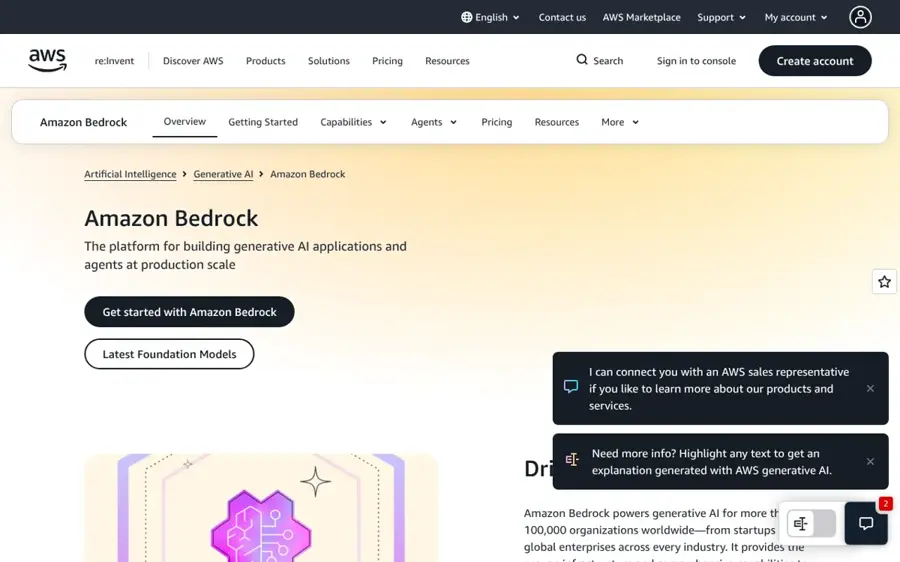
Amazon Bedrock is AWS's fully managed service for calling foundation models from many providers and building agents on top of them, without running any servers yourself.
Strengths
The model list is the draw. Scroll through Bedrock's prices and you'll find around 20 providers, including Anthropic, OpenAI, Google, Meta, Mistral AI, DeepSeek, xAI and Amazon's own models. AWS now says Bedrock powers generative AI for more than 100,000 organizations, and Gartner kept AWS in the Leaders quadrant, pointing to its guardrails and automated reasoning checks, as Virtualization Review reported.
User feedback is mostly about convenience. One reviewer quoted on PeerSpot wrote that "users do not have to worry about the infrastructure." The same page lists the downsides plainly: a complex initial setup that pulls in several AWS services, and costs that "sometimes incurs charges not explicitly mentioned in the pricing." On SoftwareReviews, Bedrock scores 84 for likeliness to recommend and 95 for plan to renew.
Key features
- Hundreds of foundation models from about 20 providers behind one API.
- AgentCore runs and scales agents built with any framework or model.
- Guardrails filter harmful content, and Automated Reasoning checks test answers against your rules.
- Batch inference on select models costs 50% less than on-demand.
Pros
- The widest third-party model choice of any pick here.
- Your data isn't stored or used to train models.
Cons
- Setup touches IAM, S3 and other AWS services, so it's slow for newcomers.
- Every model has its own price, which makes forecasting fiddly.
Amazon Bedrock pricing: Free, then pay-as-you-go per token, image or model unit (checked November 2026). New AWS accounts get up to $200 in credits on the Free plan. See pricing
Verdict: if you're already on AWS, this is the default, and I'd need a strong reason to look elsewhere.
Microsoft Foundry – best for Microsoft 365 and Azure shops
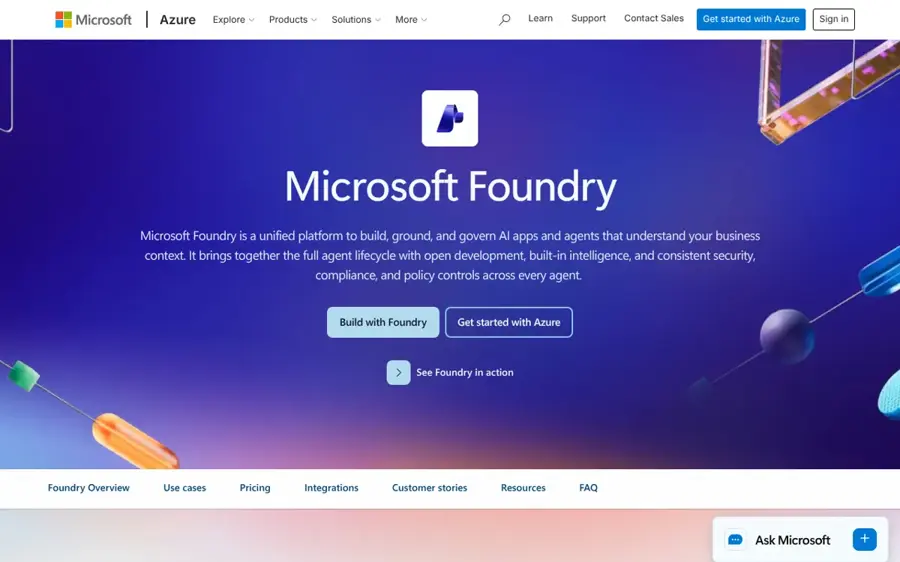
Microsoft Foundry (formerly Azure AI Foundry) is Microsoft's platform for picking models, building agents and governing them, with ties into Entra ID, SharePoint, Fabric and Defender.
Strengths
Foundry's catalog is huge on paper. Microsoft's plans page claims access to more than 11,000 foundation, open and industry models, and the platform itself is free to explore: you only pay for the models and services you use. The bigger selling point, I think, is the plumbing: agents can read from SharePoint and OneLake and inherit Entra ID permissions.
On PeerSpot, one reviewer praised the model catalog, "especially now that they've added Anthropic, which was the big one that was missing." The complaints there are about a confusing pricing structure, complex governance setup and slow support. That pricing complaint seems fair to me; Foundry splits billing across Models, Agent Service, Foundry IQ, Tools and Control Plane, each priced separately.
Key features
- Foundry Models covers OpenAI, Anthropic, open and industry-specific models with model routing.
- Foundry Agent Service hosts agents built with popular open-source frameworks.
- Foundry IQ grounds agents in your data through Azure AI Search.
- Foundry Control Plane manages access, cost and security across models and agents.
Pros
- The tightest fit with Microsoft 365, Entra ID and Defender.
- The platform itself costs nothing to explore.
- Pre-purchase plans give 5% to 15% discounts on committed spend.
Cons
- Billing is spread across many separately priced services.
- Governance setup takes real configuration work, going by PeerSpot reviewers.
Microsoft Foundry pricing: Free to explore, then pay per use for each model and service (checked November 2026). New Azure accounts get a $200 credit for 30 days. See pricing
Related: Microsoft AI review Best enterprise AI solutions
Verdict: choose Foundry if your identity, documents and security tools are already Microsoft. Otherwise the advantage shrinks.
Gemini Enterprise Agent Platform – best for agent builders on Google Cloud
Gemini Enterprise Agent Platform is the new name for Google's Vertex AI, rebuilt around building, running and governing AI agents with Gemini, Claude and open models.

Strengths
Google renamed Vertex AI at Cloud Next in April 2026. HPCwire's AIwire reported that the platform gives access to over 200 models through Model Garden, adds a visual Agent Studio alongside the Agent Development Kit, and includes a runtime for long-running agents with persistent memory. Each agent also gets a cryptographic identity, which is probably the part a company running dozens of agents will value most.
Gemini pricing is clear but moving. On Google's model price list, Gemini 4 Argon costs $2 per million input tokens and $10 per million output tokens through November 30, 2026, then $4 and $20 from December 1. A PeerSpot summary of user reviews says people "face challenges like complex navigation, lack of certain features, and slow data processing."
Key features
- Model Garden lists 200+ models, including Gemini, Claude and Gemma.
- Agent Studio offers a visual builder, and the Agent Development Kit covers code-first work.
- Agent identity, a registry and a gateway control what each agent can reach.
- Grounding with Google Search includes 5,000 free queries a month, then $14 per 1,000.
Pros
- Agent governance is more developed than most rivals'.
- You're only charged for successful requests.
- New customers get a $300 credit.
Cons
- The rename means older tutorials still say Vertex AI, which confuses searches.
- Gemini 4 Argon's rates double on December 1.
Gemini Enterprise Agent Platform pricing: Free credits, then pay per token for models and per hour for training and hosting (checked November 2026). See pricing
Related: Best cloud native AI platforms
Verdict: the strongest agent platform of the three hyperscalers right now, in my view, if you don't mind Google Cloud's learning curve.
IBM watsonx.ai – best for regulated industries
IBM watsonx.ai is IBM's studio for building generative, predictive and machine learning applications, with its Granite models plus Meta, Mistral, OpenAI and other open models, on IBM Cloud or hybrid infrastructure.
Strengths
IBM's pitch is openness and control. Gartner's Leaders placement highlighted IBM's open-weight models and its traction in financial services and the public sector, according to Virtualization Review's summary. It's also the cheapest place on this list to run a small model. Looking at watsonx.ai's rates, Granite 4 small models cost $0.0636 per million input tokens and $0.265 per million output tokens.
The free trial is a real one, too: up to 300,000 tokens and 20 compute hours a month. Reviews syndicated from G2 to AWS Marketplace are mixed. One reviewer liked that "the initial setup was very easy," but added, "I think IBM watsonx.ai could be more cost effective."
Key features
- Prompt Lab and Agent Lab for building prompts, RAG flows and agents.
- IBM Granite models plus Llama, Mistral, gpt-oss and DeepSeek options.
- LoRA and QLoRA fine-tuning on A100 or H100 GPUs.
- On-demand model hosting from $4.43 an hour on one L40S GPU.
Pros
- Very low token prices on Granite models.
- A monthly free trial instead of one-off credits.
- Strong fit for banks and the public sector.
Cons
- No Claude models in the list we saw.
- Advanced support with SLAs starts at $200 a month.
IBM watsonx.ai pricing: Free trial, then pay per million tokens from $0.0636 or per GPU hour for hosting (checked November 2026). See pricing
Related: Best enterprise AI solutions Best AI governance consulting tools
Verdict: pick watsonx.ai if compliance and model transparency matter more to you than frontier model access.
Databricks – best for agents built on lakehouse data
Databricks is a data and AI platform that runs on AWS, Azure and Google Cloud, with Agent Bricks, model serving and governance built around your existing data.
Strengths
Databricks makes sense when the hard part of your AI project is the data, not the model. Agent Bricks builds agents grounded in your tables and tunes quality with synthetic data and custom evaluation. The company cites FactSet getting 44% more accurate answers from an agent system, though that's a vendor case study, not independent research.
Pricing runs on Databricks Units (DBUs). In the example on Databricks' model serving rates, a $0.07 DBU price works out to $3 per million input tokens for Kimi K3. On PeerSpot, the most common complaint is that Databricks "is expensive, with costs quickly adding up," along with a code-heavy setup.
Key features
- Agent Bricks for building and tuning data-grounded agents.
- Model Serving for agents, generative models and classic ML in one place.
- Pay-per-token access to open models like Llama, Qwen, DeepSeek and GPT-OSS.
- AI Search, a vector database that syncs with source tables.
Pros
- Runs on all three major clouds.
- Unity Catalog handles governance for data and AI together.
Cons
- DBU math makes bills hard to predict.
- Steep for teams without data engineers.
- You still pay your cloud provider for compute during the trial.
Databricks pricing: Free trial, then pay-as-you-go per DBU, with committed-use discounts (checked November 2026). See pricing
Verdict: great if you already run a lakehouse there, and overkill if you don't.
Snowflake Cortex AI – best for SQL teams on Snowflake
Snowflake Cortex AI lets you call large language models and build data agents directly in SQL or through APIs, inside Snowflake's security perimeter.
Strengths
Cortex's trick is that analysts don't have to leave SQL. Going by Snowflake's AI Functions guide, functions like AI_COMPLETE, AI_CLASSIFY, AI_EXTRACT and AI_SUMMARIZE_AGG run models from OpenAI, Anthropic, Meta, Mistral AI, DeepSeek and xAI, and all of those models are deployed within Snowflake's perimeter. That neatly answers the question legal teams always ask.
Cost is the sore spot. PeerSpot's Snowflake user summary (covering the wider platform, not Cortex alone) notes that "the cost of Snowflake increases significantly with extensive computations" and that pricing visibility is complex.
Key features
- AI SQL functions for completion, classification, extraction and sentiment.
- AI_AGG and AI_SUMMARIZE_AGG work across rows without context window limits.
- Multimodal embeddings for text, images, audio and video.
- Data agents that query structured and unstructured data.
Pros
- No separate infrastructure if your data's already in Snowflake.
- A $400 trial credit, the biggest on this list.
- HIPAA, PCI DSS and FedRAMP support on Business Critical.
Cons
- Little reason to use it if your data isn't in Snowflake.
- Credit-based pricing is hard to estimate for AI workloads.
Snowflake Cortex AI pricing: 30-day trial with $400 in credits, then consumption-based AI credits (checked November 2026). See pricing
Related: Best enterprise AI adoption tools
Verdict: for Snowflake customers it's an easy yes; for everyone else, skip it.
OCI Enterprise AI – best for Oracle Database customers
OCI Enterprise AI (previously OCI Generative AI) is Oracle Cloud's managed service for model access and agent building, with zero data retention endpoints and dedicated GPU clusters.
Strengths
Oracle's angle is data residency and price. The service offers sovereign AI options, and models from Cohere, Google, Meta, OpenAI and xAI, going by Oracle's model list. Dedicated AI Clusters give you reserved GPU capacity when shared endpoints aren't predictable enough.
Reviews specific to the AI service are thin. One PeerSpot reviewer of OCI as a whole estimated "a 50% cost reduction compared to AWS" and rated it nine out of 10, while admitting some products "are not as feature user-friendly as those of AWS." Honestly, I'd treat Oracle as a strong option only if your core systems already run on Oracle Database.
Key features
- Managed access to Cohere, Google, Meta, OpenAI and xAI models.
- Model routing that can pick a model per request.
- Zero data retention endpoints.
- Dedicated AI Clusters for reserved GPU capacity.
Pros
- Sovereign hosting options for strict data rules.
- A $300 credit plus Always Free services.
Cons
- Pricing sits behind a cost estimator, not a plain rate card.
- Fewer independent reviews of the AI service itself.
- No Anthropic models in the current list.
OCI Enterprise AI pricing: $300 credit for 30 days, then pay per use or for dedicated clusters (checked November 2026). See pricing
Related: Best enterprise AI solutions
Verdict: worth a pilot for Oracle shops, and a long shot for anyone else.
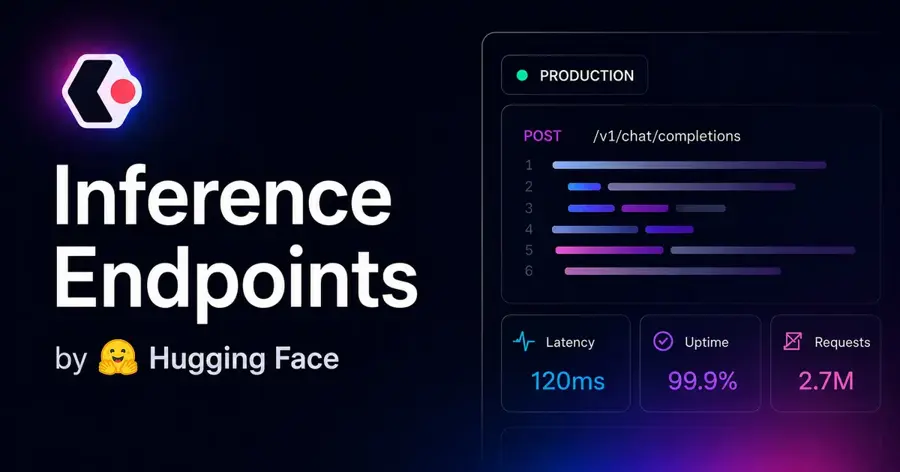
Hugging Face Inference Endpoints – best for open models on dedicated hardware
Hugging Face Inference Endpoints deploys any model from the Hugging Face Hub onto dedicated, autoscaling infrastructure on AWS, Azure or Google Cloud.
Strengths
This is the most transparent pricing on the list. Hugging Face's rate card shows CPU endpoints from $0.03 an hour, one Nvidia L4 at $0.80, one H100 at $4.50 and one B200 at $9.25. You pay for the machine, not the token, so a busy endpoint can work out far cheaper than per-token billing (an idle one can be far more expensive). The endpoint docs say it handles Kubernetes, CUDA versions and autoscaling for you, with vLLM, TGI or a custom container.
Users on PeerSpot like the inference APIs; one wrote that "it takes me a long time to run inferences on my local machine." Scaling across multiple GPUs is the main complaint.
Key features
- One-click deployment of Hub models to a private endpoint.
- Autoscaling up and down with traffic.
- Choice of AWS, Azure or Google Cloud hardware, including TPUs and Inferentia.
- Support for vLLM, TGI and custom containers.
Pros
- Clear hourly prices you can budget against.
- Any open model on the Hub, not just a curated list.
Cons
- No access to closed models like GPT, Claude or Gemini.
- You pay for idle hours unless the endpoint scales down.
- Fewer agent and governance tools than the clouds.
Hugging Face Inference Endpoints pricing: No free plan for endpoints; pay-as-you-go from $0.033 an hour (checked November 2026). See pricing
Related: Best cloud native AI platforms What is an AI model?
Verdict: the cleanest way to host an open model you've chosen, if you can keep the GPU busy.
Choosing the right AI managed services
Start with the cloud that already holds your data
Moving data between clouds costs egress fees, security reviews and weeks of approvals. If your files sit in S3, Bedrock is the shortest path; if they're in SharePoint, Foundry wins.
Price a real workload before you sign anything
Token prices look tiny until you multiply them. A support bot that reads 2,000 tokens and writes 500 on each of 100,000 monthly chats uses 200 million input tokens and 50 million output tokens. On Gemini 4 Argon's December rates, that's $800 plus $1,000, or $1,800 a month before grounding or storage. Run your own numbers in each vendor's calculator.
Ask how agents are governed
As soon as agents can call tools, you need identity, logging and limits. Google's per-agent cryptographic IDs, Microsoft's Control Plane and Bedrock's Guardrails all tackle this differently. Our agentic AI explainer covers how agents work, and the shadow AI guide explains the risk of unmanaged tools.
Decide if you need a platform or a partner
Some companies searching for managed AI services really want a firm to build and run the system for them. That's a different purchase: a consultancy sits on top of one of these platforms and charges for the people. If that's you, read our guides to generative AI consulting services and AI development companies before you talk to vendors.
Free vs paid: what you actually get
None of these services has a permanent free plan for serious AI work. What you get instead is a trial, and the size varies a lot:
| Service | Free offer | Time limit |
|---|---|---|
| Amazon Bedrock | Up to $200 in credits on the AWS Free plan | 6 months |
| Microsoft Foundry | $200 Azure credit | 30 days |
| Gemini Enterprise Agent Platform | $300 credit for new customers | See trial terms |
| IBM watsonx.ai | 300,000 tokens and 20 compute hours a month | Trial plan |
| Databricks | Free trial, some with credits | Trial period |
| Snowflake Cortex AI | $400 in credits | 30 days |
| OCI Enterprise AI | $300 credit plus Always Free services | 30 days |
| Hugging Face Inference Endpoints | None for endpoints | N/A |
Credits are plenty for a proof of concept. They won't tell you what production costs, though, because pilots rarely hit real traffic. Paying gets you the things you'd need anyway: higher rate limits, provisioned throughput, SLAs, private networking and, on AWS, access to every service instead of the 90-plus on the Free plan.
One trap: Databricks warns that if you connect your own cloud account during the trial, your cloud provider still bills you for compute. I'd set a budget alert on day one, whichever service you pick.
Final verdict
If you only pick one, pick the managed AI service from the cloud you already use, and for most companies that means Amazon Bedrock. It has the broadest model menu, and its rough edges (setup and price forecasting) are ones your AWS team already knows how to handle.
I'd make two exceptions. Microsoft-heavy companies will probably get further, faster, with Foundry because of Entra ID and SharePoint. And if agents are the whole point of your project, Google's rebuilt platform looks the most thought-through to me, as long as you price it on the post-December rates. The specialists earn their place only when your data or your regulator already decided for you.
FAQ
What are AI managed services?
AI managed services are cloud platforms that run AI models and agents for you, so you don't manage servers, GPUs or scaling. Bedrock, Foundry and Google's platform are the biggest. Consultancies that run AI for you use the term too.
How much do managed AI services cost?
They mostly bill on usage. Token prices range from about $0.06 per million on IBM's small Granite models to $20 per million output tokens for Gemini 4 Argon from December 2026. Dedicated hosting runs from $0.033 an hour on Hugging Face to well over $100 an hour for eight-GPU machines.
Which managed AI service is best for small businesses?
I'd say most small businesses should use whichever cloud they already have, then start with pay-per-token models and no commitments. If you don't use any cloud yet, Google's $300 credit and clear Gemini prices make it an easy place to experiment.
Do managed AI services train on my data?
The big providers say they don't by default. AWS states that Bedrock never stores or uses your data to train models, Snowflake deploys its models inside its own security perimeter, and Oracle offers zero data retention endpoints. Check the terms for each model you plan to use.