9 best AI outbound calling tools in 2026, compared side by side
We compared 9 AI outbound calling tools on price per minute, setup, reviews and compliance, plus the TCPA, UK and EU rules you must follow.
 Written byMuhammad Usman SiddiquiFounder and editor-in-chief
Why you can trust The AI Future
Our writers research every product, link each claim to its source and correct mistakes openly. Companies can't pay for coverage or see reviews before they're published.
Read our editorial policy
Short answer: if you want one AI outbound calling platform that most teams can run without a full engineering squad, start with Retell AI. It pairs pay-as-you-go pricing of $0.07 to $0.31 a minute with a visual builder and strong public reviews. Want a single all-in per-minute price? Pick Bland. If you're a developer who wants full control of every model in the stack, pick Vapi. I'd start with Retell, though; it's the least likely to leave a small team stuck.
AI outbound calling means software that places phone calls and holds a real conversation, such as qualifying a lead or confirming an appointment. The tools below use AI outbound calling agents that listen, reason with a large language model and reply in a synthetic voice. They're covered by robocall law in the US, UK and EU too, so the legal side gets its own section further down.
Key takeaways
- Retell AI looks like the best all-round pick for most teams, with clear per-minute pricing and a 4.9 rating from more than 800 reviews on Trustpilot.
- Real costs are per minute, not per seat. Expect roughly $0.07 to $0.31 a minute, plus numbers and concurrency.
- Enterprise platforms hide their prices: Synthflow, Regal and Thoughtly all need a sales call before you see a number.
- An AI outbound call is a robocall under US law. The FCC ruled in 2024 that AI-generated voices count as "artificial" under the TCPA, so you need prior express consent before you dial.
Our ranking method
Nobody at The AI Future ran hands-on tests or placed live calls for this roundup. We compared each tool using official pricing and product pages, published third-party reviews on Trustpilot and Capterra, and regulatory sources, as of late October 2026. Each platform was scored on six criteria:
- Outbound fit: whether it's built to place calls at volume (batch dialing, voicemail detection, transfers), not just answer them.
- Price transparency: whether you can work out your cost per minute before talking to sales.
- Ease of setup: no-code builder or API-only.
- Voice and latency: how natural and responsive conversations are, based on vendor specs and user feedback.
- Compliance tooling: opt-out handling, recording controls, PII redaction, HIPAA or SOC 2 coverage.
- User sentiment: public review scores and the size of the sample behind them.
Prices are in US dollars and they change often, so check the vendor page before you sign.
The 9 best AI outbound calling tools at a glance
| # | Tool | Category | Best for | Free tier | Starts at |
|---|---|---|---|---|---|
| 1 | Retell AI | Voice agent platform | Most teams | No | $0.07/min |
| 2 | Bland AI | Voice agent platform | All-in per-minute pricing | Yes (limited) | $0.12/min |
| 3 | Vapi | Developer platform | Developers | Yes (limited) | $0.05/min + models |
| 4 | ElevenLabs Agents | Voice agent platform | Small budgets | Yes (limited) | $6/mo |
| 5 | Thoughtly | Speed-to-lead agent | Inbound lead follow-up | No | Custom |
| 6 | Synthflow | Enterprise voice AI | Managed enterprise launch | No | Custom (annual) |
| 7 | Regal | Contact center AI | Large consumer brands | No | Custom |
| 8 | Aircall AI Voice Agents | Cloud phone add-on | Existing Aircall users | No | Custom |
| 9 | Nooks | AI-assisted dialer | Human SDR teams | No | Custom |
The best AI outbound calling tools in 2026, ranked
Retell AI – best for most teams
Retell AI is a voice agent platform for building, testing and running AI phone agents that handle both inbound and outbound calls, including batch outbound campaigns.
Strengths
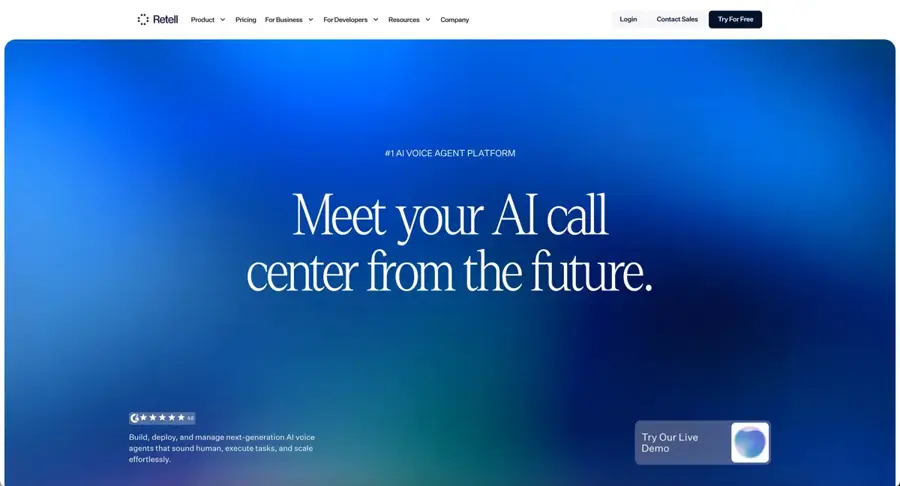
Retell sits between developer platforms and no-code tools, which is probably why it suits so many teams. On the homepage it pitches a visual builder your team can operate, outbound campaigns and CRM automation, and about 600ms latency. That last one matters; people hang up at the first robotic pause.
User sentiment is the strongest on this list. Retell holds a 4.9 TrustScore from 805 reviews on Trustpilot, where the AI-written summary says "reviewers overwhelmingly had a great experience with this company" and praises the interface. Retell does pay for a Trustpilot subscription, so I'd read that as one signal, not proof.
Key features
- Component pricing: voice infrastructure at $0.055/min, then you pick your voice and LLM.
- Batch calls: outbound lists at +$0.005 per dial.
- 20 concurrent calls included before you pay extra.
- Compliance controls: PII redaction, opt-out recording and transcription, HIPAA/BAA on higher tiers.
Pros
- Clear, published per-minute pricing
- Strong public reviews from a large sample
- Works with your own SIP trunk at no telephony charge
Cons
- Costs vary a lot with the LLM and voice you choose
- Extras add up: numbers, concurrency, QA, knowledge bases
Retell AI pricing: No free plan; then pay as you go from $0.07 to $0.31 per minute, plus $2/month per Retell phone number and $8/month per extra concurrent call (checked October 2026). See pricing
Verdict: The safest first choice, I think, if you want AI outbound calls live this quarter without hiring a voice engineer.
Related: Best AI call assistants
Bland AI – best for all-in per-minute pricing
Bland AI is an enterprise voice AI platform that runs its own speech-to-text, language model and text-to-speech stack, sold at one per-minute rate.
Strengths
Bland's pitch is simple billing and control of the stack. Looking at the pricing, the per-minute rate covers the LLM, speech-to-text and text-to-speech, with "No token charges" and no model pass-throughs. Bland also claims rivals' full stacks cost roughly $0.11 to $0.30 a minute once you add providers. That's a competitor estimate, so check it yourself.
Mind the price rise. Going by the billing docs, connected minutes went from $0.09 to $0.14 on Start and $0.12 on Build from 5 December 2025. Public user reviews are too thin to judge: the unclaimed Trustpilot profile shows just 2 reviews and a 2.9 score.
Key features
- One rate, covering STT, LLM and TTS.
- Daily caps of 100 calls on Start, 2,000 on Build and unlimited on Enterprise.
- Conversational Pathways for scripted branching flows.
- Warm and live transfers to human agents (higher tiers).
Pros
- Predictable billing with no token math
- Own model stack, so call data doesn't go to third-party model vendors
- 99.9% uptime SLA on every plan
Cons
- Prices rose in late 2025
- Low call caps on the entry plan
Bland AI pricing: Free signup credits; then Start at $0.14/min, Build at $0.12/min, Enterprise custom; transfer time from $0.04/min (checked October 2026). See pricing
Verdict: Pick Bland if finance wants one number per minute and you plan to scale past a few thousand calls a day. For a small pilot, I wouldn't bother.
Vapi – best for developers
Vapi is an API-first platform for building voice agents where you choose each model (transcriber, LLM, voice) and pay providers at cost.
Strengths
Vapi is the toolkit, not the finished car. On the pricing page there's a $0.05/min hosting fee, and model costs pass through "with no markup", so a Deepgram transcriber, an OpenAI model and an ElevenLabs voice each add their own per-minute rate.
The public reviews likely reflect that gap. Vapi has a 2.5 score from 13 reviews on its unclaimed Trustpilot page, and one reviewer wrote: "If you have any issues with the systems when deployed to live expect to be waiting a week for anything to even be looked at properly."
Key features
- $5 free credits and one included phone number to start.
- A full catalog of transcribers, LLMs and voices to choose from.
- Testing and simulation before calls reach customers.
- Concurrency of 4 calls on usage-only and 10 on Core; add more at $10/line/month.
Pros
- Lowest platform fee on the list
- Total control over models and data
- Strong for custom, code-heavy builds
Cons
- Real cost per minute is hard to predict
- Free support is community-based
Vapi pricing: Free credits; then usage at $0.05/min plus model costs; Core success package $29/month; Pro from $999/month (checked October 2026). See pricing
Verdict: It's the right call only if you've got engineers who want to own the stack.
ElevenLabs Agents – best for small budgets
ElevenLabs Agents (sold as ElevenAgents) is the voice agent product from the voice-synthesis company ElevenLabs, with bundled call minutes on monthly plans.
Strengths
ElevenLabs is best known for its voices, and that's the draw here. The agents page pitches it to "Qualify leads, recover abandoned carts, and run outbound at scale." Looking at the prices, it's the most budget-friendly option on this list: a free plan with 15 minutes of calls, and a $6/month Starter plan with 75 minutes.
Its Trustpilot score is 3.0 from 1,219 reviews, but most of those cover the wider text-to-speech product, not phone agents specifically, so I wouldn't lean on them.
Key features
- Bundled minutes: 15 free, 75 on Starter, up to 12,375 on Business.
- Extra minutes at $0.08, with burst pricing at $0.16.
- Concurrency from 4 calls on Free to 40 on Business.
- A configurable stack, so you choose the LLM, telephony provider and speech settings.
Pros
- Cheapest way to try AI outbound calls
- Excellent voice quality
- Simple, published plan pricing
Cons
- Not built around sales workflows like dialing lists and CRM sequences
- Review scores mostly reflect other products
ElevenLabs Agents pricing: Free (15 min), then paid plans from $6/month; Creator $22, Pro $99, Scale $299, Business $990 (checked October 2026). See pricing
Verdict: Start here if you want to prototype an outbound agent for the price of a sandwich. Honestly, that's a fair way to find out whether you even need the pricier tools.
Related: Best AI voice generators
Thoughtly – best for inbound lead follow-up
Thoughtly is an AI voice, SMS and email agent built to call new leads within seconds, qualify them and book meetings.
Strengths
Thoughtly is a speed-to-lead tool. The example on its homepage has the agent calling a mortgage prospect "10 seconds after she fills out the form." Calling people who just asked to hear from you is also about the cleanest consent position you can have.
The plans list unlimited voice minutes on every tier and, on Scale, "SOC 2 Type II reports + TCPA review". There aren't any prices shown, though. On Trustpilot it scores 4.0 from 7 reviews, including: "Innovative and a disrupter in this space. Support is top notch and the ROI is unreal."
Key features
- Voice, SMS and email in every plan.
- Two-way CRM sync with HubSpot, Salesforce and Zoho.
- 34+ languages and voice cloning.
- Bring your own carrier, such as Twilio or Telnyx.
Pros
- Built for the highest-converting outbound use case
- Unlimited minutes simplify budgeting
- TCPA review offered on Scale
Cons
- No public prices
- Small review sample
Thoughtly pricing: No free plan; then custom pricing on Flex, Scale and Enterprise (checked October 2026). See pricing
Verdict: Probably the best fit if your problem is leads going cold, not finding new ones.
Related: Best AI lead generation tools Best AI sales assistants
Synthflow – best for managed enterprise launch
Synthflow is an enterprise voice AI platform with its own telephony, sold on annual contracts with optional launch support from its engineers.
Strengths
Synthflow has moved upmarket. The pricing FAQ is blunt: "Synthflow has no free plan or trial and no rate by the minute." Contracts are scoped to your volume and integrations, and its engineers can build and launch agents with you.
Synthflow holds a 4.1 score from about 215 reviews on Trustpilot, where one user called it "by far the best". Many of those reviews likely date from its earlier self-serve era. Ask for current enterprise references.
Key features
- In-house telephony with sub-100ms latency claims and SIP/PBX support.
- Multi-agent flows with subflows for specialised tasks.
- An AI sandbox for versioning and rollback.
- Compliance coverage: SOC 2 Type 2, ISO 27001, HIPAA and GDPR.
Pros
- Hands-on launch support
- Strong compliance coverage
- Good fit for European buyers needing GDPR coverage
Cons
- No free plan, trial or self-serve option
- Annual commitment
Synthflow pricing: No free plan; then annual enterprise agreement, custom quote (checked October 2026). See pricing
Verdict: Choose Synthflow if you want a vendor to build it with you and the budget for an annual deal covers it.
Related: Best AI phone answering systems
Regal – best for large consumer brands
Regal is an AI agent and outbound telephony platform for enterprise contact centers in finance, healthcare, education and ecommerce.
Strengths
Regal is a full contact center stack with AI phone agents on top. The pricing page describes a good fit as "at least 25 agents and at least 100k minutes of calls a month", so it isn't for small teams. Its outbound strength is branded caller ID and spam remediation, which help calls get answered.
We could not find a public review score we could verify. In a third-party review, Assembled wrote that "Regal's voice agents sound natural and handle high call volumes in both directions."
Key features
- AI phone agents plus SMS, chat and email agents.
- Answering machine detection and concurrency controls.
- Branded caller ID and spam remediation.
- A journey builder and A/B testing.
Pros
- Strong caller ID and deliverability tools
- Blends AI and human agents
- Dedicated implementation team on all plans
Cons
- Enterprise only
- No public pricing
Regal pricing: No free plan; then custom quote based on features and commitment (checked October 2026). See pricing
Verdict: Worth a demo if you run a six-figure monthly minute volume and need calls to land. Below that, I doubt it makes sense.
Aircall AI Voice Agents – best for existing Aircall users
Aircall AI Voice Agents add natural-sounding AI agents to the Aircall cloud phone system, including trigger-based outbound calls.
Strengths
If your team already lives in Aircall, this is the least disruptive way to add AI outbound calling. On the pricing page you'll find "Trigger-based outbound calling and voicemail detection", 38 languages and in-call actions such as pulling Shopify orders or booking meetings.
Aircall scores 3.0 from 1,094 reviews on Trustpilot, with support speed a common complaint. One verified user summed up the upside: "Usually very good and easy to use."
Key features
- Trigger-based outbound calls from events in your systems.
- Voicemail detection built in.
- In-call actions across Shopify, Stripe, calendars and CRMs.
- Per-agent dashboards for resolution and transfer rates.
Pros
- No new phone system needed
- Big integration library
- Human and AI agents in one place
Cons
- We could not find a public price for AI Voice Agents
- Mixed reviews on support
Aircall AI Voice Agents pricing: No free plan; then AI Voice Agents pricing on request (checked October 2026). See pricing
Verdict: An easy add-on for Aircall shops; I wouldn't switch phone systems for it.
Related: Best AI phone answering systems Best AI call assistants
Nooks – best for human SDR teams
Nooks is an AI sales platform built around a parallel dialer, where AI handles the dialing and screening and your reps take the live conversations.
Strengths
Nooks is the pick for teams that don't want a bot on the line. The pricing page lists multi-line parallel dialing, AI answer detection, number rotation and live battlecards. Humans still talk, which likely keeps you clear of the artificial-voice rules below, though autodialer and do-not-call rules still apply.
Public reviews are thin. Capterra shows only 2 reviews, with one BDR giving it 4.0 overall and 5.0 for ease of use. Nooks itself claims "3x more meetings", which is a vendor figure.
Key features
- Parallel and power dialing with AI answer detection.
- Spam protection through number rotation and carrier registration.
- Live battlecards and real-time transcription.
- A virtual salesfloor with listen-in and whisper coaching.
Pros
- Keeps humans on every conversation
- Strong coaching tools
- Broad sales stack integrations
Cons
- Not an autonomous AI caller
- No public pricing
Nooks pricing: No free plan; then custom quote (checked October 2026). See pricing
Verdict: Probably the best way to use AI for outbound while your reps still do the talking.
Choosing the right AI outbound calling tools
Start with your call type, not the tool
Follow-ups to people who asked to be contacted (form fills, renewals, appointment reminders) are where AI outbound calling seems to work best, and where consent is easiest to prove. Cold outreach to bought lists is where it fails most, on results and on law. Our piece on why AI automation agency cold outreach fails covers the commercial side.
Work out your true cost per minute
Advertised rates rarely match the bill. On Retell and Vapi you pay for voice infrastructure, the LLM, the voice and the phone line separately. Try a quick test: take 1,000 calls at an average of 2 minutes. At $0.10 a minute that's $200 a month; at $0.30 it's $600. Then add numbers, concurrency and support. Bland and ElevenLabs are easier to forecast, which counts for a lot.
Match the build effort to your team
Vapi assumes engineers, while Retell and ElevenLabs sit in the middle. Synthflow and Regal bring their own implementation teams but expect enterprise contracts. If you're new to agents, our explainers on what agentic AI is and AI agent orchestration frameworks and vendors help you judge how much plumbing you're signing up for.
Check compliance features before demos
Ask each vendor how it handles opt-out requests mid-call, call recording consent, PII redaction, do-not-call list screening and AI disclosure scripts. Be wary of earnings promises too: the FTC sued Air AI in 2025 over deceptive claims about business growth and earnings, and PYMNTS reported in March 2026 that a proposed settlement included an $18 million judgment, largely suspended because the company couldn't pay.
Is AI outbound calling legal? US, UK and EU rules in plain English
Yes, but only with consent and disclosure, and the rules are stricter than for a human calling. What follows summarises official sources and isn't legal advice, so talk to a lawyer before you launch a campaign.
United States: the TCPA treats AI voices as artificial
On 8 February 2024 the FCC adopted a Declaratory Ruling that calls made with AI-generated voices are "artificial" under the Telephone Consumer Protection Act. The ruling itself says callers using these technologies must get the prior express consent of the person called, unless there is an emergency purpose or exemption. Telemarketing calls need prior express written consent.
The ruling also requires the message to identify the business responsible for the call and, for telemarketing, to offer an opt-out. In the FCC's words: "These requirements are applicable to any AI technology that initiates any outbound telephone call using an artificial or prerecorded voice to consumers." Individuals and state attorneys general can both sue.
A few other moving parts matter for your setup:
- Revoking consent: people can opt out by "any reasonable method", and you must honour it within 10 business days, according to Kelley Drye's summary of the FCC's 2024 rule. NCLC lists the effective date as 11 April 2025.
- "Stop one means stop all": the part of that rule applying one opt-out to all your message types has been delayed to 31 January 2027, Privacy World reports.
- One-to-one consent: the FCC rule that would have banned shared consent from lead generators was vacated by the Eleventh Circuit, NCLC notes.
- AI-specific proposals: in 2024 the FCC proposed requiring specific consent for AI-generated calls and an in-call disclosure that AI is being used, per NCLC.
- State law: states add their own rules. For example, Pennsylvania amended its Telemarketer Registration Act in July 2026, according to Privacy World.
United Kingdom: PECR and the TPS
The ICO's telephone marketing guidance says automated marketing calls need specific consent: "General consent for marketing, or even consent for live calls, is not enough." Live marketing calls must be screened against the Telephone Preference Service (TPS) and Corporate TPS, and you must say who is calling and display your number. The ICO page defines automated calls as those that play a recorded message and doesn't spell out how interactive AI agents fit, so I'd take the cautious reading and get specific consent. The guidance is under review after the Data (Use and Access) Act.
European Union: the AI Act disclosure duty
Article 50 of the EU AI Act requires AI systems that interact directly with people to be designed so those people are informed they are talking to an AI, at the latest at the first interaction (Article 50 text). The European Commission says the AI Act's transparency rules apply from August 2026. GDPR and national telemarketing rules still apply on top. For the bigger picture, see our guide to AI regulation in 2026.
One simple rule works across all three regions: call people who agreed to hear from you, say early in the call that they're speaking with an AI assistant on behalf of your company, and stop the moment they ask.
Free vs paid: what you actually get
Free tiers here are for testing, not campaigns, and that's fine. ElevenLabs gives you 15 minutes of calls and 4 concurrent calls for free. Vapi gives $5 of credits. Bland offers signup credits on its Start plan.
Paying gets you what campaigns need: more concurrent calls, higher daily caps, warm transfers, compliance features such as BAAs, and support with an SLA.
Final verdict
If you only pick one, pick Retell AI. In my view the pricing is the most transparent, the outbound campaign tools are solid, and it has the strongest public reviews on this list. Bland makes sense if you want one predictable rate and plan to scale volume, and Vapi if you've got developers who want to swap models freely. ElevenLabs Agents is a cheap way to test the idea at $6 a month. Buying an enterprise rollout? Look at Synthflow or Regal. If you want reps on the phone instead, that's Nooks.
Whichever you pick, get consent first and tell people they're talking to an AI.
FAQ
What is AI outbound calling?
AI outbound calling uses software agents to place phone calls and hold two-way conversations without a human on the line. Common uses are lead follow-up, appointment reminders, renewals and payment reminders.
How much does an AI outbound call cost?
Most platforms charge by the minute. Looking at the prices, Retell lists $0.07 to $0.31 per minute, Bland $0.12 to $0.14, and Vapi $0.05 plus model costs. A two-minute AI outbound call therefore costs roughly $0.15 to $0.60, before phone numbers and concurrency fees.
Is it legal to use AI to make outbound calls?
Yes, with consent. In the US, the FCC ruled that AI-generated voices are "artificial" under the TCPA, so you need prior express consent, and written consent for telemarketing. The UK requires specific consent for automated marketing calls, and the EU AI Act requires telling people they are talking to an AI.
Do I have to tell people they're talking to an AI?
In the EU, yes. Article 50 of the AI Act requires people to be informed at the latest at the first interaction. In the US the FCC has proposed an in-call AI disclosure, and its rules already require you to identify the business.
Sources
- AI Phone Agent Pricing (Retell AI)
- AI Voice Agents That Automate Phone Calls (Retell AI)
- Retell AI Reviews (Trustpilot)
- Pricing (Bland AI)
- Bland: Enterprise Voice AI Platform for Phone Agents (Bland AI)
- Billing & Plans (Bland docs)
- Bland Reviews (Trustpilot)
- Vapi pricing (Vapi)
- Vapi - Build Advanced Voice AI Agents (Vapi)
- Vapi Reviews (Trustpilot)
- ElevenAgents Pricing (ElevenLabs)
- Deploy AI Agents in Minutes, Not Months (ElevenLabs)
- ElevenLabs Reviews (Trustpilot)
- Pricing (Thoughtly)
- Thoughtly: Everyone deserves a follow up (Thoughtly)
- Thoughtly Reviews (Trustpilot)
- AI Voice Agent Pricing for Enterprise (Synthflow)
- AI Voice Agent Platform to Automate Your Phone Calls (Synthflow)
- Synthflow AI Reviews (Trustpilot)
- Request Pricing (Regal)
- Regal AI review (2026) (Assembled)
- Aircall Pricing & Plans (Aircall)
- Aircall Reviews (Trustpilot)
- Pricing (Nooks)
- Nooks: Revenue infrastructure for reps and agents (Nooks)
- Nooks Software Review 2026 (Capterra)
- Declaratory Ruling FCC 24-17 on AI-generated voices (FCC)
- FCC Makes AI-Generated Voices in Robocalls Illegal (FCC)
- FCC Adopts Changes to TCPA Consent Revocation Rules (Kelley Drye)
- Top Six TCPA/Robocall Developments in 2024/2025 (NCLC)
- TCPA (Privacy World)
- Telephone marketing (ICO)
- AI Act (European Commission)
- Article 50: Transparency Obligations (EU Artificial Intelligence Act)
- FTC Seeks to Ban Air AI From Marketing Business Opportunities (PYMNTS)