The 8 best AI call assistants in 2026, compared and ranked
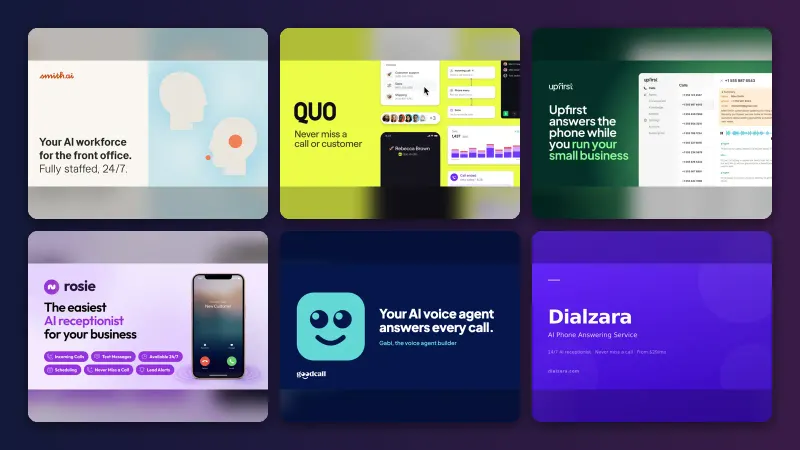
The best AI call assistant for most small businesses is Rosie. Here are eight AI receptionists and voice agents compared on price, setup and features.
 Written byMuhammad Usman SiddiquiFounder and editor-in-chief
Why you can trust The AI Future
Our writers research every product, link each claim to its source and correct mistakes openly. Companies can't pay for coverage or see reviews before they're published.
Read our editorial policy
Short answer: most small businesses should start with Rosie. At $49 a month for 250 minutes, it is the cheapest serious AI call assistant we found, and it trains itself from your website and Google profile. If you need a human to step in on tricky calls, pay more for Smith.ai. If you are building your own voice agent, use Retell AI.
An AI call assistant answers or makes phone calls for you. It picks up, talks to the caller in a natural voice, answers common questions, books appointments, takes messages and sends you a summary. Some tools are plug-and-play receptionists. Others are business phone systems with an AI agent built in. A third group are developer platforms for AI phone calls at scale. We compared eight of them on price, setup effort and what you actually get, so you can pick one in ten minutes instead of ten demos.
Key takeaways
- Entry prices start around $49 a month. Rosie, Goodcall and My AI Front Desk all sit between $49 and $99 for a starter plan.
- Watch the billing unit. Rosie bills by minute, Goodcall by unique caller, Smith.ai and Quo by call, and developer platforms by the minute with several fees stacked together.
- Already pay for a business phone line? Quo and Dialpad add AI call summaries and an AI agent to the system you use every day.
- Human backup costs a lot more. Smith.ai's human receptionist plans start at $292.50 a month for 30 calls, versus $95 for its AI plan.
- Free plans are rare. Only My AI Front Desk offers a real free tier. Most others give you a 7 to 14 day trial.
How we ranked them
Nobody at The AI Future ran hands-on tests or placed test calls for this roundup, and we have no original screenshots. We compared each AI call assistant using official pricing and product pages, published pricing breakdowns, G2 and Capterra ratings and independent reviews, as of late October 2026. Each tool was scored on six criteria:
- Price clarity: whether you can predict your monthly bill before you sign up.
- Value at small volume: what you get for under $100 a month.
- Setup effort: how fast a non-technical owner can go live.
- Call handling: booking, transfers, message taking, spam filtering and summaries.
- Integrations: calendars, CRMs and Zapier.
- Third-party reputation: ratings and reviews on G2, Capterra, Trustpilot and the App Store.
Prices are in US dollars, exclude taxes and carrier fees, and change often. Several breakdowns we cite come from competing vendors, and we flag that where it applies. Check the vendor's own page before you buy.
Our top picks at a glance
| # | Tool | Category | Best for | Free tier | Starts at |
|---|---|---|---|---|---|
| 1 | Rosie | AI receptionist | Most small businesses | No | $49/mo |
| 2 | Smith.ai | AI + human receptionist | Human backup on hard calls | No | $95/mo |
| 3 | Quo | Business phone + AI agent | Small teams on one phone system | No | $15/user/mo |
| 4 | Goodcall | AI receptionist | Long calls, unlimited minutes | No | $79/mo |
| 5 | My AI Front Desk | AI receptionist | Trying an AI call bot for free | Yes (limited) | $79/mo |
| 6 | Dialpad | Business phone + AI | AI call summaries for growing teams | No | $15/user/mo |
| 7 | Retell AI | Voice agent platform | Developers building custom agents | Yes (limited) | ~$0.09/min |
| 8 | Synthflow | Voice agent platform | No-code agents at high volume | No | ~$0.13/min |
Notes: Quo, Dialpad and My AI Front Desk prices are for annual billing. Retell AI gives new accounts free credits rather than a free plan. Retell and Synthflow per-minute figures are estimates built from their published fee components and depend on the voice, model and carrier you choose.
The 8 best AI call assistants in 2026, ranked
Rosie – best for most small businesses
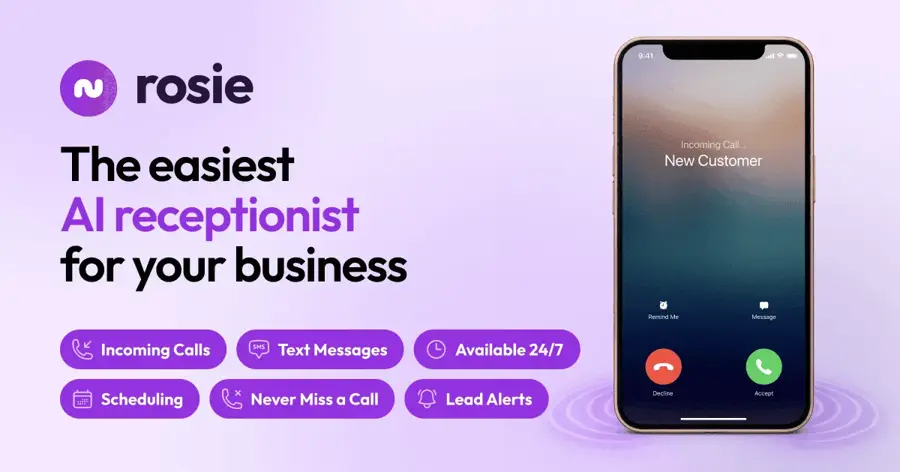
Rosie is a plug-and-play AI receptionist that answers your business line 24/7, takes messages and books jobs. Find it at heyrosie.com.
Why it stands out
Rosie wins on price and simplicity. The official pricing page lists three plans: Professional at $49 for 250 minutes, Scale at $149 for 1,000 minutes and Growth at $299 for 2,000 minutes. Every plan includes 24/7 answering, call summaries, transcripts and recordings, English and Spanish, and iOS and Android apps. That is a lot of AI call assistant for the cost of a nice dinner.
Setup is the other draw. Rosie trains itself from your Google Business Profile and website, so you are not writing scripts from scratch. A review by CloudTalk, a competing vendor, praises the zero-configuration setup but notes there are no native CRM connectors and no published overage rate. Third-party proof is thin: Capterra lists no user reviews yet, and CloudTalk reports a 4.1 out of 5 App Store rating from just nine ratings.
Verdict: If you only pick one AI call assistant for a small shop, pick Rosie and upgrade to Scale once you need booking.
Key features
- Self-training: learns from your Google profile, website and custom FAQs.
- Calendar booking: books directly into your calendar on Scale and above.
- Live transfers: warm and live transfers on Scale, waterfall transfers on Growth.
- Spam detection: filters junk calls automatically.
- 10+ voices: custom agent name, greeting and local area code.
Pros
- Lowest entry price among receptionist tools
- Clear minute allowances on every plan
- Live in minutes, no script writing
- Bilingual English and Spanish answering
Cons
- Booking and transfers need the $149 plan
- Integrations run through Zapier only
- Very few independent reviews so far
Rosie pricing: No free plan, 7-day free trial → paid plans from $49/month (checked October 2026). See pricing
Related: Best AI phone answering systems
Smith.ai – best for human backup on hard calls
Smith.ai combines an AI receptionist with a pool of live human receptionists who can take over complex calls. Find it at smith.ai.

Why it stands out
Smith.ai is the safe choice when a bad call costs you real money, such as in law, healthcare admin or high-ticket home services. Its AI receptionist starts at $95 a month for 50 calls, $270 for 150 and $800 for 500, according to a June 2026 pricing comparison by Dupple. A Smith.ai review by Fastio adds that complex calls can escalate to more than 500 human receptionists, spam calls are blocked free, and native integrations cover Clio, HubSpot and Salesforce.
The catch is cost creep. Fastio found add-ons such as recording and booking can raise the Starter plan's effective cost by 28%, and script changes go through Smith.ai support rather than a self-serve editor. On reputation, Fastio cites a 4.3 out of 5 Trustpilot rating across more than 336 reviews.
Verdict: Choose Smith.ai if a missed or fumbled call is expensive and you want a person in the loop.
Key features
- AI plus humans: hand off tough calls to live receptionists.
- Spam blocking: robocalls are filtered at no extra charge.
- Legal and CRM integrations: Clio, Lawmatics, MyCase, HubSpot and Salesforce.
- Outbound follow-up: calls back web leads and books meetings.
- Zapier: reach thousands of other apps.
Pros
- Human backup no pure AI tool offers
- Strong integrations for law firms
- Solid Trustpilot reputation
- 30-day money-back guarantee, per Dupple
Cons
- Per-call billing gets expensive past about 150 calls
- Add-on fees stack up
- Human plans start at $292.50/month
Smith.ai pricing: No free plan → AI receptionist from $95/month; human plans from $292.50/month (checked October 2026). See pricing breakdown
Quo – best for small teams on one phone system
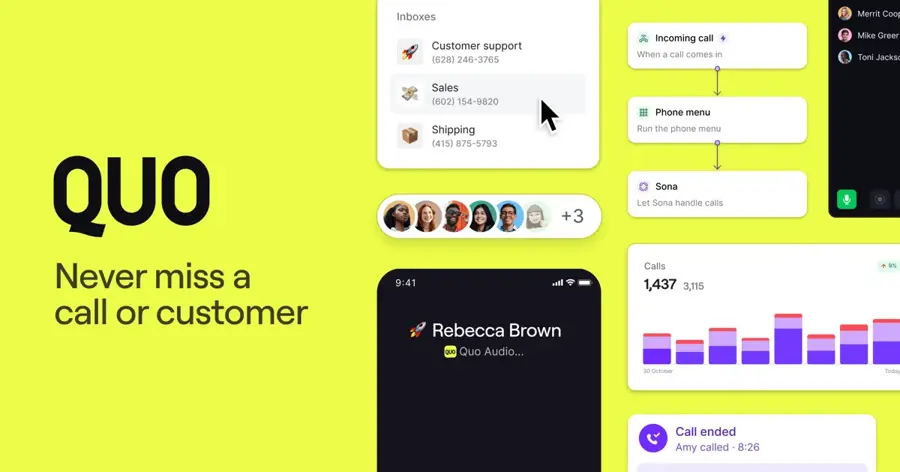
Quo, formerly OpenPhone, is a business phone app with shared numbers, texting and an AI agent called Sona that answers calls for you. Find it at quo.com.
Why it stands out
Quo is the pick if you want a full phone system first and an AI call bot second. Per Quo's own pricing guide, plans cost $15, $23 or $35 per user per month on annual billing, and every plan includes 10 Sona calls a month. Extra Sona capacity runs from $25 for 40 calls up to $199 for 600 calls, with overage between $0.45 and $1 per call. The Business plan adds AI call summaries, transcripts and contact suggestions.
Reputation is a strength. On G2, Quo holds a 4.7 out of 5 rating from more than 3,400 reviews, with reviewers citing a "Clean interface, strong integrations, and AI features," according to G2's summary. One wrinkle: Quo's own guide lists the $25 Sona tier as 50 calls in its text and 40 in its table, so confirm before you buy.
Verdict: Choose Quo if your team needs a better phone system anyway; Sona comes along for very little extra.
Key features
- Sona AI agent: answers, qualifies and takes messages on your Quo number.
- Shared numbers: the whole team works from one inbox for calls and texts.
- AI summaries: call transcripts and summaries on Business and Scale.
- AI call tags: automatic tagging on the Scale plan.
- 7-day trial: try features from all three plans.
Pros
- Phone system and AI call assistant in one app
- Large, positive G2 review base
- Low per-user price
Cons
- Only 10 free Sona calls per month
- Summaries need the $23 Business plan
- No texting during the trial
Quo pricing: No free plan, 7-day free trial → paid plans from $15/user/month billed annually (checked October 2026). See pricing
Related: Best AI phone answering systems
Goodcall – best for long calls and unlimited minutes
Goodcall is an AI phone agent for local businesses that bills by unique caller rather than by minute. Find it at goodcall.com.
Why it stands out
Goodcall's pricing model is its main appeal. According to CloudTalk's Goodcall pricing breakdown, Starter costs $79 a month for 100 unique callers, Growth $129 for 250 and Scale $249 for 500, with $0.50 per extra caller. Dupple notes all plans include unlimited minutes. If your callers tend to ask long questions, that beats paying per minute.
The flip side is that a marketing push can spike your bill, because every new phone number counts. CloudTalk, a direct competitor, puts Goodcall's aggregated reviewer score at about 3.4 out of 5 and describes its G2 presence as thin, with complaints about reaching support. Treat that as one rival's read, but it is worth knowing.
Verdict: Choose Goodcall if your calls run long and your caller count is steady.
Key features
- Unlimited minutes: billed by unique caller, not call length.
- Logic flows: 1 to 25 custom call flows depending on plan.
- Call history: 7 days on Starter, unlimited on Scale.
- 14-day trial: all features included.
Pros
- Predictable cost for long calls
- Annual billing drops Starter to $66/month
- Full-feature free trial
Cons
- Bills can jump when new callers surge
- Limited independent reviews
- Short call history on Starter
Goodcall pricing: No free plan, 14-day free trial → paid plans from $79/month (checked October 2026). See pricing breakdown
Related: Best AI phone answering systems
My AI Front Desk – best for trying an AI call bot for free
My AI Front Desk is an AI receptionist with a free starter tier, unlimited parallel calls and Zapier automation. Find it at myaifrontdesk.com.
Why it stands out
This is the only tool here with a real free plan. Dupple's June 2026 comparison lists 20 free voice minutes a month and 10 chatbot conversations with no credit card, and a Business-in-a-Box plan at $99 a month, or $79 billed annually, with 200 voice minutes and CRM sync. The company's own pricing article highlights unlimited parallel calls, a cap on receptionist minutes with usage alerts and a white-label option for agencies.
Twenty minutes is only enough to test, not to run a business. Reviews are positive but few: My AI Front Desk holds a 4.8 out of 5 rating on G2 from 15 reviews.
Verdict: Start here if you want to hear an AI answer your line before you spend a cent.
Key features
- Free tier: 20 voice minutes a month to try it out.
- Parallel calls: no busy signals during rushes.
- Zapier: connects to thousands of apps for CRM and calendar updates.
- Pronunciation guides: teach it names and industry terms.
- White label: resell it under your own brand.
Pros
- Genuine free plan, no card needed
- Usage caps protect your budget
- Agency-friendly reseller program
Cons
- Free minutes are tiny
- Small review sample
- Plan details shift often
My AI Front Desk pricing: Free → paid plans from $79/month billed annually or $99 monthly (checked October 2026). See pricing
Related: Best AI phone answering systems
Dialpad – best for AI call summaries for growing teams
Dialpad is a cloud business phone system with AI transcription, call recaps and an AI voice agent sold through sales. Find it at dialpad.com.
Why it stands out
Dialpad suits teams that want AI on every call their people make, rather than an AI that replaces them. CloudTalk's Dialpad pricing guide lists Standard at $15 per user per month on annual billing ($27 monthly) and Pro at $25 ($35 monthly). Real-time transcription, voicemail transcription and AI call recaps are included from Standard up.
Dialpad also sells AI agents and an AI receptionist, but on quote-only, conversation-based pricing, which makes budgeting harder. Its reputation is strong: CloudTalk reports a 4.4 out of 5 G2 rating across about 4,700 reviews, with praise for transcription and complaints about billing and add-on costs.
Verdict: Choose Dialpad if your team takes the calls and you want AI to write up every one of them.
Key features
- Live transcription: real-time text of every call.
- AI recaps: automatic summaries and action items.
- Sentiment cues: spot unhappy callers quickly.
- Contact center plans: scale up to support and sales teams.
- 14-day trial: no credit card on Standard and Pro.
Pros
- AI summaries included from $15/user
- Large, positive G2 review base
- Scales to full contact center
Cons
- AI voice agent pricing is quote-only
- Pro has a three-user minimum
- Reviewers flag add-on costs
Dialpad pricing: No free plan, 14-day free trial → paid plans from $15/user/month billed annually (checked October 2026). See pricing breakdown
Related: Otter.ai review
Retell AI – best for developers building custom agents
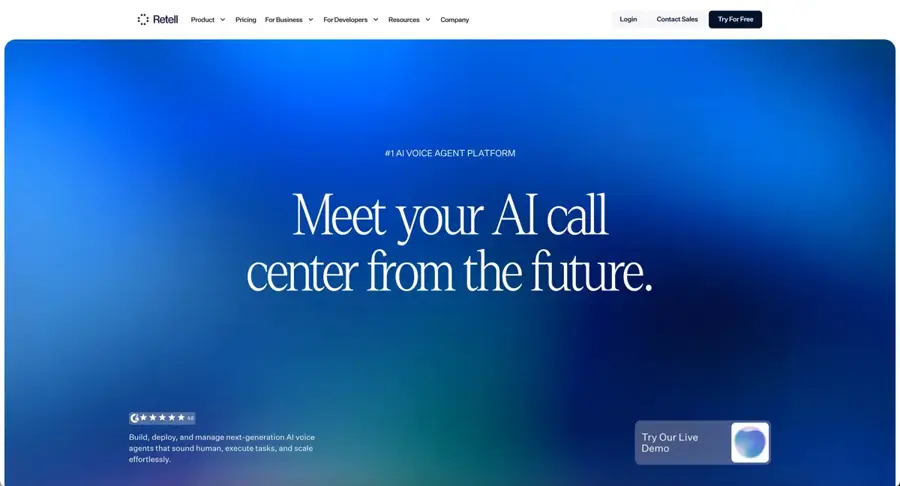
Retell AI is a developer platform for building voice agents that handle inbound and outbound AI phone calls. Find it at retellai.com.
Why it stands out
Retell AI is where you go when off-the-shelf receptionists are too rigid. Pricing is pay-as-you-go: eesel AI's October 2026 breakdown lists a $0.055 per-minute platform fee, text-to-speech from $0.015 per minute, telephony around $0.015 per minute and an LLM fee that depends on the model, plus $10 in free credits for new accounts. In practice that puts most calls at roughly $0.09 per minute and up. The same article quotes a Reddit user: "Retell does get expensive fast but their quality is solid."
It has the strongest reputation in this list. Retell holds a 4.8 out of 5 rating on G2 from more than 2,600 reviews, and G2's summary credits it as "Super simple to use, highly customizable, and strong integrations." You still need technical skills, or an agency, to build and maintain your agent.
Verdict: Choose Retell AI if you have a developer and want an AI voice call agent built exactly your way.
Key features
- Bring your own model: choose the LLM and voice per agent.
- Bring your own carrier: skip Retell telephony fees.
- Knowledge bases: first 10 free.
- Concurrency: 20 simultaneous calls included.
- Enterprise tier: SSO, role-based access and 24/7 support.
Pros
- Top-rated on G2
- Full control over voice, model and flow
- Free credits to start
Cons
- Costs stack across several fees
- Needs developer time
- Enterprise pricing not public
Retell AI pricing: Free credits → pay-as-you-go from about $0.07/minute before LLM costs (checked October 2026). See pricing breakdown
Synthflow – best for no-code agents at high volume
Synthflow is a no-code platform for building AI voice agents, aimed at agencies and larger businesses. Find it at synthflow.ai.
Why it stands out
Synthflow sits between a receptionist app and a developer platform. You build call flows visually, without code. According to CloudTalk's Synthflow pricing guide, a competitor's write-up, pay-as-you-go starts from about $0.13 per minute, enterprise contracts start at $30,000 a year, and the old $29 to $449 subscription plans have been phased out. There is a limited trial but no free plan.
On G2, Synthflow scores 4.5 out of 5 from more than 1,000 reviews, with G2's summary pointing to "Ease of use and intuitive flow builder." Reviewers also flag unclear per-minute costs, per CloudTalk.
Verdict: Choose Synthflow if you run high call volumes and want agents without hiring developers.
Key features
- Visual flow builder: design call logic without code.
- Low-latency voices: praised by reviewers for realism.
- Volume pricing: per-minute rates fall at high usage.
- Add-ons: performance routing and low-latency edge at $0.04/minute each.
Pros
- No-code, unlike most developer platforms
- Good G2 rating at scale
- Rates drop sharply at volume
Cons
- Hard to predict the monthly bill
- Enterprise contracts start high
- Old flat plans are gone
Synthflow pricing: No free plan, limited trial → pay-as-you-go from about $0.13/minute (checked October 2026). See pricing breakdown
How to choose the right AI call assistant
Start with the job, not the tool
Write down what you want the AI to do on a call. Answering FAQs and taking messages is easy and cheap. Booking appointments, transferring calls and qualifying leads usually needs a mid-tier plan. Outbound sales calls need a voice agent platform, not a receptionist. Our guide to how AI receptionists work explains the moving parts.
Match the billing unit to your calls
Count last month's calls and average length. Short, frequent calls suit per-minute plans like Rosie. Long calls from a stable customer base suit Goodcall's per-caller model. Low volume with high stakes suits Smith.ai's per-call pricing. Run your real numbers through each model before you commit.
Check what happens when the AI is stuck
Every AI call bot will meet a caller it cannot help. Check whether it can transfer live, take a detailed message or text a booking link. Transfers often sit behind a higher tier, so price that in.
Look at integrations before features
A call summary that lands in your email is fine for a solo owner. A team needs it in the CRM. Smith.ai and Dialpad have native CRM links; Rosie, Goodcall and My AI Front Desk lean on Zapier. If you are wiring up a custom bot, see our best AI chatbot builders too.
Ask about disclosure and recording rules
Rules on recording calls and on automated outbound calling differ by country and state. Make sure your greeting and settings fit where you and your callers are, and get legal advice for outbound campaigns.
Free vs paid: what you actually get
Free options are mostly trials. Here is what each tier really buys you.
| Tier | Typical cost | What you get |
|---|---|---|
| Free plan or trial | $0 | 20 free minutes a month (My AI Front Desk), $10 in credits (Retell AI) or a 7 to 14 day trial. Enough to test voice quality, not to run your line. |
| Starter | $49–$99/mo | 24/7 answering, message taking, summaries and spam filtering for a small business. Booking and transfers are often missing. |
| Mid-tier | $129–$299/mo | Calendar booking, live transfers, more call flows and more minutes or callers. |
| Human hybrid | $292.50/mo and up | Live receptionists for complex calls on top of AI, as with Smith.ai. |
| Usage-based platforms | About $0.09–$0.13/min and up | Custom agents for inbound and outbound AI phone calls at volume. |
The biggest jump in value is from free to the $149 range, where booking and transfers usually unlock. Rosie's Scale plan, for example, adds calendar booking and live transfers for $100 more than its starter tier. For most owners, that upgrade pays for itself after a handful of booked jobs.
Final verdict
Most people should start with Rosie. It is cheap, quick to set up and covers what a small business needs from an AI call assistant. Upgrade to its Scale plan as soon as you want bookings.
- Choose Smith.ai if every call is high value and you want humans in reserve.
- Choose Quo or Dialpad if you need a new business phone system and want AI built in.
- Choose Goodcall if your calls run long and your caller base is steady.
- Choose My AI Front Desk if you want to try an AI voice bot free first.
- Choose Retell AI or Synthflow if you are building custom voice agents at scale.
Comparing more options? See our roundups of AI phone answering systems and AI outbound calling tools.
FAQ
What is an AI call assistant?
An AI call assistant is software that answers or makes phone calls using speech recognition, a language model and a synthetic voice. It can greet callers, answer common questions, book appointments, take messages and transfer calls. Afterward it sends you a summary or transcript, so you know what happened on every call without listening to recordings.
What is the best AI call assistant for a small business?
For most small businesses, Rosie is the best starting point. It costs $49 a month for 250 minutes, answers 24/7 in English and Spanish, and trains itself from your website and Google profile. If you need human backup for complex calls, Smith.ai is the stronger but pricier choice, starting at $95 a month for its AI plan.
How much does an AI call assistant cost?
Plug-and-play AI receptionists usually cost $49 to $99 a month for a starter plan, and $129 to $299 for plans with booking and transfers. Developer platforms like Retell AI and Synthflow charge by the minute, roughly $0.09 to $0.13 and up. Hybrid services with human receptionists start near $300 a month.
Can callers tell they are talking to AI?
Often, yes, at least eventually. Modern voices sound natural and respond quickly, but long or unusual questions can expose the AI. Many businesses choose to say upfront that callers are speaking with an AI assistant, which sets expectations and builds trust. Some rules on automated calls may also require disclosure, so check local law.
Is there a free AI call assistant?
Very few. My AI Front Desk offers a free plan with about 20 voice minutes a month, according to a June 2026 comparison, and Retell AI gives new accounts $10 in credits. Rosie, Goodcall, Quo and Dialpad offer free trials of 7 to 14 days instead of a permanent free tier.
Can an AI call bot make outbound calls?
Some can. Developer platforms such as Retell AI and Synthflow build agents for outbound AI phone calls, and Smith.ai offers outbound follow-up to web leads. Receptionist tools like Rosie focus on inbound calls. For outbound campaigns, check consent and calling rules where you operate before you start.
Sources
- Quo pricing (Quo)
- Rosie pricing (Rosie)
- Rosie AI review (CloudTalk)
- Rosie Software Pricing, Alternatives & More 2026 (Capterra)
- Smith.ai Review 2026: Pricing Breakdown, Features, and Honest Verdict (Fastio)
- The 8 Best AI Receptionists in 2026 (Dupple)
- Goodcall pricing (CloudTalk)
- Dialpad pricing (CloudTalk)
- My AI Front Desk Pricing 2026 (My AI Front Desk)
- My AI Front Desk reviews (G2)
- Retell AI pricing 2026: Per-minute costs & plan guide (eesel AI)
- Retell AI reviews (G2)
- Synthflow pricing (CloudTalk)
- Compare Retell AI and Synthflow (G2)
- Compare Line2 and Quo (G2)