Best AI bootcamps in 2026: 7 programs compared side by side
We compared 7 AI bootcamps on price, curriculum, format and reviews, from $4,995 live classes to free ML and LLM courses.
 Written byMuhammad Usman SiddiquiFounder and editor-in-chief
Why you can trust The AI Future
Our writers research every product, link each claim to its source and correct mistakes openly. Companies can't pay for coverage or see reviews before they're published.
Read our editorial policy
Short answer: the best AI bootcamp for most career switchers in 2026 is the Fullstack Academy AI & Machine Learning Bootcamp. It runs 23 weeks of live evening classes and costs $4,995 if you pay upfront. If you already ship code for a living, pick TripleTen's AI & Machine Learning program instead. And if your budget is zero, DataTalks.Club's free ML Zoomcamp teaches more real machine learning engineering than plenty of paid courses.
An AI bootcamp is a short, intensive, career-focused program, usually three to nine months, that teaches you to build and deploy machine learning and LLM applications. It is not a prompt-writing class. We compared seven AI bootcamps online and on campus using their official pages, tuition tables and verified student reviews, as of late October 2026. Prices below are the ones each school published when we checked.
Key takeaways
- Fullstack Academy is the best value paid pick. Its list price is $9,995, but paying upfront cuts that to $4,995, according to its tuition page.
- The best AI engineer bootcamps now screen for experience. TripleTen's AI program requires two or more years of production engineering, and Turing College asks for at least a year of Python or JavaScript.
- Free options are real. DataTalks.Club's ML Zoomcamp and LLM Zoomcamp cost nothing and include peer-reviewed projects and a certificate.
- Check that the program still exists. General Assembly has closed its consumer bootcamps, and the University of Arizona lists its Springboard ML bootcamp as discontinued as of September 13, 2026.
- Treat job outcome stats as marketing. Every outcome number in this article is self-reported by the school unless we say otherwise.
How we ranked them
Nobody at The AI Future enrolled in or hands-on tested these bootcamps. We compared them using official curriculum and tuition pages, independent review sites like Course Report, and student reviews, as of October 2026. We judged each one on seven criteria:
- Curriculum depth: does it go past ChatGPT into machine learning, LLMs, RAG, agents and deployment?
- Price and financing: the published tuition, discounts, instalments and refund windows.
- Format: live or self-paced, full-time or part-time, online or on campus.
- Entry bar: whether a beginner can realistically finish it.
- Human feedback: mentors, project reviews and instructor access.
- Career support: coaching, interview prep and hiring networks.
- Reputation: ratings and written reviews on third-party sites.
The 7 best AI bootcamps at a glance
| # | Tool | Category | Best for | Free tier | Starts at |
|---|---|---|---|---|---|
| 1 | Fullstack Academy | Live online bootcamp | Career switchers on a budget | No | $4,995 |
| 2 | Le Wagon | Campus and online bootcamp | Full-time immersion | No | Varies by city |
| 3 | TripleTen | Advanced online program | Working engineers | No | $12,600 |
| 4 | Turing College | Self-paced with mentors | Developers moving into LLM apps | No | €3,500 |
| 5 | NYC Data Science Academy | Data science bootcamp | Deep data science grounding | No | $17,600 |
| 6 | ML Zoomcamp | Free cohort course | Free ML engineering | Yes | Free |
| 7 | LLM Zoomcamp | Free cohort course | Free RAG and agents | Yes | Free |
The best AI bootcamps in 2026, ranked
Fullstack Academy – best for career switchers on a budget
Fullstack Academy's AI & Machine Learning Bootcamp is a 23-week, part-time program taught live online, covering Python through deep learning, generative AI, agentic AI and MLOps. See it at fullstackacademy.com.

Why it stands out
It is the cheapest live, instructor-led AI bootcamp on this list. Classes run Monday, Wednesday and Thursday from 8 pm to 11 pm ET, so you can keep a day job. Expect 9 hours of class plus about 20 more hours of homework a week, according to Fullstack. The nine units run from a programming refresher to agentic AI frameworks with Model Context Protocol, which means the syllabus has kept up with how AI apps are built now.
On Course Report, Fullstack Academy holds a 4.78 rating from 444 reviews, across all its bootcamps. Not every review is glowing. One reviewer on its Course Report page wrote: "Everything you "get" with this class, you're able to get on the internet for free." That is the fair criticism of any bootcamp. You are paying for structure, deadlines and people, not secret content.
Key features
- Live classes: three evenings a week, 100% online.
- Modern syllabus: ML, deep learning, NLP, generative AI, agentic AI and MLOps.
- 25+ projects: built with tools like TensorFlow, Scikit-Learn, Keras and MLflow.
- Career coaching: up to a year of 1:1 coaching after you graduate, if you opt in.
- Quick admissions: an entrance decision within 24 hours of your advisor call.
Pros
- Lowest upfront price for a live AI bootcamp here
- Evening schedule works around a full-time job
- Covers agents and MLOps, not just classic ML
Cons
- About 29 hours a week is a heavy load on top of work
- Fullstack does not publish upcoming start dates without an application
- The $4,995 price depends on a discount that may change
Fullstack Academy pricing: No free plan → $4,995 upfront, $5,995 in instalments, against a $9,995 list price (checked October 2026). See pricing
Verdict: if you only pick one paid AI bootcamp and need to keep your job, pick this one.
Le Wagon – best for full-time immersion
Le Wagon's Data Science & AI bootcamp is a two-month full-time or six-month part-time course, taught online or on one of its 28+ campuses worldwide. See it at lewagon.com.
Why it stands out
Le Wagon is the only big name here that still offers a classic in-person bootcamp in dozens of cities. The full-time format is 40 hours a week, Monday to Friday, 9 am to 6 pm, and you graduate in two months, according to its online course page. The part-time option is 16 hours a week over six months. The curriculum is serious: you recode a transformer from scratch, fine-tune your own LLM, and deploy models with Docker, FastAPI and MLflow, per Le Wagon. Its 2025 refresh added two deep learning units on LLMs, RAG, agents and evaluation.
Le Wagon has a 4.95 rating from 3,831 reviews on Course Report. One online student wrote: "I gained a strong foundation in data science and AI, practical experience through the final project, and the confidence to continue learning and building." Le Wagon also says it has 33,000 graduates and 7,000+ hiring companies. Those figures are self-reported.
Key features
- Formats: full-time, part-time, online or on campus.
- Deep learning unit: transformers, LLM fine-tuning and Hugging Face models.
- MLOps: cloud training, monitoring and APIs.
- Team project: a final project in groups of three or four, with a live demo.
- Lifetime access: to course content and career advisors.
Pros
- Highest rated school on this list by review volume
- Campus option in many countries
- Fast: two months full-time
Cons
- Not for beginners: you need programming and high school maths first
- No single global price; you must check your city or ask an advisor
- Full-time means quitting or pausing your job
Le Wagon pricing: No free plan → tuition varies by campus and format, with financing and public funding of up to 100% in some cases (checked October 2026). See pricing
Related: Best AI courses for beginners
Verdict: the pick if you can clear two months and want to learn in a room with other people.
TripleTen – best for working engineers
TripleTen's AI & Machine Learning Engineering program is a 20-week advanced course for software, data and DevOps engineers with two or more years in production. See it at tripleten.com.
Why it stands out
This is the best AI engineer bootcamp here if you already code for a living. You build five projects that stack into one production system: a model served with FastAPI, Docker and Kubernetes on AWS, an LLM fine-tuned with QLoRA, and a support agent on Amazon Bedrock AgentCore with RAG and prompt-injection screening, according to TripleTen. A working ML engineer mentors you one-on-one for the whole program. It takes about 20 hours a week, with live sessions on evenings and weekends.
TripleTen has a 4.79 rating from 570 reviews on Course Report, mostly from its beginner programs, since this advanced track is new in 2026. One data science graduate's review on Course Report is a useful reality check: "I submitted well over 200 applications from October 2025 to May 2026 before landing a job."
Key features
- One production system: five projects, each reviewed live by working engineers.
- 1:1 mentor: one engineer for the full 20 weeks.
- Evaluation focus: eval harnesses, LLM-as-a-judge and drift monitoring.
- Skills audit: skip theory you already know.
- Refund window: withdraw with a full refund in the first two weeks.
Pros
- Most production-focused curriculum here
- Built around a full-time job
- You keep all your repos
Cons
- Not for beginners; a skill check is required
- Expensive, and financing pushes the total to $17,950 or $20,000
- Too new to have outcome data specific to this track
TripleTen pricing: No free plan → $12,600 upfront, or monthly payments from $350 through a financing partner (checked October 2026). See pricing
Verdict: pay for this if you are an engineer who wants an AI title, not a first tech job.
Turing College – best for developers moving into LLM apps
Turing College's AI Engineering course is a self-paced, mentor-reviewed program that teaches you to build LLM applications and agents in three to four months. See it at turingcollege.com.
Why it stands out
It is the cheapest paid option and the most narrowly focused on what AI engineers build today. Four modules cover LLM APIs from OpenAI, Anthropic and Google, LangChain and RAG with ChromaDB, agents with LangGraph and memory, and a capstone you design yourself, according to Turing College. Each project gets a 1:1 review with a senior AI engineer. Plan on around 10 hours a week, and at least a year of Python or JavaScript beforehand.
Turing College has a 4.95 rating from 432 reviews on Course Report. One AI Engineering graduate there wrote: "There is always somebody around who is willing to help you - but typically you get just a hint and some motivation to solve your problem on your own." Another, on its review page, said: "The program does not magically make you an AI expert in three months - and I don't think any course can."
Key features
- Four portfolio apps: all hosted and documented.
- 1:1 project reviews: with Senior Team Leads working in industry.
- Modern stack: LangChain, LangGraph, RAG, MCP and vector databases.
- Flexible pace: 24/7 access to materials.
- German funding: can be 100% funded with a Bildungsgutschein.
Pros
- Lowest paid price on the list
- Focused squarely on LLM apps and agents
- 14-day money-back guarantee
Cons
- Self-paced: you need discipline
- Little classic ML or deep learning theory
- Prices are in euros and aimed at a European audience
Turing College pricing: No free plan → €3,500 upfront or €1,055 a month for four months, with 50% scholarships for selected learners (checked October 2026). See pricing
Verdict: the smartest spend for a developer who wants to ship LLM apps within a season.
NYC Data Science Academy – best for deep data science grounding
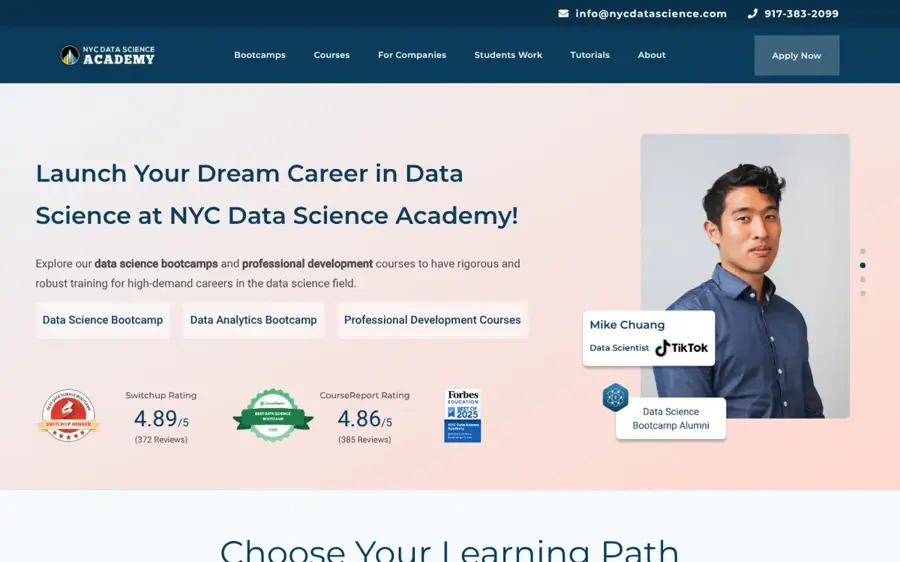
NYC Data Science Academy runs a 400-hour Data Science with Machine Learning bootcamp, taught live remotely full-time or online full- or part-time. See it at nycdatascience.com.
Why it stands out
This is the most traditional, statistics-heavy option. It teaches both R and Python, plus machine learning, deep learning and big data, with packages like Scikit-learn, Keras, TensorFlow and SpaCy, according to the school. You choose 12 weeks full-time remote live, or 16 or 24 weeks online. Its lead AI instructor previously designed the Amper Music AI composition platform and was Director of AI at Shutterstock. Prework runs 40 hours with more than 200 exercises.
The school holds a 4.83 rating from 388 reviews on Course Report. One online graduate wrote there: "The hands-on curriculum, alumni network, and relentless interview prep gave me everything I needed to break in—and keep leveling up." That is one person's story, not a guarantee.
Key features
- Two languages: R and Python.
- Project-based: four application projects plus a capstone, often company-sponsored.
- Flexible length: 12, 16 or 24 weeks.
- Career services: three rounds of resume review and mock interviews.
- Financing: 3- and 5-year loans through Skills Fund.
Pros
- Strong statistics and ML foundations
- Live remote option with real instructors
- Long track record since 2013
Cons
- Most expensive program here
- $5,000 deposit due within 7 days of acceptance
- Less focus on LLM apps and agents than newer programs
NYC Data Science Academy pricing: No free plan → $17,600 for either bootcamp format (checked October 2026). See pricing
Related: AI vs machine learning vs deep learning
Verdict: worth the premium only if you want data scientist roles, not just AI app work.
ML Zoomcamp – best for free ML engineering
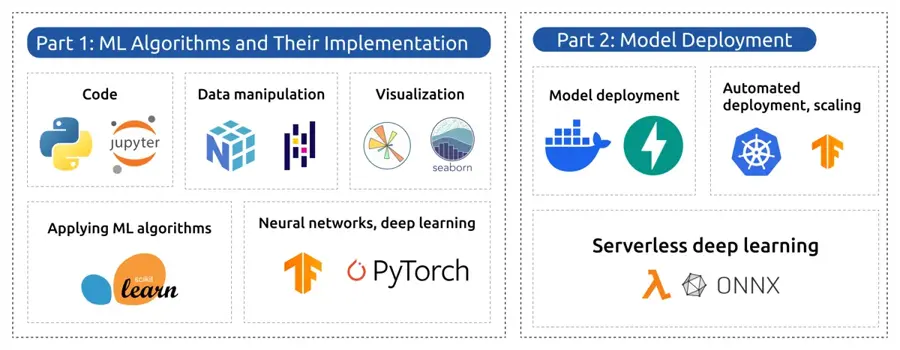
ML Zoomcamp is DataTalks.Club's free four-month course on building and deploying machine learning systems, run as a yearly cohort with self-paced access. See it at datatalks.club.
Why it stands out
It skips the notebook-only trap. You learn regression, classification, trees and deep learning, then containerise with Docker, serve with FastAPI and scale with Kubernetes and AWS Lambda, according to DataTalks.Club. To earn the certificate you submit two projects on time and peer-review three classmates' projects, per the course docs. The 2026 cohort started on September 14, 2026, but the materials stay open for self-paced study.
There are no star ratings, but the public signal is strong: the course repository has about 14,900 stars and 3,300 forks on GitHub. You need a year or more of programming experience to keep up.
Key features
- Full pipeline: from Python ML basics to production deployment.
- Two portfolio projects: midterm and capstone, peer reviewed.
- Free certificate: for cohort students who meet the deadlines.
- Community: Slack, Telegram and a YouTube playlist.
Pros
- Completely free
- Heavy on deployment, which employers value
- Large, active community
Cons
- No mentor or career coaching
- Certificate needs a live cohort; self-paced learners miss scoring
- Steep for people new to programming
ML Zoomcamp pricing: Free → no paid plan (checked October 2026). See pricing
Related: AI training courses guide
Verdict: do this before you spend a dollar. If you finish it, you may not need a paid bootcamp.
LLM Zoomcamp – best for free RAG and agents
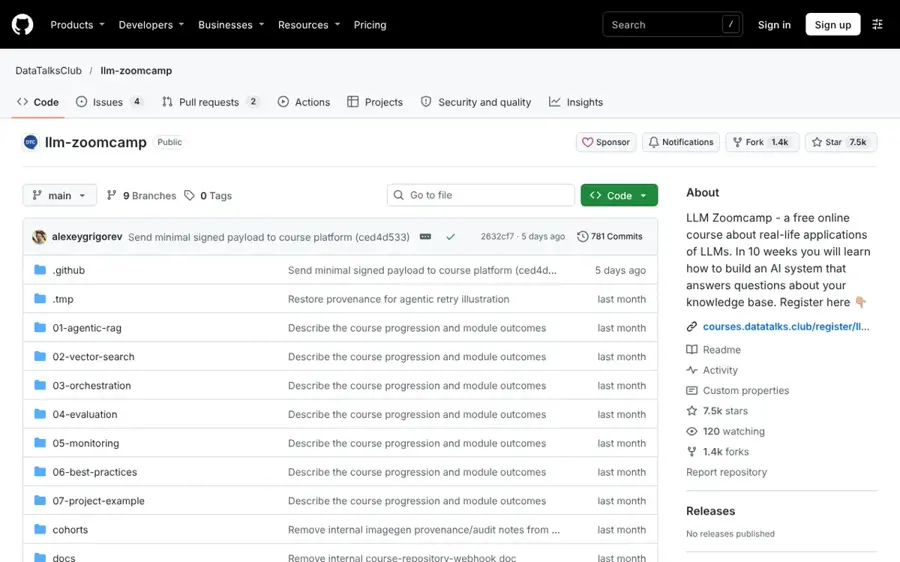
LLM Zoomcamp is DataTalks.Club's free 10-week course on building LLM applications with RAG, vector search and agents, available as a live cohort or self-paced. See it at github.com/DataTalksClub/llm-zoomcamp.
Why it stands out
It covers the exact skills that most AI engineering job ads now ask for: retrieval-augmented generation, embeddings, hybrid search, reranking, function calling, evaluation and monitoring, according to the course repository. The entry bar is low. In the course's own words: "If you can write a Python function and have heard of ChatGPT, you have enough to get started." You can start the self-paced version anytime.
Pair it with ML Zoomcamp and you get a free version of most of what Turing College charges €3,500 for, minus the 1:1 reviews.
Key features
- RAG end to end: from vector search to a production-ready assistant.
- Agents: function calling and tool use.
- Evaluation and monitoring: how to tell whether your app works.
- Two formats: live cohort or self-paced, both free.
Pros
- Free and open source
- Low entry bar for a technical course
- Short: 10 weeks
Cons
- No personal feedback outside peer review
- Covers LLM apps, not ML fundamentals
LLM Zoomcamp pricing: Free → no paid plan (checked October 2026). See pricing
Related: How to use AI prompt engineering
Verdict: the fastest free route to building a RAG app you can show an employer.
How to choose the right AI bootcamp
Start from where you are, not where you want to be
The biggest mistake is buying a course above or below your level. If you have never coded, none of these AI bootcamps is your first step; Le Wagon itself sends beginners to its Data Analytics course instead. Learn Python basics first, or start with our list of the best AI courses for beginners. If you have two or more years as an engineer, a beginner bootcamp wastes your money. Choose TripleTen or Turing College.
Decide between live and self-paced
Choose Fullstack Academy, Le Wagon or NYC Data Science Academy if you need a timetable to show up. Choose Turing College or the Zoomcamps if you are disciplined and want to save money. Be honest here. Self-paced courses are cheaper partly because many people never finish them.
Confirm the program still runs
The bootcamp market is shrinking and shifting. General Assembly has ended its consumer operations to focus on corporate training. Codesmith's homepage now pitches AI training for companies and governments. The University of Arizona marks its Springboard Machine Learning Engineering & AI bootcamp as discontinued. Before you pay, ask for the next start date in writing.
Read outcome claims like an advert
Placement rates and salary bumps on bootcamp sites are self-reported, often old, and defined by the school. Ask how many people enrolled, how many graduated, and how many of those found an in-field job within six months. Then read the negative reviews, too. For a sense of the market you are walking into, see our guide to AI jobs in 2026.
Free vs paid: what you actually get
The content gap between free and paid AI bootcamps is smaller than the price gap. The ML Zoomcamp syllabus covers deployment with Docker, FastAPI and Kubernetes, which is the same ground Le Wagon and TripleTen cover. What you pay for is everything around the content.
| What you get | Free (Zoomcamps) | Paid ($4,995 to $17,600) |
|---|---|---|
| Curriculum | Strong, open, regularly updated | Strong, often more polished |
| Feedback | Peer review only | Mentors, instructors or 1:1 reviews |
| Accountability | Cohort deadlines, no penalty for quitting | Live classes and money on the line |
| Career help | Community only | Coaching, mock interviews, hiring networks |
| Certificate | Free, for on-time cohort finishers | School certificate on completion |
| Refunds | Not needed | First two weeks at TripleTen, 14 days at Turing College |
Choose free if you can learn alone and mainly need a structured syllabus. Choose paid if you need someone to review your code, push you through month three and help you sell yourself in interviews. A good middle path: do the free LLM Zoomcamp first, then pay only if you get stuck.
Final verdict
Most people should start with Fullstack Academy. It is live, it fits around a job, and at $4,995 upfront it is the best value paid AI bootcamp we found. Choose TripleTen if you are already an engineer and want a senior AI role. Choose Turing College if you code and want LLM apps on your CV fast for €3,500. Choose Le Wagon if you can go full-time and want a campus. Choose NYC Data Science Academy only if data science, not AI app building, is the goal.
And whatever you choose, do a free Zoomcamp module first. It costs nothing and tells you whether you actually enjoy this work before you spend thousands finding out.
FAQ
What is an AI bootcamp?
An AI bootcamp is a short, intensive training program, usually three to nine months, that teaches you to build machine learning models and AI applications for a job. Good ones cover Python, machine learning, deep learning, LLMs, RAG, agents and deployment, and end with portfolio projects plus some form of career support.
How much does an AI bootcamp cost?
Published prices in October 2026 ranged from free for DataTalks.Club's Zoomcamps to €3,500 for Turing College, $4,995 upfront for Fullstack Academy, $12,600 for TripleTen and $17,600 for NYC Data Science Academy. Le Wagon prices vary by city. Financing usually raises the total you pay.
Are AI bootcamps worth it in 2026?
They can be, if you pick one that matches your level and you finish it. Reviews show graduates landing roles, but also long job searches; one TripleTen graduate reported more than 200 applications. Outcome stats on bootcamp sites are self-reported, so try a free course first and treat a bootcamp as structure and support, not a job guarantee.
Can a beginner join an AI bootcamp?
Most serious AI bootcamps expect some programming. TripleTen's AI program requires two years of production experience, Turing College asks for a year of Python or JavaScript, and Le Wagon wants programming and maths basics. Fullstack Academy starts with a programming refresher. Complete beginners should learn Python first.
What is the best AI engineer bootcamp?
For working engineers, TripleTen's AI & Machine Learning program is the most production-focused, with a one-on-one mentor and a full system built on AWS. For developers who want LLM apps on a smaller budget, Turing College's AI Engineering course costs €3,500 and centres on RAG, agents and LangGraph.
Can I do an AI bootcamp online while working?
Yes. Fullstack Academy runs evening classes three nights a week, TripleTen schedules live sessions on evenings and weekends, Turing College is self-paced at about 10 hours a week, and Le Wagon offers a six-month part-time track. Budget 10 to 30 hours a week depending on the program.
Sources
- The 12 Best AI Bootcamps of 2026 (Course Report)
- Part-Time AI & Machine Learning Bootcamp (Fullstack Academy)
- Fullstack Academy Reviews (Course Report)
- Data Science & AI course (Le Wagon)
- Data Science & AI course online (Le Wagon)
- AI & Machine Learning Engineering Advanced Program (TripleTen)
- TripleTen AI Programs (TripleTen)
- TripleTen Reviews (Course Report)
- Become an AI Engineer in 3-4 Months (Turing College)
- Financing options (Turing College Help Center)
- Turing College Reviews (Course Report)
- Data Science with Machine Learning (NYC Data Science Academy)
- ML Zoomcamp: Free Machine Learning Engineering Course and Certification (DataTalks.Club)
- Machine Learning Zoomcamp documentation (DataTalks.Club)
- machine-learning-zoomcamp repository (GitHub)
- llm-zoomcamp repository (GitHub)
- A note on our consumer operations (General Assembly)
- Machine Learning Engineering & AI Bootcamp (DISCONTINUED) (University of Arizona CPE)
- Codesmith Home (Codesmith)