10 best AI agent observability tools for 2026, compared side by side
Langfuse, LangSmith, Braintrust and seven more AI agent observability tools compared on tracing, evals, self-hosting and current pricing.
 Written byDr. Alap ZahidReviews And Guides Editor
Why you can trust The AI Future
Our writers research every product from its official pages, independent tests and user reports, link each claim to its source and correct mistakes openly. Unless an article says otherwise, we haven't tested the product hands-on ourselves. Companies can't pay for coverage or see reviews before they're published.
Read our editorial policy
Short answer: most teams should start with Langfuse, because it's open source under MIT, has a free cloud tier and a $29 Core plan, and you can move to self-hosting later without switching tools. If your agents already run on LangGraph, LangSmith is the easier fit. If evals decide what ships, pay for Braintrust. Everything else on this list of AI agent observability tools is a specialist, and I'll tell you which job each one is good at.
This category moved fast in 2026. ClickHouse bought Langfuse in January, Cisco closed its Galileo deal on May 22, and Dynatrace completed its purchase of Arize. Helicone, a popular pick a year ago, has been in maintenance mode since Mintlify acquired it. A 2025 shortlist is probably out of date.
Key takeaways
- Langfuse is the safest default: an MIT core, free self-hosting and a $29 cloud plan with unlimited users.
- LangSmith makes the most sense for LangChain and LangGraph teams, but its per-trace billing gets expensive at high volume.
- Braintrust and Arize are the strongest choices when evaluation is the main job.
- If you already pay for Datadog, its Agent Observability product puts agent traces next to your service traces.
- Opik Pro Cloud at $19 a month is the cheapest paid plan here, and Opik's code is Apache-2.0.
Our ranking method
Nobody at The AI Future ran hands-on tests for this roundup. We compared each tool using vendor pricing pages, product docs, GitHub repositories and published independent comparisons, all checked in early November 2026. We ranked them on these criteria:
- Agent tracing depth covers whether the tool shows tool calls, sub-agents, sessions and costs, not just single LLM calls.
- Evaluation support asks whether you can score outputs, build datasets from traces and catch regressions.
- Pricing transparency rewards published overage rates over "contact sales".
- Free tier value looks at what a solo developer gets for $0.
- Openness and self-hosting covers licence, OpenTelemetry support and whether you can run it on your own servers.
- Momentum checks recent releases and ownership changes that could affect the roadmap.
Prices are in US dollars. Usage bills depend on how many spans your agents produce, so "starts at" is an entry price, not your production bill.
The 10 best AI agent observability tools at a glance
| # | Tool | Category | Best for | Free tier | Starts at |
|---|---|---|---|---|---|
| 1 | Langfuse | Open-source platform | Most teams | Yes | $29/mo |
| 2 | LangSmith | Tracing and evals | LangGraph teams | Yes (limited) | $39/seat/mo |
| 3 | Braintrust | Eval-first platform | Eval-driven releases | Yes | $249/mo |
| 4 | Arize | Open source plus enterprise | Free self-hosting | Yes | $50/mo |
| 5 | Datadog Agent Observability | APM add-on | Existing Datadog users | Yes (limited) | $160/mo |
| 6 | Opik | Open-source platform | Lowest cloud bill | Yes | $19/mo |
| 7 | Pydantic Logfire | Full-stack observability | Python and Pydantic AI apps | Yes | $49/mo |
| 8 | W&B Weave | ML platform add-on | Teams on Weights & Biases | Yes | $60/mo |
| 9 | Laminar | Agent-native tracing | Finding unknown failures | Yes | $30/mo |
| 10 | AgentOps | Agent SDK | CrewAI and AutoGen builds | Yes (limited) | $40/mo |
The best AI agent observability tools in 2026, ranked
Langfuse – best for most teams
Langfuse is an open-source platform for tracing, prompt management, evaluation and datasets, with a managed cloud and a free self-hosted version.
Strengths
It's the pick independent reviewers keep landing on. TechPlained's October comparison says "For most teams starting fresh in October 2026, Langfuse is the default pick", and it priced a workload of a million traces a month at about $451 on the Core plan. The repo has 37.1k GitHub stars, which is the most of any tool here.
The licence is the big draw. Per its open-source page, tracing, evals, prompt management and the playground are all MIT licensed with no usage limits; only extras like SCIM and audit logs need a commercial key. I like that cloud and self-hosted versions share one codebase.
Key features
- Agent traces and graphs, plus session and user tracking.
- Token and cost tracking per trace.
- OpenTelemetry ingestion alongside Python and JavaScript SDKs.
- LLM-as-judge evaluators, datasets and human annotation queues.
Pros
- MIT core you can self-host for free.
- Core plan includes unlimited users.
- Published overage rate of $8 per 100k units.
Cons
- Every span and score counts as a unit, so chatty agents cost more than their trace count suggests.
- Self-hosting means running Postgres, ClickHouse, Redis and blob storage, according to TechPlained.
- SOC 2 and ISO reports start on the $199 Pro plan.
Verdict: if you only pick one, pick this.
Langfuse pricing: Free (Hobby, 50k units), then paid plans from $29/month, with Pro at $199 and Enterprise at $2,499 (checked November 2026). See pricing
Related: Best AI evaluation tools for production
LangSmith – best for LangGraph teams
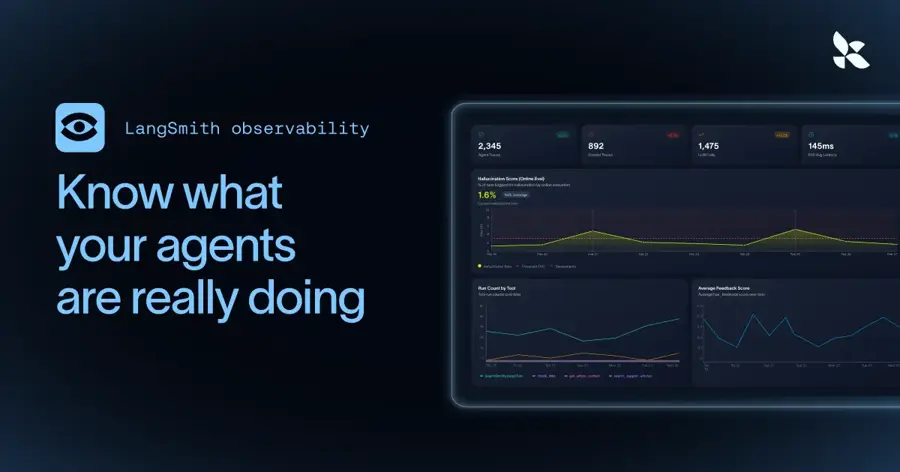
LangSmith is LangChain's commercial platform for tracing, evaluating and deploying agents, and it works with or without the LangChain framework.
Strengths
If you build on LangGraph, the integration is the selling point. You get tracing, evals and managed agent deployment from one vendor, and Plus includes one free small serverless deployment, going by the plans page. A trace counts as one execution of your app, so per eCorp IT's breakdown a long agent loop with thousands of steps costs the same as a single call.
The downside is volume. LangSmith doubled its base trace rate to $0.005 in late July, and TechPlained calls it "the most expensive option here at high volume" (about $7,567 a month in its million-trace example with longer retention). That's a lot more than I expected.
Key features
- Tracing for LangChain, LangGraph and plain code through decorators and OpenTelemetry.
- Base traces kept for 14 days, extended traces for 180.
- Tuned evaluators in public beta on Plus and Enterprise.
- Managed agent deployment billed in LangChain Standard Units.
Pros
- Tightest fit with LangGraph agents.
- Multi-step agents don't cost more per trace.
- Startup plan with discounted rates.
Cons
- Seats are billed on top of usage.
- Self-hosting is Enterprise-only.
- Default 14-day retention is short for regression work.
Verdict: worth it for LangGraph shops, but model a year of trace volume before you sign up.
LangSmith pricing: Free (Developer, 1 seat, 5k base traces), then paid plans from $39 per seat/month plus usage (checked November 2026). See pricing
Related: How to build AI agents
Braintrust – best for eval-driven releases
Braintrust is an evaluation-first platform where experiments, datasets, scorers and production traces share one data model.
Strengths
Braintrust bills by gigabytes processed and scores, not per span. That can make it cheap for deep agents with small payloads: eCorp IT's cost model put Braintrust Pro at $747 a month for 2 million traces, the lowest list price of the five tools it costed.
Every plan includes unlimited users, which matters when product managers want to review outputs too. I think it's the best fit for teams that gate releases on eval scores in CI.
Key features
- Experiments, versioned datasets and LLM-as-judge or code scorers.
- Loop, a built-in agent that writes test cases and iterates on prompts.
- Custom charts, dashboards and environment tags on Pro.
Pros
- Unlimited users on every plan.
- Strong eval tooling for CI gating.
- Free plan includes $10 of model credits.
Cons
- Pro jumps straight to $249 a month.
- Gigabyte billing is hard to forecast before you have production traffic.
- Self-hosting and BYOC need Enterprise.
Verdict: pay for it when evals, not dashboards, are your main workflow.
Braintrust pricing: Free, then paid plans from $249/month (checked November 2026). See pricing
Related: Best AI evaluation tools for production
Arize – best for free self-hosting
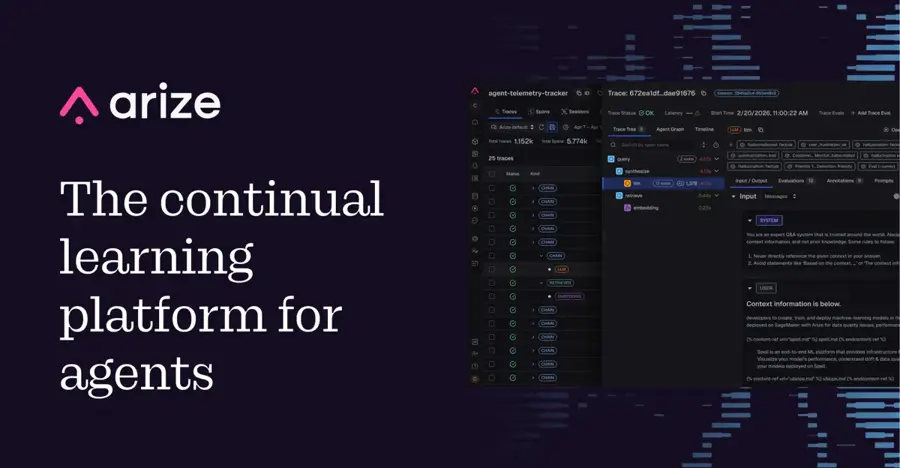
Arize makes Phoenix, an open-source tracing and evaluation app, and Arize AX, its managed enterprise platform; Dynatrace now owns the company.
Strengths
Phoenix is the lightest self-host on this list. TechPlained notes it runs as one application with SQLite by default (Postgres recommended for production), "a far smaller footprint than Langfuse or Opik". The Phoenix site claims 3M+ monthly downloads, and the repo has 12.2k stars.
The Dynatrace deal adds some uncertainty. Arize says it'll keep supporting both Phoenix and AX, with features folded into Dynatrace over time, per Engineering.com. I'd get roadmap promises in writing before a big AX contract.
Key features
- OpenTelemetry-based tracing with OpenInference auto-instrumentation.
- Datasets and experiments built from production traces.
- Unlimited users and evals on every AX plan.
- AX data regions in the US, EU and Canada.
Pros
- Phoenix is free to self-host with no feature limits.
- Same instrumentation works with Phoenix and AX.
- AX Pro is cheap at $50 a month.
Cons
- Phoenix uses the Elastic License 2.0, which isn't OSI open source.
- AX publishes no overage rate above 50k spans.
- Ownership change could shift the roadmap.
Verdict: the best free option if you want to keep traces on your own machines.
Arize pricing: Free (AX Free, 25k spans), then paid plans from $50/month (checked November 2026). See pricing
Datadog Agent Observability – best for existing Datadog users
Datadog Agent Observability, formerly LLM Observability, traces and evaluates AI agents inside the same platform as Datadog's APM and infrastructure monitoring.
Strengths
The point here is correlation. Agent spans sit next to your backend traces and real-user data under one trace ID, so you can see whether a slow tool call is really a slow database. Only LLM spans are billed, not tool or retrieval spans, which TechPlained says suits agents that make lots of tool calls.
Without other Datadog products, though, I'm not sure it earns its price.
Key features
- End-to-end agent tracing tied to APM and infrastructure data.
- Experiments and golden datasets built from annotated traces.
- Sensitive data scanning and role-based access control.
- OpenTelemetry GenAI semantic conventions supported.
Pros
- One platform for agents and the services they call.
- Bills LLM spans only.
- HIPAA compliance available.
Cons
- No self-hosting.
- Default retention is 15 days, and longer retention costs more per span.
- Little reason to choose it if you don't already use Datadog.
Verdict: a sensible add-on for Datadog shops, and an odd first purchase for anyone else.
Datadog Agent Observability pricing: Free for the first 40k LLM spans, then paid plans from $160/month billed annually for 100k LLM spans, or $200 month-to-month (checked November 2026). See pricing
Opik – best for the lowest cloud bill
Opik, from Comet, is an open-source platform for agent tracing, LLM-as-judge evaluation and test suites, with a cheap hosted cloud.
Strengths
Price is the headline. Pro Cloud is $19 a month for 100k spans and up to 50 team members, and TechPlained found Opik had "the lowest metered cloud price in this comparison" at about $264 for a million traces. It's also the only one of the five tools compared by eCorp IT that's fully under Apache-2.0. The repo sits at 23.2k stars, second only to Langfuse here.
Key features
- Agent tracing with execution graphs and multi-turn sessions.
- Test suites with pass/fail assertions for regression testing.
- 30+ built-in evaluation metrics plus custom ones.
- Integrations with 40+ frameworks, including LangGraph, CrewAI and Google ADK.
Pros
- Cheapest paid plan on this list.
- Apache-2.0 code, same as the hosted version.
- Free cloud gives 25k spans and 60-day retention.
Cons
- Free and Pro cloud list a US data region only.
- Self-hosting needs five backing services, per TechPlained.
Verdict: the budget pick, as long as US data hosting is fine for you.
Opik pricing: Free, then paid plans from $19/month (checked November 2026). See pricing
Related: Best AI evaluation tools for production Best free AI coding assistants
Pydantic Logfire – best for Python and Pydantic AI apps
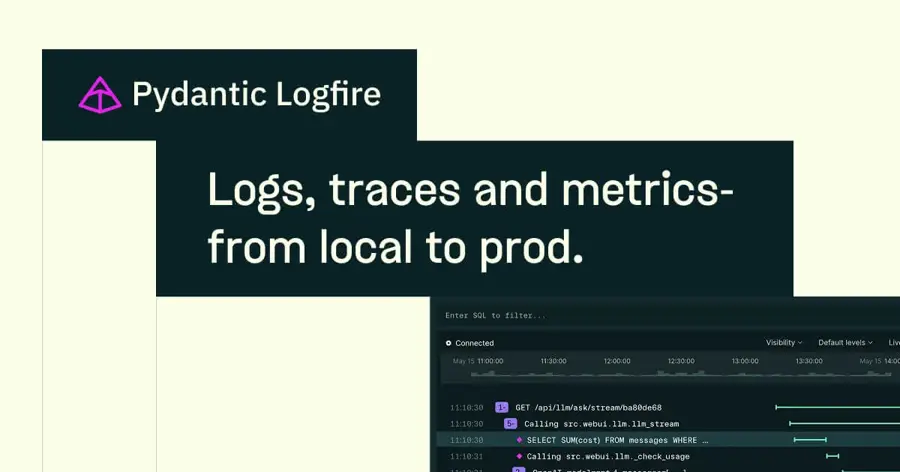
Pydantic Logfire is a full-stack observability tool from the Pydantic team that covers AI agents, evals, application performance and infrastructure on one meter.
Strengths
It's built for one-tool setups. Agent runs, service traces, host metrics and Kubernetes logs all land in one table you can query with SQL, going by the product page. The free Personal plan is hard-capped at $0, so a runaway agent can't run up a bill (a small detail I really like).
Independent coverage is thinner, and the SDK repo has 4.5k stars.
Key features
- 10 million logs, spans or metrics free each month.
- Native SDKs for Python, TypeScript and Rust, plus standard OpenTelemetry.
- AI output evaluations and human review on Team and above.
- MCP access so coding agents can query production data.
Pros
- Generous, hard-capped free tier.
- No per-agent or per-service fees.
- First-month refund if a usage spike surprises you.
Cons
- Team plan keeps only 30 days of data.
- Extra seats cost $25 each beyond five.
- Thinner third-party coverage than the leaders.
Verdict: great value for Python teams who want agents and app monitoring in one bill.
Pydantic Logfire pricing: Free, then paid plans from $49/month (checked November 2026). See pricing
Related: How to create an AI agent
W&B Weave – best for teams on Weights & Biases
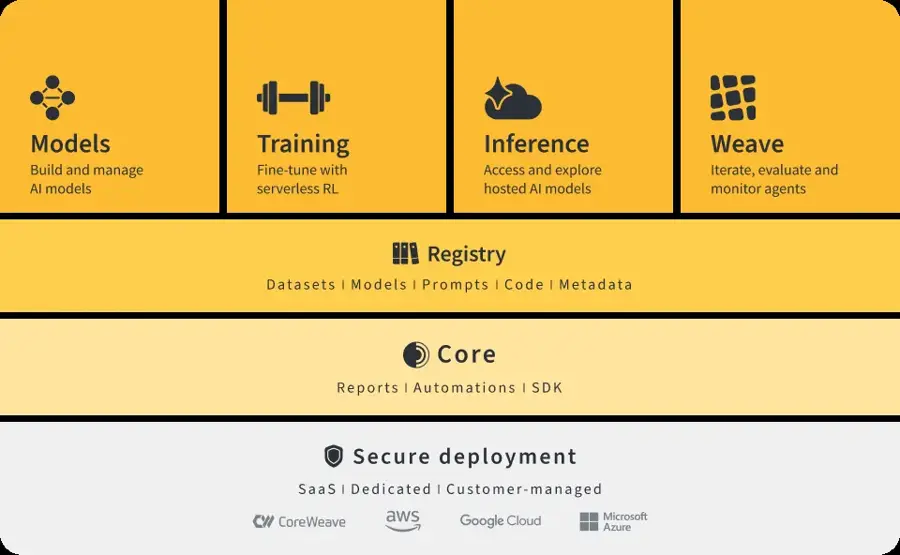
W&B Weave is the agent tracing and evaluation side of Weights & Biases, which now sells under CoreWeave's Forge brand.
Strengths
If your ML team already tracks experiments in W&B, Weave keeps agent work in the same place. Weave treats sessions, turns, tools and sub-agents as first-class objects, and coding agents like Claude Code can connect to it, per the Weave page. Agent Lens, in public preview, turns failing traces into eval cases, per Techstrong.ai.
The catch is ingestion pricing. Pro includes 1.5 GB a month and then charges $0.10 per MB, which TechPlained calls "the steepest data price in this comparison".
Key features
- Agent-native tracing with sessions, turns and sub-agents.
- Built-in and custom signals that classify agent behaviour.
- LLM-as-judge metrics and PII redaction.
Pros
- Same platform as W&B experiment tracking.
- 30-day free trial of Pro.
- Free academic Pro licence.
Cons
- Per-megabyte billing punishes long-context agents.
- Pro is limited to companies with fewer than 50 employees.
- The Forge rebrand makes plans harder to follow.
Verdict: a natural add-on for W&B users, but watch your megabytes.
W&B Weave pricing: Free, then paid plans from $60/month (checked November 2026). See pricing
Related: What is LLM AI?
Laminar – best for finding unknown failures
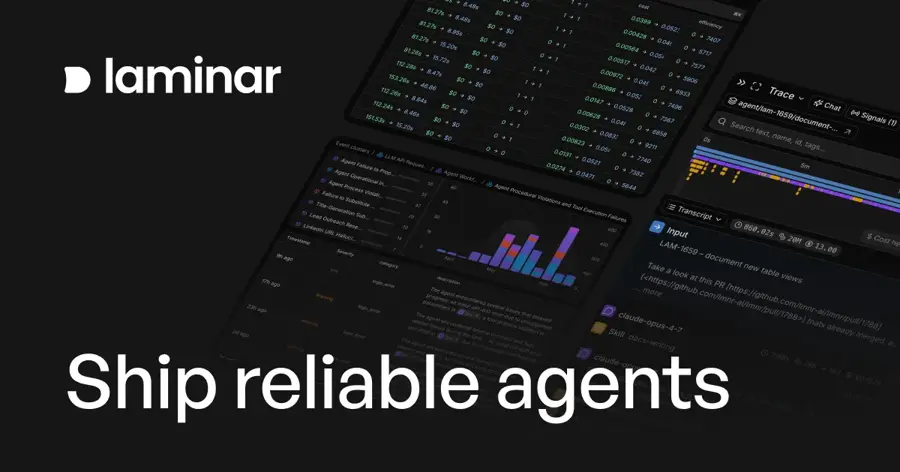
Laminar is an open-source agent observability platform that captures LLM calls, tool calls and sub-agents, then analyses runs automatically to surface failures.
Strengths
Laminar's Signals feature is the interesting part. It analyses every agent run to find failure modes you didn't think to define, then clusters similar failures into patterns, per its homepage. Browser session recording and an agent debugger are among its listed features, which suits browser-using agents.
It's a smaller project, with 3.5k GitHub stars, and I couldn't find a substantial independent review of it.
Key features
- OTLP trace ingestion and full-text trace search.
- Signals and signal clusters for automatic failure discovery.
- Browser session recording and an agent debugger.
- Evaluations, datasets and labelling queues.
Pros
- Catches failures without hand-written rules.
- Unlimited seats on paid plans.
- Low $30 entry price.
Cons
- Signals are billed separately by token.
- Free plan keeps data for only 7 days.
- Little independent coverage so far.
Verdict: worth a look if you're drowning in traces.
Laminar pricing: Free, then paid plans from $30/month (checked November 2026). See pricing
Related: Best AI agents platforms
AgentOps – best for CrewAI and AutoGen builds
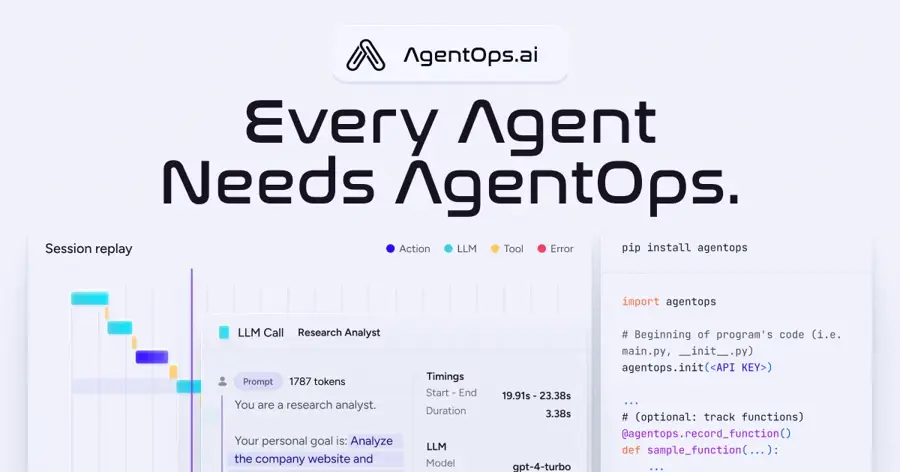
AgentOps is a developer SDK and dashboard for tracing, replaying and costing AI agent runs across popular agent frameworks.
Strengths
Setup is a pip install, and AgentOps supports OpenAI, CrewAI, AutoGen and "400+ LLMs and frameworks", going by its site. The SDK repo has 5.9k stars.
It's narrower than the platforms above. I'd treat it as a debugging tool for framework-based agents, not a full eval suite.
Key features
- Agent-agnostic SDK with LLM cost tracking for 400+ models.
- Replay analytics for agent sessions.
- Logs of errors and prompt injection attempts.
Pros
- Very quick to add to an existing agent.
- Pro removes event limits and keeps logs indefinitely.
- Session replay for multi-agent debugging.
Cons
- Free plan stops at 5,000 events.
- Lighter evaluation tooling than the leaders.
- SSO and on-premise deployment are Enterprise-only.
Verdict: quick to add, and probably easy to outgrow.
AgentOps pricing: Free up to 5,000 events, then paid plans from $40/month, pay as you go (checked November 2026). See pricing
Related: How to build AI agents
Choosing the right AI agent observability tool
Start from the framework you already use
LangGraph teams save setup time with LangSmith, and CrewAI or AutoGen users get traces fast with AgentOps. For custom agentic AI code, pick a tool with OpenTelemetry ingestion so you aren't locked to one SDK.
Price your real span count before you commit
This is where most budgets go wrong. A single agent run can produce dozens of spans, and Langfuse, Opik and Arize bill per span or unit, while LangSmith bills per trace and Braintrust and Weave bill by data volume. Run a week of real traffic on a free tier first; it's the only estimate I'd trust. If you're unsure what drives these numbers, our guide to tokens in AI is a good primer.
Check the licence if you plan to self-host
Langfuse (MIT core) and Opik (Apache-2.0) are genuinely open source. Phoenix uses the Elastic License 2.0, which allows internal use but forbids offering it as a hosted service. Braintrust and LangSmith only self-host on Enterprise.
Factor in ownership changes
Galileo now belongs to Cisco and is being folded into Splunk Observability Cloud, Arize belongs to Dynatrace, and Langfuse belongs to ClickHouse. None of that is bad by itself. Still, get data terms in writing. And I'd avoid starting fresh on Helicone: its maintenance mode means bug fixes but no new features.
Free vs paid: what you actually get
Free tiers are generous enough for prototypes. Langfuse Hobby gives 50k units and 30 days of history for 2 users; Opik's free cloud gives 25k spans with 60-day retention for up to 10 people; Logfire gives 10 million records for one person; Arize AX Free gives 25k spans with 15-day retention.
Paid plans mostly buy you three things: longer retention, more seats and compliance paperwork. Retention bites first: LangSmith base traces vanish after 14 days and Laminar's free plan keeps only 7, too short to compare this month's agent with last month's. SOC 2 reports, SSO and HIPAA agreements usually sit on the second paid tier, so a regulated team should budget for something like Langfuse Pro ($199).
Self-hosting is the third route. It's free in licence terms, but it isn't free to run.
Final verdict
If you want one answer, choose Langfuse: its open licence, published pricing and easy path between cloud and self-hosting make it the lowest-risk bet in a market where three big names changed owners this year. Choose LangSmith if you're all-in on LangGraph and can live with per-trace costs. Choose Braintrust if eval scores decide your releases. On a tight budget, Opik's $19 plan is hard to argue with. Honestly, I think most small teams will be fine on a free tier for months; spend money when retention, not features, starts to hurt.
New to agents? Start with how to build AI agents or our AI agent platforms roundup.
FAQ
What are AI agent observability tools?
They're platforms that record what an AI agent does on each run: the prompts it sends, the tools it calls, sub-agent steps, token costs and latency. Most also score outputs and turn bad traces into test datasets.
What's the best free AI agent observability tool?
For self-hosting, Langfuse's MIT-licensed core and Arize Phoenix are the strongest free options, with Phoenix being lighter to run. For hosted free tiers, Pydantic Logfire's 10 million records a month is the most generous, while Opik's free cloud gives 25k spans and 60 days of retention.
Is LangSmith only for LangChain users?
No. LangSmith can trace plain code with decorators and accepts OpenTelemetry traces, so you don't need LangChain. Its biggest advantages still matter most to LangChain teams, so without the framework, Langfuse or Opik probably give you more for the money.
Do I need OpenTelemetry support?
It's not required, but it's a smart hedge. OpenTelemetry lets you instrument your agent once and send traces to a different backend later without rewriting code. Most tools here accept it, though GenAI attribute support varies.
Can I self-host an AI agent observability tool?
Yes. Langfuse, Opik, Arize Phoenix and Laminar all have self-hostable open-source versions. Expect to run several backing services. Braintrust and LangSmith self-host only on Enterprise, and Datadog doesn't offer it.