Consensus AI and the 8 best research AI tools in 2026, compared
Consensus AI is the best starting point for cited answers from research papers. Here's how it compares with Elicit, Undermind, Scite and four more.
 Written byMuhammad Usman SiddiquiFounder and editor-in-chief
Why you can trust The AI Future
Our writers research every product from its official pages, independent tests and user reports, link each claim to its source and correct mistakes openly. Unless an article says otherwise, we haven't tested the product hands-on ourselves. Companies can't pay for coverage or see reviews before they're published.
Read our editorial policy
Short answer: Consensus AI is the best place for most students and researchers to start when they want a fast, cited answer from peer-reviewed papers, and its free plan is enough to see if it fits. If you're doing serious literature reviews, Elicit and Undermind dig deeper, and Scite is the one I'd pick for checking whether a paper's claims have held up. Everything else on this list probably fills a narrower gap.
Nobody here ran hands-on tests for this piece. I compared eight research AI tools using their official pricing and help pages, two detailed librarian evaluations and user reviews on Trustpilot and Capterra, as of early November 2026. That's less glamorous than a lab test, but librarians at Deakin University and Singapore Management University have already done the heavy lifting, and their verdicts are worth more than my first impressions would be.
Key takeaways
- Consensus searches over 220 million peer-reviewed papers and is free to start, with Pro at $20 a month or $144 a year.
- Elicit is stronger for structured literature reviews and data extraction, but its Pro plan costs $49 a month billed annually.
- Undermind is the deep-search specialist that one academic librarian rates above Consensus for finding obscure papers.
- None of these tools is reproducible enough for a formal systematic review on its own, according to Deakin Library's evaluations.
- Semantic Scholar and ResearchRabbit are free and cover a lot of what students need.
Our ranking method
We ranked the tools on research, not on hands-on testing. Each one was scored on six things:
- Source quality is whether answers come from scholarly papers rather than the open web.
- Citation traceability is how easily you can check each claim against the paper it came from.
- Search depth is how many papers the tool reads and how well it finds the less obvious ones.
- Independent verdicts are what librarians and reviewers outside the company found.
- Free tier is what you get before paying anything.
- Price is the cost of the cheapest useful paid plan for one person.
The 8 best consensus AI tools at a glance
| # | Tool | Category | Best for | Free tier | Starts at |
|---|---|---|---|---|---|
| 1 | Consensus | AI academic search | Quick evidence answers | Yes (limited) | $20/mo |
| 2 | Elicit | Research assistant | Literature reviews | Yes (limited) | $49/mo |
| 3 | Undermind | Deep literature search | Finding obscure papers | Yes (limited) | $16/mo |
| 4 | Scite | Citation analysis | Checking if claims hold up | No | $12/mo |
| 5 | SciSpace | Research workspace | Reading and drafting | Yes (limited) | $12/mo |
| 6 | Perplexity | AI search | Mixing papers with web news | Yes (limited) | $20/mo |
| 7 | ResearchRabbit | Citation mapping | Visual discovery | Yes | $10/mo |
| 8 | Semantic Scholar | Academic search engine | Free paper search | Yes | Free |
The best research AI tools in 2026, ranked
Consensus – best for quick evidence answers
Consensus is an AI academic search engine that answers questions using peer-reviewed papers, with a citation on every claim.
Strengths
It's the tool I'd hand to an undergraduate first. You type a plain question, and going by its help centre, Consensus scans more than 220 million papers, reranks the top 20 with a bigger model and only then writes an answer. If it can't find enough evidence, it says so. That last bit matters more than it sounds, because general chatbots tend to fill gaps with confident guesses.
The independent verdicts are positive but careful. Aaron Tay, a librarian at Singapore Management University, wrote in his long review that Consensus is "likely one of the top tools in its class", while warning that the Consensus Meter is "essentially a form of vote counting". Deakin Library's evaluation lands in the same place: good for early discovery, but mostly driven by titles and abstracts. User reviews are thin. On Trustpilot, Consensus has just 6 reviews and a 2.4 score, which I wouldn't read much into either way.
Key features
- The Consensus Meter shows how many papers say yes, no or mixed to a yes-or-no question.
- Deep Review synthesises 50 to 100 papers into a long report.
- A research agent plans multi-step searches and applies academic filters.
- You can chat with the full text of papers, collections or your own uploads.
- Citation Graph shows which studies build on which.
Pros
- Answers come only from scholarly papers, with citations.
- The free plan includes up to 3 Deep reviews a month.
- Pre-filters let you exclude preprints or weaker journals.
- Annual Pro works out to $12 a month.
Cons
- Much of the analysis rests on abstracts, since full text is mostly limited to open access papers.
- The meter counts papers equally, so a 50-person study weighs the same as a 5,000-person one.
- Deakin found its privacy policy has ambiguous clauses.
Verdict: if you only pick one, pick this.
Consensus pricing: Free, then paid plans from $20/month or $144/year (checked November 2026)
Related: Best AI scientific research tools Best AI for science research
Elicit – best for literature reviews
Elicit is an AI research assistant that searches, summarises and extracts data from papers, with a dedicated systematic review workflow.
Strengths
Where Consensus gives you an answer, Elicit gives you a table. You can pull methods, sample sizes and outcomes into columns across dozens of papers, which is what a real literature review needs. Deakin Library's review praises its EndNote and Zotero links and its CSV exports. It also notes that the developers themselves claim outputs are about 80 to 90% accurate, so you're expected to check.
The weak spot is reproducibility. Deakin says its conversational searches "are not directly reproducible", though a keyword search now exists on paid plans. User ratings barely exist: Elicit has a single review on Trustpilot, scoring 3.2. Not much to go on.
Key features
- The free Basic plan has unlimited search across more than 138 million papers.
- Research Reports follow a PRISMA-style structure.
- Pro can screen up to 5,000 papers in a systematic review.
- You can add up to 20 extraction columns at a time on Pro.
- It imports from Zotero.
Pros
- Data extraction tables save hours on reviews.
- Unlimited summaries and paper chat on the free plan.
- Clear information on data sources, per Deakin.
Cons
- Pro costs $588 a year, more than double Consensus Pro.
- Research Agent and Reports usage is limited on the free plan.
- Uploading paywalled PDFs can raise copyright issues.
Verdict: worth paying for if you're writing a thesis chapter, overkill for a single essay.
Elicit pricing: Free, then paid plans from $49/month billed annually (checked November 2026). See pricing
Related: Best AI scientific research tools Best free study AI tools
Undermind – best for finding obscure papers
Undermind is a deep literature search agent that reviews thousands of papers and writes up what it finds, with verified citations.
Strengths
This seems to be the expert's pick. In the same review, Aaron Tay says Undermind is his favourite tool, and he notes it evaluates about 150 results on average against Consensus's maximum of 50. It asks clarifying questions before searching. Some people find that tiresome; Tay thinks it improves results when you're new to a field, and I'd agree with that logic.
It's also cheap for what it does. CostBench lists Pro at $16 a month billed annually, checked on 4 November 2026. The catch is transparency: Tay calls the search process a "blackbox", which is a problem if you need to document your methods.
Key features
- Deep search reviews thousands of papers per query.
- Reports are organised into sections like categories, timeline and adjacent work.
- Chat with Expert lets you question every paper the search found.
- Search alerts flag new related papers.
- It reads figures as well as text.
Pros
- Deeper searching than most rivals, per one librarian's comparison.
- Low annual price for individuals.
- A free plan exists for exploratory research.
Cons
- The search process is opaque.
- Pro is billed annually only.
- Fewer built-in visualisations than Consensus.
Verdict: the best search depth per dollar on this list.
Undermind pricing: Free, then paid plans from $16/month billed annually (checked November 2026). See pricing
Related: Best AI for science research
Scite – best for checking if claims hold up
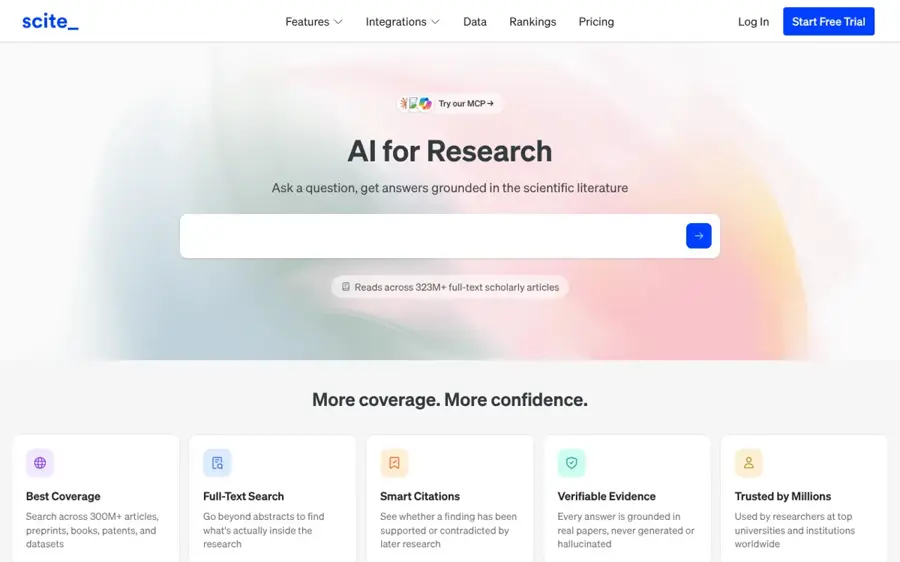
Scite is a citation analysis tool whose Smart Citations show whether later papers support or contrast a study's findings.
Strengths
Scite answers a different question from the others: not "what does the research say?" but "has this paper held up?" The tool tracks more than 1.6 billion citations, going by the Scite plans. Users seem happy. On Trustpilot, it scores 4.3 from 277 reviews, and one reviewer in August 2026 wrote that it's "more trustworthy than other AI" while complaining that uploading articles "requires quite laborious work".
Key features
- Smart Citations label citing statements as supporting, contrasting or mentioning.
- An AI assistant answers questions with references.
- Citation alerts and dashboards track papers you care about.
- Pro adds patent, clinical trial and grant datasets.
Pros
- Unique view of how a paper has been received.
- Strong user rating.
- Basic plan is cheap at $12 a month billed yearly.
Cons
- No free plan, only a 7-day trial.
- The trial rolls into a paid plan unless you cancel.
Verdict: a smart second tool to keep open next to Consensus.
Scite pricing: No free plan; paid plans from $12/month billed yearly (checked November 2026). See pricing
Related: Best AI scientific research tools
SciSpace – best for reading and drafting
SciSpace is an all-in-one research workspace with paper search, chat with PDF, literature review tables and a writing assistant.

Strengths
SciSpace tries to cover the whole process, from finding papers to building slides. It says over 11 million researchers use it. Reviews are mixed. Capterra users give it 4.4 from 80 reviews, and one research scholar praised "its AI-powered research assistance", but a professor complained of "Opaque credit consumpion" and a refused refund. That pattern (good features, frustrating credits) is likely the main thing I'd weigh before paying.
Key features
- Chat with PDF explains papers section by section.
- Literature review mode builds comparison tables.
- The SciSpace Agent runs multi-step research tasks.
- A Chrome extension and mobile app are available.
Pros
- Broad feature set in one place.
- Premium drops to $12 a month on annual billing.
- Good for non-native English readers working through dense papers.
Cons
- Credit-based usage is hard to predict, per Capterra reviewers.
- Sources disagree on whether a free plan still exists.
- Higher tiers get expensive fast, up to $200 a month.
Verdict: fine if you want one app for everything, but I'd start on monthly billing.
SciSpace pricing: Paid plans from $20/month, or $12/month billed annually (checked November 2026)
Related: Best free AI tools for students
Perplexity – best for mixing papers with web news
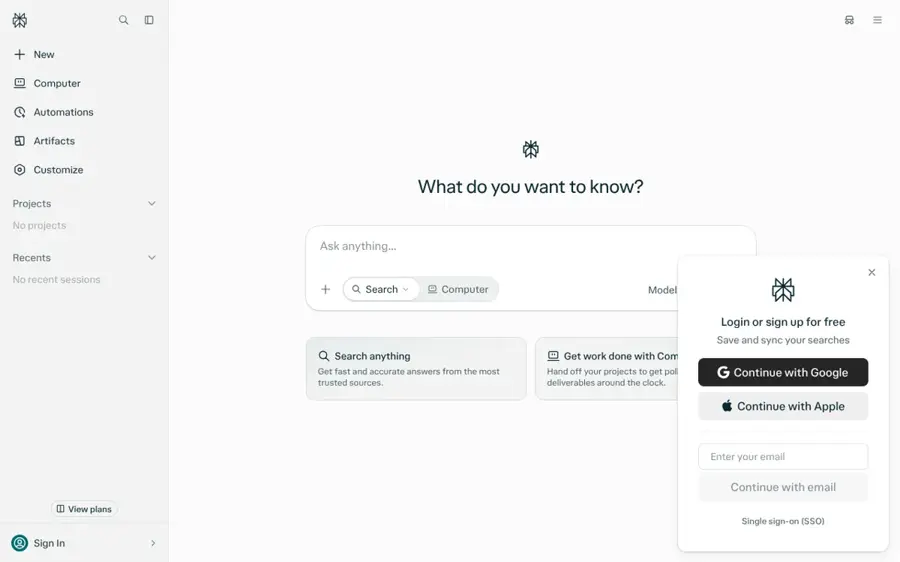
Perplexity is a general AI search engine with an Academic focus mode that limits answers to scholarly sources.
Strengths
Perplexity isn't built for academics, and that's partly the appeal. If your question mixes research with current events, policy or industry news, it'll cover both. Asian Efficiency calls Academic mode "the strongest for research that needs peer-reviewed sources" among its focus modes. Customer service is the sore point: Perplexity scores 1.4 from 851 reviews on Trustpilot, with complaints about bots in support and credits running out.
Key features
- Academic focus mode restricts searches to papers.
- Deep Research writes long cited reports on Pro.
- Pro lets you switch between several AI models.
- You can upload files and ask questions about them.
Pros
- Covers the web and scholarly sources in one place.
- Pro is $200 a year, a bit cheaper than monthly.
- Fast answers for everyday questions too.
Cons
- The free tier allows only about 3 Pro searches a day, per Asian Efficiency.
- Very poor Trustpilot rating for billing and support.
- Not designed for systematic paper screening.
Verdict: a good all-rounder, a weak specialist.
Perplexity pricing: Free, then paid plans from $20/month (checked November 2026)
Related: Perplexity AI vs ChatGPT Best AI like ChatGPT
ResearchRabbit – best for visual discovery
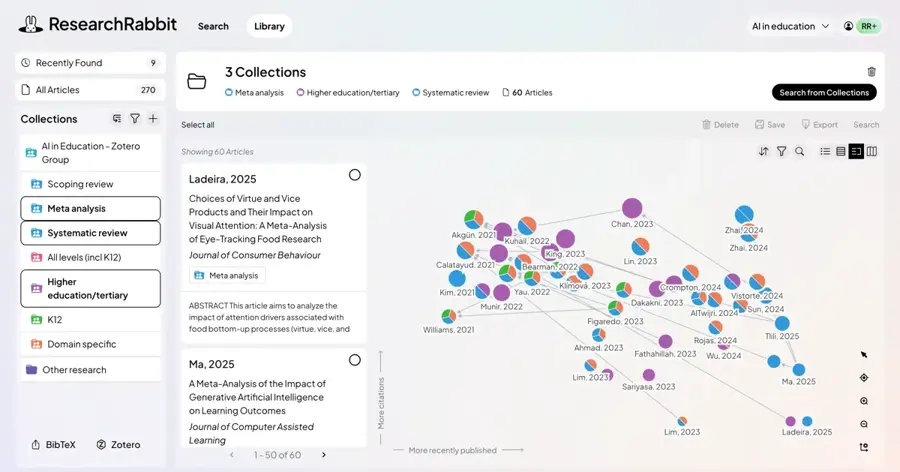
ResearchRabbit is a citation-mapping tool that finds related papers from a few seed articles and shows how they connect.
Strengths
You add a handful of papers you already trust, and ResearchRabbit suggests what cites them, what they cite and who else works on the topic. Its free tier is generous: the plans list unlimited searches across 310+ million articles and up to 50 seed articles. I couldn't find a meaningful independent user rating for it, so I'm going on features and price here.
Key features
- Seed-based discovery suggests related papers.
- Unlimited library and collections on the free tier.
- You can share collections with collaborators.
- RR+ raises the seed limit to 300 articles.
Pros
- Free Forever plan covers most literature reviews.
- RR+ is cheap and priced by country.
- Good for spotting key authors.
Cons
- No AI answers or summaries.
- You need good starting papers to get good results.
Verdict: pair it with Consensus and you've got a strong free setup.
ResearchRabbit pricing: Free, then RR+ from $10/month in the US (checked November 2026). See pricing
Related: Best free study AI tools
Semantic Scholar – best for free paper search
Semantic Scholar is a free AI-assisted academic search engine from the non-profit Ai2, indexing over 200 million papers.
Strengths
It's free, and it's the data source behind parts of other tools on this list: Deakin notes that Consensus draws abstracts via Semantic Scholar. Ai2 runs it as a non-profit with open datasets. The Semantic Reader adds inline citation cards and AI highlights, though per Ai2 the highlights cover mostly English-language computer science papers on arXiv.
Key features
- Search across 200+ million papers.
- TLDR summaries on paper pages.
- Semantic Reader shows cited-paper details inline.
- Open API and datasets for developers.
Pros
- Completely free.
- Run by a non-profit.
- Clean search with citation counts.
Cons
- No synthesis across papers.
- Reader highlights cover a narrow set of fields.
Verdict: bookmark it, even if you pay for something else.
Semantic Scholar pricing: Free (checked November 2026). See pricing
Related: Best free AI tools for students
Choosing the right consensus AI alternative
Match the tool to the stage of your research
Early on, you want orientation, and Consensus or Perplexity's Academic mode will do. Once you're screening papers, Elicit's extraction tables earn their price. Choose Consensus if you need answers; choose Elicit if you need a spreadsheet of studies.
Check full-text coverage in your field
Most AI research tools only read full text for open access papers. Tay points out that in fields like computer science or genomics coverage is decent, but in the humanities and many social sciences these tools are often summarising abstracts. If you're in history, I'd lean harder on your library's databases.
Don't use them for systematic reviews alone
Both Deakin evaluations say these tools lack the reproducibility formal reviews need. Use them for scoping, then run a documented database search.
Watch credit systems before you pay
SciSpace and Perplexity reviewers both complain about credits running out. Flat limits, like Consensus's 15 Deep reviews a month on Pro, are easier to plan around.
Free vs paid: what you actually get
For most students, free is probably enough. Consensus's free plan gives you basic search, 10 Pro messages a month and up to 3 Deep reviews, going by CostBench's November check. Combine that with ResearchRabbit, Semantic Scholar and Elicit's free plan, and you've got a capable stack for nothing.
| Tool | Free plan | Cheapest paid plan | What paying adds |
|---|---|---|---|
| Consensus | 10 Pro messages, 3 Deep reviews a month | $20/mo or $144/yr | Unlimited Pro messages, 15 Deep reviews |
| Elicit | Unlimited search and summaries | $49/mo billed annually | Systematic review workflow, more reports |
| Undermind | Exploratory research | $16/mo billed annually | More searches and full features |
| Scite | 7-day trial only | $12/mo billed yearly | Full assistant and Smart Citation reports |
| Perplexity | About 3 Pro searches a day | $20/mo | Unlimited Pro searches, Deep Research |
| ResearchRabbit | Unlimited search, 50 seeds | $10/mo (US) | 300 seeds, alerts, projects |
Paying makes sense when you're running more than a few deep searches a week, like during a dissertation. Honestly, Consensus at $144 a year is the easiest upgrade to justify; the Deep plan at $65 a month is for people doing reviews constantly.
Final verdict
Most people should start with Consensus. It's free to try, it sticks to scholarly papers, and the librarians who've looked closely rate it well while being clear about its limits. If you outgrow it, I think the next move depends on your work: Undermind for depth at $16 a month, Elicit if you're extracting data for a formal review. And keep Scite in the browser tab next to it, because knowing a paper was later contradicted is worth more than another summary.
FAQ
Is Consensus AI free?
Yes, there's a free plan. It includes basic paper search, 10 Pro messages a month and up to 3 Deep reviews. Pro costs $20 a month or $144 a year and removes the message cap, while the Deep plan at $65 a month adds 200 Deep reviews, as CostBench recorded in November 2026.
Is Consensus AI accurate?
It's grounded in real papers and cites every claim, which makes it more checkable than a general chatbot. But Deakin Library found it relies mostly on abstracts, and one librarian warns its Consensus Meter counts studies without weighting them. Treat its answers as a starting point and read the key papers yourself.
Is Consensus or Elicit better?
Consensus is better for quick, cited answers and easier for beginners. Elicit is better for structured literature reviews, since it extracts data into tables. It's pricier, though: $49 a month billed annually.
What's the best AI for finding research papers for free?
For free use, I'd combine Consensus's free plan with Semantic Scholar and ResearchRabbit. Semantic Scholar covers over 200 million papers at no cost, and ResearchRabbit's free tier finds related work from up to 50 seed papers. Elicit's free plan also allows unlimited search and summaries, so you can test all four before deciding whether anything is worth paying for.
Can I use Consensus for a systematic review?
Not on its own. Deakin Library says it lacks the transparency and reproducibility formal systematic reviews require, and Aaron Tay calls tools in this class best for scoping. Use it to explore the topic, then run documented searches in databases your library subscribes to.
For more options, see our guides to AI scientific research tools and AI for studying.