AI Dungeon alternatives in 2026: 7 options for better memory, rules and privacy
Leaving AI Dungeon? These seven alternatives fix its context limits, missing game rules or new training default, from Friends & Fables to free KoboldCpp.
 Written byRahis SaifiCo-founder and news editor
Why you can trust The AI Future
Our writers research every product from its official pages, independent tests and user reports, link each claim to its source and correct mistakes openly. Unless an article says otherwise, we haven't tested the product hands-on ourselves. Companies can't pay for coverage or see reviews before they're published.
Read our editorial policy
The best AI Dungeon alternative for most people in late 2026 is probably Friends & Fables if you want real D&D rules, or NovelAI if you mostly want to write a story with an AI co-author. Players who just want AI Dungeon's freeform style with fewer strings attached can run KoboldCpp on their own computer for free. Each fixes a different complaint, so the right pick depends on why you're leaving.
And people do have reasons. AI Dungeon's paid plans run from $14.99 to $99.99 a month, and new accounts made since September 28, 2026 share story text for training by default, RoboRhythms reported. That second change is the one I'd pay attention to. Below are seven alternatives, compared on price, memory, rules and privacy, with every price checked in early November 2026.
Key takeaways
- Friends & Fables is the closest thing to a real tabletop campaign, with 5e-style combat and parties of up to six players.
- NovelAI is cheaper than AI Dungeon's Journey plan at $10 a month and gives unlimited text generation on every paid tier.
- KoboldCpp is free and runs on your own machine, so your stories never leave it.
- Voyage comes from Latitude, the same company that makes AI Dungeon, so it fixes the gameplay complaints but not the ownership ones.
- General chatbots like Claude and ChatGPT can run a decent game, but they don't enforce rules or track your inventory on their own.
Our ranking method
Nobody at The AI Future played these games hands-on for this piece. We compared each alternative using official pricing and help pages, published third-party reviews, forum posts and player quotes, as of early November 2026. The criteria were:
- Memory and context, meaning how much of your story the AI can see before it starts forgetting.
- Game structure, such as dice, combat, inventory and rules that the AI can't simply talk its way around.
- Freedom, or how far you can go off-script before the system pushes back.
- Multiplayer support for parties and groups.
- Privacy defaults and what happens to your stories.
- Price for one player who plays a few evenings a week.
Tools built for interactive fiction rank above general chatbots. We left out apps that are mainly built around adult content.
The 7 best AI Dungeon alternatives at a glance
| # | Tool | Category | Best for | Free tier | Starts at |
|---|---|---|---|---|---|
| 1 | Friends & Fables | AI game master | D&D-style campaigns | Yes (limited) | $19.95/mo |
| 2 | NovelAI | AI story writer | Story-first solo play | Yes (limited) | $10/mo |
| 3 | Voyage | AI RPG platform | Persistent multiplayer worlds | Yes | $15/mo |
| 4 | KoboldCpp | Local AI app | Private, offline play | Yes | Free |
| 5 | Wit's End | TV party RPG | Living-room group play | No | $12.99/mo |
| 6 | Claude | General assistant | Long campaigns and lore | Yes | $20/mo |
| 7 | ChatGPT | General assistant | Quick one-shots | Yes | $8/mo |
NovelAI's free option is a one-time trial, Wit's End has a 7-day trial, and Voyage's $15 figure is the lowest subscription Latitude announced at launch.
Reasons people look for an AI Dungeon alternative
AI Dungeon isn't a bad app. Its Android version holds 4.0 stars from 106,000 Google Play reviews, according to RoboRhythms, and the free Wanderer tier has no ads. Still, the complaints that push players elsewhere are specific.
Memory costs real money
Context is the amount of story the AI reads before writing its next reply. On the membership tiers, free players get up to 4,000 tokens, Journey ($14.99) gets 8,000, Legend ($29.99) gets 16,000 and only Mythic ($49.99) and Ultimate ($99.99) reach 32,000. RoboRhythms points out that Journey's bigger models run at just 4K until you move up to Legend. For a long adventure, that's the difference between an AI that remembers your companion's name and one that doesn't. You can buy extra context with credits, which are spent per action.
Your stories may train the AI
This is newer. In a staff post on r/AIDungeon, Latitude said new accounts now have "Improve the AI" switched on by default, RoboRhythms reported, which lets the company use shared prompts and story text for evaluation and training. Going by Latitude's own explainer, logged inputs and outputs "may be published as part of an ongoing dataset collection project." You can turn it off. But people writing personal stories have a long memory here: in May 2021, a contractor at a data-labeling firm posted about 100 clippings of AI Dungeon stories to 4chan.
Honestly, I think the opt-out default matters more than the price for a lot of long-time players.
The best AI Dungeon alternatives in 2026, ranked
Friends & Fables – best for D&D-style campaigns
Friends & Fables is a browser RPG where an AI game master called Franz runs campaigns with D&D 5e-style combat, maps and dice. Play it at fables.gg.
Strengths
The big difference from AI Dungeon is structure. Franz enforces rules, tracks a party of up to six and runs tactical turn-based combat on battlemaps. In a hands-on review, DreamGen called its multiplayer handling excellent, though it also flagged the main tradeoff: the game is "Still in beta, with many features unrealised."
Narration got better when the studio made its stronger Fenix model the default on every paid plan. One Legend player quoted in the patch notes said they "haven't had to rewrite a single message" after the switch. It's a developer-picked quote, though.
Key features
- An AI game master that rolls dice and applies 5e-inspired rules.
- Multiplayer parties of up to six players.
- World-building tools with a map maker, lore pages and character generators.
- Text-to-speech narration with character voices.
- Image generation for characters, items and locations.
Pros
- Real game mechanics, so the AI can't hand you a win.
- Strong multiplayer support.
- Thousands of player-made worlds to start from.
Cons
- The cheapest plan costs more than AI Dungeon's Journey tier.
- It's web-only, and DreamGen says it's still in beta.
- Less suited to freeform stories that don't fit a fantasy RPG mould.
Friends & Fables pricing: Free with limited daily credits, then paid plans from $19.95/month (checked November 2026). See pricing
NovelAI – best for story-first solo play
NovelAI is a browser-based AI writing studio from Anlatan where the AI continues your story and a Lorebook keeps track of your world. Find it at novelai.net.

Strengths
NovelAI suits AI Dungeon players who cared more about the prose than the game. Every paid tier includes unlimited text generation, and the top Opus plan remembers up to 28,672 tokens, close to AI Dungeon's 32K ceiling at half the Mythic price. RoboRhythms put it bluntly: "NovelAI earns its $10 for people who write long stories and care about privacy." The same write-up says a September 10, 2026 privacy policy update states prompts aren't stored.
One warning. The app called "NovelAI" on Apple's App Store isn't the real one, according to RoboRhythms, and it bills $4.99 a week.
Key features
- Unlimited text generation on all paid tiers.
- A Lorebook that feeds character and world facts to the AI.
- Context of up to 28,672 tokens on Opus.
- Anime-style image generation with monthly credits.
- Built-in text-to-speech.
Pros
- Cheapest paid plan of the dedicated story tools.
- Privacy-focused, going by its own policy.
- Lots of control over writing style.
Cons
- No game mechanics and no multiplayer.
- No native phone app.
- The free trial is a one-off 50 text generations.
NovelAI pricing: Free trial, then paid plans from $10/month (checked November 2026). See pricing
Related: NovelAI review Best AI writing tools alternatives
Voyage – best for persistent multiplayer worlds
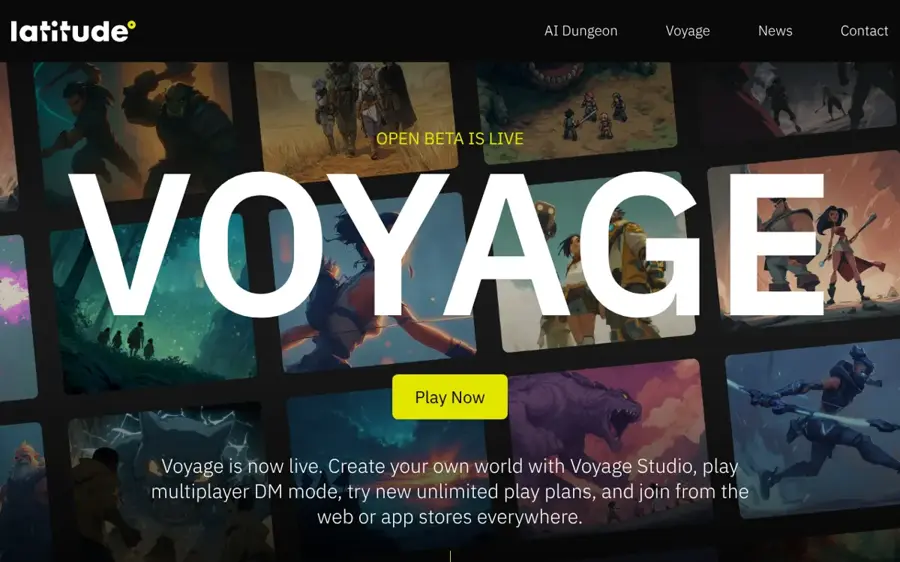
Voyage is an AI RPG platform from Latitude, the maker of AI Dungeon, where players build and share worlds that track health, gold and relationships. Play it at voyage.io.
Strengths
Voyage answers the oldest AI Dungeon complaint: the AI agrees to everything. Latitude's World Engine sits above the language model and tracks inventory, currency and geography across thousands of turns. "When the rules say you're out of gold, you're out of gold," the company writes. In its own early look, TechCrunch found that NPCs remember earlier choices, so a character you betray may avoid you later or turn into a rival in future encounters.
One player quoted on Latitude's homepage says "after 3,000 actions I'm still having a blast." It's a vendor-picked quote. Still, Voyage is in open beta on iOS, Android and the web, per RuntimeWire, and public multiplayer is free.
Key features
- A World Engine that tracks health, inventory and relationships.
- Voyage Studio for building worlds from plain-language descriptions.
- Free public multiplayer servers.
- Skill checks and unlockable abilities, some modelled on D&D spells.
- Audio narration.
Pros
- Consequences that stick, which pure chatbots can't offer.
- Free to play in public games.
- Unlimited plans also cover AI Dungeon use at your tier.
Cons
- Same company as AI Dungeon, so the same privacy questions apply.
- Solo play runs on a small starter allowance before you need to pay.
- Still in open beta.
Voyage pricing: Free, with paid plans from $15/month announced at launch (checked November 2026). See pricing
KoboldCpp – best for private, offline play
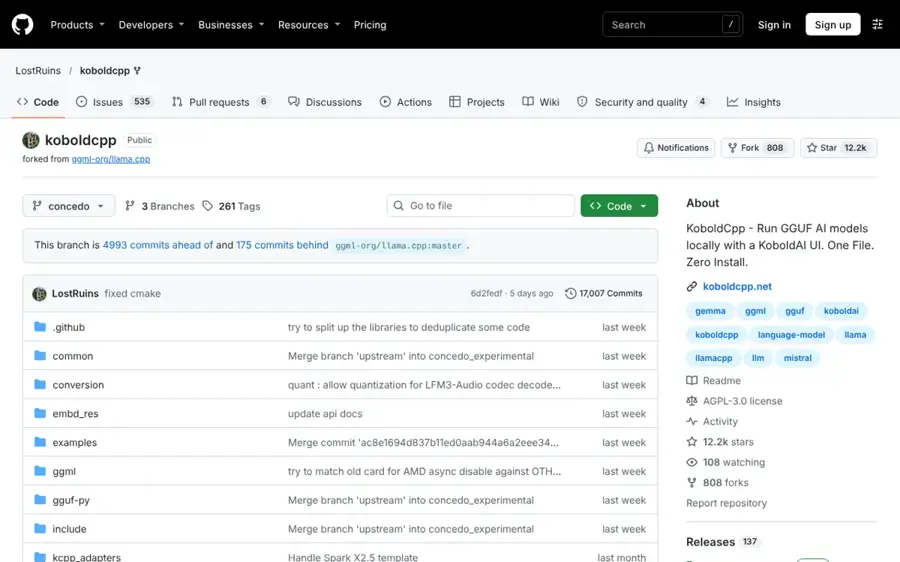
KoboldCpp is a free, open-source app that runs AI language models on your own computer, with a story and adventure mode in its built-in web interface. Download it from GitHub.
Strengths
If privacy is why you're leaving, this is the cleanest answer. KoboldCpp ships as a single executable for Windows, Linux and macOS, and it can generate text in chat, adventure, instruct or story modes. Its KoboldAI Lite interface has memory, world info and author's notes, which will feel familiar to anyone who used AI Dungeon's Story Cards. The project has about 12,200 stars on GitHub.
The catch is setup. You download a model separately, and the size of that model decides how much memory your computer needs. The developers also warn that koboldcpp.com is "a malicious fake site," so only download from GitHub or koboldcpp.net.
Key features
- Runs GGUF models locally on CPU or GPU.
- Adventure mode built for text-adventure style play.
- Memory, world info and author's notes.
- Imports Tavern character cards.
- No installation needed: one file per platform.
Pros
- Completely free, with no subscription.
- Your stories stay on your machine.
- You choose the model and the context size.
Cons
- Story quality depends on your hardware and the model you pick.
- Takes some technical comfort to set up.
- No hosted multiplayer.
KoboldCpp pricing: Free and open source (checked November 2026). See pricing
Wit's End – best for living-room group play
Wit's End is a voice-driven AI fantasy RPG from Weekend that plays on smart TVs, with an AI game master reacting to what your group says into the remote. Try it at witsend.ai.
Strengths
This one's different. Instead of typing, you speak, and the whole room plays. It runs on Fire TV, Samsung and LG TVs, and you describe your hero in plain language to create a character. I couldn't find an independent review, so the strongest assessment available comes from Weekend's own blog, which admits "Overlapping voice input can lead to surprising interpretations when everyone talks at once."
Key features
- Voice input through the TV remote.
- A new quest and cast each session.
- Characters created from a spoken description.
- Narrated, voiced outcomes.
Pros
- Lowest barrier to entry for non-gamers.
- Keeps a group involved, not one person at a keyboard.
- No rules to learn.
Cons
- No free plan after the trial.
- Light on rules and long-term campaigns.
- No independent reviews to check the maker's claims.
Wit's End pricing: No free plan; a 7-day trial, then $12.99/month (checked November 2026)
Claude – best for long campaigns and lore
Claude is Anthropic's general AI assistant, and with a very large context window it can run a text adventure or act as a game master if you set the rules. Try it at claude.com.
Strengths
Memory is Claude's edge here. Every plan, free included, lists a context window of up to 1M tokens, which dwarfs AI Dungeon's 32K top tier. In a write-up for Xebia, a developer who built a D&D game master on Claude described an improvised villain scene that "the whole table lost it" over. He also wrote: "For every moment like the fish, there was a moment where the same system confidently got something completely wrong."
Key features
- A context window of up to 1M tokens on all plans.
- Projects for storing lore, rules and character sheets.
- Memory across chats.
- Apps for web, desktop, iOS and Android.
Pros
- Huge context for long campaigns.
- Xebia's write-up describes sharp, improvised NPC scenes.
- Free plan available.
Cons
- No dice, inventory or rules engine unless you build them.
- Usage limits reset every five hours on the free plan.
- Long chats use up your limits faster.
Claude pricing: Free, then paid plans from $20/month, or $17 billed annually (checked November 2026). See pricing
Related: Claude AI review Best alternatives to Claude
ChatGPT – best for quick one-shots
ChatGPT is OpenAI's general assistant, and its free plan is enough to run a short text adventure from a single prompt. Use it at chatgpt.com.
Strengths
It's the easiest option to start, since most people already have an account. Free users get unlimited text chats with GPT-6 Luna, though the free plan's Instant context window is just 27K. Long campaigns are where it struggles. One forum user on EN World who had paid ChatGPT run D&D wrote that "It failed, but in interesting ways."
Key features
- Unlimited text chats on the free plan.
- Longer memory on the Go plan.
- Voice chat for spoken play.
- Image creation for scenes and characters.
Pros
- Free and familiar.
- Flexible enough for any genre.
- Cheap Go plan at $8 a month.
Cons
- Doesn't enforce rules or hidden world state.
- Smaller context on Free than Claude.
- Go may include ads.
ChatGPT pricing: Free, then paid plans from $8/month (checked November 2026)
Related: ChatGPT with GPT-6 review Best AI like ChatGPT
Choosing the right AI Dungeon alternative
Decide if you want a game or a story
AI Dungeon blends both. If you liked rolling dice and fighting goblins, Friends & Fables or Voyage will feel like an upgrade. If you liked steering the plot like an author, NovelAI fits better. Our sister roundup of the best AI RPG generators goes further on the game side.
Compare context limits before features
Context decides whether the AI remembers chapter one by chapter ten. AI Dungeon's free tier tops out at 4K tokens. NovelAI Opus reaches about 28.7K, and Claude lists up to 1M. I'd check this number before anything else, because it's the one that makes long adventures fall apart.
Check the privacy defaults on day one
Open the data settings the moment you sign up. On AI Dungeon, RoboRhythms suggests "Essentials only."
Match multiplayer to your group
Text parties work well on Friends & Fables, which takes up to six players. A group on one sofa will probably have more fun with Wit's End. If you mostly chat one-on-one with characters, a character app may suit you better; our guide to Character AI alternatives covers those.
Verdict
If I were leaving AI Dungeon today, I'd start with Friends & Fables for campaigns and keep NovelAI in mind for solo writing. It costs more than Journey, but it fixes the core problem: an AI that lets you win every fight. My take on Voyage is mixed. It's probably the most ambitious game here, yet it comes from the same company, so it doesn't help if trust is your reason for leaving. For privacy, nothing beats running KoboldCpp locally, as long as you're willing to spend an evening on setup.
FAQ
What is the best free AI Dungeon alternative?
KoboldCpp is the best fully free option, because it's open source and runs on your own computer with no subscription. If you don't want to install anything, Voyage's public multiplayer games are free, and ChatGPT and Claude both have free plans that can run a short text adventure from a prompt.
Is NovelAI better than AI Dungeon?
It depends on what you want. NovelAI is likely better for long solo stories: it's cheaper at $10 a month, has unlimited text on every paid tier and reaches about 28.7K tokens of context on Opus. AI Dungeon has more game-style modes, a free tier and a much bigger library of player-made scenarios.
Who makes Voyage?
Latitude, the company behind AI Dungeon, makes Voyage. It adds a World Engine that tracks health, gold and relationships, so the AI can't improvise a rule away.
Does AI Dungeon use my stories for training?
For new accounts made since September 28, 2026, the "Improve the AI" setting is on by default, according to RoboRhythms, which lets Latitude use shared story text for evaluation and training. You can switch it off under Gameplay, AI Models, then Testing & Feedback.
Can ChatGPT replace AI Dungeon?
For a quick one-shot, yes. For a long campaign, probably not on its own, since ChatGPT doesn't track dice, inventory or hidden facts, and the free plan's context window is 27K.