Best AI RPG generator tools in 2026: 8 picks for solo and group play
The best AI RPG generator tools for 2026, from AI game masters like Friends & Fables and AI Dungeon to prep helpers like Claude, with current prices.
 Written byMuhammad Usman SiddiquiFounder and editor-in-chief
Why you can trust The AI Future
Our writers research every product from its official pages, independent tests and user reports, link each claim to its source and correct mistakes openly. Unless an article says otherwise, we haven't tested the product hands-on ourselves. Companies can't pay for coverage or see reviews before they're published.
Read our editorial policy
Short answer: if you want an AI RPG generator that actually runs a game, with dice, hit points and a party, start with Friends & Fables. If you'd rather type anything and see where the story goes, AI Dungeon is still the easiest free place to do it. Everything else on this list is a specialist, and that's fine.
I'll be honest about the framing. "AI RPG generator" covers two quite different jobs: tools that play the game master for you, and tools that help a human GM build the world, the NPCs and the art. I've ranked both kinds together below, because most people searching this phrase seem to want a bit of each. Prices were checked in late October and early November 2026.
Key takeaways
- Dedicated AI game masters now track world state, so gold, health and inventory stay consistent in a way plain chatbots still struggle with.
- Friends & Fables is the closest thing to a D&D 5e table run by AI, with paid plans from $19.95 a month.
- AI Dungeon has a free, ad-free tier, and its sister product Voyage adds persistent multiplayer worlds.
- Claude and ChatGPT are better as prep tools for a human GM than as full-time game masters.
- Context length decides how much your game remembers, so it's the spec to compare before you pay.
Our ranking method
Nobody at The AI Future ran hands-on sessions with these tools for this roundup. We ranked them from official plan pages, help docs, patch notes, published independent reviews and player discussions, as of early November 2026, using six criteria:
- Game structure: does it handle rules, dice, combat and character sheets, or just prose?
- Memory: how much of a long campaign the AI can see, measured by context limits and memory features.
- World building: tools for making your own setting, NPCs and lore.
- Multiplayer: whether a group can play together, and how.
- Free tier and price: what you get for nothing, and the cost of the first paid plan.
- Outside reception: ratings and comments from players and reviewers we could link to.
Game-running tools rank above prep tools because they do more of the work. That's a judgement call, so if you're a GM who loves prep, skip straight to picks 6 to 8.
The 8 best AI RPG generators at a glance
| # | Tool | Category | Best for | Free tier | Starts at |
|---|---|---|---|---|---|
| 1 | Friends & Fables | AI game master | D&D-style campaigns | Yes (limited) | $19.95/mo |
| 2 | AI Dungeon | Text adventure | Freeform text adventures | Yes | $14.99/mo |
| 3 | Voyage | AI RPG platform | Persistent multiplayer worlds | Yes | $15/mo |
| 4 | Wit's End | TV party RPG | Living-room group play | No | $12.99/mo |
| 5 | NovelAI | AI story writer | Story-first solo play | No | $10/mo |
| 6 | Claude | General assistant | Campaign prep and lore | Yes | $20/mo |
| 7 | ChatGPT | General assistant | Quick NPCs and one-shots | Yes | $8/mo |
| 8 | Leonardo AI | Image generator | Character portraits and scenes | Yes (limited) | $12/mo |
Notes: Voyage's $15 figure is the entry price TechCrunch reported in April, and public multiplayer is free. Wit's End comes with a seven-day free trial of the Weekend app, and NovelAI has a one-time trial instead of a free plan. Claude Pro is $17 a month billed annually.
The best AI RPG generators in 2026, ranked
Friends & Fables – best for D&D-style campaigns
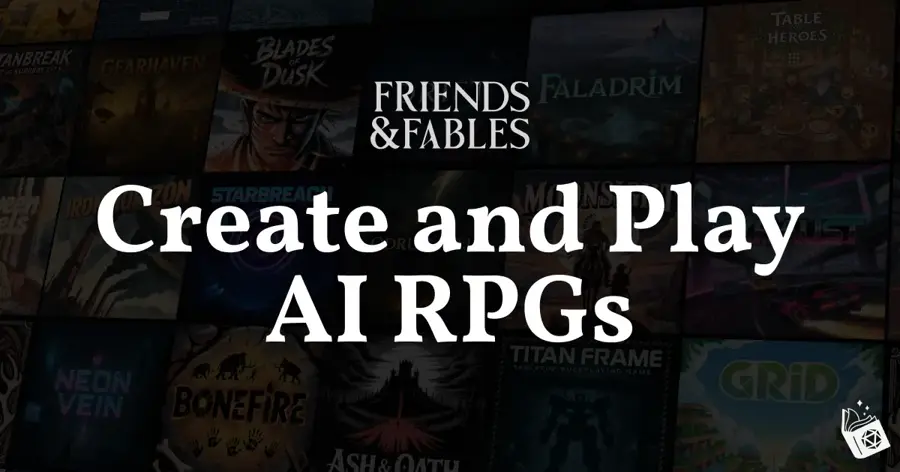
Friends & Fables is a browser-based text RPG built around an AI game master called Franz, who runs campaigns loosely on D&D 5e rules. You can play at fables.gg.
Strengths
This is the one I'd point most tabletop players to first. It started life as a Discord bot and, as the two founders explain in their relaunch post, grew into a full virtual tabletop with travel, inventory, quest and spell tracking. Going by the studio's own comparison, parties can hold up to six players, and Franz enforces game rules instead of just narrating. That's a self-description, of course. Still, an independent-ish roundup on Weekend's blog called it "one of the clearest examples of a full‑fledged AI dungeon master platform in 2026" (and Weekend sells a competitor, which makes the praise more interesting).
Narration got a real upgrade late last year. When the studio made its premium Fenix model the default on every paid plan, one Discord player quoted in the patch notes wrote: "Yeah, this is WAY better." Premium models such as Gemini 3 Pro now sit on top, paid for with monthly credits.
Key features
- An AI game master that handles combat, rests, travel and character progression.
- World-building tools for areas, NPCs, items, spells and custom homebrew.
- Multiplayer campaigns for parties of up to six.
- An Image Studio and in-campaign scene images.
- A choice of narration models, including premium ones paid for with credits.
Pros
- The most game-like structure on this list.
- All plans include unlimited turns.
- Monthly credits roll over if you don't use them.
Cons
- Paid plans went up to $19.95, $29.95 and $39.95 in December 2025.
- Rules-heavy setup may put off casual players.
- It plays best on a laptop, not a TV or phone.
Verdict: if you miss having a weekly DM, this is the pick. I think the Starter plan is enough for most solo players.
Friends & Fables pricing: Free, then paid plans from $19.95/month (checked November 2026). Starter includes 100 bonus credits a month, Pro 300 and Legend 600, per the credits update. See pricing
AI Dungeon – best for freeform text adventures
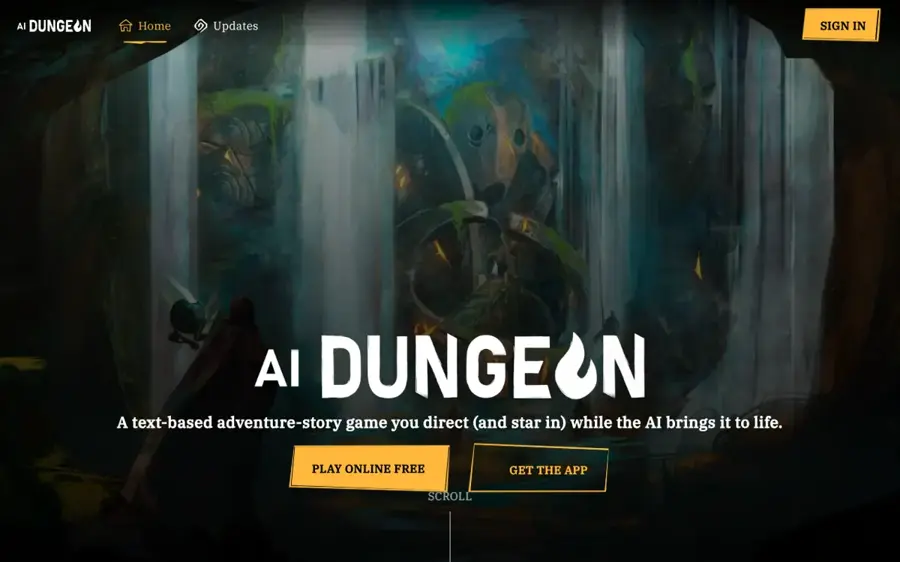
AI Dungeon is Latitude's open-ended text adventure game, where you type an action, line of dialogue or narration and the AI writes what happens next. It's at aidungeon.com.
Strengths
AI Dungeon has been around since 2019, and Latitude says it has more than 8 million registered players. The free Wanderer tier is ad-free, which RoboRhythms' review counts as its biggest strength, and its Android app holds 4.0 stars from 106K Google Play reviews. Story Cards are the clever part: lore only gets fed to the AI when a keyword appears, so a tavern's secrets stay out of the prompt until someone walks in.
The catch is memory. Context runs from 4K tokens on the free tier up to 32K on Mythic and Ultimate, going by the membership page. RoboRhythms spotted an awkward detail: on the $14.99 Journey tier, bigger models like DeepSeek V3.2 only get 4K of context, half what the small models get. It also flags that accounts created since September 28, 2026 share story text for training by default, so it's worth opening the privacy settings on day one.
Key features
- Do, Say, Story and See input modes for each turn.
- Story Cards, Plot Essentials and Story Summary to keep long games on track.
- A mix of Latitude's own fine-tuned models and hosted open models.
- Millions of community scenarios to start from.
- Credits for image generation and extra context on paid plans.
Pros
- A generous, ad-free free tier.
- Context limits are published model by model.
- A paid membership also covers premium Voyage play.
Cons
- Long stories drift unless you manage context yourself.
- New accounts share story text for training by default.
- Bugs, crashes and login problems lead its recent low-star reviews, per RoboRhythms.
Verdict: the best free sandbox here. Pay only once you know which models you'll actually use.
AI Dungeon pricing: Free, then paid plans from $14.99/month (checked November 2026). Legend is $29.99, Mythic $49.99 and Ultimate $99.99. See pricing
Voyage – best for persistent multiplayer worlds
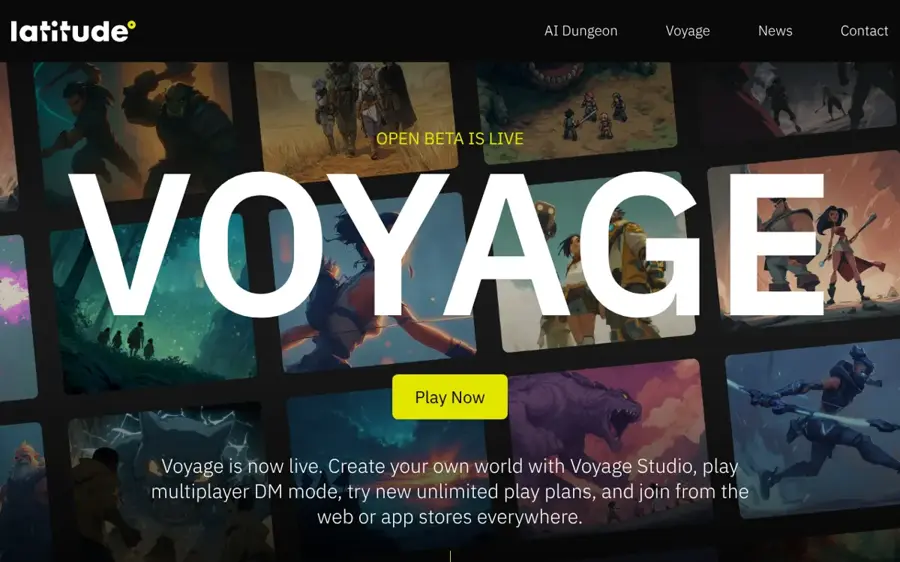
Voyage is Latitude's newer AI RPG platform, where you describe a world in plain language and then play it, alone or with others, while a World Engine tracks the rules. Find it via latitude.io.
Strengths
Voyage goes after the problem that sinks most AI campaigns: the model agrees to everything. On Latitude's site, the pitch is blunt: "When the rules say you're out of gold, you're out of gold." The World Engine tracks health, inventory, currency, geography and relationships, and TechCrunch reported it took the company five years to build. In TechCrunch's own session, a troll who'd tied up their character started talking about his marriage troubles. That's either a selling point or a warning, depending on your table.
The open beta removed the waitlist and runs on iOS, Android and the web, according to RuntimeWire. RoboRhythms adds that public multiplayer is free for parties of up to eight. One player quoted on Latitude's homepage says: "after 3,000 actions I'm still having a blast." Bear in mind that's a vendor-picked quote.
Key features
- Voyage Studio for building worlds, regions, quests and villains from text.
- A World Engine that tracks state across thousands of turns.
- NPCs that remember past encounters and can turn into rivals.
- Abilities and progression with dice-style luck.
- Multiplayer DM mode and audio narration.
Pros
- Free public multiplayer.
- Real rules sit on top of the AI narrator.
- One Latitude membership also covers AI Dungeon.
Cons
- It's still in open beta, so expect rough edges.
- Some player worlds include mature content, per TechCrunch.
- Paid plan details are harder to pin down than AI Dungeon's.
Verdict: probably the most interesting thing on this list. I'd try the free servers before paying.
Voyage pricing: Free, then paid plans reported from $15/month, with $30 and $50 tiers (checked November 2026). See pricing
Wit's End – best for living-room group play
Wit's End is a voice-driven AI fantasy RPG from Weekend that runs on your TV, with a narrator who reacts to what your group says into the remote. There's also a web version at witsend.ai.
Strengths
Every other tool here assumes someone's typing. Wit's End doesn't. On the game page it's listed for Fire TV, Samsung and LG, and you speak your actions instead. Weekend's own roundup, which puts its game first (so read it with that in mind), admits two real cons: it's "lighter on crunchy rules" than browser platforms, and overlapping voices can lead to "surprising interpretations" when everyone talks at once.
For a mixed group where half the room has never touched a character sheet, that trade-off makes sense to me.
Key features
- A new quest, cast and storyline each session.
- Heroes created from a plain-language description.
- Voice input through the TV remote.
- Voiced narration on the big screen.
Pros
- No rules to learn before you start.
- Everyone in the room can take part.
- No console or extra hardware needed.
Cons
- Light on mechanics and long-term campaign tracking.
- Voice input gets messy with a loud group.
- Nearly all the coverage we found comes from Weekend itself.
Verdict: a party game first and an RPG second. Great for game night, thin for a campaign.
Wit's End pricing: No free plan; a seven-day free trial, then $12.99/month for the Weekend app (checked November 2026)
NovelAI – best for story-first solo play
NovelAI is Anlatan's browser-based AI story writer and anime image generator, where the AI continues the text you write instead of chatting with you. It's at novelai.net.
Strengths
If your idea of an RPG is closer to co-writing a fantasy novel, NovelAI fits. Its Lorebook feeds the AI facts about your characters and world, and the top Opus plan remembers up to 28,672 tokens, per the subscription docs. RoboRhythms says the flagship text model is Xialong, a 355-billion-parameter tune of GLM-4.6 released on March 31, 2026, and it likes that NovelAI "treats you as the author."
There's no dice or combat system, though. You're the referee.
Key features
- Unlimited text generation on every paid tier.
- Lorebook entries for characters, places and factions.
- Anime-style image generation for character art.
- Built-in text to speech.
Pros
- A strong privacy pitch for personal stories.
- The cheapest paid plan here at $10.
- Images and text in one subscription.
Cons
- No game mechanics or multiplayer.
- No native phone app; a $4.99-a-week App Store app with the same name isn't it, per RoboRhythms.
- Unused subscription Anlas vanish when you cancel.
Verdict: for writers who want a game-shaped story, not a game.
NovelAI pricing: No free plan (a one-time trial of 50 text and 30 image generations), then paid plans from $10/month; Scroll is $15 and Opus $25 (checked November 2026). See pricing
Related: NovelAI review
Claude – best for campaign prep and lore
Claude is Anthropic's general AI assistant, and for RPGs it's best used to draft settings, NPCs, session notes and villain dialogue that a human GM then runs. It's at claude.ai.
Strengths
The big draw for GMs is room: every plan, free included, lists a context window of up to 1M tokens on the plans page. That's enough to paste in a whole campaign bible. The best write-up I found is a Xebia consultant's account of running a family D&D campaign with Claude as DM (his twelve-year-old son is one of the players). Its improvised Xanathar got the whole table laughing ("It was great," he writes), but he also lists the failures: it misrepresented the world, kept secrets only once told to, and wouldn't stay in character.
I think that's the honest picture for any general chatbot. Brilliant improv, shaky bookkeeping.
Key features
- Projects for keeping campaign notes and rules in one place.
- Memory across chats on every plan.
- Artifacts for generating handouts, tables and simple tools.
- Voice mode for reading NPC lines aloud.
Pros
- A huge context window for long campaigns.
- Strong long-form writing for lore and dialogue.
- Useful for everything else you do, too.
Cons
- No dice, character sheets or world state built in.
- Free plan usage limits reset every five hours.
- Drifts from established facts unless you police it.
Verdict: my pick for a human GM's prep work, not for replacing the GM.
Claude pricing: Free, then paid plans from $20/month, or $17/month billed annually (checked November 2026), per BenchLM's pricing snapshot. See pricing
Related: Claude AI review Claude vs ChatGPT
ChatGPT – best for quick NPCs and one-shots
ChatGPT is OpenAI's general assistant, handy for spinning up an NPC, a tavern menu or a one-evening adventure in a few minutes. It's at chatgpt.com.
Strengths
It's cheap to start and flexible. Since October, regular chat runs GPT-6 Sol on Plus and above and GPT-6 Luna on Free and Go, according to The AI Career Lab's plan guide. Custom GPTs on Plus let you save a GM persona with your house rules. Long campaigns are the problem. One ENWorld forum member who's tried paid ChatGPT as a DM "several times over the past few years" summed up the latest attempt in a thread on AI and D&D: "It failed, but in interesting ways."
Key features
- Custom GPTs for a reusable game master persona (Plus and up).
- Image creation for maps and character art.
- Voice chats for spoken play.
- Projects and memory for campaign notes.
Pros
- A free plan with unlimited text chats.
- Go costs only $8 a month.
- Fast for one-off generation tasks.
Cons
- The free plan's Instant model has a 27K context window.
- No built-in rules engine or dice tracking.
- Go may show ads.
Verdict: the quickest NPC and one-shot generator if you already pay for it. I wouldn't trust it with a 20-session campaign.
ChatGPT pricing: Free, then paid plans from $8/month; Plus is $20 (checked November 2026). See pricing
Related: ChatGPT with GPT-6 review Best AI like ChatGPT
Leonardo AI – best for character portraits and scenes
Leonardo AI is a Canva-owned image and video generator with 80+ models, useful for party portraits, monster tokens and scene art. It's at leonardo.ai.
Strengths
None of the text tools above make great art on their own, and players do love seeing their character. Leonardo's free plan gives 150 fast tokens a day, and Premium at $30 adds unlimited relaxed generation on Leonardo's own models, per eesel AI's pricing breakdown. TechRadar's review praised its image quality and speed, with "some UI clunkiness" as the main complaint.
Key features
- Lucid Origin and Phoenix in-house image models.
- Third-party models such as Nano Banana Pro and Seedream.
- An image editor and upscaler.
- Image-to-video for animated scene intros.
Pros
- A daily free allowance.
- Lots of model choice under one plan.
- Unused tokens roll over on paid plans.
Cons
- Premium third-party models still cost tokens.
- Token maths is easy to misjudge.
- eesel AI notes recurring complaints about refunds and failed generations using credits.
Verdict: add it only if art matters to your table. Most groups can get by on the free tier.
Leonardo AI pricing: Free, then paid plans from $12/month (checked November 2026). See pricing
Related: Leonardo AI review Best AI image generators
Choosing the right AI RPG generator
Decide who's running the game
If you want the AI to be the GM, pick from the top four. If you're the GM and want help, Claude, ChatGPT and Leonardo will save you hours of prep without taking the chair.
Compare context limits before features
Context is the AI's short-term memory, and it's the reason your quest giver forgets her own name by session five. AI Dungeon publishes its limits per tier, from 4K to 32K tokens; NovelAI's Opus tops out at 28,672. A dedicated state tracker, like Voyage's World Engine, matters more than raw context once a campaign runs for months. As one solo-play guide puts it, ask "Does recap exist or must you write it?"
Check the privacy defaults
Personal campaigns can get, well, personal. Look for training opt-outs, the way AI Dungeon now offers an "Essentials only" setting, before you write your character's tragic backstory.
Match multiplayer to your group
Friends & Fables takes up to six players and Voyage's public servers up to eight. Wit's End handles a whole sofa. The general chatbots are effectively single-player unless you share a screen.
Free vs paid: what you actually get
Free tiers are good enough to tell whether you like AI-run play, and probably not much more.
On AI Dungeon, free means smaller models and up to 4K of context with room for 25 memories, while Journey at $14.99 lifts that to 8K and 100 memories. Friends & Fables' paid plans add the Fenix narration model and monthly credits. NovelAI has no ongoing free plan at all, just 50 text generations to try. For prep, ChatGPT's free plan allows unlimited text chats on GPT-6 Luna, while Claude's free usage resets every five hours, so long brainstorming sessions hit a wall faster there. My rough rule: if you play more than twice a week, a $15–20 plan pays for itself in fewer "wait, who's this guy again?" moments.
For more options built around talking to characters instead of running campaigns, see our guides to Character AI alternatives and writing better prompts for ChatGPT, Claude and Gemini.
Final verdict
If you only pick one, pick Friends & Fables. It's the tool that most clearly behaves like a game rather than a story, and at $19.95 a month it's priced like a hobby, not a luxury. Free players should start with AI Dungeon and keep an eye on Voyage, which I suspect will be the more important Latitude product a year from now. And if you're a GM who enjoys the prep, honestly, a $20 Claude or ChatGPT plan plus Leonardo's free tier probably beats any dedicated generator.
FAQ
What is an AI RPG generator?
It's a tool that uses AI to create role-playing game content: whole adventures run by an AI game master, or pieces like NPCs, quests, maps and character art for a human GM. Friends & Fables and Voyage do the first job; Claude and Leonardo do the second.
Can AI replace a human dungeon master?
For solo play and casual one-shots, it's close. For long campaigns, I don't think it's there yet. Tools with a rules engine, like Friends & Fables and Voyage, keep facts straighter than general chatbots, but players still report drift and odd rulings.
Is there a free AI RPG generator?
Yes. AI Dungeon's Wanderer tier is free and ad-free, Voyage's public multiplayer servers are free, and Friends & Fables, ChatGPT and Claude all have free plans with limits.
Which AI is best for playing D&D?
Friends & Fables is built around D&D 5e-style rules, with combat, spells and character progression. Voyage borrows abilities from classic D&D spells, such as Counterspell, according to TechCrunch.
Can I play an AI RPG with friends?
Yes. Friends & Fables supports parties of up to six, Voyage's public servers up to eight, and Wit's End is designed for a group in one room around the TV.