Best AI roleplay generator tools in 2026: 5 picks rated 13+
The best AI roleplay generator for teens and adults: AI Dungeon, Voyage, ChatGPT, Everweave and Gemini compared on memory, rules, price and age ratings.
 Written byFahad HashmiContributing writer, AI in energy and industry
Why you can trust The AI Future
Our writers research every product from its official pages, independent tests and user reports, link each claim to its source and correct mistakes openly. Unless an article says otherwise, we haven't tested the product hands-on ourselves. Companies can't pay for coverage or see reviews before they're published.
Read our editorial policy
An AI roleplay generator is a narrator that never gets tired: you say what your character does, and it writes what happens next. For most people I'd start with AI Dungeon, which is great for freeform stories, or Latitude's newer Voyage if you want real rules and friends at the table. Both are free to start and rated 13+ on the App Store. If you'd rather build scenarios from scratch, ChatGPT and Google Gemini work well as an AI scenario generator, though they won't keep score for you.
I kept this list narrow on purpose. Companion apps built around romance, "no filter" chat or adult content are out, and so are two well-known names whose age rules shut out younger players (more on those below). What's left are five tools you could reasonably recommend to a 15-year-old D&D fan, or to their parent.
Key takeaways
- AI Dungeon has the biggest library of community scenarios and an ad-free free tier, but its free models only remember about 4K tokens of story.
- Voyage adds real game rules, so health, gold and inventory are tracked by an engine instead of being made up by the AI.
- ChatGPT and Gemini are the most flexible scenario generators, and their free tiers remember far more context than the dedicated games.
- Every pick here is rated 13+ on Apple's App Store, and some still show mature themes, so parents should check content settings.
- The cheapest paid plans start at $4.99 a month (Google AI Plus) and run to $14.99 for Latitude's games.
Our ranking method
We scored each tool on six criteria:
- Story memory, meaning how much context the AI keeps and what tools it gives you to manage it.
- Game structure, such as dice, stats, inventory and consequences that stick.
- Scenario creation, or how easily you can build and share your own setups.
- Age suitability, based on App Store ratings and each company's minimum age.
- Free tier value, judged on what you can do before paying.
- Public reception, using App Store ratings and named third-party reviews.
A tool had to be rated 13+ or lower and allow users under 18 by its own terms to make the list at all. That rule cost us some popular apps, and I think it was the right call for a general-audience list.
The 5 best AI roleplay generators at a glance
| # | Tool | Category | Best for | Free tier | Starts at |
|---|---|---|---|---|---|
| 1 | AI Dungeon | Text adventure | Freeform solo stories | Yes | $14.99/mo |
| 2 | Voyage | AI RPG platform | Rules-based adventures with friends | Yes | $14.99/mo |
| 3 | ChatGPT | General assistant | Custom scenario generation | Yes | $8/mo |
| 4 | Everweave | Fantasy text RPG | D&D-style play on your phone | Yes (limited) | $5.99/mo |
| 5 | Google Gemini | General assistant | Reusable roleplay setups | Yes | $4.99/mo |
The best AI roleplay generators in 2026, ranked
AI Dungeon – best for freeform solo stories
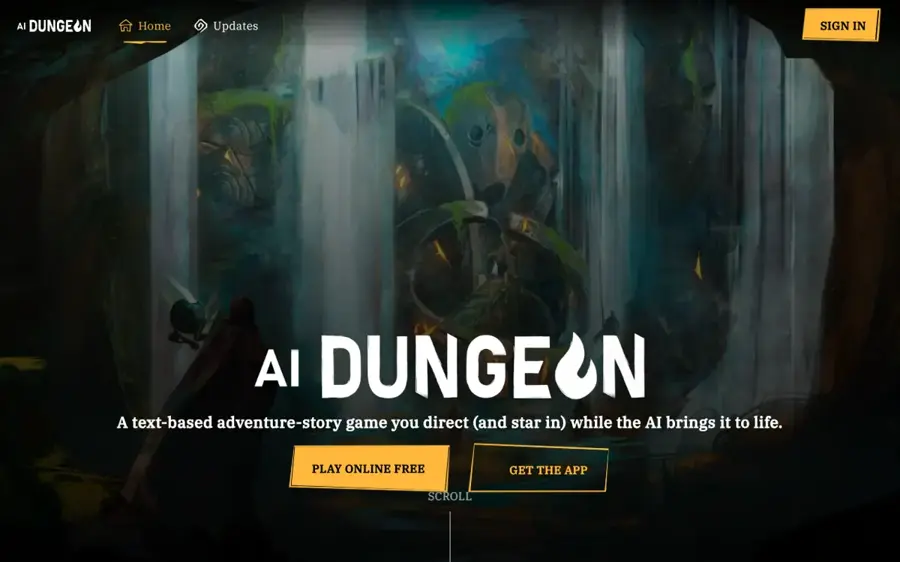
AI Dungeon is Latitude's text adventure game, where you type what your character does or says and an AI model writes what happens next.
Strengths
It's been around since 2019, and the age shows in a good way: there are thousands of community scenarios, from a Faerûn fantasy setting to a supervillain RPG, and you can start one in seconds. The memory tools are the real draw. Story Cards feed lore to the AI only when a keyword appears, so a tavern's secrets stay out of the prompt until someone walks in. It's a clever fix for a hard problem.
Players seem broadly happy. The iOS app holds a 4.4 rating from about 26,900 reviews on the App Store, and on Google Play it sits at 4.0 stars from 106K reviews. One thing to know before signing up: new accounts created since September 28, 2026 share story text with Latitude for training by default. You can switch that off under Data Privacy Settings.
Key features
- Four input modes let you write an action, speech, narration or an image request.
- Story Cards, Plot Essentials and Author's Notes control what the AI remembers.
- You can rewind any turn and try a different choice.
- Multiplayer sessions let friends add turns to the same story.
- The free tier has no ads and includes a rotating model that changes behind the scenes to cut repetition.
Pros
- Huge library of community scenarios across genres.
- Free play is ad-free.
- Context limits are published model by model, so you know what you're paying for.
Cons
- Free models run at 2K to 4K tokens of context, so long stories drift.
- Training data sharing is on by default for new accounts.
- On the $14.99 plan, bigger models like DeepSeek V3.2 get only 4K of context.
AI Dungeon pricing: Free, then paid plans from $14.99/month
Related: AI Dungeon alternatives
Voyage – best for rules-based adventures with friends
Voyage is an AI RPG platform from the AI Dungeon team, where an engine tracks the game world and the AI narrates what happens.

Strengths
Voyage fixes the problem I find most annoying in AI roleplay: the AI agrees to everything. Latitude's pitch is blunt: its World Engine "sits atop the AI as an impartial judge", tracking health, inventory, currency, geography and relationships. When you're out of gold, you're out of gold. The engine took Latitude five years to build, and in TechCrunch's hands-on look, a troll who'd tied up the reporter's character started talking about his marriage troubles. That's exactly the kind of weirdness I'd want from a fantasy world.
It's new, though. Latitude dropped the waitlist for an open beta on iOS, Android and the web, and the iOS app has only 153 ratings so far, averaging 4.1 on the App Store. That's a thin track record, and rough edges are likely for a while.
Key features
- Skill checks use your stats, skills and equipment to decide outcomes.
- Up to 8 players can join a co-op game or a public server.
- A Dungeon Master mode lets one person run the game while the AI handles narration.
- Voyage Studio lets you define characters, lore, quests, maps and rules, then publish the world.
- Characters remember promises and betrayals across sessions.
Pros
- Real game rules keep the AI from inventing loot or skipping consequences.
- Strong multiplayer and DM options for groups.
- One Latitude membership also covers premium AI Dungeon.
Cons
- Still in open beta with a small number of public ratings.
- English only on iOS at the moment.
- Private servers and unlimited play need a paid plan.
Voyage pricing: Free on public servers, then paid plans from $14.99/month
Related: Best AI RPG generators
ChatGPT – best for custom scenario generation
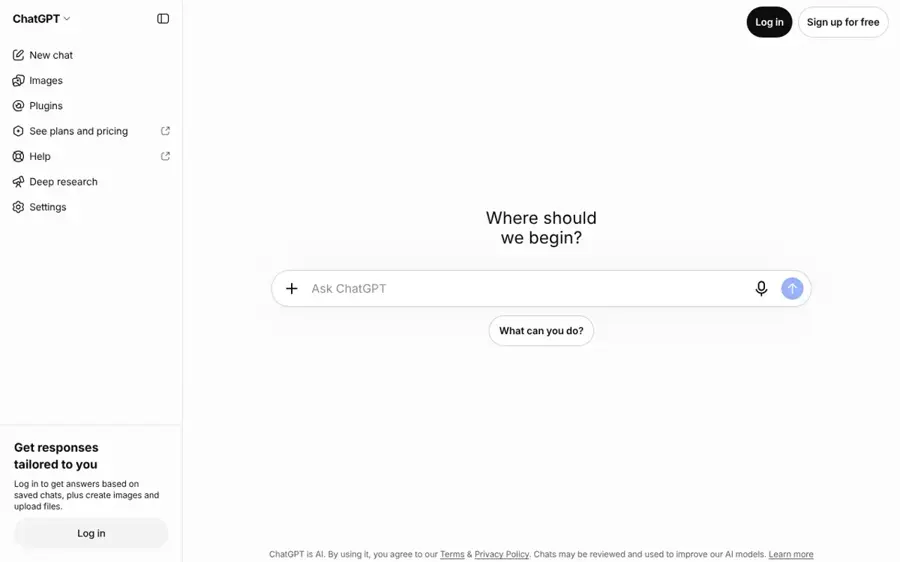
ChatGPT is OpenAI's general assistant, and with a good setup prompt it works as a flexible AI scenario generator and game master.
Strengths
ChatGPT isn't a game, so you bring the structure. Tell it the setting, your character, the tone and a rule like "roll a d20 for risky actions and show me the result", and it'll run with it. Memory is the big technical advantage. Even the free tier gets a 27K-token context window for GPT Instant, several times what AI Dungeon's free models get, and Go raises that to 54K for Instant chats.
Nothing enforces your rules, though. ChatGPT will happily forget your inventory or let a fight go your way because you asked nicely. With 4.8 stars from roughly 12 million ratings on the App Store, it's hardly an unknown, but it wasn't designed for long campaigns.
Key features
- Unlimited text chats on the free plan, subject to abuse guardrails.
- Custom GPTs let you save a game master persona and its rules.
- Projects keep your world notes and past sessions in one place on paid plans.
- Voice chat lets you play a scene out loud.
- Image creation can illustrate characters and maps.
Pros
- The largest free context window on this list.
- Works for any genre, from mystery to sci-fi to classroom history roleplay.
- You can generate dozens of scenario hooks in one request.
Cons
- No built-in dice, stats or inventory tracking.
- The $8 Go plan may include ads.
- Users 13 to 18 need parental consent.
ChatGPT pricing: Free, then paid plans from $8/month. See pricing
Related: ChatGPT review AI tools like ChatGPT
Everweave – best for D&D-style play on your phone
Everweave is a fantasy text RPG with an AI Dungeon Master, built around classes, dice and abilities borrowed from tabletop games.

Strengths
Everweave sits between AI Dungeon's open sandbox and Voyage's full engine. You pick a class (fighter, paladin, warlock, barbarian and others), roll dice and level up abilities like Action Surge or Lay on Hands (the full list goes class by class). On the App Store, the developers call it early stage and "still growing rapidly", which I appreciate as an honest label.
It has 4.3 stars from about 8,700 ratings on the App Store, which seems like a decent showing for a young app. It's fantasy only, though. If you want a cyberpunk heist or a school mystery, this isn't the tool.
Key features
- An AI Dungeon Master reacts to your choices in real time.
- Class abilities and dice rolls follow tabletop conventions.
- Settings run from grand fantasy war to quiet medieval life.
- Message packs are sold separately from monthly plans.
Pros
- Cheapest monthly plan of the dedicated games, at $5.99.
- Familiar D&D-style classes and mechanics.
- Strong rating for a young app.
Cons
- Fantasy settings only.
- English only on iOS.
- Early-stage product, by its own description.
Everweave pricing: Free to download, then paid plans from $5.99/month
Google Gemini – best for reusable roleplay setups
Google Gemini is Google's AI assistant, and its Gems feature lets you save a custom roleplay or scenario setup to reuse later.

Strengths
Gems are what earn Gemini its place here. You write the instructions once (setting, narrator voice, rules, your character sheet), and every new chat with that Gem starts from the same base. Looking at Google's plans, Gems, Canvas and Gemini Live are all included on the free tier, and the cheapest paid plan, Google AI Plus, is $4.99 a month in the US.
It's rated 4.7 from about 2.4 million ratings on the App Store. Like ChatGPT, it has no game engine, so long campaigns depend on you keeping notes.
Key features
- Gems store reusable instructions for a narrator or game master.
- Gemini Live supports spoken back-and-forth scenes.
- Canvas gives you a document view for world notes and lore.
- Image generation and editing are on the free plan.
Pros
- Lowest paid entry price on this list.
- Gems are free, so you can save setups without paying.
- Fits in if your family already uses Google accounts.
Cons
- No dice, stats or world-state tracking.
- The free tier runs Google's Flash-Lite model rather than Flash or Pro.
Google Gemini pricing: Free, then paid plans from $4.99/month. See pricing
Related: Gemini vs ChatGPT
Age ratings and content settings, tool by tool
Age rules decided what made this list, so here they are in one place. All five picks carry a 13+ rating on Apple's App Store, but "13+" covers a fair amount: AI Dungeon's listing still flags infrequent mature or suggestive themes, horror and crude humor.
| Tool | App Store rating | Minimum age in the company's rules |
|---|---|---|
| AI Dungeon | 13+ | 13+ store rating; mature themes possible |
| Voyage | 13+ | 13+ store rating; fantasy and realistic violence |
| ChatGPT | 13+ | 13, with parental consent from 13 to 18 |
| Everweave | 13+ | Under 13 only with parental or guardian consent |
| Google Gemini | 13+ | 13+ store rating |
Latitude's written filter for AI Dungeon targets only content involving the sexual exploitation of children, so mature themes in stories come down to the model and the scenario. If you're a parent, I'd sit with your kid for their first session and look at the community scenarios they pick. Elsewhere, OpenAI asks for parental consent from 13 to 18, and Everweave lets under-13s in only with a parent or guardian's consent.
Two big names didn't qualify. Character.AI's iOS app is now rated 18+ on the App Store, and the company has been winding down open-ended chat for under-18s in favour of guided Stories (our Character AI review covers the details). Friends & Fables, a well-liked AI game master for D&D 5e, requires users to be at least 18 under its terms of service. Both are fine for adults; they just don't fit a general-audience list.
Limits and failure modes
Most complaints about AI roleplay trace back to one number: the context window. That's how much recent text the model reads before it writes the next reply, measured in tokens. A token is roughly three-quarters of a word.
Some rough maths makes it concrete. AI Dungeon's free models run at 4K tokens, so call it 3,000 words of memory. Say your AI Instructions, Plot Essentials and two Story Cards take 800 words. That leaves about 2,200 words for the actual story, and if each turn (your action plus the AI's reply) runs about 150 words, the AI can see roughly the last 14 turns. Anything older is gone unless it's in a card.
Run the same maths on ChatGPT's free 27K window and you get around 20,000 words, or something like 130 turns. Much better. I suspect most players won't hit that ceiling in a single evening. But a bigger window doesn't fix the other failure mode, which is that a plain chatbot invents things to please you. Ask for a sword you don't have and it'll often hand it over.
That's the trade-off in one sentence: dedicated games like Voyage and Everweave enforce rules but remember less, while general assistants remember more but enforce nothing. Latitude has admitted memory is its weak spot: in a September post, it said fixing key bugs in AI Dungeon's memory system took eight months.
Choosing the right AI roleplay generator
Pick a game engine if you care about stakes
If losing should mean something, you want Voyage or Everweave. Their dice and stats stop the AI from rescuing you every time. Freeform tools are better when you just want to see where a story goes.
Use a general assistant to generate scenarios, then play them elsewhere
ChatGPT and Gemini are great at producing ten scenario hooks, a villain's backstory or a town map description in one go. You can paste the best one into AI Dungeon as a custom scenario and get Story Cards on top.
Check the data settings before your first story
AI Dungeon's new accounts share story text for training by default. It takes a minute to switch that off, and I'd do it before writing anything personal.
Match the age rating to the player
A 13+ rating is a floor, not a guarantee. ChatGPT needs parental consent for anyone under 18, and community-made scenarios on any platform can drift into darker themes than you'd expect.
Free vs paid: what you actually get
The free tiers are better than they used to be. AI Dungeon's free play is ad-free, Voyage lets anyone play free on public servers, and ChatGPT's free plan has unlimited text chats. So what does money buy?
| Tool | Free tier | Cheapest paid plan | Main upgrade |
|---|---|---|---|
| AI Dungeon | Small models, 2K to 4K context, 25 memories | $14.99/mo | 8K context on small models, bigger models, 100 memories |
| Voyage | Public multiplayer servers | $14.99/mo | Private servers and unlimited play |
| ChatGPT | 27K context on GPT Instant | $8/mo (Go) | 54K context, more uploads and images; may include ads |
| Everweave | Free download; free allowance unclear | $5.99/mo | Monthly plan; message packs from $2.99 |
| Google Gemini | Flash-Lite model, Gems included | $4.99/mo (AI Plus) | Flash model and double the usage limits |
For AI Dungeon, the paid jump matters less than you'd hope. On the $14.99 tier, DeepSeek V3.2 runs at 4K context, the same as free small models, and you need the $29.99 tier to get 8K on it. Honestly, that pricing quirk surprised me. If you're paying mainly for memory, I'd look at ChatGPT Go first, since $8 buys a much larger window, even without any game features.
I haven't found a clear figure for how many free messages Everweave gives new players, so try the free download before you buy a plan.
Final verdict
For most people, I'd start with AI Dungeon. It's free, it's ad-free, and its scenario library means you don't have to write a setup before you can play. If you're running games for a group, Voyage is probably the more interesting bet, because an engine that says no is what AI roleplay has been missing; I'd just give its open beta a few months to settle. And if you mainly want an AI scenario generator for writing prompts or classroom roleplay, ChatGPT's free tier is hard to beat for the memory alone.
FAQ
What is an AI roleplay generator?
It's a tool that writes an interactive story with you. You describe what your character does, and the AI responds as the narrator and the other characters. Some, like Voyage and Everweave, add game rules such as dice and stats; others, like ChatGPT, are open-ended.
Is there a free AI roleplay generator?
Yes. AI Dungeon, Voyage, ChatGPT and Gemini all have free tiers, and Everweave is free to download. AI Dungeon's free play is ad-free, while the free versions of ChatGPT and Gemini have usage limits.
Are AI roleplay apps safe for teenagers?
The five tools on this list are rated 13+ on the App Store, but ratings aren't the full picture. ChatGPT requires parental consent from 13 to 18, and AI Dungeon's listing flags infrequent mature themes. I'd recommend checking content and privacy settings together with your teen.
Can I use ChatGPT as an AI scenario generator?
Yes, and it's good at it. Ask for a setting, a goal, three complications and a twist, and you'll get a playable scenario in seconds. On a paid plan, you can save the setup as a custom GPT to reuse it. Our guide to writing better AI prompts covers the basics.
Why does the AI forget what happened earlier in my story?
The model can only read a limited amount of recent text, called the context window. On AI Dungeon's free tier that's about 4K tokens, or roughly 14 turns of story in a typical setup. Putting key facts in Story Cards or a pinned summary is the usual fix.