Odysseus AI review 2026: is PewDiePie's free self‑hosted AI workspace good?
Odysseus AI is PewDiePie's free, open-source AI workspace you host yourself. We weigh its features, real costs, security record and best alternatives.
 Written byDr. Alap ZahidReviews And Guides Editor
Why you can trust The AI Future
Our writers research every product from its official pages, independent tests and user reports, link each claim to its source and correct mistakes openly. Unless an article says otherwise, we haven't tested the product hands-on ourselves. Companies can't pay for coverage or see reviews before they're published.
Read our editorial policy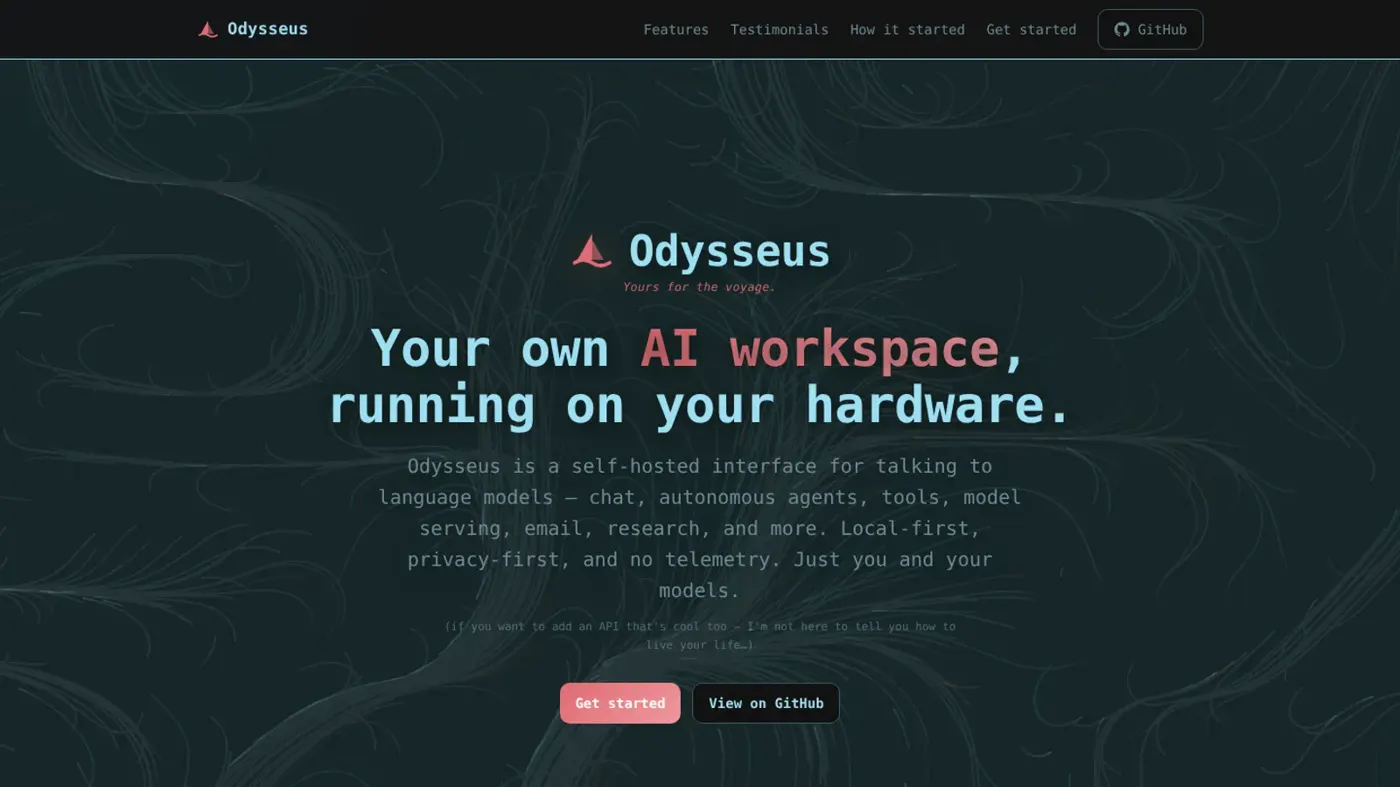
Our verdict on Odysseus (self-hosted AI workspace)
Odysseus is an ambitious, free and genuinely private AI workspace that local-AI hobbyists should try on their own machine. Skip it for now if you need stable releases, support, or a tool you can safely expose to the internet.
Pricing Free and open source (AGPL-3.0-or-later); costs only for your own hardware or optional API usage
Visit Odysseus (self-hosted AI workspace)Is Odysseus AI good? If you're comfortable running Docker and you want a private, ChatGPT-style workspace on your own hardware, I think it's one of the most interesting free options of 2026. If you just want an AI chatbot that works when you open a browser tab, it isn't for you, and the security record so far means you shouldn't put it on the open internet without care.
Odysseus is the self-hosted AI workspace started by Felix Kjellberg, better known as PewDiePie, which is why so many people search for "pewdiepie ai". It's open source, it costs nothing, and as of 7 November 2026 its GitHub repository shows 95.3k stars, 362 contributors and roughly 1.1k open issues. That last number tells you a lot.
Nobody at The AI Future installed or ran Odysseus for this review. So I won't pretend I timed a Deep Research run or broke the image editor. Instead, I went through the official repo and landing page, the project's own roadmap and security policy, independent write-ups from GIGAZINE and PromptQuorum, published security research, and the user comments I could find, all as of early November 2026. Where someone else did the hands-on work, I'll name them.
Odysseus AI at a glance
| Item | Details |
|---|---|
| Our rating | 3.5 out of 5 |
| Best for | Technical users who want a private, all-in-one AI workspace and already run local models |
| Price | Free (AGPL-3.0-or-later open source); you pay for your own hardware or any API you connect |
| Runs on | Linux, Windows and macOS via Docker or native install; mobile access through the browser |
| Website | odysseus-dev.github.io/odysseus |
The PewDiePie AI project in brief
Odysseus is a web app you host yourself. It sits between you and whatever language models you point it at, whether that's a model running on your own GPU through Ollama, llama.cpp or vLLM, or a cloud API such as OpenAI or OpenRouter (the supported back ends are listed in the project README, as summarised on DEV Community). It doesn't ship its own model. That's a common point of confusion: Odysseus is the interface and the tooling around the model, not a rival to GPT or Claude at the model level.
The landing page pitches it as "Local-first, privacy-first, and no telemetry," followed by a very PewDiePie aside: "if you want to add an API that's cool too". Kjellberg announced it in a YouTube video titled "MY trillion $Dollar Project is finally OUT!", Dexerto reported, and the repo itself was created on 31 May 2026, according to DEV Community.
Since then, a few things have changed. The project moved from Kjellberg's personal GitHub account to a community organisation called odysseus-dev, which PromptQuorum describes as community-run. The licence also switched: early coverage said MIT, but the current repo is AGPL-3.0-or-later, and its latest licence commit reads "Change project license to AGPL-3.0-or-later". For a hobbyist, that won't matter. For a company planning to build a hosted product on top of it, it matters a lot.
The self-deprecating tone is part of the charm, for what it's worth. The roadmap opens with "It works great for me (lol)" and "(I don't know what I'm doing, help)." That's refreshing, and it's also a warning label.
Key features
Chat and agents
The core is a chat window with two modes. GIGAZINE's walkthrough of a Windows install shows a toggle between Chat Mode and Agent Mode, a web search switch, a shell-access switch that only appears in Agent Mode, and a "Nobody" mode that turns off memory and history saving. In Agent Mode the assistant can call built-in tools (bash, files, web and memory) plus any MCP server you connect, with each tool toggled separately, per the landing page.
Cookbook for local models
This is the feature I'd most want to see work well.
Cookbook scans your hardware and recommends, downloads and serves models, with "270+ catalogued models" according to the project site. Anyone who's tried to work out which quantised model fits in 12GB of VRAM will see the appeal. The catch is that the roadmap calls Cookbook reliability on other computers "probably the area most likely to need work", so I'd expect some failed downloads on unusual setups.
Deep Research and Compare
Deep Research runs multi-step web searches, reads the sources and writes a cited report. Compare sends one prompt to several models and shows the answers side by side, with blind testing and a synthesis step, according to the README. One Lemmy commenter who set it up with Ollama singled out getting "multiple models to give answers to the same question and voting on the correct answer" as a highlight.
Documents, email, notes and calendar
Here's where Odysseus goes well past a chat UI. There's a writing-first document editor with AI suggestions, an IMAP/SMTP email client with triage, tags, summaries and reply drafts, plus notes, tasks, reminders and CalDAV calendar sync, per the repo. Kjellberg told viewers he doesn't want the AI doing his writing for him; 80 Level quotes him saying "I want to do it, and it can help if I want it to." I like that framing for the editor.
Image gallery and extras
You also get a gallery with generation, background removal and inpainting, custom themes, presets, sessions and two-factor authentication. Kjellberg has called the image editor his own Photoshop, while admitting it's nowhere near as capable, 80 Level reported.
Pricing and plans
There's only one plan, and it's free. No paid tier exists, no cloud-hosted version is sold by the project, and the landing page says "No sales team, no demo request, no Trojan horse." Kjellberg also promised at launch that "This project will never cost any money," 80 Level reported.
| Option | Price (checked November 2026) | What you get |
|---|---|---|
| Odysseus (self-hosted) | Free | Every feature: chat, agents, Cookbook, Deep Research, Compare, documents, email, notes, calendar, gallery |
| Local models | Your hardware and electricity | Fully private use; quality depends on your GPU or Mac |
| Cloud APIs (optional) | Whatever the provider charges | Stronger models via OpenAI, OpenRouter and others, but your prompts leave your machine |
Free covers everything in the software. The real cost is time and hardware. A capable local setup needs a decent GPU or a well-specced Mac, and PromptQuorum points out that Docker on macOS can't use the Metal GPU, so Apple Silicon owners need the native install for accelerated model serving. If you only connect an API, the containers are light, though you're then paying per token and giving up the main privacy benefit.
Performance and independent testing
Hard benchmarks for Odysseus don't really exist, and that makes sense: its speed and answer quality depend almost entirely on the model you connect. What independent reviewers have tested is setup and usability.
GIGAZINE installed it natively on Windows and found the install "mostly automated", ending at a local dashboard on port 7000. There was one snag along the way. Python 3.12 or later failed the version check, so they had to install 3.11 first. Their conclusion was that it gives "an experience comparable to that of dedicated AI services." The Docker route in the README is four commands, with the app on localhost:7011 and the first admin password printed in the container logs.
User feedback I could find is thin but fairly positive about day-to-day use. The Lemmy commenter described it as "more a quality-of-life thing" and reported "No real issues so far," while warning that because it was vibe-coded "it could be a total mess" compared with Open WebUI. That's one person, not a trend, so treat it as an anecdote.
The project is candid about its rough edges. The roadmap says Agent Mode is "too heavy for smaller local models", because tool schemas, skills and memory can eat the context window before your request even starts. If you're running an 8B model with an 8k context, I suspect that's the problem you'll hit first.
Security: the part that worries me
Odysseus can touch your files, your shell, your email and remote GPU machines over SSH. That's powerful, and the early security record has been rough.
In June, researcher Yunus Aydin published a write-up (CVE-2026-70619 and CVE-2026-70620) showing that any logged-in, non-admin user could redirect the server-wide embedding endpoint to an attacker's server, which would then receive other users' chat, RAG, memory and vault text "in plaintext." Soon after launch, 80 Level pointed readers to security researcher Jamieson O'Reilly's breakdown of how the agent's ability to connect to other machines could be abused, and a later report summarised a second one-click admin takeover that was first posted to r/LocalLLaMA.
To be fair, the maintainers seem to be responding. The security policy now tells you to keep authentication on, use HTTPS beyond localhost, disable open signup and keep shell, MCP, email and model-serving tools restricted to admins. Recent commits include fixes such as revoking API tokens when an admin is demoted. Still, the policy also says security fixes land on the default branch "until formal releases are cut," and the repo has no tagged releases yet. My advice: run it on localhost or behind Tailscale or a VPN, and don't open signup to strangers.
Best suited to
Odysseus fits a fairly specific person. You've probably already got Ollama or llama.cpp running, you're comfortable reading Docker logs, and you'd like one place for chat, research, notes and email that doesn't send your context to a big AI company. Developers and privacy-focused tinkerers are the obvious audience.
It's a poor fit for non-technical users, for teams that need support or an SLA, and for anyone who'd expose it to the internet without a reverse proxy. If you just want a free AI tool you can open in a browser, our list of free no-sign-up AI tools is a gentler starting point.
Odysseus AI alternatives worth considering
- Open WebUI is the established self-hosted choice, with 158K+ GitHub stars and enterprise extras like SSO, RBAC and audit logs. Choose it if you want maturity over features.
- AnythingLLM is a single-file desktop app for macOS, Windows and Linux that runs on-device with "No accounts, no API keys, no token limits." Choose it if you don't want to touch Docker at all.
- Claude is the hosted assistant Odysseus openly borrows its interface ideas from. Choose it if you'd rather pay for stronger models than manage your own hardware.
For more options, our roundup of the best open source AI tools covers other self-hosted projects, and our grammar AI tools guide helps if your main need is cleaning up writing rather than running agents.
Verdict: who should use it and who should skip it
I'd give Odysseus 3.5 out of 5. The feature list is ambitious, the price can't be beaten and the privacy pitch is genuine; for a project barely five months old, that's a lot. But I can't rate it higher while it has no tagged releases, more than a thousand open issues and several serious security disclosures in its first months. If you're a local-AI hobbyist, install it on your own machine and enjoy it. If you need something your family or your team can rely on, I'd wait for formal releases, or start with Open WebUI.
Honestly, I'd love to see a version 1 that's boring and stable. Odysseus probably gets there, given how many contributors it has. It just isn't there yet.
FAQ
Is Odysseus AI good?
For technical users, yes, with caveats. It packs chat, agents, Deep Research, model comparison, documents, email and calendar into one free self-hosted app. GIGAZINE called the experience comparable to paid AI services. But it's young, it has no formal releases, and researchers found serious security bugs in 2026, so keep it off the public internet.
Is Odysseus AI really made by PewDiePie?
Yes. Felix Kjellberg (PewDiePie) started it and announced it in his "MY trillion $Dollar Project is finally OUT!" video. The repo began on his personal GitHub account in May 2026 and has since moved to the odysseus-dev organisation, where 362 contributors have worked on it. Kjellberg still appears in the commit history (the roadmap's latest commit is under his pewdiepie-archdaemon account), but PromptQuorum notes it couldn't confirm his current day-to-day involvement, and neither can I.
Is Odysseus AI free?
Yes, completely. There's no paid plan or hosted version, and the code is open source under AGPL-3.0-or-later. You'll only pay for your own hardware, or for API fees if you connect a cloud provider such as OpenAI.
Do I need a powerful PC to run Odysseus?
Not for the app itself, which runs in Docker containers. You need serious hardware only for local models: enough VRAM or unified memory for the model you pick. Cookbook recommends models that fit your machine. On Apple Silicon, use the native install, because Docker on macOS can't use the Metal GPU.
Is Odysseus AI safe to use?
It's reasonably safe on localhost with authentication on, but I wouldn't expose it publicly. Researchers disclosed an embedding-endpoint hijack and reported one-click admin takeovers in 2026. The project's security policy recommends HTTPS, disabling open signup, admin-only shell and email tools, and putting it behind a VPN or Tailscale.
What we like
- Completely free, with no paid tier or hosted upsell
- Chat, agents, Deep Research, model comparison, documents, email, notes and calendar in one app
- Works with local back ends (Ollama, llama.cpp, vLLM) and APIs (OpenAI, OpenRouter)
- Cookbook recommends and serves models that fit your hardware
- No telemetry, and your data stays on hardware you control
What could be better
- Several published security flaws in 2026, including one-click admin takeovers
- No tagged releases yet and about 1.1k open issues on GitHub
- Needs Docker or Python setup skills; not for non-technical users
- Agent Mode is too heavy for small local models, by the roadmap's own admission