Pokemon AI generator review 2026: Lambda's Text‑to‑Pokémon, costs and IP rules
There's no official Pokemon AI generator. We review Text-to-Pokémon, the best-known fan model: what it does, what it costs to run and why selling the output is risky.
 Written byMuhammad Usman SiddiquiFounder and editor-in-chief
Why you can trust The AI Future
Our writers research every product from its official pages, independent tests and user reports, link each claim to its source and correct mistakes openly. Unless an article says otherwise, we haven't tested the product hands-on ourselves. Companies can't pay for coverage or see reviews before they're published.
Read our editorial policy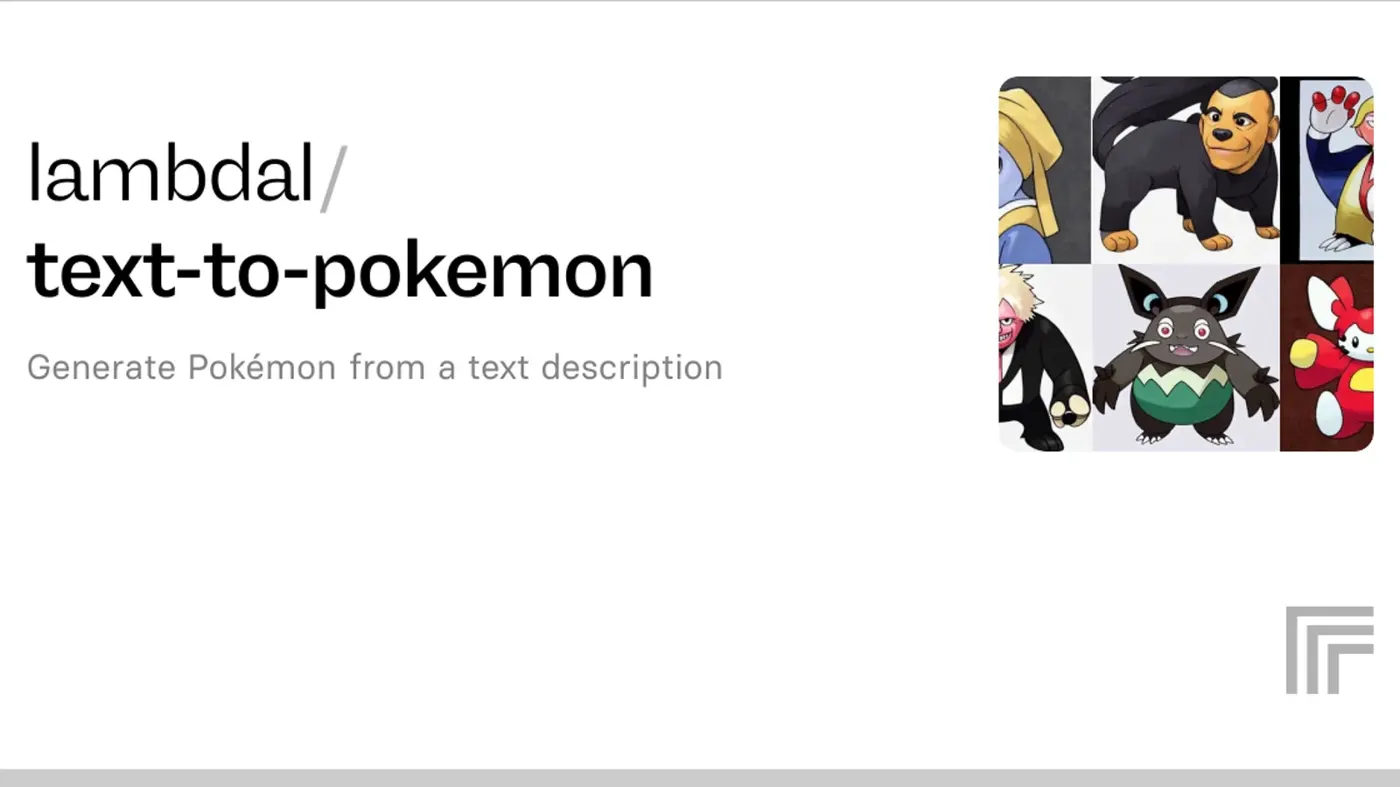
Our verdict on Text-to-Pokémon (Lambda Labs, unofficial fan model)
Text-to-Pokémon is a cheap, well-documented fine-tuning demo that's fun for private Fakemon sketches and for learning how fine-tunes work. Skip it if you want polished art or anything you plan to sell.
Pricing Free open weights on Hugging Face; hosted on Replicate at $0.000225/sec of Nvidia T4 time ($0.81/hr)
Visit Text-to-Pokémon (Lambda Labs, unofficial fan model)Here's the short version. There's no official "Pokemon AI" product: The Pokémon Company doesn't make or endorse a Pokemon AI generator, and every tool sold under that name is a third-party app. The best-known one, and the one this review looks at, is Text-to-Pokémon, a free Stable Diffusion model fine-tuned by Justin Pinkney at Lambda Labs in 2022. It still works, it's very cheap to run, and it's showing its age badly in late 2026.
Nobody at The AI Future ran hands-on tests for this piece. We reviewed the model from its public model cards, the hosting pages on Replicate and Hugging Face, Lambda's own write-up and press coverage, as of early November 2026. I'll say where a claim comes from.
One more thing up front, because it matters more than the image quality: Pokémon and its character names are trademarks of Nintendo (the games are copyright Nintendo, Creatures and Game Freak, per Pokémon's legal page), and the IP rules are strict. If you want to sell what you make, read the section on fan art before you generate anything.
Text-to-Pokémon at a glance
| Item | Detail |
|---|---|
| What it is | Stable Diffusion fine-tuned on Pokémon-style images |
| Made by | Justin Pinkney at Lambda Labs (2022) |
| Where you run it | Replicate (paid per second), Hugging Face weights (free, your own GPU) |
| Cost | Free to download; Replicate bills Nvidia T4 time at $0.000225 per second |
| Best for | Developers, hobbyists and anyone curious about fine-tuning |
| Our rating | 3/5 |
Pokemon AI generators explained
An AI Pokemon generator takes a text prompt (or sometimes an image) and returns a creature drawn in the visual language of the games: round bodies, big eyes, flat colour, a white background. Fans have a word for the output. Wikipedia's Fakemon article describes them as "unofficial, fanmade fictional creatures based on the Pokémon franchise", and it names Pinkney's Text-to-Pokémon as an example of the online Fakemon generators that followed.
The mental model is simple. A general image model like Stable Diffusion can draw almost anything, but getting a consistent style out of it takes long, fussy prompts. Fine-tuning trains it a little more on a narrow dataset, so the style gets baked in. Pinkney put it bluntly on X, as quoted by TechCrunch: "Once you have a fine tuned model, it can't help but generate Pokemon not matter the prompt you give it." So you type "robotic cat with wings" and get a Pokémon-shaped robotic cat. No style keywords needed.
Going by Lambda's write-up, the training data was the Pokémon set from the FastGAN project (almost a thousand images), captioned automatically by an image-captioning model called BLIP. That's a tiny dataset by 2026 standards, and I think it explains most of the model's quirks.
Key features
Plain-language prompts
You don't need prompt engineering. The Replicate readme leads with exactly that promise, and its example prompts are single names or short phrases: "Girl with a pearl earring", "Totoro", "Hello Kitty". Type your own name and you'll get a creature back; TechCrunch's reporter got "a red-haired spider that only has three legs".
A handful of tuning knobs
The hosted version exposes a few controls. TechCrunch lists the number of output images, the number of denoising steps and the classifier-free guidance scale. On the API page, the sample call sends a prompt and sets num_inference_steps to 50.
More steps usually means a cleaner image and a longer, pricier run.
Open weights you can run yourself
The model's on Hugging Face as lambda/sd-pokemon-diffusers, with a short Python snippet using the Diffusers library. A second copy, justinpinkney/pokemon-stable-diffusion, ships the original checkpoint for the CompVis Stable Diffusion scripts and generates 512 by 512 images in its sample command. Both cards list local apps such as Draw Things and DiffusionBee.
A safety filter that misfires
The model card admits a known bug in its own code comments: "Sometimes the nsfw checker is confused by the Pokémon images." It shows you how to switch the checker off "at your own risk". I'd leave it on (and I'd be wary of any site that has switched it off without telling you).
A recipe for training your own
This is where the model still earns its keep, in my view. Lambda's post walks through the whole fine-tune: 2 A6000 GPUs, about 15,000 steps, roughly 6 hours and about $10 on Lambda's cloud. It says any GPU with more than 16GB of VRAM should work if you shrink the batch size. For a lot of people, Text-to-Pokémon was their first look at how cheap fine-tuning had become.
Pricing
There's no subscription. You pay for compute, or nothing at all if you've got a capable GPU. Prices below were checked in November 2026.
| Option | Cost | Notes |
|---|---|---|
| Hugging Face weights | Free | You supply the GPU; the card targets CUDA, with an Apple "mps" option |
| Replicate (hosted) | $0.000225/sec on an Nvidia T4 ($0.81/hr) | Pay per second of run time; the model was listed as "Cold", so the first run waits for a boot |
| Hugging Face Space demo | Free | The Space showed a build error when checked, so it's not usable |
The T4 rate comes from Replicate's hardware prices. Here's a worked example with numbers I'm assuming, not measuring: if one run takes 20 seconds of T4 time, that's 20 x $0.000225 = $0.0045, so 100 runs cost about 45 cents. Even if your runs take three times longer, you'd be at around $1.35 for 100. Cold boots add waiting time; whether Replicate bills that time for this model isn't something I could confirm, so check your dashboard after the first run.
Cheap? Very. The catch is everything else.
Performance and independent testing
I couldn't find a recent independent benchmark of Text-to-Pokémon, and there are no G2, Trustpilot or app-store ratings for it, because it isn't a consumer app. What exists is usage data and press coverage from launch.
The usage numbers are big. Replicate's model page shows 7.9 million runs, which is a lot for a hobby model from 2022. Downloads have faded, though: the Hugging Face cards showed 96 downloads last month for the Diffusers version and 250 for Pinkney's checkpoint. That gap tells me most people met the model through a web demo, used it for fun, and moved on.
TechCrunch's coverage is the closest thing to a hands-on review. Its reporter found the creature versions of real people "really cursed" and called the results for real Pokémon names "creepier", describing them as "an alternate universe version of characters you've loved since childhood". That matches what you'd expect from a small dataset: the model nails the general look but gets anatomy and fine detail wrong.
Limits and failure modes
- The base model is a 2022-era Stable Diffusion release, so hands, text and fine detail are far behind 2026 image models.
- The style is locked in. You can't easily ask for pixel art, a trainer, or a realistic render.
- Outputs are 512 by 512 in the reference command, which is small for print.
- The source dataset is gone: The Pokémon Company sent a DMCA notice and the dataset page now says it's been taken down.
- The free Hugging Face demo was broken when checked, and the Replicate version starts cold.
- Real Pokémon names give you warped versions of trademarked characters, which is exactly the content that's riskiest to share.
That DMCA notice is, honestly, the most telling fact in this review. The same page still lists 22 models trained on the dataset, so the takedown doesn't remove the models. It does show how The Pokémon Company feels about its art being used as training data.
Fan art, commercial use and Pokémon IP
This part isn't legal advice, and the law on AI images is still moving. But the basics are clear enough.
Start with the owner's own terms. Pokémon's legal page covers fan art, and it says that distributing derivative works gives The Pokémon Company a royalty-free licence to use them "for any purpose". It then adds that this doesn't grant the creator any right to use the IP "beyond a personal, noncommercial home use." In plain terms, a Fakemon on your own wallpaper is one thing. Selling it on stickers, shirts or NFTs is another, and the more it looks like a real Pokémon (or uses the name), the bigger the trademark and copyright risk.
A few practical rules follow from that. Don't use "Pokémon" or real Pokémon names in a product title, shop name or logo. Don't imply your creature is official, licensed or endorsed; it isn't. And check the rules of any contest or platform: in 2024 The Pokémon Company disqualified several finalists from its TCG Illustration Contest, where VGC reports that generative AI was "expressly forbidden" by the rules.
There's a separate question of who owns an AI image at all. Our explainer on whether you can copyright AI art covers that. And the dataset licence adds one more wrinkle: the Hugging Face page lists it as CC BY-NC-SA 4.0, a non-commercial licence, which I think makes commercial use of anything trained on it even shakier.
If you want something you can sell, I'd design an original creature that doesn't lean on any Pokémon's silhouette, name or colour scheme, and I'd ideally finish it by hand.
Best suited to
Text-to-Pokémon makes sense for three groups. Developers learning fine-tuning get a well-documented, $10 example with code. Hobbyists with a decent GPU get free, unlimited Fakemon-style sketches for personal fun. And teachers running an AI class get a memorable demo of what a fine-tune does to a base model.
It's a poor fit if you want polished art, a phone app, or anything you plan to sell. Casual users will probably prefer a browser tool that doesn't need an account or a GPU.
| You want | Better choice |
|---|---|
| To learn how fine-tuning works | Text-to-Pokémon on Hugging Face |
| Quick Fakemon sketches, no sign-up | Perchance's AI Pokemon Generator |
| Higher-quality creature art in many styles | A general image generator such as Fotor or Leonardo AI |
| Art you can sell | An original design, not a Pokémon look-alike |
Text-to-Pokémon alternatives
Perchance AI Pokemon Generator
Perchance hosts a community-made AI Pokemon Generator billed as "free, no sign-up, unlimited". It's the low-effort option. As with any user-made page, the terms and the model underneath can change without notice, and I couldn't confirm which model it runs.
Fotor
Fotor's old AI Pokemon generator address now opens its general AI image generator, which lets you pick models such as Nano Banana, Midjourney, FLUX and GPT Image. That's a big quality jump over a 2022 fine-tune. There's a free tier with limited credits and paid Pro, Pro+ and Max plans on Fotor's plans page, though the dollar figures didn't load when we checked.
Leonardo AI
If you want character art with style control and you're willing to learn a token system, Leonardo is a common pick. Our Leonardo AI review covers its pricing, and our roundup of the best AI image generators compares it with other options. For prompt ideas, see our guide to anime AI prompts.
Verdict
I'd give Text-to-Pokémon 3 out of 5. It was a clever, influential demo in 2022, and with 7.9 million runs on Replicate it clearly found an audience. But the image quality is from another era, the free demo's broken, and the training set was pulled after a DMCA notice from The Pokémon Company. Use it if you want to understand fine-tuning or make private Fakemon for fun; skip it if you want good-looking art or anything commercial. For most people, I suspect a modern general image generator and an original design will be the better bet.
FAQ
Is there an official Pokemon AI generator?
No. As far as I can tell, no tool called a Pokemon AI generator is made or endorsed by The Pokémon Company, Nintendo or Game Freak. Text-to-Pokémon came from Lambda Labs, and the browser tools are third-party sites.
Is Text-to-Pokémon free?
The weights are free on Hugging Face if you have your own GPU. On Replicate you pay for run time, at $0.000225 per second on a T4, so a typical batch of images costs fractions of a cent to a few cents.
Can I sell AI generated Pokemon?
That's risky. Pokémon's legal page says fan art rights don't extend "beyond a personal, noncommercial home use", and the training data carried a non-commercial licence. Talk to an IP lawyer before selling anything that looks like, or is named after, a Pokémon.
Can I use AI Pokemon art in contests?
Check the rules first. The 2024 Pokémon TCG Illustration Contest banned generative AI, and The Pokémon Company disqualified finalists who broke its rules.
Why do AI Pokemon look strange?
The model learned from fewer than a thousand images on an older version of Stable Diffusion, so it gets the overall style but often mangles faces, limbs and detail. Newer general models do better, though they bring their own IP questions.
What we like
- Free open weights you can run on your own GPU
- Plain-language prompts with no style keywords needed
- Very cheap per image on Replicate's per-second billing
- Well-documented fine-tuning recipe (about $10 and 6 hours of training)
What could be better
- Image quality from a 2022-era Stable Diffusion base
- Training dataset taken down after a DMCA notice from The Pokémon Company
- Free Hugging Face demo showed a build error; Replicate version starts cold
- Not suitable for commercial use given Pokémon's IP terms and the non-commercial dataset licence