Paradox AI review 2026: what the Olivia recruiting bot does, costs and risks
Paradox AI's Olivia chatbot automates screening and scheduling for high-volume hiring. Here's what it does, what it costs, and the security lapse to know about.
 Written byDr. Alap ZahidReviews And Guides Editor
Why you can trust The AI Future
Our writers research every product from its official pages, independent tests and user reports, link each claim to its source and correct mistakes openly. Unless an article says otherwise, we haven't tested the product hands-on ourselves. Companies can't pay for coverage or see reviews before they're published.
Read our editorial policy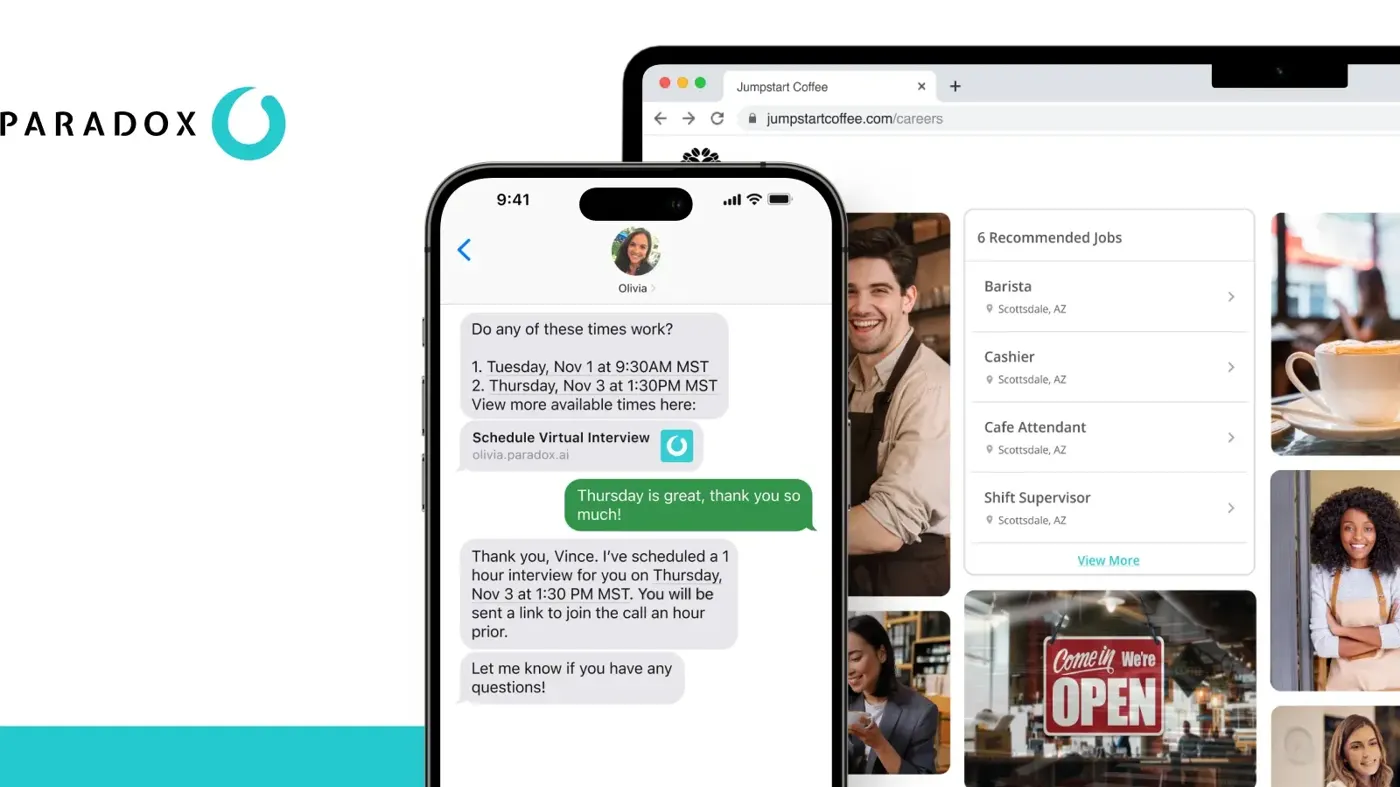
Our verdict on Paradox (Olivia)
Paradox AI is a sensible buy for chains and Workday customers doing high-volume hourly hiring, where Olivia can save recruiters hours of scheduling. Small businesses and anyone wanting transparent pricing should skip it, and every buyer should ask hard questions about security after the 2025 McHire lapse.
Pricing Quote-based only; no free plan or trial. Third-party estimates start around $1,000/mo
Visit Paradox (Olivia)Paradox AI is a recruiting software company whose chatbot, Olivia, texts job applicants, screens them, books their interviews and nudges them through onboarding. It's legit, it's big, and since October 2025 it's owned by Workday. Is it worth it? For a chain hiring hundreds of hourly workers a month, I think probably yes. For a five-person shop that hires twice a year, almost certainly not: you'd be buying an enterprise contract to solve a problem a shared calendar could handle.
There's also a security story you should know about before signing anything. I'll get to it.
Paradox AI at a glance
| Item | Details |
|---|---|
| Our rating | 3.5 out of 5 |
| Best for | Franchises, retailers, restaurants and other high-volume hourly hiring |
| Pricing | Not published; quote-based through sales (Paradox or Workday) |
| Free plan | No |
| Owner | Workday (deal completed October 1, 2025) |
| Website | paradox.ai |
Paradox AI explained: Olivia and the Workday deal
Paradox was founded in Scottsdale, Arizona, in 2016, and it was one of the first companies to build conversational recruiting software. Instead of making a candidate fill in a long web form, Olivia asks the questions over text, chat or a careers-site widget, then pushes the answers into whatever applicant tracking system (ATS) the employer already runs.
So when people search "what is Paradox AI recruiting", that's the answer: automation for the dull middle of hiring.
Screening questions, interview scheduling, reminders, FAQs, offer paperwork. Olivia handles them around the clock, and recruiters step in for the parts that need a human.
The customer list is mostly household names. 7-Eleven, Nestle, Marriott, Chipotle, Wendy's and Dell have all been named as clients, and McDonald's runs its McHire application system on Olivia (which matters later). In my view that list tells you more about who the product is for than any feature page does.
Then Workday bought it.
The deal closed on October 1, 2025, and Olivia is now sold as the Workday Paradox Candidate Experience Agent, available "for both existing and new customers through Workday or Paradox". Workday didn't disclose the price when it announced the deal. Paradox's CEO, Adam Godson, said joining Workday means the company can "bring that vision to more organizations".
Key features
Conversational applications
This is the core.
Candidates apply by chatting with Olivia, usually on a phone, and the answers land in your ATS as a normal application. For hourly roles, where a lot of people apply from a phone on a break, that's a sensible design choice. Long desktop forms lose those applicants. A text thread probably doesn't, or at least loses fewer of them.
Interview scheduling
Olivia offers time slots, books the interview and sends reminders. On the Paradox site, the pitch is "Schedule instantly, without all the work."
Not unique, then. Plenty of ATS products now do scheduling too, so the real difference is that it happens inside the same chat the candidate already started, with no second link to click or account to make.
A full ATS, or a layer on top
You can use Paradox as your system of record or keep your current one. The homepage describes both: an ATS "that automates, not frustrates" and a layer that works "without replacing your system of record." Workday customers now get it as a native add-on, which I'd guess is where most new deals will come from.
Job posting to Indeed
Jobs can be pushed to Indeed with a toggle, and candidates can finish a full application on the Indeed listing itself. Paradox claims this raises the likelihood of a job being clicked by 21%. That's a vendor number, so treat it as a claim, not a result.
Career sites, CRM and hiring events
There's a conversational career site builder, a candidate CRM for re-engaging past applicants, and tools for running hiring events (registration, reminders, screening and on-the-spot scheduling). Early-career teams get text and email campaigns aimed at students.
Reporting
Paradox says it tracks over 1,000 metrics, with dashboards and an sFTP export to your own BI tools. Olivia can also ask candidates how they feel at each stage, which is a neat idea if you actually read the answers.
Languages
Software directory listings show Olivia in more than 30 languages, including Spanish, Arabic, Japanese, Thai and Ukrainian. For a global retailer, that's a real point in its favour.
Pricing and plans
Paradox doesn't publish prices. There's no free plan and no self-serve trial; you book a demo and talk to sales. That didn't change after the Workday deal.
Software directories list a starting point of roughly $1,000 a month, and one third-party breakdown puts a mid-size rollout at $30,000 to $95,000 a year depending on modules, plus a one-off implementation cost of $15,000 to $35,000. None of those are quotes. They're planning ranges, and big franchise contracts are negotiated privately.
| Option | Price | Notes |
|---|---|---|
| Free plan | None | No self-serve sign-up |
| Entry deployment | About $1,000/mo (third-party estimate) | Quote-based, annual contract |
| Mid-size rollout | About $30,000 to $95,000/yr (third-party estimate) | Varies with modules and locations |
| Implementation | About $15,000 to $35,000 one-off (third-party estimate) | ATS integration and setup |
| Workday customers | Quote | Sold as the Workday Paradox Candidate Experience Agent |
Honestly, I find hidden pricing frustrating in any product. Here it's at least understandable, because a 50-store deployment and a 5,000-store one are very different jobs. Just go in expecting a sales process measured in weeks.
Security record and independent scrutiny
Here's the part that shapes my rating most.
On June 30, 2025, security researchers Ian Carroll and Sam Curry contacted Paradox about McHire, the McDonald's hiring system built on Olivia. They'd found a staff login page linked from the McHire site, guessed the username and password (both were "123456"), and landed in a test account. From there, an API flaw let them pull other applicants' chat records by changing an ID number. Their applicant's ID was 64,185,742, which is why headlines said 64 million records were potentially exposed.
Paradox's own write-up tells a narrower story. It says the problem was fixed "within a few hours", that the researchers viewed only five chats with candidate details (names, emails, phone numbers and IP addresses), that no Social Security numbers were exposed, and that only one client was affected. It also admits the test account "had not been logged into since 2019 and frankly, should have been decommissioned." The company then launched a bug bounty program and a security contact address.
I'll give Paradox credit for owning it: "We take responsibility for this issue. Full stop." That's a better response than most vendors manage. Still, a default-style password on a production login with no multi-factor authentication isn't a subtle bug. It's a basic one, and it happened at a company holding personal data for millions of job seekers. If you're buying, I'd ask hard questions about what changed, and whether Workday's security reviews now cover the old Paradox stack.
Beyond that, independent evidence is thin. The handful of user reviews on software directories are mostly positive about time saved, with one titled "Great in theory, Poor Execution and Poorer Customer Service". With only a few dozen public reviews spread across sites, I wouldn't read much into any average score.
Best suited to
Paradox makes the most sense if you hire hourly staff in volume across lots of locations: restaurants, retail chains, hotels, logistics and healthcare support roles. Recruiters at that scale spend hours each day on scheduling, and Olivia takes that off their plate. It's also an easy add for companies already on Workday, since it's now sold inside Workday's own recruiting suite.
Who should skip it? Small businesses, startups hiring a few salaried roles a year, and anyone who wants to sign up today and try it. There's simply no path for you; the product isn't built that way. If you're in that group, our guide on how to use AI in recruiting covers cheaper ways to automate the same steps.
Job seekers land here too, often asking "is Paradox AI legit?" because a text from "Olivia" looks a bit like spam. It's real. If a big employer you applied to uses Paradox, a text from Olivia is probably part of the normal process. Still, check that the message matches a job you actually applied for, and never send bank details or ID numbers by text before you've got a written offer from the employer itself. If you're on the candidate side, our Jobhire AI review looks at a tool that works for applicants instead.
Paradox AI alternatives
- Fountain is aimed at the same frontline crowd and bundles an ATS, CRM, onboarding (including I-9 and W-4 forms) and shift scheduling. I'd look at it if you want hiring and scheduling workers in one place.
- HireVue focuses on interviews and skills assessments rather than chat-based applications. It says it's completed 70 million interviews. Pick it if structured assessment matters more to you than speed.
- Phenom covers hiring, internal mobility and retention in one talent platform. It probably fits large employers who want more than a recruiting chatbot.
For a wider list, see our roundup of the best AI tools for HR teams.
Verdict
I'd give Paradox AI 3.5 out of 5. The idea is sound, and for high-volume hourly hiring it probably saves real recruiter time: a text conversation beats a 20-minute mobile form for most applicants. The customer list and the Workday backing suggest it isn't going anywhere.
What holds it back is the hidden pricing, a setup measured in weeks, and the 2025 McHire lapse. That last one would make me slow down before handing over applicant data. Big chains and Workday shops should take the demo.
Everyone else can skip it without missing much.
FAQ
What is Paradox AI recruiting?
It's recruiting software built around Olivia, a chatbot that talks to job applicants by text and chat. Olivia screens candidates, answers their questions, schedules interviews and sends reminders, then passes everything into the employer's ATS. It's mostly used for high-volume hourly hiring by large chains, and it's now part of Workday.
Is Paradox AI legit?
Yes. Paradox is a real company founded in 2016, and Workday completed its acquisition on October 1, 2025. Large employers, including McDonald's, use it. It did have a security lapse in 2025, which it fixed and disclosed. If Olivia texts you, check the job matches one you applied for.
Who owns Paradox AI?
Workday does. It completed the purchase on October 1, 2025, and now sells Olivia as the Workday Paradox Candidate Experience Agent.
How much does Paradox AI cost?
Paradox doesn't publish prices, and there's no free plan or trial. Third-party estimates start at about $1,000 a month, with mid-size rollouts often quoted at $30,000 to $95,000 a year plus setup fees. You'll need a sales call to get a real number.
Who is Olivia from Paradox?
Olivia isn't a person. She's the AI assistant Paradox built to chat with candidates on behalf of employers, so the "Olivia" texting you about an interview is software. A recruiter or hiring manager at the company still makes the hiring decision. If the texts keep coming after you've lost interest, I think replying to say you've withdrawn is the polite way out.
What we like
- Candidates apply and book interviews by text, which suits mobile-first hourly applicants
- Handles screening, scheduling, reminders and onboarding steps around the clock
- Works as a full ATS or on top of Workday and other systems
- Native option for Workday customers since the October 2025 acquisition
- Available in more than 30 languages
What could be better
- No published pricing, free plan or self-serve trial
- Weeks of setup and integration work
- 2025 McHire security lapse involving a '123456' test-account password
- Overkill and too costly for small businesses