AWS AI review 2026: Bedrock, Kiro, Quick, pricing and verdict
AWS AI is Amazon's family of AI services, led by Bedrock. We weigh its models, agents, free tier, pricing and limits, and who should use it.
 Written byFahad HashmiContributing writer, AI in energy and industry
Why you can trust The AI Future
Our writers research every product from its official pages, independent tests and user reports, link each claim to its source and correct mistakes openly. Unless an article says otherwise, we haven't tested the product hands-on ourselves. Companies can't pay for coverage or see reviews before they're published.
Read our editorial policy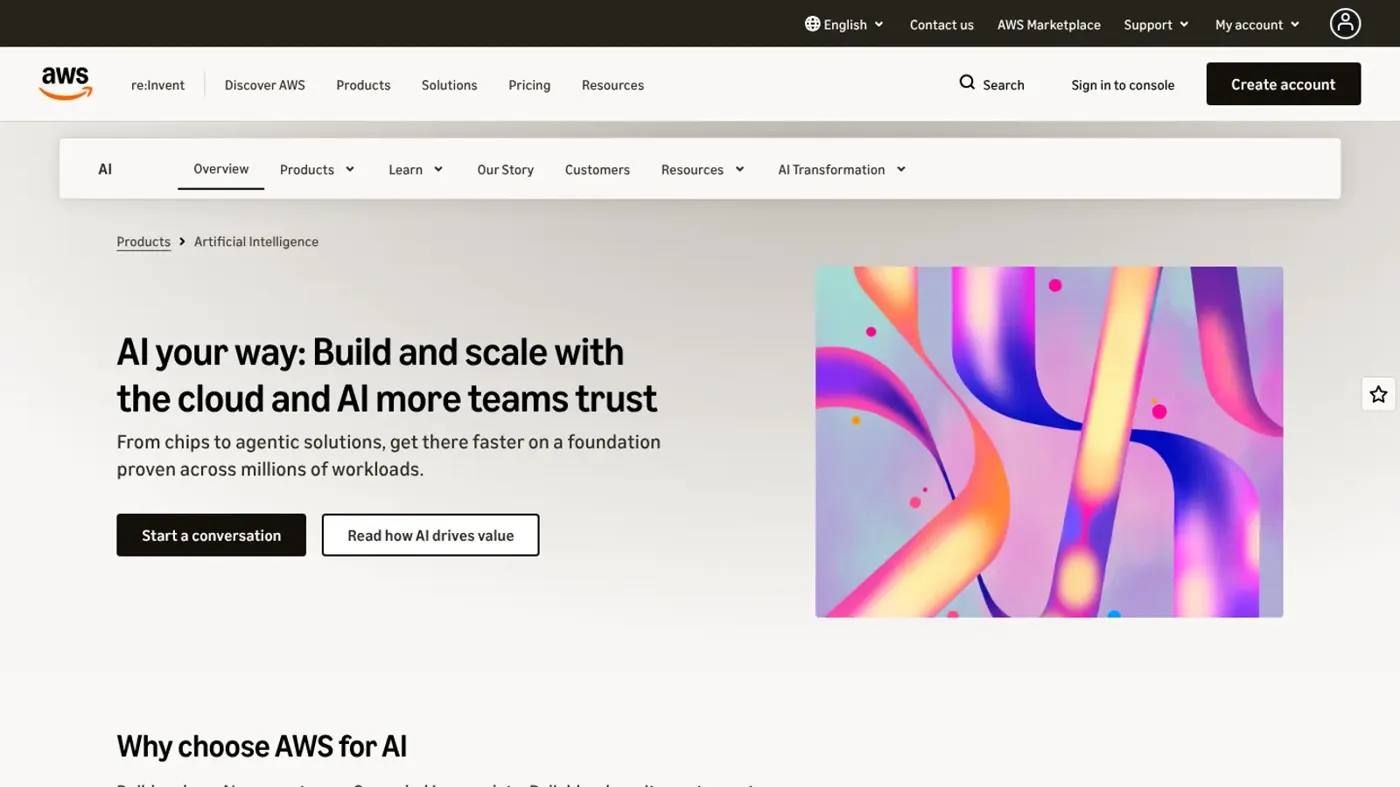
Our verdict on AWS AI (Amazon Bedrock, AgentCore, SageMaker AI, Kiro, AWS Quick)
AWS AI is the safest pick for companies that already run on AWS and need generative AI under strict security and compliance rules. Solo developers and small teams will probably find a direct OpenAI or Claude API simpler and cheaper to manage.
Pricing Free plan with up to $200 credits for 6 months; Bedrock pay per token (Nova 2 Lite $0.30/$2.50 per 1M input/output tokens); Kiro free, then $20-$200/user/mo; AWS Quick free, Plus $20/user/mo annual
Visit AWS AI (Amazon Bedrock, AgentCore, SageMaker AI, Kiro, AWS Quick)AWS AI is Amazon's set of AI services for building apps, agents and models on Amazon Web Services, and it's worth it if your data and infrastructure already live on AWS. The centre of it is Amazon Bedrock, a pay-per-token API for hundreds of models from Anthropic, OpenAI, Meta, Amazon and others. Around it sit AgentCore for agents, SageMaker AI for training your own models, Kiro for coding and AWS Quick for office work.
I'd rate it 4 out of 5. The security controls are excellent and the model choice is huge. But the pricing is spread across dozens of meters, the default rate limits can bite, and the product names keep changing (Amazon Q Developer is being retired in favour of Kiro). If you typed "as ai" into a search bar, this is almost certainly what you were after.
AWS AI in brief
There isn't one product called AWS AI. It's a family of services, sold separately and billed separately, that share AWS accounts, IAM permissions and one bill. That matters for how you evaluate it: you don't buy "AWS AI", you pick the layer you need.
A useful mental model is a stack of four layers. At the bottom are chips and compute (Trainium, Inferentia and GPU instances). Above that, SageMaker AI is for teams that train or fine-tune their own models. Bedrock is the layer most developers touch: you call a model through an API and pay per token, with no servers to run. On top sit finished apps, like Kiro for developers and AWS Quick for knowledge workers.
Scale isn't the question. Bedrock is used by more than 100,000 organizations, and AWS claims it has "nearly 2X more production-ready AI capabilities than other cloud providers" on its AI overview. That second number is AWS marking its own homework, so I'd treat it as marketing until someone independent counts.
Key features
Amazon Bedrock: one API, hundreds of models
Bedrock's main draw is choice. The model list spans AI21 Labs, Amazon, Anthropic, Cohere, DeepSeek, Google, Meta, Mistral AI, Moonshot AI, NVIDIA, OpenAI, Qwen, Stability AI, xAI and more. You switch models by changing a model ID, not by signing a new vendor contract.
The OpenAI addition is the big change this year. In April, AWS announced that OpenAI models, Codex and Managed Agents would come to Bedrock in limited preview, with OpenAI usage counting toward existing AWS spending commitments. For a big company with a committed AWS budget, that last detail is probably worth more than any benchmark.
Bedrock also bundles the plumbing you'd otherwise build yourself: Knowledge Bases for retrieval-augmented generation (if RAG is new to you, it means fetching your own documents into the prompt), Guardrails for content filtering, model evaluation, batch jobs and prompt routing.
AgentCore and Managed Agents
AgentCore is the agent runtime. It hosts agents built with any framework, gives them memory, a browser tool and a code interpreter, and handles identity and tracing. It supports the open MCP and A2A protocols, so tools you build aren't locked to one model. If you're new to the idea of agentic AI, the short summary is that agents call tools in a loop until a task is done, and AgentCore is where that loop runs.
Bedrock Managed Agents, powered by OpenAI sits on top of AgentCore and is still marked as a preview. It pairs OpenAI models with the agent loop behind Codex, and each agent gets its own AWS identity and permissions. I like that design choice: an agent with its own IAM role is much easier to audit than one sharing a developer's keys.
Amazon Nova models
Nova is Amazon's own model family. Nova 2 Lite is the cheap workhorse at $0.30 per million input tokens and $2.50 per million output tokens on the standard tier. Nova 2 Pro and Nova 2 Omni (which can also output images) are both still labelled preview, which is a little odd for models first shown in November 2025. There's also Nova 2 Sonic for speech-to-speech voice apps and Nova Act for browser automation agents, priced at $4.75 per agent hour.
Bedrock Guardrails and data privacy
This is where AWS is strongest. Bedrock never stores or uses your data to train models, encrypts data in transit and at rest, and is in scope for ISO, SOC, GDPR and FedRAMP High, as well as being HIPAA eligible. Guardrails add content filters, denied topics, PII redaction and Automated Reasoning checks, which test a model's answer against rules you define. AWS says Guardrails can block up to 88% of harmful content; that's a vendor figure, and "up to" is doing a lot of work.
SageMaker AI
SageMaker AI is for teams who want to train, fine-tune and host their own models on managed infrastructure. It covers notebooks, training jobs, real-time and serverless inference, MLflow and HyperPod clusters. It's powerful and, honestly, overkill if all you want is to call Claude or GPT from an app. Most product teams will never need it.
Kiro and AWS Quick
These are the finished apps. Kiro is an agentic IDE and CLI built around spec-driven development: you write structured requirements, and it plans, codes and checks against them. It's replacing Amazon Q Developer, whose IDE plugins and paid subscriptions reach end of support on April 30, 2027; new Q Developer signups stopped on May 15.
AWS Quick is the workplace assistant: chat, deep research, automated Flows, dashboards and basic web apps, with connectors for Slack, Microsoft 365, Google and QuickBooks. The free plan doesn't need an AWS account at all, and that surprised me for an Amazon business product.
AWS AI pricing and plans
Bedrock and SageMaker AI are pay-as-you-go. Kiro and Quick use seat plans. The table pulls the main numbers together; prices are in US dollars before tax.
| Service | Free option | Paid pricing |
|---|---|---|
| AWS account (Free plan) | Up to $200 in credits over 6 months; 30+ always-free services | Pay-as-you-go after upgrading to the Paid plan |
| Amazon Bedrock | Covered by account credits | Per token, per model; batch is 50% cheaper for select models; Nova 2 Lite $0.30 / $2.50 per 1M input / output tokens |
| Bedrock AgentCore | Some registry usage free each month | Runtime $0.0895 per vCPU-hour plus $0.00945 per GB-hour; Gateway $0.005 per 1,000 calls |
| SageMaker AI | Free Tier for the first 2 months (e.g. 250 notebook hours, 50 training hours) | Per instance-hour, or Savings Plans |
| Kiro | Free: 50 credits/month | Pro $20, Pro+ $40, Pro Max $100, Power $200 per user/month; teams $20/seat; extra credits $0.04 |
| AWS Quick | Free for one user | Plus $20/user/month annual ($25 monthly); Max $100 ($125 monthly); Enterprise tiers $3, $20 or $40/user plus $250/account |
AWS AI free tier: what you really get
New accounts on the AWS Free plan get $100 in credits straight away and can earn up to $100 more. The catch is the clock. The Free plan account closes after 6 months or when the credits run out, whichever comes first, and it only covers select services. You won't be charged unless you switch to the Paid plan, which is a genuinely good safety net for students and hobbyists.
The app-level free tiers are thinner. Kiro Free gives 50 credits a month with open-weight models and Claude Sonnet 4.5. That's enough to try it, not to work in it. Quick Free is more generous. One user gets chat, deep research, automated Flows, app building and connectors to the tools they already use, with no AWS account needed.
A worked cost example
Say you run a support chatbot that handles 10,000 requests a day. Each request sends 1,000 input tokens and gets 300 output tokens back, and you use Nova 2 Lite on the standard tier.
- Input: 10,000 x 1,000 = 10M tokens a day, at $0.30 per million = $3.00.
- Output: 10,000 x 300 = 3M tokens a day, at $2.50 per million = $7.50.
- Total: $10.50 a day, or about $315 over a 30-day month.
Output tokens are 30% of the volume but over 70% of the bill. That ratio is typical, and it's why trimming answer length usually saves more than trimming prompts. Add Guardrails content filters and denied topics and you pay another $0.15 each per 1,000 text units (a text unit is up to 1,000 characters), based on the worked examples on Bedrock's pricing page. Swap Nova for a frontier Claude or GPT model and the same traffic could cost several times more.
Performance and independent testing
Bedrock's speed depends on the model you pick, so the useful independent numbers are about Amazon's own models and the platform around them.
At launch, Nova 2 Pro Preview scored 62 on Artificial Analysis' Intelligence Index at medium reasoning, well behind the 73 that Gemini 3 Pro Preview scored at the time. Artificial Analysis also measured a time to first answer token of 15.75 seconds at medium reasoning, a bit slower than the 12.69-second median for its price tier. Good value, then, but not a leader. I suspect most Bedrock customers use Nova for cheap high-volume jobs and reach for Claude or GPT when quality matters.
Reviewers on PeerSpot, the enterprise review site, give a consistent picture. They praise the security, data encryption and the range of models in one place; one data scientist reported a "90 to 95% plus success rate while extracting the data from unstructured documents". The complaints are just as consistent: complex initial setup that needs two or three other AWS services, documentation that could be better, and costs that "sometimes incurs charges not explicitly mentioned in the pricing". One reviewer rated it seven out of ten because it was "slightly difficult to integrate with our product".
Limits and failure modes
A company that sells an AI gateway layer for Bedrock (so it has a reason to find faults) published a long list of production complaints. Some are fair and match what I'd expect from any big cloud:
- Default service quotas can be low for some models and Regions, and raising them can mean a support ticket.
- Latency varies at peak hours because Bedrock is a shared, multi-tenant service; the same prompt can take 2 seconds in the morning and 6 in the afternoon.
- Managed Knowledge Bases are quick to set up but limit how you chunk and rank documents, so teams with tricky retrieval needs sometimes rebuild RAG themselves.
- CloudWatch gives infrastructure metrics, not per-conversation cost or agent traces, though AgentCore's tracing and evaluations now cover some of that gap.
The product churn is my own biggest worry. In about a year, AWS has started retiring Q Developer for Kiro, launched Quick and its six plans, and kept Nova 2 Pro in preview. Plan for names and APIs to move.
Best suited to
AWS AI makes the most sense for teams that already run on AWS and need AI under the same security and compliance rules. Regulated buyers gain most. Banks, healthcare companies and public sector teams benefit because IAM roles, private networking, CloudTrail logs and HIPAA eligibility come built in. AWS's favourite example is Robinhood, which went from 500 million to 5 billion tokens a day on Bedrock in six months while, by AWS's account, cutting AI costs by 80%.
It's also a good fit if you want to switch between Anthropic, OpenAI and open-weight models without rewriting your app. That flexibility is real.
Skip it if you're a solo developer building a weekend project. Signing up directly with OpenAI or Anthropic's Claude is simpler, with one API key and one bill. And if you just want a chat assistant for work, AWS Quick competes with tools that are more polished and better known.
AWS AI alternatives worth considering
| Alternative | Pick it if |
|---|---|
| Google Cloud Vertex AI | Your data sits in Google Cloud or BigQuery, or you want Gemini models first. |
| OpenAI API direct | You mainly want GPT models and OpenAI's newest features the day they ship, with one API key. |
| Claude API direct | You mainly want Anthropic's models for writing, coding or agents, and don't need a cloud platform around them. |
For teams building customer-facing bots without much cloud work, our list of AI chatbot developer tools covers lighter options.
Verdict
I think AWS AI is the safest enterprise choice for running generative AI at scale, and a clumsy one for everyone else. Bedrock's model range, now including OpenAI, plus its privacy guarantees and IAM-based security are hard to beat if compliance is your bottleneck. The trade-off is complexity. Dozens of price meters, quotas to manage and a product line that keeps renaming itself all add up to real engineering time, and someone on your team will need to own the bill.
If you're already on AWS, start with Bedrock and Nova 2 Lite and add AgentCore when you need agents. If you aren't, I'd probably go direct to a model provider first and come back when security reviews start slowing you down.
FAQ
What is AWS AI?
It's Amazon Web Services' group of AI products. Amazon Bedrock gives API access to hundreds of models, AgentCore runs AI agents, SageMaker AI trains and hosts custom models, Nova is Amazon's own model family, Kiro is a coding environment and AWS Quick is a workplace assistant. Each one is priced and billed separately, so you only pay for the layers you actually use, and many teams start with Bedrock alone.
Is AWS AI free?
Partly. New AWS accounts on the Free plan get up to $200 in credits for 6 months, and SageMaker AI has a 2-month free tier. Kiro Free includes 50 credits a month, and AWS Quick Free covers one user. Beyond that, Bedrock charges per token and the apps charge per seat.
How to integrate AI into an app?
Pick a model API (Bedrock, OpenAI or Claude) and call it from your backend. Send the user's input plus instructions, return the model's answer, and add limits, logging and content filters. Don't call it straight from the browser with exposed keys.
How to add AI to your website?
The easiest route is a hosted chatbot widget you paste into your pages. For more control, build a small backend endpoint that calls a model API and connects it to your site's content with RAG. Our guide to integrating AI in a website walks through both options step by step.
How to use AI in an app?
Use AI where it removes a real chore: summarising long text, answering support questions, extracting data from documents or drafting replies. Keep a human check on anything risky, show users when content is AI-generated, and track accuracy and token costs from day one so a popular feature doesn't surprise you with its bill.
What we like
- Hundreds of models in Bedrock, now including OpenAI models alongside Anthropic, Meta and Amazon Nova
- Strong privacy: Bedrock doesn't store or use your data to train models, and it's HIPAA eligible and FedRAMP High
- IAM permissions, Guardrails and per-agent identities make AI easier to audit
- Cheap in-house models, with Nova 2 Lite at $0.30 per million input tokens and 50% off for batch
- Free plan with up to $200 in credits and no charges unless you upgrade
What could be better
- Pricing is split across dozens of meters and services, which makes bills hard to forecast
- Initial setup can need several other AWS services, and reviewers ask for better docs
- Default quotas and peak-hour latency can be a problem for production apps
- Product churn: Q Developer is being retired for Kiro, and Nova 2 Pro is still in preview