Jungle AI review 2026: features, pricing, pros and cons
Jungle AI turns slides, PDFs and YouTube videos into quizzes and flashcards. We weigh its plans, its free tier and what students say about reliability.
 Written byDr. Alap ZahidReviews And Guides Editor
Why you can trust The AI Future
Our writers research every product from its official pages, independent tests and user reports, link each claim to its source and correct mistakes openly. Unless an article says otherwise, we haven't tested the product hands-on ourselves. Companies can't pay for coverage or see reviews before they're published.
Read our editorial policy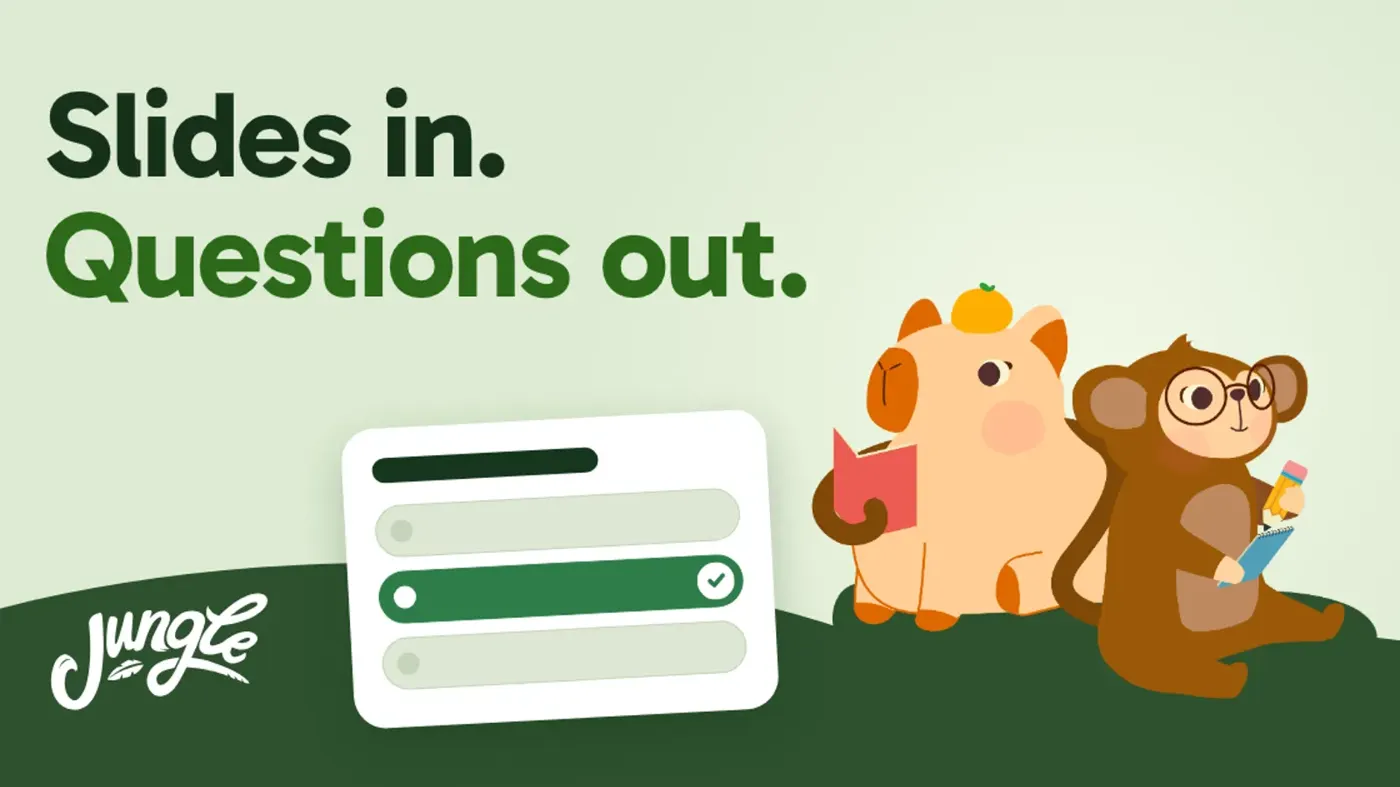
Our verdict on Jungle AI (Jungle: AI Flashcards & Quiz, by Mindflow Inc.)
Jungle AI is a focused, affordable way to turn lecture slides into practice questions, and it suits lecture-heavy science and pre-med courses. Try the free plan on a real deck first; skip it if your course is essay-based or the reported upload problems hit you.
Pricing Free (2 generations/month); Pro $15/mo or $72/yr ($6/mo); Elite $37/mo or $180/yr ($15/mo)
Visit Jungle AI (Jungle: AI Flashcards & Quiz, by Mindflow Inc.)Short version: Jungle AI is a study app that turns your lecture slides, PDFs and YouTube videos into multiple-choice questions and flashcards, then schedules them for spaced repetition. It's free to start, Pro costs $15 a month (or $6 a month billed yearly), and in early November 2026 I think it's one of the more focused AI quiz makers for students who already have their course material. The weak spots are a stingy free plan and a steady trickle of complaints about uploads that don't work.
One thing to clear up first. "Jungle AI" is the name of two unrelated products, and this review covers the student app at jungleai.com, made by Mindflow Inc. in San Francisco. The other one, Jungle.ai, is an industrial machine-learning company whose Canopy product watches wind and solar assets for early signs of failure. Since this search lands mostly on study tools and app listings, I'm going with the flashcard app.
Nobody on our team ran a hands-on test of Jungle for this piece, so you won't find stopwatch timings or screenshots of my own decks here. We reviewed it as it stood in late October and early November 2026, using Jungle's own site and app listings, a competitor's published comparison, and about 20 recent app-store reviews.
Where someone else made a claim, I'll say who.
Jungle AI in brief
Jungle is a web app with iOS and Android versions. You upload class material, it writes practice questions, and you answer them while a little tree grows and an animal character canoes down a river (yes, really). The App Store listing pitches it as "as if AI, Quizlet, and Duolingo had a baby", which is a fair summary of the vibe.
It wasn't always called Jungle. RemNote's comparison page says the app was previously known as Wisdolia, which explains why older reviews and directory listings still use that name. The team page on Jungle's about page lists Julian Alvarez as CEO and co-founder, David Glass as CPO and co-founder, and Benjamin Keep as learning science advisor.
Jungle claims "over 1 million students" on its App Store page. I can't verify that number independently. The Android app shows 100K+ downloads and was last updated on October 31, 2026, so the rest of the user base is presumably on iPhone and the web.
Key features
Questions from almost any file
This is the core. Going by the app listing, Jungle can generate questions from PDFs, Word documents, PowerPoints, video and audio files, YouTube videos, Google Drive links and web page URLs. Output includes multiple-choice questions, flashcards and written answers, and you get instant AI feedback on what you got wrong.
The homepage puts most of its energy into multiple choice.
Its argument is that "the hardest part is making the wrong answer choices good enough to be believable", which I'd agree with: a quiz where the wrong options are obviously silly teaches you nothing.
Spaced repetition and a daily review
Jungle builds a daily review that resurfaces the topics you're weakest on, and the listing describes it as "similar to Anki". RemNote's write-up says Jungle adapts its review intervals to how comfortable you are with each item. Elite subscribers can set their own daily review size, according to the plans page.
Chat, explanations and a voice tutor
You can chat with a document or video when you're stuck, ask for analogies, and get AI explanations of answers. There's also a voice tutor, a monkey (of course) that quizzes you out loud and can pull up an image from your slides mid-call. Free users get 8 AI chat messages an hour; unlimited voice tutor calls are an Elite perk.
Exam templates and image occlusion
Jungle is leaning hard into medical students. The homepage shows a USMLE Step 1 style vignette and says MCAT and "more on the way", and the Elite plan adds question templates for those exams plus automatic image occlusion (hiding labels on a diagram so you can quiz yourself on them). A vet student's testimonial on the homepage fits that audience.
Anki export and lecture recordings
Pro adds export to Anki, which matters more than it sounds: if you ever leave Jungle, your cards can come with you. You can also record lectures, five a month on Free and unlimited on Pro.
Jungle AI pricing and plans
Prices were checked on November 2, 2026 on Jungle's pricing page (US dollars; your local price can differ, and Jungle says you'll see it before paying). Yearly billing is advertised as a 60% discount.
| Plan | Monthly billing | Yearly billing | Main limits and extras |
|---|---|---|---|
| Free | $0 | $0 | 2 generations a month, documents up to 30 pages, videos up to 30 minutes, 1 exam-style generation, 5 lecture recordings, 8 AI chat messages an hour |
| Pro | $15/month | $6/month ($72/year) | Unlimited generations on documents of any size, 3x more questions per generation, unlimited AI explanations, Anki export |
| Elite | $37/month | $15/month ($180/year) | Everything in Pro, plus Step 1 and MCAT templates, auto image occlusion, unlimited voice tutor calls, a claimed 30% boost in question quality |
Is Jungle AI free? What the free plan really includes
Yes, but barely enough to judge it. Two generations a month means two uploads: one lecture deck and one reading, say. You do get advanced-difficulty questions on up to four generations and one exam-style set, so the free tier's fine for a trial, though I doubt anyone could run a whole semester on it.
The in-app prices are messier than the website's. The App Store lists a Weekly Super Learner plan at $6.99 alongside Monthly Super Learner at $15.00, Yearly Super Learner at $72.00, Monthly Elite at $37.00 and Yearly Elite at $179.99, plus older-looking "Mega Mind" tiers at $7.99 a month and $59.99 a year. That weekly option works out to roughly $30 a month. Honestly, I'd steer well clear of it; if you're going to pay, the yearly Pro plan is by far the cheapest route.
Performance and independent testing
Here's where the evidence gets thin. The only head-to-head numbers I could find come from Jungle itself. Its homepage shows a chart comparing question quality against Quizlet, Turbo, Gizmo and Studyfetch (listed "in random order"), scored on relevance to the document, ease of understanding and how plausible the wrong answers are. The method, by Jungle's description, was to have each platform generate questions from the same three documents, anonymise them, and score them with "a question quality LLM judge".
That's a reasonable design on paper. But it's a vendor's own test on three documents, graded by an AI model it doesn't name, and the competitors aren't even matched to their bars. I'd treat it as marketing until someone outside the company repeats it, and I couldn't find anyone who has. The Elite plan's "30% boost in question quality" has the same problem: there's no published baseline.
App-store reviews fill some of the gap, with the usual caveat that they're anecdotes. On the App Store, one Anatomy and Physiology student wrote that the questions "are authentic and exactly like ones I see on my test." Another reviewer praised the slide reference feature, which shows the exact slide an answer came from. The complaints are about reliability rather than question quality. One App Store reviewer reckoned the app and website work only about three-quarters of the time, with the rest spent stuck on a loading screen. Another App Store complaint: it "Won't give many questions even with pages of notes. 17 max".
On Google Play, the three most recent reviews shown were all negative: one user couldn't log in, another's PDF upload just bounced back to the main screen, and a premium subscriber wrote that "the app doesn't allow for documents uploads and it says "error" when I press explanation of answers". That's a small sample. Still, upload failures on a paid plan are the kind of thing I'd want fixed before recommending the app without reservations.
The ratings tell a split story: 4.6 out of 5 from 1,015 ratings on the App Store, and 4.2 from about 4,350 on Google Play, both checked in early November 2026. My read is that the iPhone app is in better shape than the Android one, though that's an inference from ratings and a handful of reviews, not a measurement.
One privacy note. Mindflow's App Store privacy label says contact info and identifiers "may be used to track you across apps and websites owned by other companies." That's common for consumer apps, but it's worth knowing if you're signing up with a school email.
Best suited to
Jungle makes the most sense if you already have the material and need to drill it. Think lecture-heavy courses with long slide decks: anatomy, pharmacology, biology, the sort of class where the exam is mostly multiple choice. The Step 1 and MCAT templates make it a natural fit for pre-med and medical students, and I suspect that's where Jungle sees its future, given how much of the homepage is aimed at them.
It's a weaker fit if you want to take notes in the same app, since RemNote describes Jungle as a "source-to-practice workflow rather than a full editor". It's also probably not for you if your course is essay-based, or if two free uploads a month is all you can afford. For broader picks, our guides to the best AI for studying and free study AI tools cover more ground.
Jungle AI alternatives
- Gizmo: probably the closest rival, another AI flashcard and quiz app with a gamified feel. It's rated 4.8 on Google Play's similar-apps list next to Jungle's 4.2. Pick it if Jungle's Android reliability worries you.
- RemNote: choose it if you want notes and flashcards in one place, with SM-2 and FSRS scheduling and PDF annotation.
- Anki: the free, open-source standard for spaced repetition. You write (or import) your own cards, which is slower, but it's the app Jungle exports to anyway.
If you're stuck on homework problems rather than memorising slides, a solver like Gauth AI does a different job entirely.
Verdict
I'd give Jungle AI 3.5 out of 5. The idea's right, the multiple-choice focus suits how a lot of science exams work, and the yearly Pro price of $72 is cheap next to most study subscriptions. What holds it back is trust: question-quality claims that only Jungle has measured, and enough upload and login complaints that I'd be nervous relying on it the week before a final. Use the two free generations on a real lecture deck first. If the questions look like your professor's, the yearly Pro plan's worth it; if your course is essay-based or you're on Android and the app fights you, skip it.
FAQ
Is Jungle AI free?
Yes, Jungle has a free plan, but it's limited to 2 generations a month, documents up to 30 pages, videos up to 30 minutes and 8 AI chat messages an hour. Paid plans start at $15 a month for Pro, or $6 a month if you pay $72 for a year, as of November 2026.
Is Jungle AI the same as Jungle.ai?
No. Jungle AI at jungleai.com is a student flashcard and quiz app made by Mindflow Inc. Jungle.ai is a separate industrial company whose Canopy software monitors wind and solar assets for faults. They share a name and nothing else, so check the domain before you sign up for either one.
Can Jungle AI export flashcards to Anki?
Yes, but only on a paid plan. Anki export is listed as a Pro feature, so it's also included with Elite. That's useful if you'd like to generate questions in Jungle and then review them in Anki's own scheduler.
Is Jungle AI good for medical students?
It seems built for them. The Elite plan adds USMLE Step 1 and MCAT question templates and automatic image occlusion, and the homepage features a vet student. There's no independent evidence on how well its Step 1 style questions match the real exam, so I'd use it alongside a dedicated question bank, not instead of one.
Was Jungle AI called Wisdolia?
Yes. RemNote's comparison page says Jungle AI was previously known as Wisdolia. That's why some older directory listings still use the Wisdolia name. The developer on both app stores is Mindflow Inc., based in San Francisco.
Ratings around the web
Ratings as of 12 Nov 2026. Scores change over time; follow the links for the latest.
What users are saying
We read about 20 recent app-store reviews: the reviews shown on the US App Store listing, App Store reviews republished by JustUseApp, and the latest Google Play reviews. That's a small sample, so treat the split as rough. Students praised question quality and the slide-to-quiz workflow; complaints centred on uploads failing, crashes and loading screens.
Common praise
- Questions closely match real exam questions
- Fast quizzes and outlines from uploaded slides and PDFs
- Slide reference shows where each answer came from
Common complaints
- Uploads that fail or return errors, including on premium
- Crashes, login problems and loading screens
- Too few questions per document and hourly feedback caps
Based on: App Store reviews of Jungle, Google Play reviews of Jungle
What we like
- Turns PDFs, PowerPoints, YouTube videos, web pages and audio into multiple-choice questions and flashcards
- Built-in spaced repetition with a daily review of weak topics
- Yearly Pro plan is cheap at $72 a year
- Anki export on Pro, so your cards aren't locked in
- Step 1 and MCAT question templates and auto image occlusion on Elite
What could be better
- Free plan allows only 2 generations a month
- Recent app-store reviews report failed uploads, login problems and loading screens, even on paid plans
- Question-quality claims come only from Jungle's own LLM-judged comparison
- In-app weekly plan ($6.99/week) is far pricier than the website's yearly billing