Build vs buy AI agents: which is better in 2026?
Should you build your own AI agent or buy one? We compare cost, speed, control and success rates, with current Agentforce, Copilot Studio and API prices.
 Written byRahis SaifiCo-founder and news editor
Why you can trust The AI Future
Our writers research every product from its official pages, independent tests and user reports, link each claim to its source and correct mistakes openly. Unless an article says otherwise, we haven't tested the product hands-on ourselves. Companies can't pay for coverage or see reviews before they're published.
Read our editorial policy
For most companies, buying an AI agent beats building one in 2026, at least for the first project. Buy when the job is common (support tickets, IT help, sales follow-ups) and you need it live this quarter; build when the agent is the product, or when it has to touch data and systems no vendor can reach. That's the short answer to the build vs buy AI agents question, based on vendor pricing pages, analyst research and independent cost breakdowns checked in early November 2026.
The strongest number in favour of buying comes from MIT. Its NANDA initiative found that buying from specialised vendors and partnering "succeed about 67% of the time, while internal builds succeed only one-third as often", Fortune reported. I think that's the single most useful data point here, though it covers generative AI broadly and not agents alone.
Nobody at The AI Future built or bought an agent for this piece. We compared the two paths using official docs, published surveys and third-party cost models.
Quick verdict by use case
- Customer support on Salesforce, Zendesk or Microsoft 365: buy. The vendors already price per action or per resolution, and the integrations exist.
- An agent that is itself your product, or your edge: build. You'll want to own the prompts, the evals and the roadmap.
- Regulated workflows such as claims or audits: buy or go hybrid, because controls and audit trails count for more than novelty, according to StackAI's decision framework.
- You don't know yet: buy one off-the-shelf agent, measure it for a quarter, then decide.
Our take: the build-or-buy label is getting blurry. KPMG's January 2026 paper says 57% of organisations it surveyed favour a blend of building and buying, up from 51% a quarter earlier. I'd guess most readers will end up there too.
Build vs buy AI agents: side-by-side comparison table
| Factor | Buy (vendor agent) | Build (your own agent) |
|---|---|---|
| Time to first live agent | Days to weeks, if the use case fits the product | A prototype in days; production takes months of evals and hardening |
| Staff needed | An admin plus a process owner | Engineers, a product owner and subject experts |
| Pricing model | Per action, per resolution, per seat or prepaid credits | Model tokens, hosting, monitoring tools and salaries |
| Integrations | Deep inside the vendor's own apps, thinner outside them | Anything you can reach with an API |
| Model choice | Set or limited by the vendor | Any model, swapped whenever you like |
| Data control | Governed by the vendor contract | Yours, along with the security work |
| Lock-in risk | Higher: pricing meters change | Lower, but you own every outage |
Sources for the table: KPMG, StackAI and the vendor pages linked in the pricing section.
Features compared
Bought agents come with the plumbing done
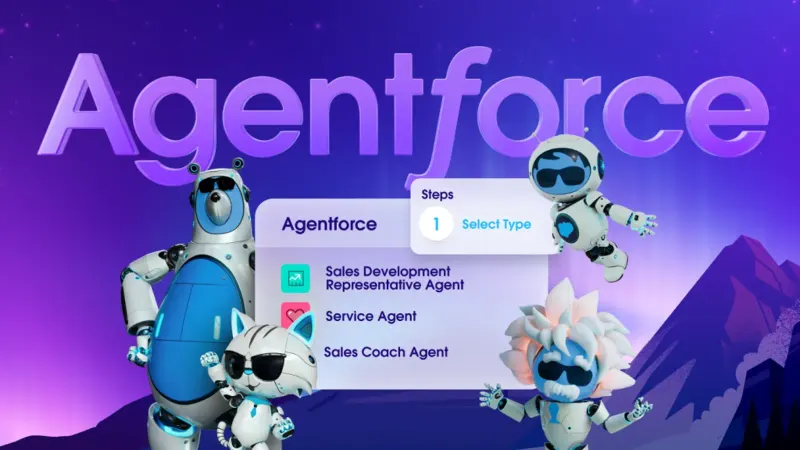
A vendor agent arrives wired into the software it lives in. Salesforce defines an Agentforce action as "a specific function that an AI agent executes on the platform", such as updating a record or answering a product question, according to a pricing breakdown by The D*AI*LY Brief that quotes the Salesforce page. Since June 2026 Salesforce has also sold Help Agent, a ready-made service agent billed per resolution.
Microsoft takes a similar line. Licensed Microsoft 365 Copilot users can build internal agents in Copilot Studio at no extra cost, while a standalone Copilot Studio plan lets you publish agents to websites and apps that unlicensed people can use, going by Microsoft's plan comparison.
KPMG names UiPath, Moveworks and DataRobot as examples of the "hundreds of vendors" selling agent platforms. The catch it flags: you depend on the vendor "for updates, support, and long-term sustainability", and customisation has limits.
Built agents give you the steering wheel
Building means picking your own model, framework and tools. KPMG's paper argues that even teams building on a framework such as LangGraph or Microsoft Agent Framework "retain full ownership", which is the main reason to build at all. It also says building "often takes longer than buying or borrowing" and needs real investment in software, data infrastructure and product management.
The build path doesn't have to be heavy. Anthropic, writing about teams it had worked with, said "the most successful implementations weren't using complex frameworks or specialized libraries" in its guide to building agents; the post now carries a note that the tooling has changed since December 2024. Honestly, that advice has aged well. Start with plain API calls and add a framework only when you feel the pain.
There's also a middle lane. Hosted agent runtimes, observability tools and agent builders (Claude Managed Agents, LangSmith Deployment, Copilot Studio itself) let you write the logic while someone else runs the servers. If you're building, our guide on how to build AI agents covers the basic steps.
Quality of output and success rates
There's no fair way to run "the same prompt" through build and buy, since a built agent is only as good as the team behind it. The better yardstick is how often each path reaches production and stays there.
On that, buying looks safer. MIT's figure (vendor-led projects succeeding about twice as often as internal builds) is the clearest. Lead author Aditya Challapally told Fortune: "Almost everywhere we went, enterprises were trying to build their own tool." The data, he said, showed purchased tools delivered more reliable results.
Quality is still the main thing that sinks agents, whoever builds them. In LangChain's State of Agent Engineering survey of more than 1,300 professionals, published in June 2026, 57% had agents in production and 32% named quality as a top barrier. Latency came second at 20%. Only 52% ran offline evaluations, while 89% had some observability in place. That gap worries me more than the model choice does, because a team that doesn't run evals can't tell whether its own agent is getting better or worse.
Then there's the wider failure rate. Gartner expects more than 40% of agentic AI projects to be cancelled by the end of 2027 "due to escalating costs and unclear business value", Reuters reported. The same report says Gartner believes only about 130 of the thousands of agentic AI vendors are real, with the rest "agent washing" old chatbots. So buying isn't a free pass. You still have to check that the vendor's agent actually acts, not just chats.
Pricing compared
Bought agents mostly bill per unit of work. Built agents bill per token, plus tooling, plus people. Here's how the main meters looked in late October and early November 2026.
| Option | Path | List price | Billing unit |
|---|---|---|---|
| Salesforce Agentforce Flex Credits | Buy | $500 per 100,000 credits ($0.10 per action) | Per action |
| Salesforce Agentforce add-ons | Buy | $125 per user a month | Per seat, unmetered |
| Salesforce Help Agent | Buy | $2 per resolution | Per resolution, packs of 1,000 |
| Microsoft Copilot Studio | Buy or build | $200 per 25,000 Copilot Credits a month | Prepaid credits or pay-as-you-go |
| Microsoft 365 Copilot | Buy | $30 per user a month, paid yearly | Per seat (internal agents) |
| Zendesk AI agents | Buy | $1.50 per automated resolution (committed) | Per resolution |
| OpenAI API, gpt-6.1-sol | Build | $2 input / $10 output per million tokens | Per token |
| OpenAI API, gpt-6-luna | Build | $0.10 input / $0.50 output per million tokens | Per token |
| LangSmith Developer | Build | Free, 1 seat, 5,000 base traces a month | Then pay-as-you-go |
Sources: Agentforce and Zendesk prices from The D*AI*LY Brief (checked against vendor pages on 30 October 2026) and eesel AI; Microsoft Copilot pricing; OpenAI API pricing; LangSmith plans.
The token prices look tiny next to $0.10 an action. They aren't the real cost of building, though. Salaries are. A single engineer costs far more a year than most mid-sized support desks would spend on Agentforce credits (our breakdown of AI engineering salaries has current figures), and you'll likely need more than one person once evals, monitoring and on-call duty are counted.
Bought agents carry their own surprise. Per-action billing means a 20-step agent costs 20 times as much per chat as a one-step one. The D*AI*LY Brief worked through a 10,000-chat month and found Agentforce Flex Credits ranged from $0.50 to $3.33 per resolved case, depending only on how many actions the agent took. That spread surprised me. It means you can't really budget a bought agent until it has run on your own tickets for a few weeks.
Reviewer and analyst views
On buying
The D*AI*LY Brief's analysis is blunt about Salesforce's metering: "If you budgeted on conversations, your estimate is wrong in whichever direction your agent's design pushes it." Its advice is to pick Flex Credits for agents averaging under about 12 actions per chat and to skip the $2-per-conversation option entirely for new deployments.
eesel AI sells a rival support agent, so take this with a pinch of salt. Still, it quotes one Salesforce admin: "Not even Salesforce can tell you how much Agentforce will cost."
On building
KPMG is the most even-handed source I found. It says building suits organisations "with advanced technical expertise, a robust and scalable infrastructure, well-defined governance, and a clear strategic vision", and it expects healthcare, life sciences, financial services and Big Tech to lean that way because of their sensitive data and budgets. It also warns that building may be "more viable for larger companies versus smaller ones". That seems fair to me. A 40-person firm probably can't spare two engineers for a year on an agent it could rent.
StackAI, a vendor of agent tooling itself, makes a point I'd agree with: "Most teams can get a proof of concept working in days." Getting the same workflow running reliably, with real permissions and audit trails, "is the real work". That's where home-built agents tend to stall.
Which one should you choose?
Buy if your agent does something lots of companies need, inside software you already pay for. Support deflection in Zendesk, case handling in Salesforce and internal Q&A in Microsoft 365 all fit. You'll pay a premium per task; in exchange, you skip months of engineering, and the MIT data suggests your odds of reaching production roughly double.
Build if the agent is where your value lives. A legal research firm whose product is its research agent shouldn't rent that from Salesforce. Neither should a company whose agent needs to act across five in-house systems that no vendor connects to. In those cases the vendor premium is probably the bigger risk.
And if you build, be honest about the run cost. Budget for evals and observability from day one (our list of AI agent observability tools is a fair starting point), because LangChain's data suggests that's where teams fall short.
My own view? Most teams should buy their first agent and build their second. The first project teaches you what your workflows actually look like, and that knowledge is what makes a later build worth the money. For the wider question of buying any turnkey AI system against rolling your own, including self-hosted models, see our turnkey AI system vs building your own comparison.
FAQ
Is it cheaper to build or buy an AI agent?
Buying is usually cheaper at first. Model tokens cost little (OpenAI's gpt-6-luna is $0.10 per million input tokens), but engineering salaries, evals and monitoring dwarf that. Building can win at very high volume, when per-action vendor fees add up faster than a small team's payroll.
How long does it take to build an AI agent?
A prototype can take days, StackAI notes. Production is the slow part: permissions, audit trails, evaluations and monitoring often take months, and KPMG says building pulls experts away from other work.
Do bought AI agents work better than custom ones?
On average, they reach production more often. MIT's NANDA research found vendor-led generative AI projects succeeded about 67% of the time, while internal builds succeeded about a third as often. A well-run in-house team can still beat a generic vendor agent on a specialised task.
What does a hybrid build-and-buy approach look like?
Typically, you buy the platform and build the parts that set you apart. That might mean Copilot Studio or a hosted agent runtime underneath, with your own prompts, tools and evaluations on top. KPMG found 57% of organisations it surveyed now favour this blend. Our explainer on agentic AI covers how these agents work.
What should I check before buying an AI agent?
Check how it's billed (per action, resolution or seat), whether unused credits expire, which systems it can act in, and whether it truly takes actions. Gartner warns many vendors are "agent washing" chatbots. Ask for a pilot on your own data before you sign anything long.