Websim AI review: free plan, credits, features and who it's for
Websim AI turns prompts into games and apps you can share and remix. Here's what the free plan covers, how credits work and where it falls short.
 Written byFahad HashmiContributing writer, AI in energy and industry
Why you can trust The AI Future
Our writers research every product from its official pages, independent tests and user reports, link each claim to its source and correct mistakes openly. Unless an article says otherwise, we haven't tested the product hands-on ourselves. Companies can't pay for coverage or see reviews before they're published.
Read our editorial policy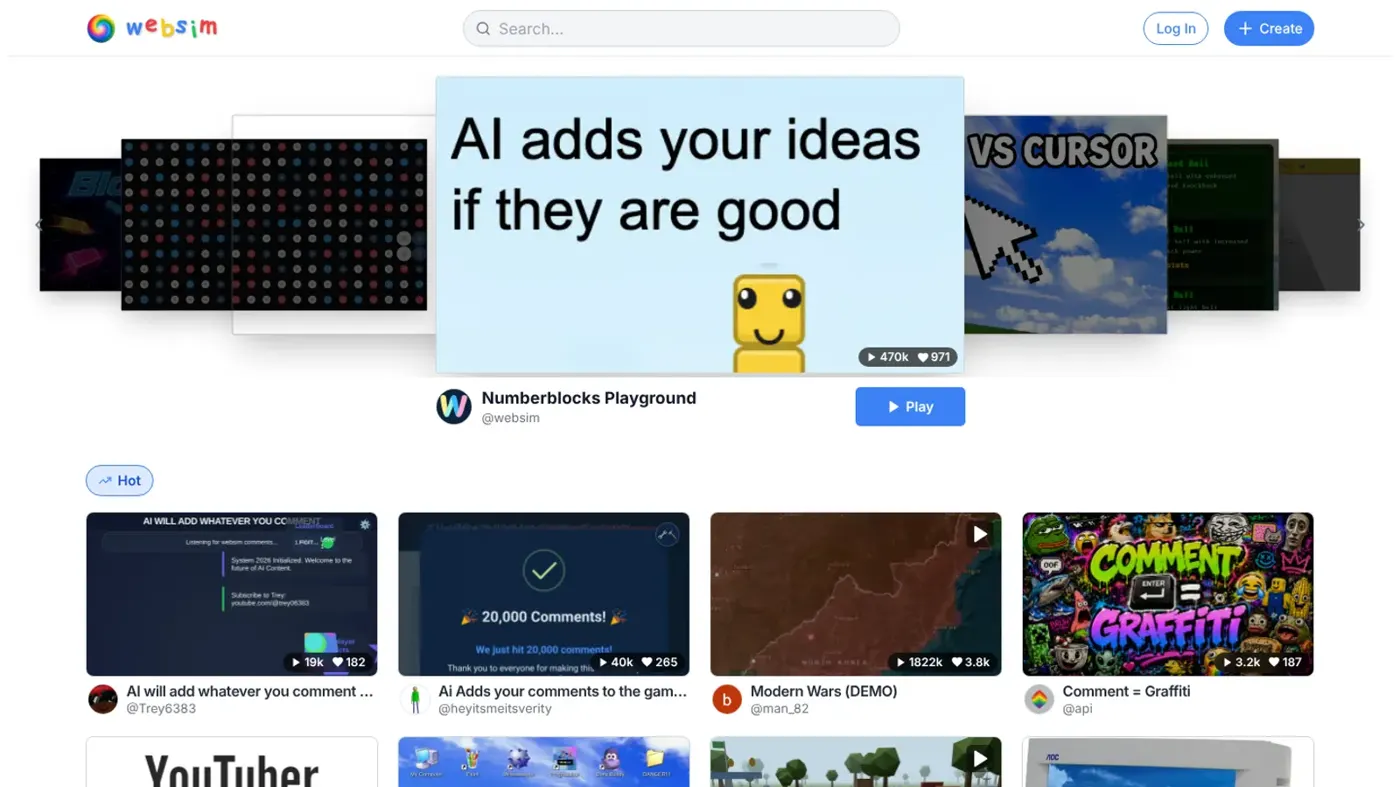
Our verdict on Websim (Websim, Inc.)
Websim is one of the easiest ways to turn an idea into a playable game or AI toy and share it, especially with a ChatGPT account connected. Students, hobbyists and tinkerers should try it; founders and developers who need private, maintainable software should skip it.
Pricing Free (300 credits at sign-up plus a daily claim); Starter 10,000 credits/week; Pro 30,000 credits/week; Max 60,000 credits/week; one-time credit purchases. Dollar prices shown in-app after sign-in.
Visit Websim (Websim, Inc.)Websim AI is a free, browser-based playground where you describe a game or app in a sentence and an AI agent writes the code, then you post it to a public feed where other people play it, comment on it and remix it. It's worth trying if you want to make toys, small games or AI-powered experiments without touching a terminal. I wouldn't build a business on it, though. The credit system has changed several times, paid features creep in, and private projects cost money.
The site lives at websim.com now (the old websim.ai address shows the same site), and it's run by Websim, Inc. If you remember it as the "internet simulator" that hallucinated fake web pages, that's still its roots: the terms of service still describe "simulated webpages". In practice it has grown into something closer to a social network for vibe-coded games.
Websim AI in brief
Here's the mental model I'd use. Websim has three layers stacked on top of each other.
- A build agent that turns your prompts into HTML, JavaScript and assets, and edits the project live while you chat with it.
- A runtime with built-in "abilities" (language models, image generation, text-to-speech, multiplayer, a database) that your project can call without API keys.
- A social feed with likes, comments, remixes, tips and a recommendation algorithm, a lot like a short-video app but for playable projects.
Credits are the glue. You spend them when a prompt runs a paid model or when a project calls an expensive ability, and you can earn them back through tips and engagement rewards. That loop is clever. It's also the source of most complaints, which I'll get to.
The homepage gives you a fair sense of the audience. Its "Hot" row currently mixes a Windows XP simulator, a "YouTuber Simulator", a Numberblocks playground and a pile of comment-driven multiplayer games. Websim's own explainer post pitches it as "a beginner-focused alternative to developer-focused tools like Cursor", and that's accurate. It's built for teenagers, hobbyists and curious tinkerers far more than for engineers.
Key features
The Build agent
You open a project, click the hammer icon and type what you want. The agent writes code and you watch the preview change. A model picker sits next to the prompt box; the editor's current list includes Gemini 3.1 Pro, Gemini 3 Flash, GPT-5.4 Nano, GPT-5.1, Kimi K2.7 and Claude Sonnet 4.6, with the cheaper ones open to free accounts and the premium ones gated behind paid plans. The August 21 update added a premium "Websim Max" model and support for modern app frameworks with nothing to set up. Typing /clear wipes the agent's memory without touching your files, which is handy when a long chat starts going in circles.
Building with your ChatGPT account
This is the feature I'd point most people to first. Since July you can connect a ChatGPT account and the build agent runs on that instead of your Websim credits. A free ChatGPT account works, and Websim charges nothing for it. Setup's the annoying part: you'll copy a 15-minute device code, possibly verify your phone, and flip a "device code authorization for Codex" switch in ChatGPT's security settings before signing in again. Ten fiddly minutes, once. After that your ChatGPT plan sets the message limits, not Websim.
AI abilities inside your projects
Projects can call AI themselves. Websim's built-in AI abilities cover language models (text and image input), image generation with transparent backgrounds and several aspect ratios, and text-to-speech in 11 languages with male and female voices. You can even pass your own ElevenLabs voice ID. Image-to-image costs 100 credits per use, so a public project that leans on it can drain someone's balance quickly.
The appeal is obvious if you've ever built this the usual way. Normally you'd need an API key, a backend to hide it, a server and some rate limiting. Here you tick a box.
Multiplayer, databases and group builds
Multiplayer got a rework in August: publishing an update no longer kicks players out mid-game, and dropped connections reconnect on their own. Projects can now store roles and permissions, so you can give friends mod powers or keep an admin panel to yourself. There's also a "Group build" setting where visitors post ideas, vote, and the agent builds the winners. Websim City 2.0 was made that way with more than 30 contributors, which I think is a genuinely fun idea.
Remixing and the comment-reading agent
Any public project can be remixed. Remixers can now pick "Suggest to original", and the creator presses Merge to let the agent fold in the parts that fit. Your project's agent can also read comments and reply, take bug reports and fix them. Its replies carry an AI badge (good call, for what it's worth; nobody likes finding out a "dev" was a bot).
Websim AI pricing and plans
Websim runs on credits, with a free tier and three subscriptions. The plan cards inside the app list these allowances:
| Plan | Credits | Unused credits bank up to | Extras |
|---|---|---|---|
| Free | 300 at sign-up, then 200 a day if you claim them | n/a | Free-tier models only |
| Starter | 10,000 a week | 80,000 | Premium models |
| Pro | 30,000 a week | 240,000 | Premium models, private projects |
| Max | 60,000 a week | 480,000 | Premium models, private projects |
You can also buy credits as a one-time purchase. Dollar prices only show up after you sign in, and I couldn't confirm them from a public Websim page, so check the plan screen in your account before you commit. Payments are non-refundable except where the terms say otherwise, and price rises take effect 14 days after Websim posts them.
The free plan in practice
Quite a lot, as long as you stay on the cheap models. You get the build agent, the feed, remixing, multiplayer and the built-in abilities. You don't get premium models or private projects, so everything you make on Free is public. And the free allowance has moved around: on January 12 Websim said it was discontinuing free daily credits, the creator program and video rewards. The daily claim is back on the plan card now, and August brought back credits for making videos, but I'd treat any free allowance here as something that can change without much warning.
A worked example with credits
Say you're on Free and you claim every day. That's 300 + (7 × 200) = 1,700 credits in your first week, then 1,400 a week after. Starter gives 10,000 a week, roughly seven times the free rate, and Pro's 30,000 is about 21 times. If you're on Starter and don't build for a month, your balance banks up to 40,000 and keeps growing until it hits the 80,000 cap (eight weeks of unused credit). So the cap only bites if you pay and then barely build, which is probably the main case where Starter is wasted money.
The other lever is the ChatGPT connection. If the agent runs on your ChatGPT account, building costs zero Websim credits, and your credits only go on premium abilities like image-to-image. For a hobbyist, I'd guess that combination makes Free plus a free ChatGPT account the best value on the site.
Performance and independent testing
I couldn't find a published, independent benchmark of Websim's build agent. What's out there is user feedback, and it's thin and noisy. Websim's Trustpilot profile (under websim.ai) sits at 3.2 out of 5 from just 14 reviews, and half of them are one-star.
The positive reviews are short and practical. One reviewer from Venezuela called it "Useful, it helps small developers develop niche websites and games". Another said it "gets me ideas". The negative ones cluster around money. A September reviewer who'd used it since 2024 wrote that "everything was free" at first and that credits "just suddenly popped up". Two reviewers, in March 2025 and March 2026, described being charged for subscriptions they believed they'd cancelled or never agreed to, and said support stopped replying.
The r/WebSim subreddit tells a different story, mostly because it's full of people sharing what they built: clickers, a Doors fan game, an infinite-crafting clone. The complaints there are smaller but telling. One user asked whether others were seeing the same copy-and-paste layout when a prompt doesn't specify a style. Another reported the site not working in Russia. A third, in a post titled "please give me credits", is a fair snapshot of the audience's age.
Limits and failure modes
Most of Websim's limits come from the same design choice: it's optimised for fast, public, single-page fun. That works well for a game jam and badly for anything you need to maintain.
- Everything is public on Free. If your idea is sensitive, you'll need Pro or Max for private projects.
- The terms grant Websim a perpetual licence to your content, including to "improve and train our AI models". You keep ownership, but read that clause before you build anything commercial.
- Generated output defaults to a samey look when your prompt is vague. Spell out the style you want.
- Credit rules have changed several times in the past year. Budget for that uncertainty.
- Billing and support complaints are real. Cancel through your account settings and keep the confirmation.
- It's not a full-stack app builder. There's no obvious path to export a production backend, auth and a custom deployment pipeline, so a serious product will outgrow it.
Age matters too. The terms bar children under 13, and 13 to 17 year-olds need a parent or guardian's consent. Given how young the community seems, I'd want parents to know that going in.
Best suited to
Websim fits a narrow but real set of people. Here's how I'd decide:
| You are... | Websim fit | Why |
|---|---|---|
| A student or hobbyist learning to build | Good | Free, no setup, instant audience and remixable examples |
| A teacher running a vibe-coding class | Decent | Easy start, but public-by-default projects and the age rules need thought |
| Someone prototyping an AI toy | Good | Built-in LLM, image and voice abilities with no API keys |
| A founder building a real product | Poor | No clear production path, licence terms, private projects cost extra |
| A professional developer | Poor | You'll want an editor and your own stack |
If vibe coding is new to you, our guide to vibe coding and the walkthrough on prompts for vibe coding with AI agents are good primers before you start.
Websim AI alternatives worth considering
Lovable
Lovable is the pick if you want a real web app with a database and auth that you can keep running. It's aimed at founders, not players. Our Lovable vs OutSystems comparison and the list of Lovable alternatives cover the trade-offs.
Base44
Base44 sits between the two: prompt-driven like Websim, but focused on business apps with users and data. See our Base44 review.
Cursor
Cursor is for people who can read code and want an AI agent inside a proper editor. It's a big step up in control and in learning curve; our Cursor review goes through it.
And if you're weighing whether to build agents yourself at all, our piece on build vs buy for AI agents is a useful sanity check.
Verdict
I'd give Websim 3.5 out of 5. As a free sandbox for making games and AI toys, it's one of the easiest places I know of to go from an idea to something your friends can play, and the ChatGPT connection makes the free tier far more usable than it was earlier this year. I'd mark it down for the shifting credit rules, the billing complaints and the licence terms, which together make me reluctant to recommend it for anything you'd want to own or sell. Use it to play, learn and prototype. Skip it if you need private, maintainable software.
FAQ
What is Websim AI?
Websim is a browser-based platform where an AI agent writes games and apps from your prompts, and a public feed lets people play, comment on and remix them. It started as an "internet simulator" and now leans heavily on games and multiplayer projects.
Is Websim AI free?
Yes, there's a free plan with 300 credits at sign-up and a daily credit claim, plus access to free-tier models. Premium models and private projects need a paid Starter, Pro or Max plan. You can also build for free by connecting a ChatGPT account.
Is Websim AI safe for kids?
The terms don't allow children under 13, and users aged 13 to 17 need parental consent. Projects are public by default and the community is large and loosely moderated, so I'd say younger teens should use it with a parent aware of what they post.
Can I use what I make on Websim commercially?
You keep ownership of your content, but you give Websim a broad, perpetual licence to use it, including to train its models. The terms also bar you from presenting AI output as human-made. Read them before you build anything you plan to sell.
Which AI model does Websim use?
It depends on what you pick. The build agent's model picker includes options from Google, OpenAI, Anthropic and Moonshot, and you can route the agent through your own ChatGPT account instead.
Ratings around the web
Ratings as of 21 Nov 2026. Scores change over time; follow the links for the latest.
What users are saying
We read all 14 Trustpilot reviews of websim.ai and about 25 recent posts on r/WebSim. Reddit is mostly creators sharing games and asking for credits, while Trustpilot is dominated by complaints about once-free features becoming paid and unwanted charges, so this small sample is split.
Common praise
- Helps beginners make games and websites quickly
- Good source of ideas and a playful community
- Easy sharing and remixing of projects
Common complaints
- Features that used to be free now cost credits
- Unexpected subscription charges and slow or missing support replies
- Generic, samey output when prompts are vague
Based on: Trustpilot reviews of Websim (websim.ai), r/WebSim subreddit
What we like
- Free to start, with no setup or API keys needed
- Build agent can run on a free ChatGPT account without spending Websim credits
- Built-in language model, image generation and text-to-speech abilities for your projects
- Multiplayer, databases, remixing and group builds make projects social
- Large community feed gives your project an instant audience
What could be better
- Free-plan projects are always public; private projects need Pro or Max
- Credit and free-allowance rules have changed several times
- Billing and support complaints in user reviews
- Broad, perpetual licence over your content, including for model training