Inspirit AI Scholars program review 2026: cost, curriculum and is it worth it?
The Inspirit AI Scholars program is a $1,400, 25-hour live online AI course for high schoolers. We weigh the curriculum, schedule, student feedback and alternatives.
 Written byBurhan AqibSenior writer, policy and analysis
Why you can trust The AI Future
Our writers research every product from its official pages, independent tests and user reports, link each claim to its source and correct mistakes openly. Unless an article says otherwise, we haven't tested the product hands-on ourselves. Companies can't pay for coverage or see reviews before they're published.
Read our editorial policy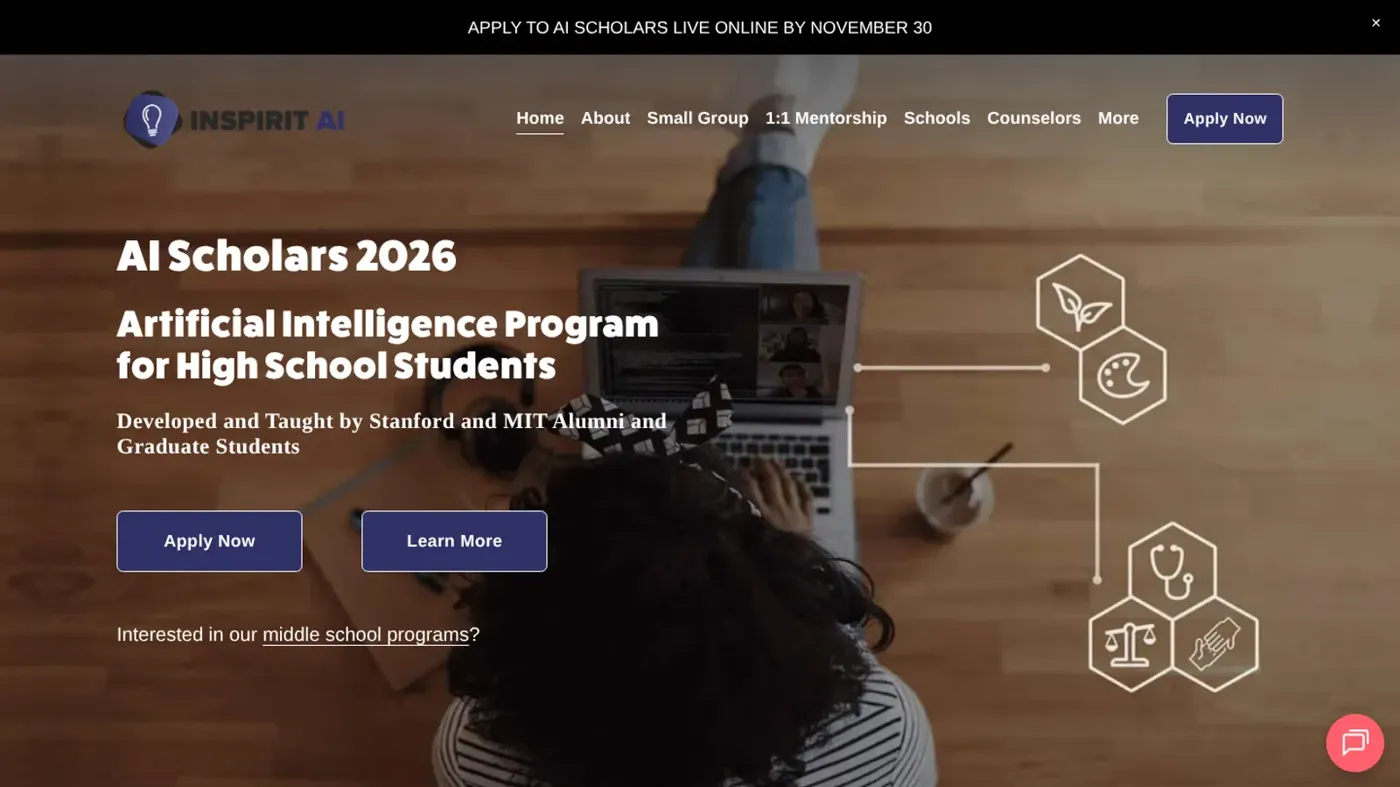
Our verdict on Inspirit AI Scholars
A well-run, beginner-friendly AI course with small groups and a real project at the end. Worth it for curious teens who need a live teacher to stay motivated; skip it if your teen already codes or you're mainly buying a line on a college application.
Pricing $1,400 for 25 hours (live online, small group); payment plans and limited need-based aid; 1:1 research from $2,500; no free plan
Visit Inspirit AI ScholarsThe Inspirit AI Scholars program is a live online AI course for high school students: 25 hours of small-group classes in Python and machine learning, ending in a team project and a short presentation. It costs $1,400. I think it's a good, well-organized first taste of AI for a curious teenager who wants a teacher in the room, but it isn't a shortcut into Stanford, and the same money buys a lot of alternatives.
If you're a parent weighing this against a summer of free online courses, that's the real question. The teaching seems solid. The value depends on how much your kid gets from live instruction and a group, rather than from a video playlist.
Inspirit AI Scholars program at a glance
| Detail | Inspirit AI Scholars |
|---|---|
| Who it's for | High school students, grades 9 to 12 (middle schoolers have separate courses) |
| Format | Live online, on Zoom, in small breakout groups |
| Length | 10 sessions of 2.5 hours (25 hours) |
| Price | $1,400, all inclusive; payment plans and limited need-based aid |
| Coding needed? | No; algebra is the only real prerequisite |
| Our rating | 4 out of 5 |
| Website | inspiritai.com |
Inspirit AI overview
Inspirit AI is a Palo Alto company founded in 2019 by Stanford alumni. AI Scholars is its flagship course, and classes are taught by graduate students, alumni and advanced undergraduates from Stanford, MIT and other universities, plus some industry people. The team page lists curriculum leads like Brianna Chrisman, a Stanford bioengineering PhD student who used to be a software engineer at Google.
One thing worth knowing up front: the footer of every page says Inspirit AI "is not an official Stanford University academic program."
It's a private company staffed by people from those schools. I don't think that's misleading on Inspirit's part (they say it plainly), but the "Stanford/MIT" branding is loud, and some families probably read more into it than is there.
The scale is bigger than I expected.
The homepage claims students from more than 2,800 high schools and 70+ countries, over 450 instructors, and 300+ alumni accepted to Ivy League schools. Those are the company's own numbers, and that last one says nothing about whether the course caused the admissions (strong applicants tend to sign up for programs like this in the first place).
Key features
Python and machine learning in the first five sessions
The first half is the classroom part. Each day opens with an applied question ("How does Alexa work?" is one example given), then moves into the intuition and some of the maths behind neural networks, decision trees and logistic regression. Students code small projects in Python notebooks on Google Colab, such as classifying cells as cancerous or healthy, or sorting restaurant reviews into positive and negative.
That's a sensible beginner syllabus. It's also a lot for five sessions of 2.5 hours, so I'd guess complete beginners will understand the ideas better than they'll be able to rebuild the code alone afterwards. Inspirit sends optional prep material first: a Python and AI basics video series plus short readings. If your teen's never coded, I'd make sure they actually do it.
The AI for social good project
Sessions 6 to 10 are given to a group project with a mentor. Before the course starts, students pick their top three project areas, and Inspirit tries to match them. The highlights listed on the site include TruthLens, a deepfake detector built with computer vision; SmokeSignal, for early wildfire detection; a colorectal tissue classifier; and an NLP project on meme-stock surges. The project ends with each group giving an 8 to 10 minute presentation that families can watch, and the overview page says students deploy "their own custom live app." That's the bit I like most. A finished, explainable project is a much better thing to talk about in an essay or interview than a certificate.
Small groups and grad-student instructors
The program overview quotes a 5:1 student-to-teacher ratio; the FAQ says the average is 6 to 1. Either way, it's small. Students sit in a main Zoom room run by a program manager and break out into groups with their instructor, and beginners are grouped with students at a similar level. Advanced cohorts exist for teens who already code.
College and career workshops
This part's openly about admissions. Workshops cover instructors' own college essays, preparing for top CS and AI programs, and how to present project work on GitHub, LinkedIn and a resume. There are also instructor talks on their research.
Honestly, it's the part I'd weigh least: useful, but your school counselor or a library book covers a lot of it for free.
Learning portal, certificate and no homework
Students get access to a learning portal with Python prep, extra coding assignments, more than five complete AI projects and 50+ recorded research talks. Materials stay live for 3 months. There's no set homework, though students usually spend 2 to 4 hours outside class on the final presentation. A certificate of completion arrives a few weeks after the course, and recommendation letters are up to the instructor.
Inspirit AI Scholars pricing and schedule
The program page lists a single price: $1,400, "all inclusive". That covers the 25 hours of class, extra help sessions and all materials, and there's no free version or trial (which is normal for a live course, so I wouldn't hold it against them).
| Program | Hours | Price |
|---|---|---|
| AI Scholars (high school, small group) | 25 | $1,400 |
| AI Deep Dives (follow-on small-group course) | 25 | $1,400 |
| AI + X Individual Research (1:1) | 10 | $2,500 |
| AI + X Individual Research Fellowship (1:1) | 25 | $5,000 |
That works out to $56 an hour of class time.
For a live group of five or six with a grad-student teacher, I'd call that fair, not cheap. Payment's due at least 30 days before the start, payment plans are available, and families can ask admissions for a need-based financial aid form (the FAQ is clear that the aid is limited).
Schedules are flexible. Winter cohorts run daily from December 19 to 30 or from December 26 to January 5, with an application deadline of November 30. Spring cohorts meet once a week for ten weeks from mid-January, and summer runs two-week weekday blocks from June to August, plus five-week weekend cohorts. All times are in Pacific Time, so a student in Europe or Asia will want to check the evening slots carefully.
Applications are rolling, and decisions come back within one to two weeks, and the only requirement is an interest in AI, so I wouldn't think of this as a selective program in the way a funded university one is.
Performance and independent feedback
There's no independent study of learning outcomes for AI Scholars that I could find, so feedback from families and students is the main evidence. On Trustpilot, Inspirit AI has a 4.8 score from 75 reviews, with 92% five-star and no one- or two-star reviews. Trustpilot also flags that the company hasn't invited reviews recently, and the profile mixes reviews of AI Scholars with the 1:1 research program.
The praise is consistent: friendly, knowledgeable instructors, and the feeling of building something real. One student who joined with no background said they still got to "create a meaningful project, present it" without feeling out of their depth. A parent who works in financial technology wrote that their son started out seeing AI as something that could solve almost anything and ended up "questioning its confidence, recognizing its limitations".
The complaints are mild but useful. One student wrote, "It was a bit slower-paced until I moved up an age group." Another said, "Some of the coding did seem a bit difficult for beginners, but it was overall good." A third "struggled with finding a strong purpose in the personal project section".
Put together, that suggests the pace depends a lot on which group you land in, which is probably the main risk with any small-group class.
On the admissions question, I'd be cautious. Paid summer programs that anyone with $1,400 can join aren't likely to impress admissions readers on their own. What can help is the project itself, if your teen can explain what they built and what went wrong.
Best suited to
AI Scholars fits a high schooler who's curious about AI, hasn't coded much, and learns better with a live teacher and peers than alone with tutorials. It also suits families who want a structured winter or summer commitment with a clear end product. I'd skip it if your teen already codes in Python and has built a model or two; they'll likely get more from the advanced cohort, the 1:1 research option or a free university course. And if the main reason is college applications, I don't think it's worth $1,400 on that basis alone.
Inspirit AI alternatives worth considering
Carnegie Mellon AI Scholars
Same name, very different program. CMU's AI Scholars is a four-week residential course in Pittsburgh for rising high school seniors, and it's fully funded and merit-based: tuition, housing and meals are covered. It's far more selective and demands full-time attendance, but if your teen qualifies, it's the stronger signal and costs nothing.
Polygence
Polygence pairs high schoolers with a research mentor for an independent project in many subjects, AI included. It's closer to Inspirit's 1:1 research track than to AI Scholars, and it suits a student who already knows what they want to study.
Free online AI courses
A motivated teen can learn the same Python and machine learning basics for free. Our guide to free AI courses and our list of the best AI courses for beginners are good starting points, and Google's AI courses are a solid free option. You lose the live teacher and the group project, which is exactly what you pay Inspirit for.
Verdict
I'd give the Inspirit AI Scholars program 4 out of 5. It's a well-run, beginner-friendly course with small groups, a sensible syllabus and a finished project at the end, and the student feedback is unusually warm. The price is the sticking point: $1,400 is fair for live small-group teaching, but it's a lot if your teen would happily learn from free material. My rule of thumb is clear. Pay for it if your kid needs a teacher and a group to stay motivated; skip it if you're mostly buying a line on a college application.
Students thinking further ahead might also like our explainer on careers in AI and machine learning.
FAQ
Is the Inspirit AI Scholars program worth it?
For a curious beginner who learns best with a live teacher, probably yes. You get 25 hours in groups of five or six, a mentor-led project and a final presentation for $1,400. It's harder to justify if your teen already codes, can stick with free courses on their own, or mainly wants a boost for college applications, since the program's open to anyone who pays.
How much does Inspirit AI cost?
AI Scholars costs $1,400 for 25 hours of live online classes, with materials included. The Deep Dives follow-on course is also $1,400. The 1:1 research mentorship costs $2,500 for 10 hours or $5,000 for 25 hours. Payment plans and limited need-based financial aid are available on request.
Is Inspirit AI part of Stanford?
No. Inspirit AI is a private company founded by Stanford alumni, and its own site says it's not an official Stanford University academic program. Instructors come from Stanford, MIT and elsewhere, but there's no Stanford credit.
Do you need coding experience for Inspirit AI?
No. About half of students are new to programming, according to Inspirit, and algebra is the only maths you need beforehand. The course teaches Python from the basics, and there's an optional prep video series. Students who already code can join advanced cohorts with harder projects.
Does Inspirit AI help with college admissions?
It includes college prep workshops and instructor talks, and many alumni went to top universities. But it's open to anyone who applies and pays, so I doubt the name alone carries much weight. A project your teen can explain well in an essay is likely the most useful thing it produces.
Ratings around the web
Ratings as of 20 Nov 2026. Scores change over time; follow the links for the latest.
What users are saying
We read about 16 recent Trustpilot reviews from students and parents. Nearly all were positive about instructors and projects; the mixed ones mentioned pace (too slow in one group, too hard for beginners in another) and trouble defining a project. The sample is small and covers all Inspirit programs, not only AI Scholars.
Common praise
- Friendly, knowledgeable instructors
- Building and presenting a real AI project
- Accessible for students with no coding background
Common complaints
- Pace can be too slow or too fast depending on the group
- Some coding felt hard for complete beginners
- Hard to find a clear purpose for the personal project
Based on: Trustpilot reviews of Inspirit AI, Trustpilot reviews of Inspirit AI (page 2)
What we like
- Small live groups (5 or 6 students per instructor)
- No coding experience needed; Python taught from the basics
- Mentor-led group project ending in a presentation and a deployed app
- Many schedule options across winter, spring and summer
- Very positive student and parent feedback on Trustpilot
What could be better
- $1,400 is a lot next to free online AI courses
- Open enrollment, so it carries little weight in admissions on its own
- Not an official Stanford program despite heavy Stanford/MIT branding
- Pace depends on your group; some found it slow, others found the coding hard
- Portal materials only stay live for 3 months