Best AI search visibility gap analysis tools in 2026: 8 picks for every budget
Find the prompts, sources and pages where AI names your competitors instead of you. We compare 8 gap analysis tools, from free to enterprise.
 Written byMuhammad Usman SiddiquiFounder and editor-in-chief
Why you can trust The AI Future
Our writers research every product, link each claim to its source and correct mistakes openly. Companies can't pay for coverage or see reviews before they're published.
Read our editorial policy
If you want to know exactly which prompts, sources and pages are handing AI answers to your competitors, start with the Semrush AI Visibility Toolkit or Peec AI. Semrush has the clearest "where am I missing?" filter for prompts and sources. Peec AI goes deepest on citation gaps, down to the URL. The rest of these AI search visibility gap analysis tools are enterprise upgrades, budget options or specialists. I'd start with one of those two unless your budget or company size rules them out.
A gap analysis tool is a different animal from a plain AI search checking tool. A checker tells you whether ChatGPT mentions you. A gap tool tells you where a rival is named and you aren't, which third-party sites feed those answers, and what content you need to win them back. We compared eight tools on that job, using official pricing and help pages, published third-party reviews and G2 ratings reported by other reviewers, as of late October 2026. For the broader view of mentions, sentiment and share of voice, see our sister roundup of the best AI brand visibility analysis tools.
Key takeaways
- Gaps come in four kinds: prompt gaps (questions where rivals appear and you don't), source gaps (sites that cite rivals but not you), citation gaps (AI names you but links elsewhere) and narrative gaps (AI describes rivals more favourably). Most tools cover two or three.
- URL-level data is what makes a gap fixable. A domain tells you who's winning, but a URL tells you which page to beat or which editor to pitch.
- Budget picks exist: Promptmonitor starts at $39 a month and Otterly.AI at $29, while AthenaHQ has a free plan for a first look.
- One run proves little, because AI answers change from run to run. I'd treat a gap as real only once it repeats over weeks.
Our ranking method
Nobody at The AI Future ran hands-on tests or took screenshots for this roundup. We ranked each tool using its official product, pricing and help pages, published gap-analysis guides from the vendors, independent roundups and G2 ratings as reported by Brand24 and others, as of late October 2026. We scored each tool on seven criteria:
- Prompt gaps: can it list the prompts where competitors appear and you don't?
- Source and citation gaps: does it show the domains and URLs that cite rivals but not you?
- Content gaps: does it point to topics, fan-out queries or pages you need to create?
- Actionability: recommendations, agents, outreach contacts or briefs that turn a gap into a task.
- Engine coverage: which answer engines are included and which cost extra.
- Price per AI answer: prompts × models × frequency for the money.
- Independent feedback: G2 ratings and published reviews, with conflicts of interest noted.
Our top picks at a glance
| # | Tool | Category | Best for | Free tier | Starts at |
|---|---|---|---|---|---|
| 1 | Semrush AI Visibility Toolkit | SEO suite add-on | Prompt and source gaps | No | $99/mo |
| 2 | Peec AI | Dedicated AI visibility | URL-level citation gaps | No | $95/mo |
| 3 | Profound | Enterprise GEO platform | Enterprise competitive gaps | No | Custom |
| 4 | Ahrefs Brand Radar | SEO suite add-on | Market-wide gaps with no setup | No | $50/mo |
| 5 | SE Visible | Dedicated AI visibility | Gap data on a mid budget | No | $89/mo |
| 6 | Promptmonitor | Dedicated AI visibility | Outreach-ready source gaps | No | $39/mo |
| 7 | AthenaHQ | Dedicated AI visibility | A free first gap check | Yes (limited) | $295/mo |
| 8 | Otterly.AI | Dedicated AI visibility | Small budgets | No | $29/mo |
The best AI search visibility gap analysis tools in 2026, ranked
Semrush AI Visibility Toolkit – best for prompt and source gaps
The Semrush AI Visibility Toolkit is a $99 add-on that benchmarks your AI visibility against competitors and lists the prompts, topics and sources where they get cited and you don't.
Strengths
Semrush built a workflow that maps almost exactly onto a gap analysis. In its own guide to finding AI visibility gaps, Semrush splits gaps into five levels: mention, prompt, source, citation and narrative. In the Competitor Research report, you enter your site and up to four competitors, then apply a "Missing" filter to see topics and exact prompts where AI names a rival but not you. The same filter on the Sources tab shows domains that cite competitors and haven't mentioned you, which becomes an outreach list. Semrush says this draws on more than 289 million prompts and responses. That's a big pool, and I think it's the toolkit's real selling point.
The limits bite at the entry price. Going by the Semrush knowledge base, you get 25 tracked prompts, one project and one domain for Brand Performance, with extra domains and extra users at $99 each, and no free trial. Brand24 reported a 4.4/5 G2 rating from 4,034 reviews for the full Semrush suite, and quoted a Reddit user who called Semrush's AI tracking "pretty limited honestly".
Key features
- A "Missing" filter in Competitor Research for topics, prompts and sources.
- Brand Performance reports on share of voice, sentiment and narrative drivers, updated weekly.
- Prompt Tracking runs daily checks on 25 prompts at the base price.
Pros
- The clearest prompt-gap and source-gap workflow on this list
- Gap data sits next to your keyword and backlink data
- Market-level data from day one, no prompt setup needed
Cons
- Only 25 tracked prompts for $99
- No free trial for the toolkit
- Extra users and domains cost $99 each
Semrush AI Visibility Toolkit pricing: No free plan; then $99/month; 50 extra prompts cost $60/month (checked October 2026). See pricing
Related: Best AI visibility optimization tools
Verdict: if you already live in Semrush, this is probably the fastest route from "we're missing" to a list of prompts and sites to fix.
Peec AI – best for URL-level citation gaps
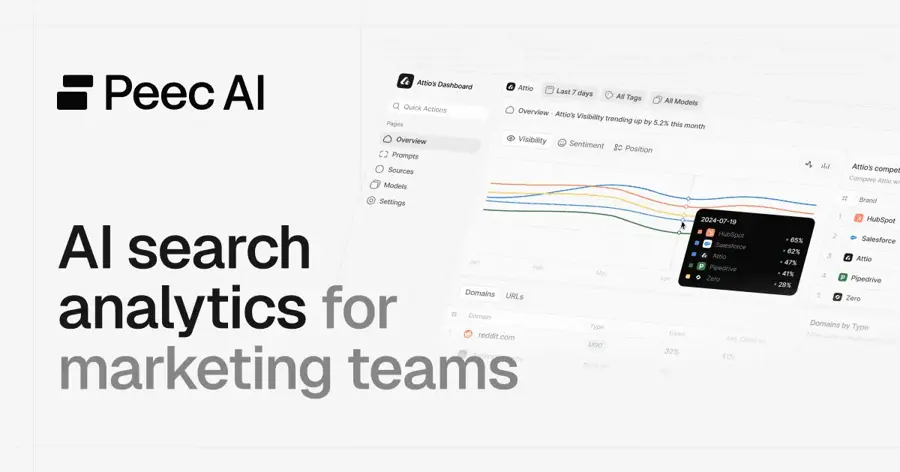
Peec AI is a dedicated AI search analytics platform that tracks visibility, position, sentiment and share of voice daily, with a gap analysis of sources that name competitors but not you.
Strengths
Peec AI describes its gap analysis, on the plans page, as "Sources that appear often and name competitors but not you, by source, domain, subdomain, URL, and host." That granularity is the point, and it's why I rate this one so highly. The Rank Masters, which compared citation gap tools, put it simply: "A score tells you that you lost. A URL tells you to whom." Peec also classifies each source as competitor, editorial, reference or UGC and adds ranked recommended actions split into earned and owned.
The catch is engine choice: self-serve plans track three models, and Claude, Perplexity and Grok are listed only on Enterprise. In Brand24's roundup (Brand24 sells a competing tool), Peec AI held a 4.8/5 G2 rating from 21 reviews, though the reviewer said it "shows the data but offers little guidance on what to do next". The recommended-actions features seem aimed at closing that gap.
Key features
- Gap analysis lists competitor-only sources by domain, subdomain and URL.
- Sources are classified as competitor, editorial, reference or UGC.
- Prompt suggestions point to prompts worth adding based on coverage gaps.
- Recommended actions rank opportunities, grouped by earned and owned.
Pros
- The most granular citation gap view at this price
- Unlimited seats and competitors on every plan
- 4,500 AI answers a month on the $95 plan
Cons
- Only three models on self-serve plans
- Claude and Perplexity need Enterprise
- No free plan
Peec AI pricing: No free plan, then paid plans from $95/month for 50 prompts; Pro $245, Advanced $495 (checked October 2026). See pricing
Related: Best AI visibility tracking tools
Verdict: probably the best pure citation gap tool for most marketing teams and agencies.
Profound – best for enterprise competitive gaps
Profound is an enterprise AI search platform that benchmarks you against the brands winning AI citations, prompt by prompt, across up to nine answer engines.
Strengths
Profound treats gap analysis as a full workflow. Its competitor benchmarking page covers prompt-level competitive insights to "reverse-engineer what makes their content win", competitor change monitoring with "AI-generated gap analysis via Slack", and head-to-head content optimisation that compares your page with the competitor page landing a citation.
Access is the problem. Profound dropped its self-serve Starter and Growth brand plans in September 2026, Brand24 reports. Looking at the prices, there's now a free trial (50 prompts daily for seven days on ChatGPT, Gemini and Google AI Overviews) and then custom Enterprise pricing. Brand24 reported a 4.5/5 G2 rating from 1,128 reviews and said price is the most common complaint.
Key features
- Prompt-level competitor insights show the prompts driving rival citations.
- Head-to-head optimisation compares your page with the cited competitor page.
- Change monitoring sends alerts when competitor citation performance shifts.
- Up to nine answer engines are covered on Enterprise.
Pros
- Turns a gap into a page-level brief
- Competitor discovery based on real citations
- SSO/SAML and SOC 2 for security reviews
Cons
- No published price after the trial
- Trial covers only three engines
- More than most small teams will use
Profound pricing: Free 7-day trial; then Enterprise plans at custom pricing (checked October 2026). See pricing
Verdict: the strongest gap-to-content workflow I can see, if you can get through a sales process.
Ahrefs Brand Radar – best for market-wide gaps with no setup
Ahrefs Brand Radar measures any brand's AI visibility across an index of 519 million+ prompts and tracks your own custom prompts, so you can benchmark competitors before writing a single prompt.
Strengths
Brand Radar is the fastest way to see who owns your category. On the product page, topic data shows "where your content is (or isn't) feeding AI responses". For content gaps specifically, it surfaces the fan-out queries AI generates behind the scenes "to find content gaps".
Ahrefs admits the index "works best for established brands or topics with meaningful search demand", so newer brands should rely on custom prompts. In Brand24's roundup, the full Ahrefs suite held 4.5/5 on G2 from 714 reviews, and the reviewer called Brand Radar great for "where do we stand?" but less helpful for "what should we do next?"
Key features
- The AI Visibility Index holds 519 million+ prompts, with historical data back to 2025.
- Fan-out queries expose the hidden searches AI runs, useful for content gaps.
- Competitor benchmarks cover mentions, citations and AI share of voice.
- Custom prompts run daily, weekly or monthly, with tags by topic or funnel stage.
Pros
- Instant competitor gaps with no setup
- Custom prompts included in paid Ahrefs plans
- Covers social sources that AI cites
Cons
- Thin index coverage for low-demand brands
- Descriptive more than prescriptive
- Claude uses 8 checks per update
Ahrefs Brand Radar pricing: No free plan (a separate free checker exists); then custom prompt packages from $50/month; daily custom prompts included in paid Ahrefs plans (checked October 2026). See pricing
Related: Best free AI visibility checking tools Best AI visibility tracking tools
Verdict: likely the best place to spot category-wide gaps on day one, especially if you already pay for Ahrefs.
SE Visible – best for gap data on a mid budget
SE Visible is SE Ranking's standalone AI visibility platform, with competitor gaps in prompt research, citation gaps and content gaps listed in its plan comparison.
Strengths
For the money, SE Visible packs in a lot of gap data. The plan breakdown includes "Prompts where you appear" and "Competitor gaps" under prompt research, "Citation gaps", citation share, source classification and fan-out queries under citation analytics, and "Content gaps" and agents under actions. The $89 Basic plan includes 75 tracked prompts, about 11,250 AI answers a month, five projects and unlimited seats.
Recommendations look newer than the monitoring, and I'd want to see them mature. When Brand24 reviewed it, the verdict was "You'll see the gaps, but you won't find any recommendations." The current plan breakdown includes agents and content gaps, so check which tier has them during the 10-day trial. There was no G2 rating yet at the time of Brand24's review.
Key features
- Competitor gaps show prompts where rivals appear and you don't.
- Citation gaps list cited domains and pages, with source classification.
- Fan-out queries reveal the searches behind each AI answer.
- Reporting includes client access, a Data Studio connector, API and MCP.
Pros
- About 11,250 AI answers a month for $89
- Unlimited seats and five projects from the start
- 10-day free trial
Cons
- Claude only on the $399 Agency plan
- No independent ratings yet
SE Visible pricing: No free plan (10-day trial), then paid plans from $89/month, or $71/month billed annually (checked October 2026). See pricing
Related: Best AI visibility tracking tools Best AI brand visibility analysis tools
Verdict: probably the best value per AI answer for teams that want prompt and citation gaps without an enterprise bill.
Promptmonitor – best for outreach-ready source gaps
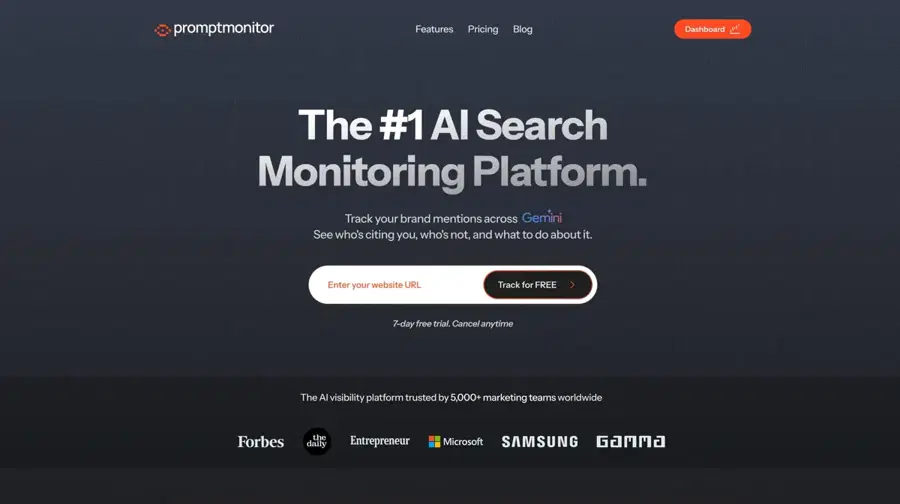
Promptmonitor is a low-cost AI visibility tracker that pulls every cited source for every prompt and adds publisher contact details, so a source gap becomes an outreach list.
Strengths
Most tools stop at "this site cites your rival". Promptmonitor's plans all include competitor and citation tracking "and the publisher contacts no other tool gives you". A review by PromptLayer, which says it uses the tool, describes an "Opportunities" list of sources that don't mention you yet, "complete with SEO metrics like domain authority and author contact information".
The entry plan is small. Starter covers one website and 25 prompts checked semi-weekly, and Claude, DeepSeek and the rest need Growth. We found no independent G2 rating, so the praise is probably early.
Key features
- Citation tracking covers every cited source for every prompt, on every plan.
- Publisher contacts give you outreach details for sources that skip you.
- Eight AI models are covered on Growth and above.
Pros
- Cheapest way to get citation gap data with contacts
- Unlimited seats from Growth
- 7-day trial on every paid plan
Cons
- Starter runs only semi-weekly
- Starter covers three models and one site
- No independent ratings yet
Promptmonitor pricing: No free plan (7-day trial), then paid plans from $39/month, or from $33/month billed yearly (checked October 2026). See pricing
Verdict: the pick for PR and link-building teams who want to act on source gaps the same day.
AthenaHQ – best for a free first gap check
AthenaHQ is an AI search visibility platform with competitor insights, citation intelligence and on-page and off-page actions, plus a free Essential plan.
Strengths
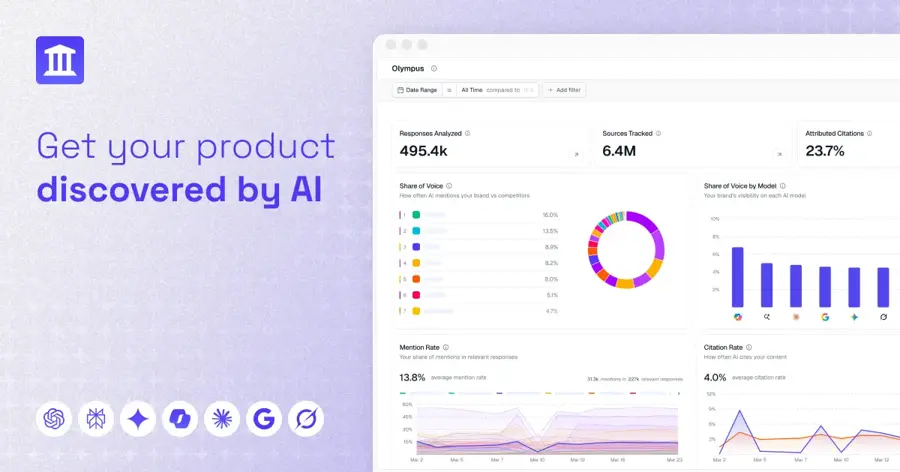
AthenaHQ is the only pick here with an ongoing free plan. On the plans page, Essential is free with 300 credits (one credit equals one AI response), including "Sources and competitor insights" and content recommendations. Brand24 singled out its competitor heatmaps, which "show at a glance which topics your competitors own in AI answers, with most-cited sources right underneath."
The $295 Starter plan adds 3,600 credits across 11 models, unlimited prompts and competitors, on-page and off-page actions and a content optimisation agent. API access and extra credits are paid add-ons. The same page shows a G2 rating of 4.9 out of 5, in line with the 4.9/5 from 44 reviews that Brand24 reported.
Key features
- The free Essential plan gives 300 credits with sources and competitor insights.
- Competitor heatmaps show topics rivals own, with their top sources.
- 11 models are covered, including ChatGPT, Perplexity, Gemini, Claude, Copilot and Grok.
- Actions cover on-page and off-page fixes plus a content agent.
Pros
- A real free plan for a baseline gap check
- Wide model coverage on Starter
- Turns gaps into tasks
Cons
- Big jump from free to $295
- 300 free credits run out quickly
- API and extra credits cost more
AthenaHQ pricing: Free, then paid plans from $295/month (checked October 2026). See pricing
Related: Best AI visibility optimization tools
Verdict: I'd start here if you want to see your competitor gaps before spending anything.
Otterly.AI – best for small budgets
Otterly.AI is a low-cost AI search monitoring tool with brand reports, link citation analysis and a GEO audit that compares you with a competitor set.
Strengths
Otterly AI is the cheapest credible way to start a gap habit, I think. Zapier lists the Lite plan at $29 a month for daily tracking of 15 prompts across Google AI Overviews, ChatGPT, Perplexity and Microsoft Copilot, with Claude, AI Mode and Gemini as add-ons, and called it "one of the most affordable tools for getting started on the market currently." Rankability describes link citation analysis that shows which URLs each engine references most, and a GEO audit "with SWOT, competitor set, and tactic gaps."
Fifteen prompts is a small sample for gap work, and the next tier jumps to $189 a month. Brand24 reported a 4.7/5 G2 rating from 54 reviews, with reviewers noting that sentiment is sometimes misclassified. We couldn't load Otterly's own pricing page while researching, so confirm prices there before you buy.
Key features
- Link citation analysis shows the URLs each engine cites most.
- The GEO audit covers SWOT, competitor set and tactic gaps.
- Keyword-to-prompt builds prompts from your SEO keywords.
Pros
- Lowest entry price on this list
- Easy setup from existing keywords
- Covers the four core engines
Cons
- Only 15 prompts on Lite
- Gemini and AI Mode cost extra
- Big price step to Standard
Otterly.AI pricing: No free plan, then paid plans from $29/month (as reported by Zapier, October 2026). See pricing
Related: Best free AI visibility checking tools
Verdict: the right first paid tool for a solo marketer; upgrade once you know which prompts matter.
Choosing the right AI search visibility gap analysis tools
Decide which gap you need to close
Different gaps need different fixes. If AI ignores you on key prompts, you need prompt and content gap data (Semrush, SE Visible, Ahrefs). If third-party sites drive the answers, you need source gaps (Peec AI, Promptmonitor). If AI names you but links to someone else, look for citation gaps at URL level.
Do the prompt maths
Prompts × models × days gives you the number of AI answers you're buying. Using published plan limits:
| Plan | Prompts | AI answers per month | Price | Cost per 1,000 answers |
|---|---|---|---|---|
| Promptmonitor Growth | 50 | 4,500 | $79 | About $18 |
| Peec AI Starter | 50 | 4,500 | $95 | About $21 |
| SE Visible Basic | 75 | About 11,250 | $89 | About $8 |
| AthenaHQ Starter | Unlimited (credit based) | 3,600 | $295 | About $82 |
Answer volumes come from each vendor's pricing page. Some tools do more analysis per answer, but two $90 plans clearly aren't equal.
Match the engines to your buyers
A gap on ChatGPT isn't a gap on Claude. Peec AI keeps Claude and Perplexity on Enterprise, SE Visible adds Claude on its Agency plan, and Ahrefs charges 8 checks per Claude update.
Use this quick decision table
| Your situation | Choose |
|---|---|
| You want to see gaps for free first | AthenaHQ Essential |
| Solo marketer, under $50 a month | Otterly.AI or Promptmonitor |
| PR or link-building team | Promptmonitor or Peec AI |
| Already on an SEO suite | Semrush AI Visibility Toolkit or Ahrefs Brand Radar |
| Agency or mid-size team | Peec AI or SE Visible |
| Enterprise with a content team | Profound |
Running your first gap analysis
Whichever tool you choose, the process is similar.
- Pick three to five real competitors. Use the brands AI already cites, not just the ones you track in SEO.
- Build 20 to 50 buyer prompts. Cover your product categories, audiences and buying stages.
- Filter for missing. List the prompts where rivals appear and you don't, then the sources behind those answers.
- Sort fixes into owned and earned. Owned means creating or updating your pages. Earned means pitching the editors, review sites and forum threads AI already cites. See our guide to increasing AI citations.
- Re-check after four to eight weeks. Keep the prompt set stable in the meantime.
One warning before you act on any single result. In SparkToro's study, 600 volunteers ran 12 prompts through ChatGPT, Claude and Google's AI a combined 2,961 times, and found less than a 1 in 100 chance that ChatGPT or Google's AI would return the same list of brands in any two of 100 responses. (SparkToro discloses that its research partner works at an AI tracking startup.) A gap that shows up once may be noise, while one that repeats across weeks is probably real.
Free vs paid: what you actually get
Free AI search checking tools give you a snapshot. Paid gap tools give you a list of things to fix, tracked over time.
- Free checkers from Ahrefs, Semrush, HubSpot and others show a one-off read on mentions and competitors. They're a decent way of confirming a problem; see our roundup of free AI visibility checking tools.
- Free plans and trials such as AthenaHQ Essential (300 credits), Profound's seven-day trial or SE Visible's 10-day trial let you see real competitor and source gaps, but the samples are too small to trust for trends.
- Paid plans add daily tracking, URL-level citation gaps, missing-prompt filters, recommendations and exports.
A sensible path, in my view: run a free check, then buy the cheapest plan that covers your buyers' engines with at least 50 prompts. Our explainer on what AI visibility is covers the metrics.
Final verdict
If you only pick one, pick the Semrush AI Visibility Toolkit when you already use Semrush, and Peec AI when you don't. Semrush has the clearest missing-prompt and missing-source filters; Peec AI has the deepest citation gap data, down to the URL, from $95 a month. SE Visible is the value pick at $89. Enterprises that want gap analysis wired straight into content production should talk to Profound. On a tight budget, Promptmonitor ($39) gives you source gaps with publisher contacts, Otterly.AI ($29) gets you started, and AthenaHQ lets you look for free. Want the wider category? See our best AI visibility tracking tools.
FAQ
What is an AI search visibility gap analysis tool?
It's software that runs buyer-style prompts through ChatGPT, Gemini, Perplexity, Google AI Overviews and other engines, then compares your results with competitors. It shows the prompts where rivals are named and you aren't, the sources and URLs that cite them instead of you, and the content you need to win those answers back.
What is a citation gap in AI search?
A citation gap is a page or site that AI engines cite when answering a prompt, which mentions your competitors but not you. Closing it means getting included on that page through outreach, or publishing a better page of your own that the engine is more likely to cite next time.
Is Otterly AI good for gap analysis?
Otterly AI is a good budget starting point. Its link citation analysis shows the URLs each engine cites most, and its GEO audit compares you with a competitor set. The $29 Lite plan tracks only 15 prompts, though, so serious gap work usually needs a larger plan or a tool such as Peec AI or SE Visible.
What is the best AI search checking tool for free?
For a free check, AthenaHQ's Essential plan includes 300 credits with sources and competitor insights, which is enough for a first gap view. One-off free checkers from Ahrefs, Semrush and HubSpot are faster but show a snapshot rather than gaps over time. Expect to pay once you need daily tracking.
How often should I run an AI visibility gap analysis?
Track prompts daily or weekly, but review gaps monthly. AI answers vary a lot between runs, so a gap should repeat across several weeks before you act on it. Give new content four to eight weeks before judging it.
Sources
- AI Visibility Toolkit: Boost Brand Visibility in AI Search (Semrush)
- How to find AI visibility gaps with Semrush (Semrush)
- Pricing for Peec AI - AI Search Analytics for Marketing teams and SEO agencies (Peec AI)
- Pricing - Profound (Profound)
- AI Search Competitive Benchmarking Tool (Profound)
- Ahrefs Brand Radar: See ANY brand's AI visibility (Ahrefs)
- Plans & Pricing (Ahrefs)
- Pricing & Plans | SE Visible AI Visibility Platform (SE Ranking)
- Promptmonitor Pricing — Choose Your Plan (Promptmonitor)
- Promptmonitor Review: Boost Your AI Workflow Efficiency (PromptLayer)
- Plans & Pricing | Action on AI Search (AthenaHQ)
- The best AI visibility tools (Zapier)
- Otterly AI Review for Agencies (2026) (Rankability)
- AI Brand Visibility Tracking Tools: 16 Best for 2026 (Brand24)
- Best AI Citation Gap Analysis Tools (2026): Compared (The Rank Masters)
- NEW Research: AIs are highly inconsistent when recommending brands or products (SparkToro)