Digital AI review 2026: Digital.ai features, pricing, pros and cons
Digital.ai is an enterprise DevSecOps platform, not a marketing tool. We break down its products, AWS Marketplace pricing, user feedback and who should skip it.
 Written byFahad HashmiContributing writer, AI in energy and industry
Why you can trust The AI Future
Our writers research every product, link each claim to its source and correct mistakes openly. Companies can't pay for coverage or see reviews before they're published.
Read our editorial policy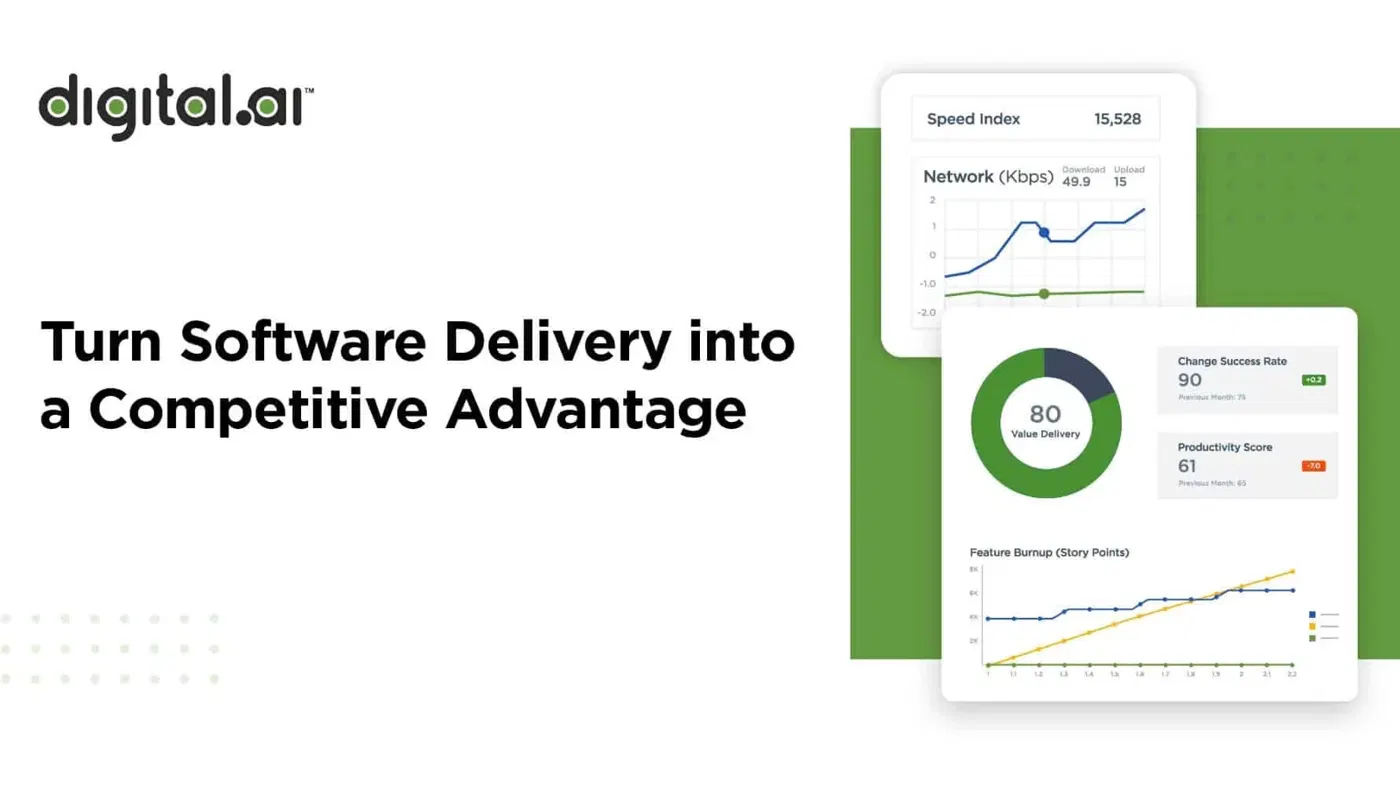
Our verdict on Digital.ai
Digital.ai is a mature, broad software delivery platform for regulated enterprises with many teams, and its mobile app protection is its standout. Large enterprises with complex release governance should shortlist it; small teams, anyone wanting transparent pricing, and people looking for AI marketing software should skip it.
Pricing No free plan; quote-based. AWS Marketplace lists Essential App Protection at $20,000/12 months and AI change-risk or ITSM analytics at $250,000/12 months; Agility, Release and Deploy via private offer
Visit Digital.aiDigital.ai isn't a chatbot or a marketing app. It's an enterprise software delivery platform from Raleigh, North Carolina that bundles agile planning, release orchestration, deployment automation, app testing, mobile app security and analytics, and it now pitches all of that as "agentic AI for the entire software lifecycle". If you run software delivery at a bank, insurer, carmaker or government agency, it's worth a look. If you're a small team, a solo developer or someone looking for AI digital marketing tools, it's probably the wrong product.
Nobody at The AI Future ran Digital.ai hands-on for this review. It's sold through sales calls and private contracts, with no self-serve free plan to sign up for. Instead, we reviewed the Digital.ai platform as it stands in late October 2026 using the official product pages, the company's 2026 press releases, its AWS Marketplace listing and published user reviews on AWS Marketplace and PeerSpot. Where a user reports a result, we say who.
The headline: I think the platform's strength is its breadth in regulated industries, and its mobile app protection is the most distinctive piece. The trade-offs are opaque pricing, a user interface several reviewers call dated, and AI features that users say are still uneven outside the security product.
About Digital.ai
Digital.ai is a set of enterprise tools stitched into one platform, covering the work that happens before and after code is written. The company says it was formed by the leading providers of agile planning, DevOps, and application security technologies, and it describes its job as unifying, securing and generating predictive insights across the software delivery lifecycle for Global 5000 enterprises.
Long-time DevOps people will recognise the parts. The AWS listing names six products: Agility, Application Security, Continuous Testing, Release, Deploy and Intelligence. A August 2026 partnership announcement also lists TeamForge for application lifecycle management and refers to the security line by its older brand, Arxan Security. One PeerSpot-sourced AWS reviewer still calls Release and Deploy by their old names, XL Release and XL Deploy.
A few facts about the company, as of October 2026:
- Ownership: private. Pricing tracker PricingSaaS lists it as founded in 2020 and backed by TPG Capital, with 101 to 1,000 employees.
- Leadership: Derek Holt is CEO, as quoted in the company's March 2026 Quick Protect Agent v2 announcement.
- Customers: the company says 53% of Fortune 100 companies use its testing product, and its homepage cites 57 government entities worldwide.
- Deployment: on-premises, private cloud and SaaS options, according to the knowmad mood announcement.
The current positioning is that most AI tools speed up coding, while the real enterprise bottlenecks sit in planning, security, testing and release. Digital.ai's homepage puts it as applying "agentic AI upstream in planning and downstream in security, testing, and DevOps". If you want background on what that term means, our explainer on what agentic AI is and how agents work covers the basics.
Key features
Agility: enterprise agile planning
Digital.ai Agility is the planning layer: portfolio planning, capacity, and links between work items and business strategy, aimed at CIOs, PMOs and product leaders. The product page promises "AI-powered predictive intelligence" on top of unified planning data. This is a competitor to Jira Align-style scaled agile tools, not to a simple team board.
Digital.ai also publishes the long-running State of Agile survey. Its 18th edition, released October 28, 2025, reported AI adoption among respondents rising from 68% to 84%, while only 49% said they had guardrails in place. That gap is probably the problem Digital.ai's governance pitch is built around.
Release and Deploy: orchestration and deployment
Digital.ai Release orchestrates release pipelines through reusable templates, self-service catalogs and built-in governance steps. Digital.ai Deploy handles the actual pushes to "containers, private and public clouds, middleware, and mainframe". The AWS listing says Deploy can run thousands of simultaneous deployments and roll back automatically on failure.
The mental model is simple: Jenkins, GitHub Actions or Argo CD build and ship artifacts; Release sits above them and decides who approves what, in which order, with which change tickets.
User reviews on AWS Marketplace describe exactly that pattern, with integrations to Jenkins, Argo CD, Ansible, Terraform, Jira and ServiceNow change requests.
Application Security: post-build mobile app hardening
This is the product Digital.ai leads with in 2026. Application Security adds obfuscation, anti-tamper checks, runtime threat detection and runtime application self-protection (RASP) to finished apps, "all post-build with no source code changes". It supports frameworks including Swift/Objective-C, Flutter, React Native, Unity and C/C++.
The Quick Protect Agent v2, announced March 4, 2026, analyses app code to find the most sensitive components and obfuscates only those areas, which the company says reduces the performance hit. It also connects hardening to Digital.ai Testing so protected builds can be tested without tripping their own anti-tamper defences.
The case for it comes from Digital.ai's own data. Its 2026 Application Security Threat Report says 87% of monitored client-facing apps faced attacks in 2026, up from 55% in 2022, and that iOS (86%) and Android (89%) attack rates have nearly converged. I'd treat these as vendor figures from vendor telemetry, not independent research.
Testing: real devices and browsers at scale
Digital.ai Testing (formerly Continuous Testing) gives you real and virtual mobile devices plus browsers across seven global data centres, including one in Switzerland. It runs functional, performance and accessibility checks in one pass and adds AI root-cause analysis for failed tests. The company says more than 10 million tests ran on it in 2025. It also supports device features that are awkward to fake, such as biometrics, network throttling, geolocation and interrupts, and it added Android Auto and Apple CarPlay test automation in January 2025.
Intelligence: delivery analytics and change-risk prediction
Digital.ai Intelligence pulls data from Digital.ai and third-party tools into one data lake, with DORA and flow metrics, persona dashboards and machine learning models that predict delivery timeframes and the probability that a change will fail. On AWS Marketplace this shows up as separately priced ITSM process optimisation and change risk prediction modules.
Digital.ai pricing and plans
Digital.ai doesn't publish a price list, and there's no free plan. PricingSaaS records a single quote-based offering called "Digital.ai Flex Points", and Capterra lists Digital.ai Release as "Contact vendor" with no free trial. The only public numbers we found are on the AWS Marketplace listing, checked October 2026:
| AWS Marketplace item | What it covers | Listed cost (12 months) |
|---|---|---|
| Mobile Application | Essential App Protection, low-code protection for iOS and Android | $20,000 |
| ITSM, 500K annual | ITSM process optimisation, AI/ML analysis of 500K transactions | $250,000 |
| CRP, 500K annual | Change risk prediction, AI/ML analysis of 500K transactions | $250,000 |
| CRP onboarding | Analytics setup and ITSM connector for ServiceNow or Remedy | $50,000 |
| SMPO onboarding | Analytics setup and ITSM connector for ServiceNow or Remedy | $50,000 |
Agility, Release, Deploy and the fuller app protection suite are sold through custom private offers; the listing tells you to email the AWS orders team. The listing also states that no refunds are available.
There's no honest way to give one number. A reviewer on AWS Marketplace who uses the testing and test management side called the licensing "a little expensive", especially enterprise licences, and PeerSpot's summary of Release reviews notes that "the cost of Digital.ai Release is high". I'd budget in tens of thousands of dollars a year at minimum, plus implementation time.
Performance and independent testing
We found no independent benchmark of Digital.ai's platform, which is normal for enterprise DevOps software. The best evidence is verified user reviews. We read the ten reviews of Digital.ai currently shown on the AWS Marketplace review list, which are syndicated from PeerSpot, plus PeerSpot's pros and cons summary for Release. Scores in those reviews ranged from 6 to 9 out of 10, with most at 7 to 9.
What users consistently report:
- Integrations are the strength. A user at BNP Paribas describes running production deployments through Release with Jenkins and Argo CD, and using a go/no-go gate tied to ServiceNow change requests. That reviewer gave it 8 out of 10.
- Standardisation saves time. One reviewer says creating an Azure resource group and subnets by hand "would have taken one to two days", while the automated templates finish "within a minute".
- The interface is dated. Several reviewers say new users feel lost, one calls the UI "a bit old and not very appealing", and another flags a hidden toggle that causes steps to be skipped.
- AI is uneven. A test manager rated it 6 out of 10, saying manual mobile testing is "very good" but automated testing is "hit and miss" and that AI test generation "did not work entirely flawlessly". Another reviewer wanted "more AI capability" in Release.
A worked example: what the time savings look like
The same test manager reported that QA engineers used to spend four to five hours per release on test management and reporting, and now save "at least one or two hours for each release". Take the low end and plug in illustrative numbers: 4 QA engineers, each handling 10 releases a month, saving 1 hour each time, frees 40 hours a month, or about 480 hours a year. At a loaded cost of $60 an hour that's roughly $28,800 a year.
That's in the same range as a single $20,000 app protection line item on AWS, which is the point: I'd expect Digital.ai to pay off when you have many teams and many releases, not one team shipping twice a month.
The limits
- Small teams: no free tier, no self-serve plan, no public pricing. You can't try it over a weekend.
- Developer experience: reviewers describe a steep first-use curve and forms that lose your inputs if you go back a step.
- Test automation speed: one reviewer says open-source tools like Cypress and Playwright are faster for web tests with parallel execution.
- AI maturity: the AI story is strongest in app security; in Release and Testing, users say it's still catching up.
Who it's for
| Your situation | Fit | Why |
|---|---|---|
| Bank, insurer or government team with change-control rules | Strong | Approval gates, ServiceNow integration and on-premises options |
| Company shipping consumer iOS and Android apps | Strong | Post-build app hardening plus real-device testing |
| Enterprise mixing mainframe, VMs and cloud | Good | Deploy targets mainframe, middleware, containers and cloud |
| Startup or small dev team | Poor | No free plan, quote-only pricing, heavy setup |
| Marketer looking for AI digital marketing software | None | Digital.ai doesn't do marketing |
If your interest is the security side, compare it against our list of the best AI code security tools. If you're evaluating platforms across the business, our roundup of enterprise AI solutions is a better starting point.
Digital.ai alternatives
- GitLab: a single DevSecOps platform that runs from source control to deployment, with the Duo Agent Platform billed through usage credits at a standard rate of $1 per credit, per GitLab's pricing. Better if you want one tool your developers already live in.
- Harness: CI, CD, GitOps, infrastructure as code and security testing orchestration. It has a free plan with Harness Open Source, an all-in-one Essentials bundle and a modular Enterprise plan.
- Atlassian Jira: the default alternative to Agility for planning. Jira has a free plan for up to 10 users, and paid tiers include Rovo AI credits and agents in Jira.
None of these covers post-build mobile app hardening in the way Digital.ai's Application Security does, so if that's your main need, the shortlist looks different.
Verdict
Digital.ai is a serious, mature platform for large enterprises that need governed release pipelines, mixed legacy and cloud deployments, and hardened mobile apps. Its AI work is most convincing in app security, where Quick Protect Agent v2 tackles a real and growing attack problem. Elsewhere, users still describe the AI as a work in progress, and I'd say the dated interface is the price you pay for flexibility.
I'd use it if you're a regulated enterprise with many teams, many releases and a procurement process that's used to quote-based software. Skip it if you're a small team, want transparent pricing or need a quick trial. It's also not the "digital AI" tool you want if you were searching for AI marketing software. We rate it 3.5 out of 5.
FAQ
What does Digital.ai do?
Digital.ai sells an enterprise platform for planning, testing, securing, releasing and deploying software. Its main products are Agility, Release, Deploy, Testing, Application Security and Intelligence. In 2026 it markets them as one AI-powered platform that adds agentic AI to the steps around coding, not to code generation itself.
Is Digital.ai free?
No. Digital.ai has no free plan and no public price list. Pricing is quote-based, and its AWS Marketplace listing shows items such as Essential App Protection at $20,000 for 12 months. Other products, including Agility, Release and Deploy, are sold through private offers, so you need to contact sales for a quote.
Is Digital.ai an AI digital marketing tool?
No. Despite the name, Digital.ai hasn'thing to do with AI digital marketing. It's DevSecOps and software delivery software. If you landed here looking for AI marketing or sales tools, our guide on how to use AI for sales is a closer match.
Who owns Digital.ai?
Digital.ai is a private company. PricingSaaS lists it as founded in 2020 and backed by private equity firm TPG Capital. It's headquartered in Raleigh, North Carolina, and Derek Holt is its chief executive officer.
What is Digital.ai Quick Protect Agent?
Quick Protect Agent is Digital.ai's guided tool for hardening Android and iOS apps after they're built, with no source code changes. Version 2, announced in March 2026, uses an LLM to find the most sensitive parts of the code and obfuscate only those, and links protection to Digital.ai Testing in CI/CD pipelines.
What are the main Digital.ai alternatives?
For DevOps pipelines, GitLab and Harness are the closest alternatives, both with self-serve options. For agile planning, Atlassian Jira is the common choice. For mobile app hardening, you'll need a dedicated app security vendor instead, since general DevOps platforms don't offer the same post-build protection.
What users are saying
We read the ten verified user reviews shown on Digital.ai's AWS Marketplace review list (syndicated from PeerSpot) plus PeerSpot's pros and cons summary for Digital.ai Release, checked October 2026. Scores ranged from 6 to 9 out of 10. This is a small sample from enterprise users only; we found no meaningful Reddit, X or app-store discussion of the product.
Common praise
- Integrations with Jenkins, Argo CD, ServiceNow and Jira
- Standardised, automated releases that cut manual work
- Good manual mobile testing on hosted real devices
Common complaints
- Dated, confusing user interface
- Automated testing and AI features are hit and miss
- High cost of enterprise licences
Based on: Digital.ai reviews on AWS Marketplace, Digital.ai Release pros and cons on PeerSpot
What we like
- Covers planning, release, deployment, testing, app security and analytics in one platform
- Post-build mobile app hardening with no source code changes, now guided by an LLM-enhanced agent
- Strong integrations with Jenkins, Argo CD, Ansible, Terraform, Jira and ServiceNow
- On-premises, private cloud and SaaS deployment options for regulated industries
- Real-device testing across seven global data centres, including Switzerland
What could be better
- No free plan, no trial for Release and no public price list
- Users describe the interface as dated and hard for newcomers
- AI features outside app security are reported as uneven, especially automated testing
- Expensive for small teams; AWS listing offers no refunds
Sources
- AI-Powered DevOps Platform (Digital.ai)
- About Us (Digital.ai)
- Digital.ai Agility (Digital.ai)
- Digital.ai Release (Digital.ai)
- Digital.ai Deploy (Digital.ai)
- Digital.ai Application Security (Digital.ai)
- Digital.ai Continuous Testing (Digital.ai)
- Digital.ai Intelligence (Digital.ai)
- Agentic AI is accelerating how software gets built and how it gets attacked: 2026 AppSec Threat Report (Digital.ai)
- Digital.ai brings post-build mobile app protection into the CI/CD pipeline with Quick Protect Agent v2 (Digital.ai)
- Digital.ai and knowmad mood deepen global partnership (Digital.ai)
- Digital.ai's 18th State of Agile Report (Digital.ai)
- Digital.ai launches end-to-end automated testing for Android Auto and Apple CarPlay (Digital.ai)
- Digital.ai by Digital.ai (AWS Marketplace)
- Digital.ai Reviews (AWS Marketplace)
- Digital.ai Release: Pros and Cons 2026 (PeerSpot)
- Digital.ai Release Software Pricing, Alternatives and More 2026 (Capterra)
- Digital.ai Pricing and Plans (PricingSaaS)
- Pricing (GitLab)
- Harness Pricing (Harness)
- Jira pricing (Atlassian)