Anthropic's IPO filing renews debate over an AI bubble: what it means if it pops
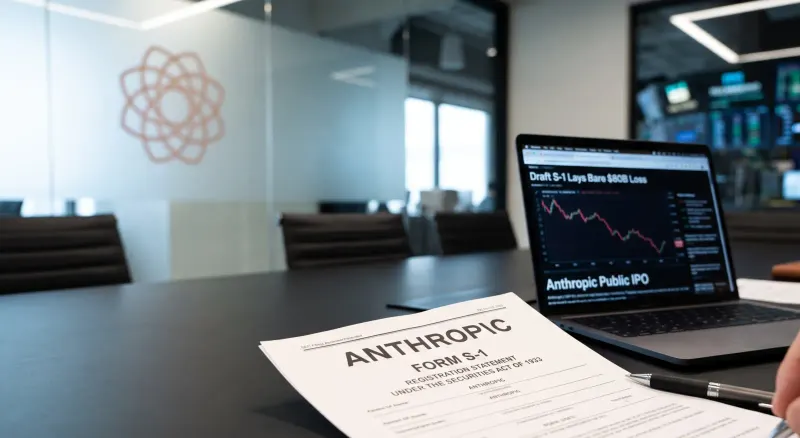
Anthropic filed for a Nasdaq listing on Oct. 26. Analysts and economists are again asking whether AI is a bubble, and what would follow if it burst.
 Written byRahis SaifiCo-founder and news editor
Why you can trust The AI Future
Our writers research every product, link each claim to its source and correct mistakes openly. Companies can't pay for coverage or see reviews before they're published.
Read our editorial policy
Anthropic filed paperwork on Oct. 26 for an initial public offering, and the filing has revived debate over whether AI is a financial bubble. According to the company's announcement, it plans to list on the Nasdaq Global Select Market under the symbol "ANT".
The question matters because the IPO could test how much investors will pay for AI companies. Economists say a sharp fall in AI valuations could spread well beyond tech.
What Anthropic has filed
The company submitted a Form S-1 registration statement to the U.S. Securities and Exchange Commission. Anthropic said the number of shares and the price range have not yet been determined.
Anthropic confidentially submitted a draft in June, NPR reported. That came a week after the company said its valuation had reached $965 billion.
USA Today, in an explainer by Greta Reich, said the 335-page filing did not state a valuation. It said some investors have guessed it could reach $2 trillion, which would make it the largest IPO ever. That figure is an investor guess, not a company number.
The same report said trading is expected to start before Thanksgiving. It described the debut as a litmus test for investor demand that could set the stage for other private AI companies, including OpenAI.
The numbers in the filing
According to USA Today, Anthropic reported $16.3 billion in revenue in the first half of 2026. The VC Corner, which read the prospectus, put it at $16,286 million, against $1,163 million a year earlier.
Yahoo Finance reported that, according to the S-1, Anthropic had a net loss of $80.7 billion through June. It said most of that came from accounting charges. The company lost $42 billion in 2025, Yahoo said.
One expert quoted by USA Today pointed to the cost side. Financial counselor Tess Waresmith said Anthropic has committed to more than half a trillion dollars in computing costs. She said growth must keep pace for a high share price to make sense.
What an AI bubble means
USA Today defines a bubble as overinvestment in a sector that will not deliver a positive return, which eventually creates market instability. Rob May, author of the 2026 book "Investing in AI", cited the 19th-century railroad bubble and the 1990s dot-com bubble as examples.
May said overinvestment could mean data centers, model providers or startups, and that these will not all fare alike. He said he sees "pockets of bubbles" but does not expect a violent pop.
Experts disagree on whether a bubble exists. Nvidia CEO Jensen Huang said in August that he is willing to pay hundreds of millions of dollars a year for AI services, USA Today reported. The same article noted that Sequoia Capital estimated a $600 billion gap between AI spending and returns in 2024.
How big the exposure is
Consultancy Oliver Wyman published an analysis in January. It found the "Magnificent Seven" tech stocks made up 35% of the S&P 500, the same top-seven concentration as at the dot-com peak.
The report cited a JP Morgan estimate that more than $6 trillion in funding will be needed by 2030 for AI data centers, energy projects and supply chains. It also said a growing share is debt-financed.
Oliver Wyman described two ways a bust could unfold: an equity sell-off, or a sell-off made worse by AI-related credit defaults. In the equity case, it said, a repeat of the early 2000s would wipe out about $33 trillion of value at today's valuations.
The firm also described a milder path. It said valuations have not yet reached dot-com extremes, so a correction would not automatically cause a broad rout.
Who would be affected
USA Today quoted Dennis Kelleher, CEO of the nonprofit Better Markets, who said a burst could hurt ordinary Americans. He listed lost corporate profits, unpaid loans, bank failures, falling stock markets and a contracting economy. He also said that if there is no bubble, the economy could benefit from the AI buildout.
In a July report by The Hustle, experts split the impact into several groups:
- Investors: Ryan Cummings of the Stanford Institute for Economic Policymaking said AI firms are priced as if each will win, and not all will.
- Retirement savers: Researcher John Turner said S&P 500 tracker funds carry 35% exposure to the Magnificent Seven. Savers may not realise how exposed they are.
- Consumers: Cummings described a "wealth effect". Falling portfolios lead people to cut spending, which can drag on the wider economy. He said he would be surprised if the U.S. avoided a recession before the end of 2028.
- Workers: Azeem Azhar of Exponential Views said data center construction creates jobs, though those jobs are temporary.
NPR has reported the same wealth-effect concern. Its guest said a large enough stock market fall could be recessionary.
Not all bubbles end the same way
Will Quinn of Queen's University Belfast told The Hustle that a bust is not guaranteed to be economically devastating. Turner said the dot-com crash left behind real internet infrastructure.
The sources differ on the dot-com decline. Oliver Wyman says the Nasdaq fell by nearly 80% from March 2000 to October 2002. The Hustle cites a 77% drop.
Turner said the AI boom, like the dot-com bubble, is so far largely equity-funded, whereas the housing bubble was propped up by debt. Oliver Wyman warns that AI debt is rising, citing more than $100 billion in hyperscaler bond issuance in six months.
What happens next
Anthropic's pricing and first-day trading will be the next data points. The company has not yet set a price range or share count, according to its own announcement.
Yahoo Finance's coverage of the filing said it boosted the AI trade, which had been in a slump. USA Today reported that if Anthropic is overvalued, the bubble would grow and any fallout would be larger, according to Kelleher.
None of these sources say a crash is certain. The Hustle's experts also stressed that nobody can know a bubble until after it bursts.
Sources
- What is the 'AI bubble' and what happens if it pops? (USA Today via Lee Enterprises)
- Anthropic files S-1 with the SEC for proposed initial public offering (Anthropic)
- What happens if the AI bubble bursts? (Oliver Wyman)
- What happens when the AI bubble pops? (The Hustle)
- Anthropic publicly files IPO prospectus, noting strong revenue growth and massive spending (Yahoo Finance)
- Anthropic IPO live updates (Yahoo Finance)
- Anthropic S-1: IPO Filing, ANT Ticker, Revenue and Losses (The VC Corner)
- AI giant Anthropic prepares to sell stock to the public, files preliminary IPO paperwork (NPR)
- Is the AI boom an AI bubble? (NPR)