Harvard AI course in 2026: what's free, what's paid and which to pick
The main Harvard AI course, CS50 AI, is free to take online. Here's how it works, what Harvard's paid AI courses cost, and which one suits you.
 Written byMuhammad Usman SiddiquiFounder and editor-in-chief
Why you can trust The AI Future
Our writers research every product from its official pages, independent tests and user reports, link each claim to its source and correct mistakes openly. Unless an article says otherwise, we haven't tested the product hands-on ourselves. Companies can't pay for coverage or see reviews before they're published.
Read our editorial policy
There isn't one Harvard AI course. There are dozens, and the one most people mean is CS50's Introduction to Artificial Intelligence with Python, a seven-week coding course you can take free online, with an optional $299 verified certificate through edX. If you can't code, or you want a business angle instead, Harvard also sells shorter non-technical courses from about $250 up to $1,995, plus a graduate certificate in AI that costs $14,320.
Is it worth it? For the free CS50 course, I think yes, if you already know some Python and you're willing to put in real hours. The paid business courses are a harder call, and that's mostly about price per hour, which I'll get to.
The background: Harvard's AI courses come in four flavours
Harvard doesn't run one AI school. Its courses come out of different parts of the university, each with its own platform, price and idea of who the student is. Search Harvard's online catalogue for "artificial intelligence" and you'll get 48 results, from TinyML for microcontrollers to AI in clinical dentistry.
Most of them fall into four groups:
- Free courses from CS50, Harvard's computer science team, which run on edX and on Harvard's own OpenCourseWare site.
- Business and leadership courses from Harvard Business School Online and Harvard Kennedy School Executive Education.
- Short self-paced courses from Harvard Online, some of them only a few hours long.
- For-credit courses and certificates from Harvard Extension School.
The flagship, the one that shows up when people search "harvard ai course", is CS50 AI. It's taught by Brian Yu, with David J. Malan, and the seven weeks map neatly onto the big ideas of the field: search, knowledge, uncertainty, optimization, learning, neural networks and language. Each week is a lecture followed by a hands-on project you write in Python and submit for automatic grading.
The course has kept up with the field. Its current description lists large language models alongside graph search and classification, and the last project is called Attention, after the idea at the heart of today's language models. The prerequisite is CS50x (Harvard's general intro to programming) or "at least one year of experience with Python". That second option matters more than people expect.
The business courses work differently. There's no code. You watch case studies, do reflection exercises and, in some cases, join a live session with faculty. They're aimed at managers who need to make decisions about AI rather than build it.
Real examples: five Harvard AI courses side by side
Here's a sample of what's actually on offer right now, with the prices and time commitments Harvard lists. I've added one column of my own: an estimated cost per hour of study, worked out from the listed weeks and weekly hours. It's rough, but it's the comparison I'd want before handing over a card.
| Course | Who runs it | Length | Price | Rough cost per study hour |
|---|---|---|---|---|
| CS50's Introduction to AI with Python | CS50 on edX | 7 weeks, 10–30 hrs/week | Free; $299 verified certificate | $0, or about $1.40–4.30 with certificate |
| Data Science and AI Principles | Harvard Online | 5 weeks, 4–5 hrs/week | $1,200 | About $48–60 |
| Generative AI: How to Use It and Why It Matters | Harvard Kennedy School Executive Education | 6 weeks, 4–5 hrs/week | $1,995 | About $67–83 |
| AI Essentials for Business | HBS Online | 4 weeks, 16–24 hrs total | $1,949 | About $81–122 |
| Artificial Intelligence Graduate Certificate | Harvard Extension School | 4 courses, 8 months to 3 years | $14,320 | Not listed per hour |
That spread surprised me. On a per-hour basis, the free coding course with a paid certificate is somewhere between about 10 and 85 times cheaper than the business courses, and it asks far more of you.
A couple of smaller options fill the gaps. The Agentic AI Skills Builder, led by Harvard professor Hanspeter Pfister, costs $250 and has you build working agent workflows with Claude Cowork: a morning briefing, automated note-taking and a local knowledge wiki. It needs about 2–3 hours a week and has no formal prerequisites. For people who've finished CS50 AI and want more depth, Introduction to Neural Networks and Deep Learning with Python is an eight-week edX course, also free to audit with a $299 certificate.
And if you want actual Harvard credit, the CS50 AI material also runs through the Extension School as CSCI E-80, a four-credit online course. The spring section runs from January 25 to May 15, 2027.
Benefits and limitations
Let's start with what's good. CS50 AI is a real university course, not a marketing funnel, and the full lectures and projects are free. You write an AI that plays Minesweeper, another for Tic-Tac-Toe and one for the game Nim, instead of watching someone else do it. That's the part I'd value most, because building things is how the ideas stick.
The business courses have a different strength: they're built around cases and frameworks from people who study AI adoption for a living. AI Essentials for Business is taught by Karim R. Lakhani and Marco Iansiti, and its exercises ask you to apply the material to your own organisation (sketching your company's data pipeline, for example, and proposing an AI project). If your job is to decide what your team should buy or automate, that's probably more useful than learning how a neural network does backpropagation.
Now the limitations, and there are real ones.
The CS50 certificates aren't Harvard credentials. The course FAQ is blunt about this: "Our free and verified certificates are not accredited academic offerings from Harvard or any of its affiliate institutions." The free CS50 certificate needs a score of at least 70% on every project, and the paid edX version is the same work with identity verification on top. Employers may like seeing CS50 on a CV, but it isn't a degree.
The workload also catches people out. Ten to 30 hours a week for seven weeks is a part-time job. Without a year of Python behind you, I'd guess most of that time goes on fighting the language rather than learning AI.
Then there's completion. A 2019 study in Science by Justin Reich and José Ruipérez-Valiente looked at HarvardX and MITx courses on edX over six years. In 2017-18, just 3.13% of participants completed their course. Among learners who'd paid for the verified track, 46% finished. The free course is a gift; it's also very easy to abandon.
The business courses have their own problems. At $1,949 for 16–24 hours, AI Essentials for Business is expensive for what's essentially a well-produced, self-paced module with a 90-day access window. You're paying for the Harvard Business School name, the case material and the certificate. Some employers will reimburse that. If yours won't, I'd want a very specific reason to pay it.
Practical takeaways for picking a course
Here's how I'd match people to courses, based on what each one actually teaches and costs.
If you can already code a bit and you want to understand how AI works under the hood, take CS50 AI and audit it for free. Pay the $299 only if you want the verified certificate or you know the payment will keep you honest (the completion numbers above suggest it often does). It's the best AI coding course Harvard offers for the price, by a wide margin.
If you've never programmed, don't start with CS50 AI. Start with CS50x, which is also free and was designed for beginners; two thirds of its students have never taken computer science before. Then come back.
If you manage people and need to make decisions about AI, the business courses make more sense. I'd lean towards the $1,200 Data Science and AI Principles course over the $1,949 HBS course for most managers, mainly because it covers how data quality and algorithms affect AI systems, and it now includes a live faculty Q&A with each run. That's a judgement call, though, and the HBS case approach suits some people better.
If you want a Harvard AI certificate that carries academic weight, the Extension School's graduate certificate is the real thing. You take four courses for graduate credit (foundations, NLP and machine learning, deep learning and computer vision, and ethics and law), with no application required. It's also $14,320, and Harvard itself says it'll be difficult without Python. That's a serious commitment, and I wouldn't do it without a clear career plan.
It's also worth comparing against other providers before you commit.
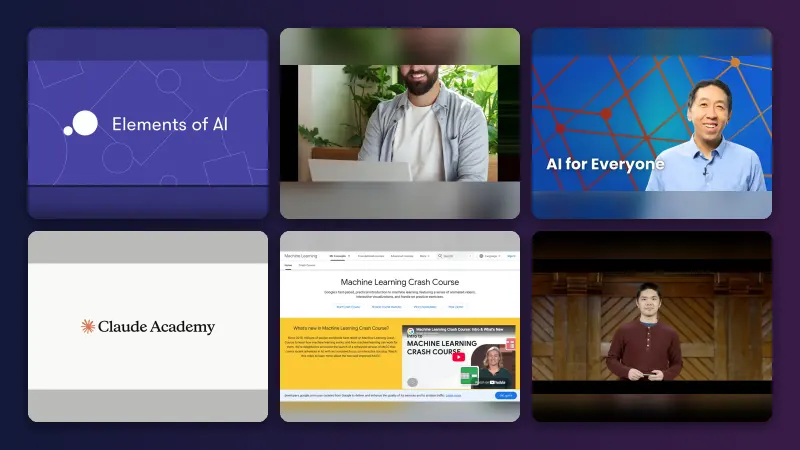
Our guide to free AI courses covers options from beyond Harvard, and Google's AI courses are a cheaper route if you mostly want practical skills with AI tools. If you're weighing a career move, our explainer on careers in AI and machine learning is a sensible next read.
Next steps for Harvard's AI courses
A few dates are already fixed. CS50 AI's current term has an overall deadline of 30 June 2027, and the team says it re-evaluates the course a few months before that and may extend it by six or 12 months. Work you've completed this term carries over if it does. If the course moves to a new edition, though, old projects won't count.
The Extension School's AI certificate has its next start in spring 2027, with registration open until January 19, 2027. The next run of the Kennedy School's generative AI course runs from January 11 to February 19, 2027, with registration closing on January 4.
Beyond those dates, I'm guessing. My sense is that Harvard will keep adding short, practical courses like the Agentic AI Skills Builder, because the catalogue already leans that way and the topics change too fast for semester-long courses to keep up. I'd also expect CS50 AI to keep adding material on language models, since that's where the field has moved fastest. Neither of those is announced, so treat them as predictions.
My verdict? If you've got enough Python, the free CS50 course is one of the best online AI classes from any university. The business courses are good but pricey; I'd only pay full price with an employer covering it.
FAQ
Which AI course is best?
It depends on your starting point. For people who can code a little, I think CS50's Introduction to AI with Python is the strongest pick: it's free, project-based and taught by Harvard staff. Managers who won't write code are probably better served by a short business course, such as Harvard Online's Data Science and AI Principles.
Which course is best for AI if you can't code yet?
Start with CS50x, Harvard's free introduction to computer science, which assumes no experience. After that, CS50 AI becomes realistic. If you don't want to code at all, a non-technical option like the Kennedy School's six-week generative AI course or our list of AI courses for beginners will suit you better.
Which is the best AI course you can take for free?
CS50 AI is hard to beat.
All seven weeks of lectures and projects are free, and scoring at least 70% on every project earns a free CS50 certificate. The paid $299 edX version adds identity verification. Neither is an accredited Harvard credential, so don't present it as one.
Which is the best course in AI for a career change?
If you're serious about switching into AI work, the Harvard Extension School graduate certificate carries real academic credit, but it costs $14,320 and expects Python and statistics. A cheaper path is CS50x, then CS50 AI, then a portfolio. Our AI engineer course explainer covers that route in more detail.
Which is the best online course for AI if you run a team?
For team leads, I'd look at HBS Online's AI Essentials for Business ($1,949) or Harvard Online's Data Science and AI Principles ($1,200). Both skip coding and focus on decisions: where AI fits, what data it needs and which ethical risks to watch. Ask your employer about reimbursement first, since neither is cheap.