AI essay grader explained: how it scores, how accurate it is and where it's biased (2026)
An AI essay grader scores writing against a rubric. Here's how it works, what the accuracy and bias research says, and when teachers and students should trust it.
 Written byDr. Alap ZahidReviews And Guides Editor
Why you can trust The AI Future
Our writers research every product from its official pages, independent tests and user reports, link each claim to its source and correct mistakes openly. Unless an article says otherwise, we haven't tested the product hands-on ourselves. Companies can't pay for coverage or see reviews before they're published.
Read our editorial policy
An AI essay grader is software that reads a piece of student writing, compares it with a rubric and suggests a score plus written feedback. Most of today's tools run on large language models like ChatGPT, and the research says they're decent at landing near a human score but much worse at matching it exactly. I think that makes them useful for drafts and practice, and risky for any grade that really counts.
This guide draws on published studies, news reporting and the tools' own pages as of late October 2026; nobody at The AI Future tested these graders hands-on. For products and prices, see our roundup of the best AI graders and the wider list of AI grading tools for teachers. Here I'm sticking to how the technology works and how far to trust it.
Inside an AI essay grader: two generations of software
Computers have been scoring essays for decades. The older systems were trained on hundreds of human-graded essays for a single prompt, then learned which measurable features predicted a high mark. ETS's e-rater engine, used in testing, is the best-known example. Going by ETS's own description, it looks at things like vocabulary-based content analysis, lexical complexity, the proportion of grammar and mechanics errors, and organisation and development scores.
That approach worked. It was also expensive.
As The Hechinger Report explained, building one of these older graders meant training it on graded essays for each question, which only made economic sense for something like a standardized test where thousands of students answer the same prompt. They could be gamed too: once students worked out which features counted, some nonsense essays scored well because they were sprinkled with fancy vocabulary.
The new generation is different. A teacher (or a startup's product, on the teacher's behalf) pastes in the rubric and the essay, and a general-purpose language model is told to score it. No training on that prompt is needed. That's why so many products appeared so fast, and why a student can now get an "AI paper grader" verdict on a history essay in seconds.
| Feature | Older essay scoring engines | LLM-based AI essay graders |
|---|---|---|
| Setup | Trained on hundreds of graded essays per prompt | Reads your rubric, no prompt-specific training |
| What it looks at | Measurable features (errors, vocabulary, length, organisation) | Patterns learned from huge amounts of text |
| Typical use | Standardized tests with one shared prompt | Any class assignment, any rubric |
| Feedback | Mostly a score | Score plus comments in plain language |
| Known weak spot | Gamed by stuffing in fancy words | Scores cluster in the middle; style sways marks |
One analogy helps here. An LLM grader is a bit like a supply teacher who's handed your rubric five minutes before class: quick, broadly sensible, and inclined to give a lot of people a C. The research below suggests that last part isn't a joke.
AI essay grader accuracy: what the studies found
The study most people cite came from Tamara Tate's team at UC Irvine. They had ChatGPT score 1,800 middle and high school history and English essays on a six-point scale, using only the human raters' rubric. In one batch of 943 essays it was within a point of the human score 89% of the time; that fell to 83% and then 76% in two other batches. Exact agreement was only about 40%, compared with roughly half the time between two humans, Hechinger reported. Tate called ChatGPT "roughly speaking, probably as good as an average busy teacher", but said it wasn't accurate enough for high-stakes tests or final grades.
"Within one point" sounds reassuring until you remember the scale only runs from 1 to 6. On that scale, a one-point miss can be the gap between a pass and a fail.
University work looks shakier. A study in Assessment & Evaluation in Higher Education put 50 undergraduate bioscience essays through two versions of ChatGPT under four prompting conditions. Times Higher Education reports that the AI usually marked higher than humans, inflated weak essays and marked down strong ones; in one case the gap was 40 marks out of 100. Co-author William Kay of Cardiff University said LLMs "cannot, and should not, be relied upon for assigning grades to extended written work by students."
A Cambridge-led study of 761 undergraduate psychology essays from three UK universities found a related pattern: AI gave higher marks to longer essays with more complex vocabulary and sentence structures, as ThePrint summarised it. Style over substance, in other words.
And on the plus side? A March 2026 preprint testing open-weight models on three public essay datasets found "moderate to high agreement" with humans when giving one overall score, with a quadratic weighted kappa of about 0.6 (arXiv). The same paper found models were consistently harsher than humans on grammar and conventions. So the overall number can look fine while the individual rubric lines drift.
One caveat cuts across all of this: several of these studies used models that are now a generation or two old. Newer ones are probably better. I'd still want to see that proved on real classroom essays before I believed a vendor's headline figure.
Bias in AI grading: style, dialect and inherited gaps
The Learning Agency ran ChatGPT over the ASAP 2.0 benchmark, about 24,000 argumentative essays by U.S. middle and high school students, with demographic data attached. Writing in The 74, its authors said most score differences between groups were tiny, with one exception: Black students scored lower than Asian students. That same gap was already in the human scores. The model didn't invent the bias, but it copied it faithfully. They also found ChatGPT "handed out a lot of Cs" where humans gave more As and Fs.
The style problem is sharper. In a March 2026 preprint, researchers gave two open models (LLaMA 3.3 70B and Qwen 2.5 72B) the same answers with grammar errors, informal language or non-native phrasing added, and told the models to grade content only. They didn't listen. On essay tasks, informal language cost 1.90 and 1.20 points on a 10-point scale, and non-native phrasing cost 1.35 and 0.90. Math and programming answers showed little bias.
That worries me more than the accuracy figures do. A student writing in their second language can have a perfectly good argument and still lose a grade band for how it sounds, and a prompt that says "ignore style" doesn't seem to fix it. Compare that with CoGrader's pricing page, which promises "Objective grading that eliminates potential human biases." I'd treat claims like that with a lot of caution until a vendor publishes group-level results.
Real examples: classrooms, state tests and admissions
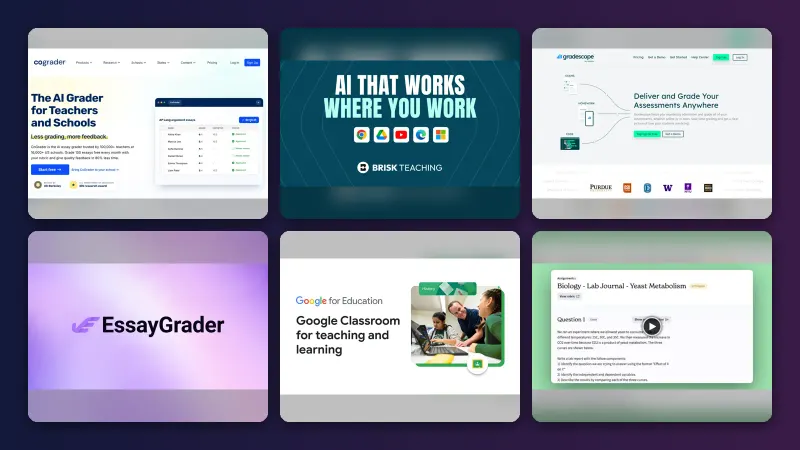
Teachers are the biggest users. Dedicated tools such as CoGrader and EssayGrader import a class from Google Classroom or Canvas, score against a rubric and let the teacher approve comments before release. EssayGrader's plans start with 100 free gradings a month, and the company says, based on an internal survey of 1,000 active teachers, that it saves an average of 6 to 10 hours a week. That's a vendor survey. Google has also built drafting into the gradebook: since February 2026, Gemini in Google Classroom can suggest feedback on written work, which the teacher must review before students see it (EdTech Innovation Hub).
Students use the other side of the same idea. Grammarly's AI Grader agent estimates the grade a draft is likely to get from your assignment brief and rubric, then updates the prediction as you revise.
State testing went there first. In spring 2024 Texas began scoring open-ended STAAR answers with an "automated scoring engine", and the agency expected to need fewer than 2,000 human scorers instead of about 6,000, saving $15 million to $20 million a year, according to the Texas Tribune. Humans rescore a quarter of responses, plus any the engine has low confidence in or doesn't recognise, such as answers with lots of slang or another language.
College admissions is the cautionary tale. UNC-Chapel Hill stopped using an AI rating of grammar and writing quality in its essay review because, as applicants used AI writing tools, scores "increasingly skewed higher" and the rating stopped telling readers anything (GovTech). Former admissions officer Daniel Klasik put it bluntly: polished essays "all get good grammar scores, but they're largely interchangeable."
Benefits and limitations
The benefits are real, and mostly about time. Hechinger's example: an English teacher with six classes of 25 who spends 20 minutes per essay needs 50 hours to grade one assignment. If software drafts the first pass, a teacher can probably set more writing, and students get feedback while they still care about it.
- Fast first-pass scores and comments on drafts.
- Students can revise before submitting instead of after the grade.
- Consistent on the same essay when the prompt doesn't change, per the bioscience study.
- Useful for spotting class-wide weak spots, like a wave of run-on sentences.
The limitations are just as concrete. Scores bunch in the middle, so the best and weakest writers get the least accurate marks. Length, vocabulary and "proper" style sway the score. Bias in old human grades gets copied. And as Tate warned Hechinger, a teacher who hands off all the reading may stop noticing the mistakes that tell them what to teach next. That last point is easy to miss, and I think it matters most.
Practical takeaways for teachers and students
For teachers
Use an AI grader for formative work and first drafts; keep final and high-stakes grades human. Spot-check papers at the top and bottom of the score range, since that's where the studies found the biggest misses. When a vendor quotes accuracy, ask Tate's two questions: how often does the AI match a human exactly on each essay, and how often is it within one point? Student essays are student data, too, so check privacy terms before you upload a class set. Our explainer on AI in education covers the wider policy picture.
For students
An AI grader is a reasonable second reader for a draft, especially if you feed it your teacher's actual rubric. Don't treat its number as a promise; it may be a full grade off in either direction. If the feedback mostly says "use more sophisticated vocabulary," be sceptical. That's exactly the bias researchers keep finding, and it isn't what most teachers reward.
For college applicants
Honestly, I'd be wary of any "AI college essay grader" that gives your personal statement a score. Admissions essays aren't graded on a rubric the way class essays are, and the UNC story suggests polish alone doesn't stand out any more. Use AI for typo-level checks if you like, then get a person you trust to read it for voice. And don't let AI write it for you. Your own voice is the thing readers are looking for, and AI checks are a risk too, however unreliable AI detectors can be.
Next steps for AI essay grading
More grading will probably happen inside tools teachers already use, like Google Classroom, instead of in separate apps. Researchers are also pushing a fix that's cheaper than retraining: the March 2026 rubric study suggests schools estimate a model's systematic offsets using a small set of human-scored essays and correct for them, a "bias-correction-first deployment strategy" (arXiv). And I'd guess pressure will grow on vendors to publish exact-agreement and group-level results, not just headline accuracy.
What we still don't know is the big one: does AI-graded feedback make students better writers over a term? Tate's team said that was their next question. Until there's an answer, I'd keep the teacher's name on the final grade.
FAQ
What is an AI essay grader?
It's software that scores student writing against a rubric and drafts feedback. Older versions, like ETS's e-rater, were trained on graded essays for each prompt. Newer ones use large language models that read your rubric directly. Teachers use them for first-pass grading; students use them to predict a grade before submitting.
How accurate is an essay grader AI?
Close, not exact. In UC Irvine's study of 1,800 school essays, ChatGPT was within one point of trained human raters 76% to 89% of the time on a six-point scale, but matched exactly only about 40% of the time. A university study found AI inflated weak essays and underrated strong ones, sometimes by a wide margin.
Are AI graders biased?
They can be. A Learning Agency study found ChatGPT copied a scoring gap between Black and Asian students that already existed in human grades. A March 2026 preprint found models docked points for informal or non-native phrasing even when told to grade content only. Math and code grading showed much less of this effect.
Is there a good AI college essay grader?
I'd be cautious. Admissions readers want voice and story, and UNC-Chapel Hill dropped its own AI writing ratings because AI-polished essays all scored high. Use a grader for typos; use a person for everything else.
Is it cheating to run my essay through an AI grader?
Usually not, if it only gives feedback and you do the rewriting yourself. Getting AI to write or rewrite the essay is a different matter, and many schools ban passing off AI text as your own. Policies vary a lot between courses, even inside one school, so check yours. If it's unclear, ask your teacher directly whether AI feedback on drafts is allowed. I suspect most would rather you asked than guessed.