What AI agents offer customer support automation in 2026: what the evidence says
AI support agents can now resolve routine tickets and help human staff work faster. Here's what the research, vendor claims and real deployments show.
 Written byBurhan AqibSenior writer, policy and analysis
Why you can trust The AI Future
Our writers research every product from its official pages, independent tests and user reports, link each claim to its source and correct mistakes openly. Unless an article says otherwise, we haven't tested the product hands-on ourselves. Companies can't pay for coverage or see reviews before they're published.
Read our editorial policy
In February 2024, a Canadian tribunal ordered Air Canada to pay a passenger because its website chatbot had invented a refund rule. That small case is a good place to start, because it marks the line today's AI support agents are trying to cross: from bots that talk to software that acts, and that a company has to answer for. So what do AI agents offer customer support automation? In short, they can now answer, look up and complete a large share of routine requests (refunds, order changes, account fixes) on their own, and they help human agents work faster on the rest. What they don't offer yet is reliable judgement on messy, emotional or high-stakes cases.
The short answer to what AI agents offer customer support automation
An AI customer service agent is a language model hooked up to your help content and to the systems behind it: billing, orders, the CRM. Older chatbots matched keywords to scripted answers. An agent reads the request, decides what to do next and can call a tool to do it, such as issuing a refund or updating an address. (If the term "agentic" is new to you, our explainer on agentic AI covers the basics.)
The offer comes in two flavours, and it's worth keeping them apart. Front-line agents handle customers directly and hand off when they're stuck. Agent assist tools sit beside a human and draft replies, summarise tickets and suggest the next step. Most vendors now sell both, often priced in completely different ways.
The background: from scripted bots to agents that act
Customer support was one of the first jobs large language models were pointed at, and it's also where we have some of the best evidence. The study most people cite is "Generative AI at Work" by Erik Brynjolfsson, Danielle Li and Lindsey Raymond, which tracked 5,179 support agents given an AI assistant. Issues resolved per hour rose 14% on average. For novice and low-skilled workers the gain was 34%, while experienced staff saw minimal change, and the authors also found better customer sentiment and higher retention. It was published in the Quarterly Journal of Economics in 2025.
That's an agent assist result, not a fully automated one. I think the distinction matters more than vendors let on.
The big forecast came next. In March 2025 Gartner predicted that agentic AI would resolve 80% of common customer service issues without human help by 2029, cutting operating costs by 30%, as CX Today reported. Gartner's analyst Daniel O'Sullivan also warned that customers will increasingly send their own AI to deal with companies, which is a strange thought: your bot negotiating with my bot over a late parcel.
A few months later Gartner struck a more cautious note. A recap by Maven AGI (a vendor, so read it with that in mind) notes that Gartner expects more than 40% of agentic AI projects to be cancelled by the end of 2027, and that it reckoned only about 130 of the thousands of vendors claiming agentic features were the real thing. Gartner calls the rest "agent washing".
Real examples, good and bad
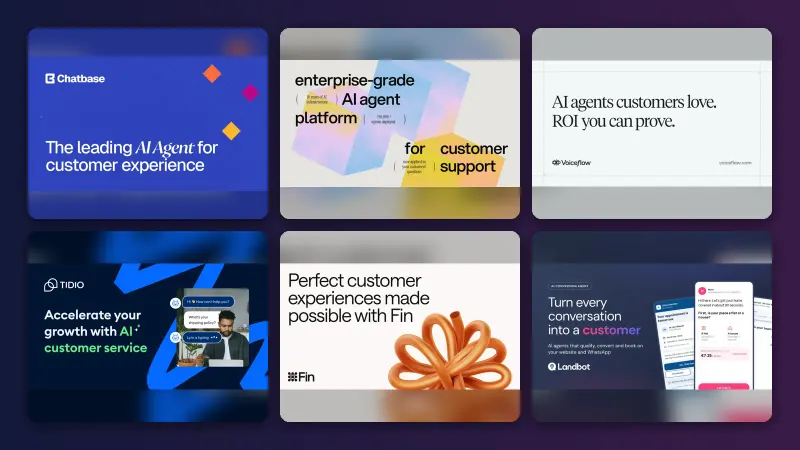
Intercom's Fin is probably the best-known front-line agent. On Fin's homepage, Intercom claims an average resolution rate of 76% across more than 12,000 customers and about 2 million resolutions a week. Those are the vendor's own numbers, measured its own way.
Zendesk makes a similar pitch. Its plans page says its AI agents can "Resolve up to 80%+ of even the most complex service issues across any channel", and its AI agents page now lists standalone agents (branded Zendesk + Forethought) that can run on top of other helpdesks too. For the human side, the Copilot page claims an 82% increase in agent productivity, without much detail on how that was measured.
Klarna is the case everyone brings up. In 2024 the company said its AI assistant was handling 75% of customer chats in more than 35 languages, the work of roughly 700 agents. Later its CEO, Sebastian Siemiatkowski, told Bloomberg that the push had hurt quality, as Maginative reported: "As cost unfortunately seems to have been a too predominant evaluation factor when organizing this, what you end up having is lower quality." Klarna started hiring human agents again, though it still expects AI to shrink headcount over time.
Then there's the gap between the demo and the dashboard. One r/artificial thread from a B2B team describes going live with a support bot and reaching 6% deflection by month three and 8% by month eight, after the vendor had pitched around 40%. The poster's account manager then called 7–12% "typical for complex B2B". It's one team's story. Still, I'd treat any headline resolution claim as a ceiling, not a forecast.
And Air Canada? The chatbot told Jake Moffatt he could claim a bereavement discount within 90 days of buying a ticket. That wasn't the policy. CBS News reports that the tribunal rejected the idea that the chatbot was a separate legal entity and made the airline pay. If your agent says it, you probably own it.
Benefits and limitations
The benefits are real, and mostly about volume. An agent doesn't sleep, can answer in dozens of languages and costs a fraction of a human per conversation on simple tasks. The NBER evidence suggests the human side gains too, especially newer staff who get the experienced team's best answers fed to them in real time.
Here's a rough worked example of the economics, using Fin's published price of $0.99 per outcome (with a 50-outcome monthly minimum). The ticket volume and resolution rates are my own illustrative numbers, not anyone's real results.
| Scenario (10,000 conversations a month) | Resolved by AI | AI bill at $0.99 each | Left for humans |
|---|---|---|---|
| Vendor-style result (76%) | 7,600 | $7,524 | 2,400 |
| Middling result (40%) | 4,000 | $3,960 | 6,000 |
| Reddit-thread result (8%) | 800 | $792 | 9,200 |
The point of the table is that pay-per-outcome pricing looks cheap when the agent works and harmless when it doesn't, but the staffing savings swing wildly between rows. Your real number decides whether the project pays off, and you won't know it until you've run the thing on your own tickets.
The limitations are just as concrete. Measurement is the first one. Even Intercom's own guide to resolution versus deflection admits that "most vendors use their own AI to grade their own work", and a deflected chat can simply be a customer who gave up. Accountability is the second, as Air Canada learned. Third, some work resists automation; Klarna's reversal suggests that people with money problems often want a person, and that cutting cost first tends to show up in quality later. I'd add a fourth from the Gartner numbers: plenty of products sold as agents are still chatbots with a new label.
Practical takeaways for support teams
Start with the boring tickets. Password resets, order status and plan questions are where the published success stories cluster, and they're the easiest to check. Leave billing disputes and complaints with humans until you've got data.
Ask every vendor how they count a resolution, and who grades it. Then ask for a trial on your own historical tickets, because a benchmark deck tells you very little. If they won't do that, I'd be wary.
Give the agent only the tools it needs. Each action you connect (refunds, cancellations, address changes) is a place it can go wrong, and the more of your systems it touches, the more an API integration needs proper permissions and logging. Read real transcripts every week, not just the dashboard. And keep an obvious route to a human; Siemiatkowski's line that customers should know "there will be always a human if you want" seems like sound advice from someone who learned it the expensive way.
If you're weighing up building your own instead, our guide on how to create an AI agent shows what's involved, and our roundup of AI chatbot builders covers the lighter options.
The next two years
Gartner's 2029 target is three years out, and I'm not convinced the industry will hit 80% on anything but the simplest queries by then. Prices, though, are already shifting from per seat to per outcome, which puts some risk back on the vendor. That's a healthy change. I'd also expect more of the "AI talking to AI" traffic O'Sullivan described, as shoppers' own assistants start filing complaints and chasing refunds for them.
For jobs, the picture is mixed. Agents seem likely to absorb the simplest tier of work first, which matches the pattern in our piece on AI agents at work. My guess is that support teams get smaller and more senior rather than disappearing, though that's a guess, and the Klarna episode shows companies can overshoot in either direction.
FAQ
What are the best agent assist AI solutions?
Two widely used options are Intercom's Copilot, at $35 per user a month, and Zendesk's Copilot, which drafts replies, suggests next steps and comes with its Suite Enterprise + Copilot plan. "Best" depends on which helpdesk you already use, since assist tools work best inside the inbox your team lives in.
Is an AI customer service agent the same as a chatbot?
Not quite. A classic chatbot follows scripts. An AI agent uses a language model to understand the request and can act in connected systems, like processing a refund. Gartner has warned that many so-called agents are relabelled chatbots.
How much does AI customer support cost?
Pricing varies by model. Intercom charges $0.99 per Fin outcome with a 50-outcome monthly minimum, plus $19 per helpdesk seat if you use Intercom's inbox. Zendesk's Suite Team plan, which includes AI agents, starts at $55 per agent a month billed yearly. Check current prices before you budget.
Can AI agents replace human support staff?
For simple, repetitive requests, they can handle a large share. For complex or emotional cases, the evidence says no, at least not yet. Klarna rehired humans after quality slipped, and the Brynjolfsson study found the clearest gains came from AI helping people, especially newer staff who resolved 34% more issues per hour. I think most teams will end up with a mix of both for years.