How big are AI data centers? Land, power and chips explained (2026)
The largest AI data centers now cover hundreds of acres and draw close to a gigawatt each. Here's how big they are by land, power and chip count.
 Written byBurhan AqibSenior writer, policy and analysis
Why you can trust The AI Future
Our writers research every product from its official pages, independent tests and user reports, link each claim to its source and correct mistakes openly. Unless an article says otherwise, we haven't tested the product hands-on ourselves. Companies can't pay for coverage or see reviews before they're published.
Read our editorial policy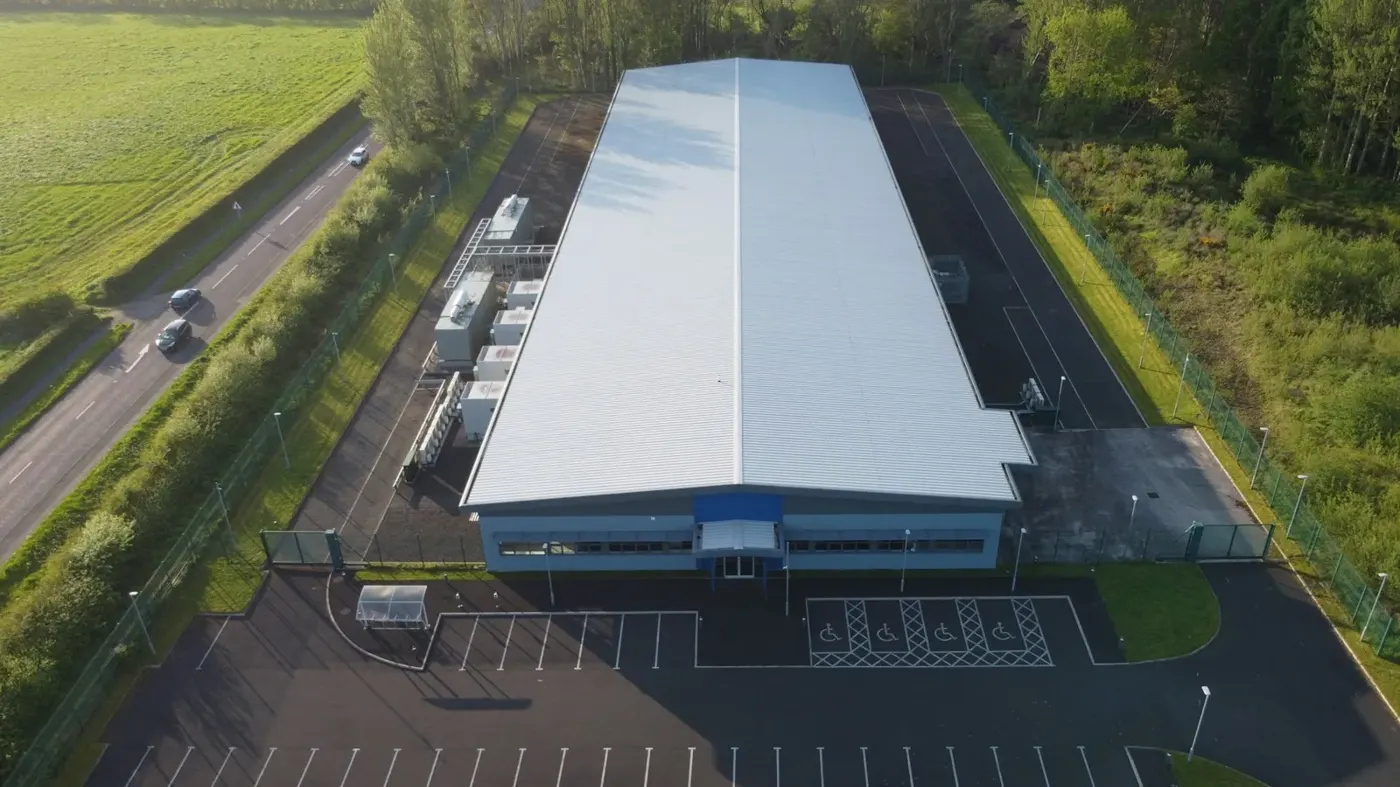
The biggest AI data centers are now the size of small towns. OpenAI's flagship Stargate campus in Abilene, Texas, covers about 875 acres, and Meta's Hyperion site in Louisiana runs roughly 5 miles long by 1 mile wide. Measured by electricity, the largest single sites already draw close to a gigawatt, which is more than the average demand of a city like San Diego (about 800 megawatts).
So when people ask how big AI data centers are, there are really three answers: land, power and chips. They don't always line up. A campus can look enormous from a satellite and still be mostly substations, cooling plant and empty ground waiting for phase two.
I think power is the number worth watching, and by the end you'll probably see why.
Inside an AI data center
An AI data center is a facility full of specialised chips (mostly GPUs, plus custom accelerators like Amazon's Trainium) that train AI models and then answer requests from them. Microsoft calls it a "purpose-built facility designed specifically for AI training as well as running large-scale artificial intelligence models and applications" on its Fairwater announcement, and that's a fair definition.
The difference from an ordinary cloud data center is how the machines work together. A normal cloud site runs thousands of small, separate jobs: websites, email, a company's accounting software. An AI site is wired so that hundreds of thousands of chips behave like one computer working on one problem, such as training a single large language model. That needs very fast networking between racks, and it's why these buildings get so dense.
There are two kinds of work going on. Training builds a model by running it over huge amounts of data, again and again, adjusting it each time. Inference is what happens when you type a question into a chatbot and the finished model answers. If you want the longer version, our piece on AI inference vs training covers it, and what an AI model actually is fills in the basics.
Density is the part that surprised me most. A single Nvidia GB200 NVL72 rack holds 72 GPUs, weighs more than one and a half tonnes and can use up to 120 kilowatts. An average US home draws something like 1.2 kilowatts over a year, so one rack is roughly the electricity of 100 homes, packed into a cabinet about 2.2 metres tall. The IEA says the power density of AI servers rose elevenfold between 2020 and 2025, with another fourfold rise expected by 2027. Floors get thicker concrete; cooling moves from fans to liquid.
AI data center sizes, measured three ways
Land
Land is the easiest measure to picture, so here's a rough conversion I worked out using an American football field (1.32 acres including the end zones) and Manhattan's land area of about 59 square kilometres.
| Site | Whole-site area | Football fields (approx.) | Share of Manhattan |
|---|---|---|---|
| xAI Colossus 1, Memphis | 0.39 sq km | 73 | Under 1% |
| Microsoft Fairwater, Wisconsin | 315 acres (1.3 sq km) | 240 | About 2% |
| OpenAI Stargate, Abilene | 875 acres (3.5 sq km) | 660 | About 6% |
| Meta Hyperion, Louisiana | 11 sq km | 2,000+ | About 19% |
Those are whole campuses, measured from satellite images by the research group Epoch AI (Fairwater's figure is Microsoft's own). The buildings that hold servers are a much smaller slice. At Abilene, the eight IT buildings add up to roughly 10% of the site; the rest is power gear, cooling and space between them. Fairwater's three buildings total 1.2 million square feet under roof, which Microsoft says took 26.5 million pounds of structural steel and 120 miles of medium-voltage underground cable.
Power
This is where the real ranking happens. Epoch AI's current estimates of IT power (what's already running, not what's planned) put the Anthropic-Amazon campus in New Carlisle, Indiana, first at about 1,037 megawatts. Colossus 2 comes next at about 946 MW, then Stargate Abilene at about 824 MW and Microsoft's Fairwater Atlanta at about 636 MW.
Planned capacity is bigger again. Epoch expects Microsoft Fairwater Wisconsin to reach about 2,263 MW by 2028, with Meta Hyperion at about 1,632 MW the same year. Meta's long-term goal for Hyperion is 5 gigawatts. For a sense of scale: five gigawatts is a handful of large nuclear reactors' worth of output, aimed at one company's computers.
Chips
Chip counts are the hardest to pin down because companies round them. Amazon says Project Rainier launched with nearly half a million Trainium2 chips spread across several US data centers, and it expected Anthropic to be on more than 1 million of them by the end of 2025. OpenAI said its Stargate sites under development, at over 5 gigawatts, would run over 2 million chips. Microsoft only says "hundreds of thousands" of Nvidia GPUs for Fairwater.
The biggest sites right now
Stargate in Abilene is probably the best-known example. Oracle started delivering the first Nvidia GB200 racks there in June 2025, and OpenAI began early training and inference work soon after. In September 2025 OpenAI added five more sites in Texas, New Mexico, Ohio and the Midwest, taking Stargate to nearly 7 gigawatts of planned capacity and more than $400 billion in investment.
Project Rainier is a different design. Instead of one giant hall, it links many Trainium2 "UltraServers" (each one combines four servers with 16 chips apiece, so 64 chips) across several buildings. Hyperion, meanwhile, is the land champion: Mark Zuckerberg said it will "cover a significant part of the footprint of Manhattan", with a first 2-gigawatt phase due by 2030 and a price tag around $10 billion.
Honestly, the names change so fast that any ranking goes stale in a few months.
Benefits and limits of building this big
The case for size is straightforward. Frontier models train faster when every chip can talk to every other chip at full speed, and that's much easier inside one campus than across a continent. Microsoft claims Fairwater will deliver ten times the performance of the world's fastest supercomputer. Efficiency is improving too; the IEA says energy used per AI task has been falling by at least an order of magnitude a year, a rate it calls unprecedented in energy history.
The limits are just as concrete. In its latest data centre update, the IEA found that electricity demand from data centers rose 17% in 2025, while AI-focused sites jumped about 50%. It projects total data center use roughly doubling from 485 TWh to 950 TWh by 2030 (around 3% of global demand), with AI-focused sites tripling to 465 TWh. Supply chains for gas turbines, transformers and chips have tightened, and grid connections are stuck in planning queues.
Then there's the local cost. Big builds bring temporary workers, noise, traffic and, in some places, higher electricity prices. Water use is a separate fight, covered in our explainer on how much water AI uses. My own view is that falling energy per task won't offset this much growth any time soon; more use usually wins that race. If you want the wider picture, is AI bad for the environment? weighs the emissions side.
Practical takeaways for you
For most people, these sites are invisible: you ask a chatbot something, and a rack in Texas or Indiana does the maths. Your single question uses very little energy. The total is what's growing.
If you live near a proposed campus, it's worth following the planning hearings and any utility rate cases, because that's where decisions about grid upgrades and who pays for them get made. If you run a business that depends on AI services, I'd expect capacity to stay tight for a while; the IEA's list of bottlenecks suggests new supply can't just be switched on. And if you're curious about who supplies the hardware, our guide to AI chip companies is a good next read.
The next few years
What we know: the five largest tech spenders put more than $400 billion into capital spending in 2025, and the IEA expects that to rise another 75%. OpenAI has a $500 billion, 10-gigawatt commitment for Stargate. Data center operators have signed conditional deals with small modular reactor projects totalling 45 gigawatts, up from 25 GW at the end of 2024, and many new sites plan onsite gas plants plus big batteries to cope with sudden swings in demand.
What I'm guessing: some of these projects will slip, probably by years rather than months, because transformers and turbines can't be ordered overnight. I also suspect the record for a single campus will pass 2 gigawatts of running IT power before 2029. Would I bet on Hyperion reaching the full 5 GW? Not yet.
FAQ
What do AI data centers do?
They train AI models by running them over huge datasets and adjusting them as they go. They also run the finished models (inference), which is what happens each time you send a chatbot a prompt or generate an image.
What is an AI data center?
It's a data center built around AI chips such as Nvidia GPUs or Amazon's Trainium, with very fast networking so hundreds of thousands of chips can work as one computer. AI sites use far more power per rack than ordinary cloud facilities, often up to 120 kilowatts, so they need liquid cooling, heavier floors and their own substations. Microsoft's Fairwater site in Wisconsin, for example, needed 120 miles of underground cable.
What are AI data centers for?
They build and serve AI products: chatbots like ChatGPT and Claude, image and video generators, coding assistants and AI search. Companies such as OpenAI, Anthropic and Meta use them to train new models, then to answer user requests.
What are data centers for AI, compared with regular ones?
A regular data center hosts many separate, small jobs like websites, email and business apps. A data center for AI is designed to act as one giant supercomputer on a single task. That's why it packs chips more densely, needs much more electricity per square foot and relies on specialised networking between racks. Amazon's Trainium2 UltraServers, for instance, link 64 chips with dedicated cables before connecting to the wider cluster.
How big are data centers for AI?
The largest campuses cover anywhere from about 0.4 square kilometres (xAI's first Colossus) to 11 square kilometres (Meta's Hyperion). The biggest running sites draw close to 1 gigawatt of IT power, and planned ones aim for 2 to 5 gigawatts. A large traditional data center, by comparison, usually uses tens of megawatts.