Options AI review 2026: features, pricing, pros and cons
Options AI is a $19-a-month expected move charting and spread-planning app for US options traders. Here's what it does well, what it costs and who should skip it.
 Written byDr. Alap ZahidReviews And Guides Editor
Why you can trust The AI Future
Our writers research every product from its official pages, independent tests and user reports, link each claim to its source and correct mistakes openly. Unless an article says otherwise, we haven't tested the product hands-on ourselves. Companies can't pay for coverage or see reviews before they're published.
Read our editorial policy
Our verdict on Options AI
Options AI is a well-priced visual planner for traders who already use defined-risk spreads, and its expected move charts are the real draw. Spread traders should try it with paper trades first; skip it if you want an AI that trades for you or need advanced strategies.
Pricing 10-day free trial; $19/mo or $180/yr upfront; live trading via Tradier (Lite $0.35/contract, or Pro $10/mo for $0 equity options commissions)
Visit Options AIOptions AI is a $19-a-month charting and planning app for US options traders, built around one idea: the expected move. It isn't a trading bot and it won't pick trades for you. If you already trade spreads and want a faster, more visual way to set them up and manage them, I think it's one of the better-value tools around. If you're hoping an "AI" will make you money on autopilot, skip it.
The name oversells the AI part a little (my opinion, but the product is mostly clever charting with a chat assistant bolted on). Still, the charting is the good bit.
Options AI at a glance
- Rating: 3.5 out of 5.
- Best for: retail traders who already understand defined-risk spreads and want quicker setup, what-if planning and visual trade management.
- Pricing: 10-day free trial, then $19 a month or $180 a year paid upfront.
- Live trading: through a linked Tradier brokerage account, which has its own fees.
- Website: optionsai.com.
Options AI in brief
Options AI, Inc. is a US fintech company that makes analysis and trade-planning software for options traders. It was started by John Foley, Alex Griffiths and CC Lagator. Foley had spent the previous decade building an institutional options brokerage, and the pitch has always been the same: give everyday traders the multi-leg spread strategies that big desks use, without the spreadsheet pain.
One thing that confuses people is the company's history. Options AI used to run its own broker-dealer, Options AI Financial LLC, a FINRA and SIPC member that charged a flat $5 per options trade. That's changed. The company's terms of use now say plainly that Options AI, Inc. "is not a broker-dealer and does not provide securities trading or brokerage services." Live orders go through Tradier instead.
Foley explained the switch on Tradier's own podcast, The Brew (episode 492). Running a broker-dealer meant a lot of regulatory and compliance work for a small team, and handing that to Tradier frees them up to ship features. Existing customers had their accounts moved over and were offered 12 months of Tradier Pro, which normally costs $10 a month.
Honestly, I think that was the right call. A $19 software subscription and a full brokerage are two very different businesses.
The service is for adults (18+) and is run from the United States. Anyone outside the US is responsible for checking whether it's allowed where they live.
Key features
Expected move charts
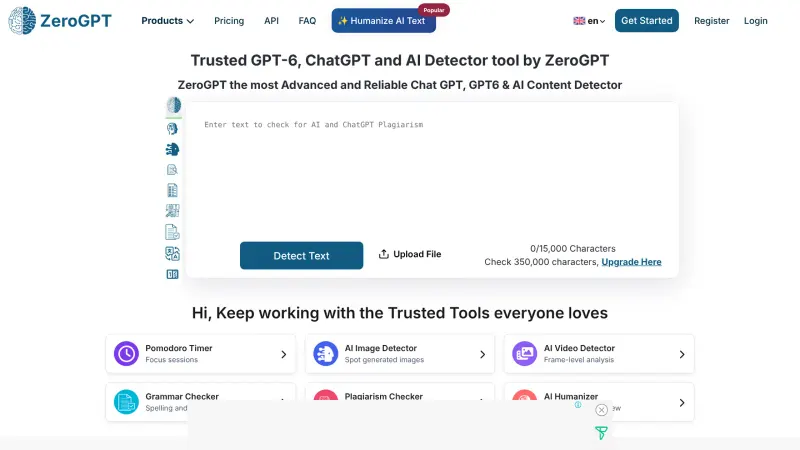
Everything in the app hangs off the expected move: how far the options market is pricing a stock or ETF to move by a given expiration date. Options AI calculates it as 92.5% of the value of the at-the-money straddle for each expiry, which is a common rule of thumb among options traders. Its support notes on the expected move walk through how directional and income traders might each use it when picking strikes.
The chart shows that range across several future expiration dates, including 0DTE (same-day) contracts. You see where a stock has been and, next to it, what the options crowd thinks could happen next; that's genuinely useful around earnings.
QuickStrike trades
QuickStrike is the patented bit (the homepage lists US patents 11,908,007 and 12,205,169). You say whether you're bullish, bearish or neutral, and it builds candidate trades using the expected move to place the strikes. Spread widths default to either at-the-money out to the expected move, or the expected move plus or minus one strike.
Each candidate shows max loss, max gain and a probability of profit. On the free public tools page for C3.ai (whose ticker, amusingly, is AI), a December put was showing a 32% probability of profit next to a bear call spread at 86%. Those numbers are model outputs, not forecasts, and the app is careful to say so.
Profit calculator and what-if simulator
The what-if simulator lets you drag a trade forward in time and see what it might be worth tomorrow or next week at different prices. Instead of the classic hockey-stick payout diagram, Options AI draws profit and loss as coloured zones right on the price chart.
For visual people, that's a big improvement. I'd guess it's the main reason new spread traders stick with the app.
Position Copilot
This is the "AI" in the name, at least now. Position Copilot is a chat assistant for managing open positions, which the company calls "the first AI-powered chat assistant for position management." I couldn't find any independent write-up of how good its answers are, so I'd treat it as a helpful extra rather than the reason to buy. Options AI doesn't say which language model powers it.
Trade management and alerts
Once a trade is on, you manage it on the same expected move chart, with real-time visual tracking and trade alerts to help plan an exit. There's also a virtual portfolio for paper trading, which is included in the free trial.
Free tools without an account
Plenty of it works before you sign up. The free tools site shows today's expected move for SPY, QQQ and SPX, sample 0DTE strategies, per-stock profit and loss zones and an economic calendar. That's a nice way to see if the visual style clicks for you before the trial clock starts.
Options AI pricing and plans
Pricing is refreshingly simple. There's one plan.
| Plan | Price | What you get |
|---|---|---|
| Free trial | $0 for 10 days | Full platform, paper trading, what-if simulator, virtual portfolio, access to the options support team |
| Monthly | $19/month | Full platform; cancel anytime |
| Annual | $180/year upfront | Same features, a bit over 20% cheaper than monthly |
| Free tools | $0, no login | Expected move charts and sample strategies on tools.optionsai.com |
Your card gets billed when the trial ends, so set a reminder if you're only window shopping.
The subscription doesn't cover trading costs. To place real orders you connect a Tradier account, and Tradier charges separately. On Tradier's plans page, the free Lite plan charges $0.35 per options contract, while Tradier Pro costs $10 a month with no commission on stock and equity options trades (index options still cost $0.35 a contract, and there's a $9 assignment or exercise fee). Exchange and regulatory fees apply on top.
The promos are a bit muddled, which annoyed me. Options AI's trade for free page says depositing $1,000 at Tradier qualifies you for 12 months of Tradier Pro. Tradier's own Options AI landing page describes a different deal: two months of Tradier Pro plus two months of Options AI reimbursed, with a $1,000 balance kept for the whole period, ending December 31, 2026. Read the small print on whichever one you click.
So the realistic monthly cost for an active trader is probably $19 plus $10, or $29, before fees. That's still cheap next to most options analytics tools.
Performance and independent testing
There's surprisingly little independent testing of Options AI out there, and almost none of the recent kind. The most detailed independent hands-on review I could find was written while Options AI was still its own broker.
That reviewer liked the interface a lot, describing it as looking "like a phone app on a website" and saying "$19/month is a steal for a tool of this magnitude." They singled out the scanner, which lets you run the same trade across preset lists like top gainers, losers, unusual volume and sectors, then compare results side by side. Their support request was fixed within a few hours, too.
The same review flagged two problems. The old $5 flat commission was expensive for small accounts (that one's gone now that trading runs through Tradier). And at the time, only a handful of strategies were supported: call spreads, put spreads, iron condors and butterflies. Options AI has since added more, since the homepage now talks about everything "from calls to credit spreads", but the app still leans hard on defined-risk spreads. If you trade naked options, ratio spreads or calendars, it's probably not built for you.
On the AI side, I couldn't find any published test of Position Copilot's accuracy. That's a real gap for a product with AI in its name.
I also couldn't find enough recent user reviews on app stores, Reddit or review sites to judge user sentiment fairly, so I'm not going to guess at it.
One more thing worth saying plainly: no tool's probability-of-profit number guarantees anything. Options can lose money fast, and the company's own disclaimer says options "may expose investors to potentially significant losses." None of this review is investment advice.
Best suited to
Options AI makes the most sense for a fairly specific person. You already know what a vertical spread or an iron condor is. You trade a few times a week, mostly defined-risk trades on liquid names and index ETFs. And you're tired of building every spread by hand from an options chain.
It's also decent for people learning spreads, thanks to the paper trading and the visual zones, as long as you learn the theory elsewhere too. A $19 app can't teach you risk management on its own.
I'd skip it if you want an AI that trades for you (it doesn't), if you live outside the US and can't open a Tradier account, or if you need advanced strategies and deep volatility analytics. Long-term buy-and-hold investors don't need it at all.
Options AI alternatives worth considering
OptionStrat
The closest match for visual strategy building. OptionStrat has a strategy builder with over 50 pre-made strategies, an optimizer that ranks trades for a target price and date, and an unusual options flow scanner. Free users get data delayed by 15 minutes.
It's broker-neutral, so it's better if you don't want to use Tradier, but it doesn't have an expected move-first workflow.
Tradier on its own
If you mainly want AI help and you'd be trading at Tradier anyway, Tradier now lets you connect your account to an AI assistant through an MCP server, so you can ask about your portfolio, analyse option strategies and place trades in plain language. You lose the expected move charts, though.
Interactive Brokers
For more experienced traders, Interactive Brokers lets clients connect Claude, ChatGPT or Grok to their account to read positions, pull market data and draft trade instructions. The AI can't place orders itself: instructions wait for you to review them.
That's a sensible safety rail, in my view.
If you're comparing AI trading products more broadly, our Trader AI review and Tradevisor AI review cover two very different takes, and our list of AI tools for personal finance is a gentler starting point. For background on how banks and funds use these models, see AI use cases in finance and our explainer on explainable AI in finance.
Verdict
I'm giving Options AI 3.5 out of 5. The expected move charts, QuickStrike setup and profit zones are smart, clearly built by people who've traded spreads for a long time, and $19 a month is fair. That's a good tool at a fair price.
What holds it back is the stuff I couldn't verify. There's little recent independent testing, no public evidence on how good Position Copilot actually is, and the brokerage move to Tradier means you're juggling two companies, two bills and two sets of promo terms. If you trade defined-risk spreads regularly, I'd start the 10-day trial and use only paper trades until the charts make sense to you. If the word "AI" is what caught your eye, I'd look elsewhere, because the value here is in the charting.
FAQ
Is Options AI legit?
Yes, it's a real US company, Options AI, Inc., founded by John Foley, Alex Griffiths and CC Lagator. It used to run a FINRA-registered broker-dealer and now sells software only, with live trades placed through Tradier Brokerage, a FINRA and SIPC member. That doesn't mean its trade ideas will make money.
Is Options AI free?
Not really. There's a 10-day free trial with full access, including paper trading, and some free public tools on tools.optionsai.com such as expected move charts for SPY, QQQ and SPX. After the trial, it's $19 a month or $180 a year, and Tradier trading fees are separate.
Does Options AI trade for you?
No. It suggests trades from your own inputs and the expected move, and you decide. Orders only go through a Tradier account you connect yourself, and the terms say nothing it shows is investment advice.
Which AI trader is the best?
There isn't one best AI trader, and I'd be wary of anything promising automatic profits. For options spreads, Options AI and OptionStrat are both strong visual planners. If you want a chat assistant tied to a broker, Tradier and Interactive Brokers now connect accounts to AI assistants, with you approving trades.
What is the expected move in Options AI?
It's how far the options market expects a stock or ETF to move up or down by a given expiry. Options AI calculates it as 92.5% of the at-the-money straddle price and uses it to place strikes when it builds spreads. It's a market estimate based on implied volatility, so treat it as the crowd's guess, not a prediction. Real moves can be bigger, especially around earnings or surprise news.
What we like
- Expected move charts make it easy to see what the options market is pricing in
- QuickStrike builds defined-risk spreads from a simple bullish, bearish or neutral view
- Profit and loss zones drawn on the price chart are easier to read than payout diagrams
- Low, simple price: one $19 plan with a 10-day trial and paper trading
- Free public expected move tools with no login
What could be better
- Little recent independent testing and no published evidence on Position Copilot's accuracy
- Live trading needs a separate Tradier account with its own fees and promo terms
- Built mainly around defined-risk spreads, so less useful for advanced strategies
- US-focused; not a fit for traders who can't open a Tradier account